
lovethailand home >Central Travel Attractions >Lop Buri Travel Attractions >Muang Lop Buri >Tha Hin > Wat Kawitsararam Ratchaworawihan
TL;DR: Wat Kawitsararam Ratchaworawihan is located at Phet Racha Road, Tha Hin Subdistrict, Mueang Lopburi District, Lopburi 15000, open Wednesday - Sunday, hours 07.00-17.00 hrs.
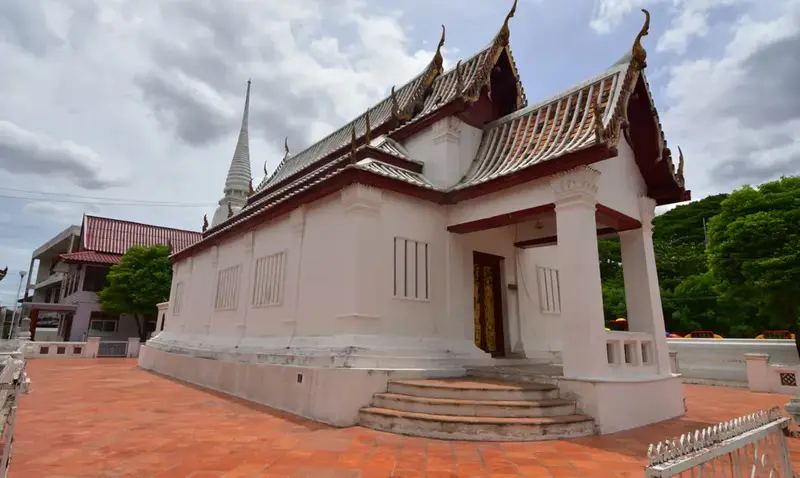
Wat Kawitsararam Ratchaworawihan
Open Days: Wednesday - Sunday
Opening Hours: 07.00-17.00 hrs.
Wat Kawitsararam Ratchaworawihan is an important royal temple in Lopburi that reflects the religious, political, and cultural history of the old city with remarkable clarity. Located in the heart of the historic district, directly south of King Narai’s Palace, this temple is not merely a place of worship but also a significant historical landmark closely connected to the royal court, the urban development of Lopburi, and the memory of the Ayutthaya period. Its architectural remains and sacred buildings still preserve the atmosphere of an old royal monastery that once stood beside one of the most important palace compounds in Siam.
The temple stands on Phet Racha Road in Tha Hin Subdistrict, Mueang Lopburi District, Lopburi Province. Its position beside King Narai’s Palace immediately highlights its historical importance, because temples located near royal palaces were often closely associated with the court and with important state ceremonies. In the case of Wat Kawitsararam, local tradition holds that it was once used as a site for the royal oath-taking ceremony known as the ritual of drinking the sacred water of allegiance, a ceremony that symbolized loyalty to the king and the state in earlier times.
According to tradition, the temple was originally called “Wat Khwit.” Later references connected with King Narai’s Palace note that during the reign of King Rama IV, the temple was granted the name “Wat Kravisararam.” The temple was further restored during the reign of King Rama V, and in 1938 Phra Kittiyanamuni, who was the abbot at that time, requested that the temple name be changed to “Wat Kawitsararam.” The meaning of this name is understood as “the temple of the king,” which reflects the temple’s royal associations and its status within the religious landscape of Lopburi.
Today, Wat Kawitsararam Ratchaworawihan is recognized as a third-class royal monastery of the worawihan grade. This status itself shows that the temple has long been regarded as an important monastery within the Thai ecclesiastical and royal system. It is not only significant because of its age, but also because it preserves layers of history from the Ayutthaya period, the early Rattanakosin era, and later restorations that helped maintain its standing as one of Lopburi’s prominent temples.
One of the most striking features of the temple is its ordination hall, which preserves elements of Ayutthaya-period architecture. The ubosot is notable for having a single entrance and exit arrangement, while its windows are formed with pierced openings in the old style. These elements create a distinctive architectural character that differs from later temple buildings and helps visitors understand the design language of earlier Siamese religious architecture. At the front of the ordination hall is a projecting porch added during the reign of King Rama IV, who also enlarged the sacred boundary of the ubosot beyond its earlier form.
Inside the ordination hall, the principal Buddha image is in the Mara-vijaya posture and is identified as being in the U Thong artistic style. This gives the interior of the ubosot a strong historical presence, because U Thong-style Buddha images are associated with early Siamese Buddhist art and reflect a visual tradition rooted deeply in the formative centuries of Thai temple culture. The presence of such an image within the temple emphasizes its antiquity and its significance as a sacred site that has been revered over many generations.
The murals inside the ordination hall are decorated with floral motifs. Although these paintings are not described as large narrative murals, the floral patterns still contribute to the gentle beauty of the interior and reflect traditional Thai decorative taste. They add softness to the sacred space and allow visitors to appreciate not only the architectural structure of the ubosot but also the artistic details that define its devotional atmosphere.
Behind the ordination hall stands a large circular chedi set on a square base. This chedi is one of the important visual landmarks within the temple grounds. Its form combines the symbolism of the stupa tradition with the compositional clarity of Thai sacred architecture, and it serves as an important anchor in the temple’s overall layout. Together with the ubosot, it helps create the historic silhouette of Wat Kawitsararam and reinforces the sense that this temple has long functioned as a major Buddhist center in the old city.
Another historically valuable feature of the temple is the group of monastic residences built in the reign of King Rama IV. These buildings are significant because they provide evidence of later restoration and continued royal patronage. Rather than being a temple preserved only in its ancient form, Wat Kawitsararam reveals a long process of care, rebuilding, and adaptation across different periods of Thai history. The presence of these later structures shows that the temple remained active and important well beyond the Ayutthaya era.
Within the temple there is also a beautiful Tripitaka library. As in many important Thai monasteries, such a building symbolizes the role of the temple not only as a place for ritual worship but also as a center of Buddhist learning and scriptural preservation. The library adds another layer of meaning to the temple, reminding visitors that royal monasteries often served as places where sacred knowledge, ceremonial life, and artistic heritage came together in one space.
The overall atmosphere of Wat Kawitsararam is especially appealing because of its location in Lopburi’s historic quarter. Even though it lies within the urban area, the temple retains a calm and dignified mood. Walking through the grounds, visitors can sense a contrast between the bustle of the surrounding city and the stillness preserved within the monastery compound. This calmness, combined with the temple’s age and proximity to nearby historical landmarks, makes it especially rewarding for travelers who enjoy cultural and historical exploration rather than rushing from one sightseeing point to another.
Wat Kawitsararam also gains additional significance from its close relationship with nearby landmarks. Because it stands next to King Narai’s Palace and not far from Phra Prang Sam Yot, Prang Khaek, Wat Phra Si Rattana Mahathat, and Baan Vichayen, it can easily be included in a broader historical walking route through old Lopburi. This makes the temple not only a destination in itself but also an essential part of understanding the larger historical landscape of the city, where palace, monastery, shrine, and foreign-influenced architecture all stand within a relatively compact urban area.
In the present day, Wat Kawitsararam Ratchaworawihan continues to function as both a living temple and a historical site. It serves the local religious community while also welcoming visitors interested in the history of Lopburi, the art of the Ayutthaya period, and the relationship between temple and monarchy in Thai history. This dual role gives the temple a special importance, because it is not simply a preserved monument from the past, but a place where sacred continuity and historical memory still coexist.
Getting There to Wat Kawitsararam Ratchaworawihan is convenient because the temple is located in the central historic area of Lopburi. Visitors arriving by train can get off at Lopburi Railway Station and continue by local transport or on foot depending on their route through the old city. Those traveling by private car can go directly to Phet Racha Road, where the temple stands beside King Narai’s Palace. Because several major attractions are nearby, the temple fits naturally into a one-day historical itinerary around the city center.
Overall, Wat Kawitsararam Ratchaworawihan is a temple of considerable value for anyone who wants to understand Lopburi beyond its most familiar landmarks. It offers a combination of sacred architecture, royal history, ceremonial memory, and urban heritage in one place. For travelers interested in old temples, Ayutthaya art, and the deeper layers of Lopburi’s identity, this monastery is one of the most meaningful sites to include in the journey.
| Summary | A third-class royal monastery of the worawihan grade located beside King Narai’s Palace in Lopburi. |
| Highlights | Ayutthaya-style ordination hall, U Thong-style principal Buddha image, large circular chedi, beautiful Tripitaka library, and strong historical links to the royal court and old Lopburi. |
| History / Period | An old temple dating back to the Ayutthaya period, originally called Wat Khwit. It was granted a new name in the reign of King Rama IV, restored further in the reign of King Rama V, and renamed Wat Kawitsararam in 1938. |
| Current Abbot | Phra Thammawachirasunthon |
| Address | Phet Racha Road, Tha Hin Subdistrict, Mueang Lopburi District, Lopburi 15000 |
| Getting There | The temple is easily accessible from Lopburi city center and Lopburi Railway Station. It is located beside King Narai’s Palace and can be conveniently visited together with nearby historical attractions in the old town. |
| Open Days | Wednesday - Sunday |
| Opening Hours | 07.00-17.00 hrs. |
| Facilities | Temple grounds for walking, historic architecture, nearby urban amenities, and easy access to other major heritage sites in Lopburi old town. |
| Zones | Ordination hall, principal Buddha image, mural area, large chedi behind the ubosot, monastic residences from the reign of King Rama IV, and the Tripitaka library. |
| Nearby Tourist Attractions | 1. King Narai’s Palace – approx. 100 m. 2. Baan Vichayen – approx. 500 m. 3. Prang Khaek – approx. 600 m. 4. Phra Prang Sam Yot – approx. 1 km. 5. Wat Phra Si Rattana Mahathat – approx. 1.1 km. |
| Nearby Restaurants | 1. Inthanin Coffee, King Narai’s Palace – approx. 120 m. Tel. 098-270-0809 2. G&k And Orca – approx. 500 m. Tel. 086-065-5031 3. Khao Moo Tod Poon Jan – approx. 650 m. Tel. 095-710-2303 4. Joke Krungsri – approx. 750 m. Tel. 087-256-8243 5. Pizza Thai Prang Khaek Lopburi – approx. 850 m. Tel. 086-135-9640 |
| Nearby Accommodations | 1. Lopburi Residence Hotel – approx. 2.5 km. Tel. Please verify directly with the hotel before booking 2. Dad D Resort by Lopburi Inn – approx. 3 กม. Tel. 036-420-777 3. Lop Buri Inn Hotel – approx. 3.8 km. Tel. 036-412-300 4. JRD Grand Place – approx. 4.3 km. Tel. 090-116-2292 5. Benjatara Boutique Resort – approx. 5.7 km. Tel. 036-422-608 |
| Main Contact Number | +66 3661 8593 |
Frequently Asked Questions (FAQ)
Q: Where is Wat Kawitsararam Ratchaworawihan located?
A: It is located on Phet Racha Road, Tha Hin Subdistrict, Mueang Lopburi District, Lopburi Province, close to King Narai’s Palace.
Q: What type of temple is Wat Kawitsararam Ratchaworawihan?
A: It is a third-class royal monastery of the worawihan grade.
Q: What historical period does the temple date back to?
A: The temple dates back to the Ayutthaya period and was originally known as Wat Khwit.
Q: What style is the principal Buddha image in the temple?
A: The principal Buddha image is in the Mara-vijaya posture and belongs to the U Thong artistic style.
Q: What can visitors see inside Wat Kawitsararam?
A: Visitors can see the Ayutthaya-style ordination hall, the U Thong-style principal Buddha image, floral murals, the large circular chedi, monastic residences from the reign of King Rama IV, and the beautiful Tripitaka library.
Q: What attractions are near Wat Kawitsararam Ratchaworawihan?
A: Nearby attractions include King Narai’s Palace, Baan Vichayen, Prang Khaek, Phra Prang Sam Yot, and Wat Phra Si Rattana Mahathat.
Q: Why is Wat Kawitsararam historically important?
A: The temple is believed to have been associated with the royal oath-taking ceremony in the past and has long been closely connected with the palace, the monarchy, and the old city of Lopburi.
Q: Where can I get more information?
A: For more information, you can contact +66 3661 8593.
Tel : 036618593
 Tel : 036618593
 Category: ●Places of Worship
 Group: ●Temple
Last Update : 6 MonthAgo
 Last Update : 6 MonthAgo
 Click to Access the Navigation Map GPS
Wat Kawitsararam Ratchaworawihan Map
Recommend

 Art, Culture and Heritage
 Historical Sites and Monuments(5)
 Landmarks and Memorials(3)
 Royal Palace(1)
 Art, Craft Centres, Tradition(7)
 Museums(11)
 Historic Homes and Cities(1)
Temple(25)
Historic Homes and Cities(1)
Temple(25)
 Other Sacred Sites(3)
 Suburban Living
 Village, Community(4)
 Floating Market(1)
 Nature and Wildlife
 National Parks and Marine Reserves(2)
 Mountain (Doi)(3)
 Dam, Reservoir, Lake(4)
 Waterfalls(5)
 Hot Springs(1)
 Caves(2)
 Flower Field(1)
 Entertainment and Agricultural
 Zoos and Aquariums(2)
 Farms, Parks and Ecotourism(4)
 Outdoor and Adventure Activities(1)


