
lovethailand home >North Travel Attractions >Chiang Rai Travel Attractions >Mae Fa Luang >Mae Salong Nai > Doi Hua Mae Kham
TL;DR: Doi Hua Mae Kham is located at Mae Salong Nai Subdistrict, Mae Fa Luang District, Chiang Rai Province, open Open Daily, hours 08:00 – 17:30.
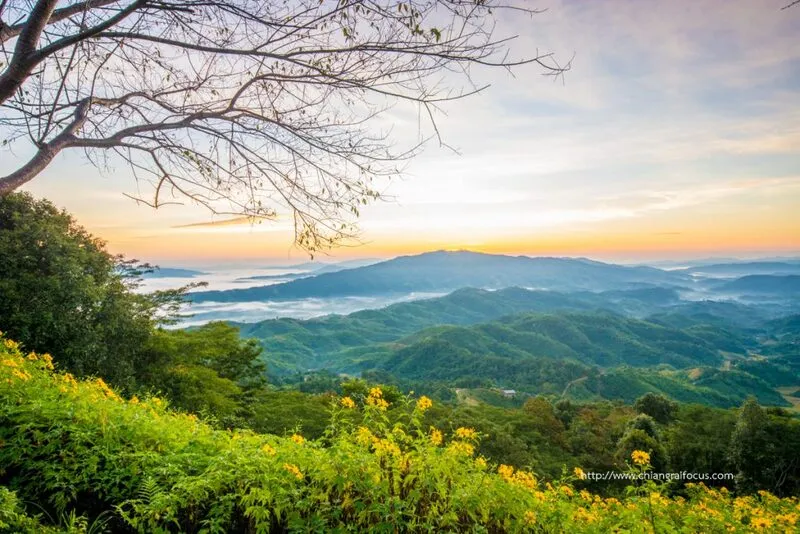
Doi Hua Mae Kham
Open Days: Open Daily
Opening Hours: 08:00 – 17:30
Doi Hua Mae Kham is one of Chiang Rai’s mountain destinations with a distinctly different character from many of the province’s more famous viewpoints. Its appeal lies not only in sea-of-mist scenery and cool mountain air, but also in its hill-tribe communities, seasonal fields of golden Mexican sunflowers, and the quiet atmosphere of a borderland highland area that still feels genuinely local. Located in Mae Salong Nai Subdistrict, Mae Fa Luang District, at around 1,850 meters above sea level, it is a destination that offers both natural beauty and a strong cultural dimension.
In overall travel terms, Doi Hua Mae Kham is more than a mountain viewpoint. It is a place where wide mountain landscapes, village life, and seasonal travel all come together. Visitors who make the journey here do not only see layered hills and drifting mist. They also encounter a large hill-tribe settlement, a highland route near the Thai–Myanmar border, and a slower, quieter travel rhythm that is increasingly hard to find in more commercial destinations.
The mountain area is home to a large community in which the Lisu are the main ethnic group, along with Akha, Hmong, and Muser residents. This gives the destination a strong local identity. Travelers arriving here can sense immediately that this is not simply a scenic platform for photos, but a living mountain area shaped by real communities, local traditions, and long-established cultural practices.
One of the most culturally significant periods of the year is the Lisu New Year celebration known as Kin Wor, which takes place around the Chinese New Year season. During this period, local people wear vibrant traditional clothing, hold celebrations, dance, and gather for community events over several days. For travelers interested in culture as much as scenery, this makes Doi Hua Mae Kham especially meaningful.
From a nature-tourism perspective, Doi Hua Mae Kham is best known for its golden Mexican sunflower bloom in November. At that time, hillsides and roadside slopes brighten with dense yellow flowers, turning the mountain into one of Chiang Rai’s most photogenic cold-season destinations. The contrast between the yellow blossoms, blue sky, and green mountain backdrop creates a memorable landscape that draws photographers and winter travelers every year.
The sunflower scenery here feels especially dramatic because the flowers are not limited to a small planted plot. Instead, they spread naturally across broad mountain slopes, creating the impression that the hills themselves are glowing. In the soft morning light, this effect becomes even more striking, and it is one of the reasons Doi Hua Mae Kham has such a strong visual identity during November.
Beyond the flowers, the mountain is also well known as a sunrise and sea-of-mist viewpoint. On suitable mornings, the valleys below fill with mist while mountain ridges rise above it in overlapping layers. The beauty here is wide, calm, and atmospheric rather than dramatic in a sharp or rugged way. It is a place where many travelers simply stand quietly and watch the landscape change.
The terrain around Doi Hua Mae Kham supports panoramic viewing very well. The surrounding mountain system creates deep valleys and long ridgelines, so when mist gathers below, the effect is highly layered and visually rich. This makes the site especially appealing for landscape photography and for travelers who enjoy open mountain vistas rather than enclosed forest viewpoints.
Part of the attraction of Doi Hua Mae Kham is the sense of remoteness. Although reaching it takes time, the reward is a more peaceful atmosphere than many better-known mountain attractions in Chiang Rai. It remains relatively quiet, local, and community-oriented, which appeals strongly to travelers who want to experience highland Chiang Rai in a more authentic way.
For overnight visitors, the destination offers even more value. Staying on or near the mountain means being able to enjoy the cold evening air and then wake early for sunrise and mist without rushing up from the city. Accommodation in the area includes basic park lodging, agricultural-station stays, and homestay-style options in nearby communities. This makes Doi Hua Mae Kham suitable for travelers who want a slower, more immersive mountain trip.
Photographers often find Doi Hua Mae Kham especially rewarding because the site offers several kinds of visual experiences: wide mountain panoramas, sunflower-covered slopes, misty valleys, and village scenes with a strong local identity. During the sunflower bloom, the mountain becomes particularly vivid, with strong color contrast and excellent opportunities for both wide-angle and atmospheric photography.
The appearance of Doi Hua Mae Kham changes noticeably by season. In the late rainy season and early cool season, the mountains are lush and green. November is the most famous period because of the golden flowers. During the later cool months, even after the bloom begins to fade, the area still remains attractive for its cold air, open viewpoints, and quiet mountain scenery. This seasonal variation makes it a good repeat destination for travelers who enjoy northern Thai landscapes.
Getting There From Chiang Rai city, travelers can use Highway 1130 along the old Doi Mae Salong route, then turn right at the Akha junction, pass Ban Thoet Thai, and continue toward Ban Mae Kham. The total distance is about 100 km, and the drive usually takes around 2–3 hours depending on road conditions and stops along the way. The later sections are mountain roads with curves and elevation changes, so careful driving is recommended, especially in rain or heavy mist.
The route itself is part of the experience. Along the way, visitors pass mountain villages, borderland scenery, and stretches of highland road with sweeping views. Travelers who enjoy mountain driving often appreciate this road very much, though it is important to drive slowly and cautiously because of the bends and changing conditions.
Visitors without a private car should plan ahead, especially for local transfers and accommodation, because public transport is not as frequent as in Chiang Rai city. Some travelers stay in nearby Thoet Thai or Mae Salong Nai and then continue onward to the mountain from there. This can make the journey more manageable while still preserving the full highland experience.
Practical preparation is important. Warm clothing, comfortable walking shoes, and drinking water are recommended, especially for those coming early in the morning or during the windy cool season. Overnight visitors should also confirm lodging or camping arrangements in advance, as the most popular periods, especially during the flower bloom, can be busier.
For travelers interested in local culture, Doi Hua Mae Kham offers more than scenery. The surrounding communities allow visitors to sense the rhythm of highland life through village atmosphere, traditional clothing, and the daily setting of a mountain settlement. Respectful observation and slow travel are often enough to make the visit feel meaningful.
Overall, Doi Hua Mae Kham is a Chiang Rai destination that combines mountain scenery, seasonal flowers, sunrise mist, and hill-tribe culture in a compelling way. It may not be as widely known as some of the province’s most famous peaks, but that is part of its charm. For travelers looking for a more peaceful and culturally grounded highland experience, Doi Hua Mae Kham is an excellent choice.
| Name | Doi Hua Mae Kham |
| Summary | A high mountain destination in Mae Fa Luang, Chiang Rai, at about 1,850 meters above sea level, known for golden Mexican sunflowers, sea-of-mist views, sunrise scenery, and Lisu hill-tribe culture |
| Location | Mae Salong Nai Subdistrict, Mae Fa Luang District, Chiang Rai Province |
| Highlights | Golden Mexican sunflowers in November, sunrise viewpoint, sea of mist, borderland mountain scenery, and Lisu community atmosphere |
| History / Landscape Character | A highland area near the Thai–Myanmar border, home to a large hill-tribe village with Lisu as the main ethnic group, alongside Akha, Hmong, and Muser communities |
| Distinctive Features | Ideal for winter travel, panoramic mountain views, flower photography, sunrise, and overnight stays in a peaceful highland environment |
| Travel Information | From Chiang Rai, follow Highway 1130 via the old Doi Mae Salong route, turn right at the Akha junction, pass Ban Thoet Thai, and continue to Ban Mae Kham; total distance about 100 km, taking around 2–3 hours |
| Current Status | Open to visitors, especially popular during the sunflower bloom and cool season |
| Open Days | Open Daily |
| Opening Hours | 08:00 – 17:30 |
| Fees | No public entrance fee information found for the mountain area itself |
| Caretaker | Doi Hua Mae Kham Forest Park / Mae Salong Nai Subdistrict Administrative Organization |
| Main Contact Number | Doi Hua Mae Kham Forest Park 053-918101, 095-6758491 / Mae Salong Nai SAO 053-730322, 053-730360 |
| Official Website / Official Page | www.maesalongnai.go.th / Doi Hua Mae Kham Forest Park Facebook page |
| Nearby Tourist Attractions | 1. Doi Hua Mae Kham Forest Park about 2 km 2. Hua Mae Kham Waterfall about 2 km 3. Ban Thoet Thai about 14 km 4. Doi Mae Salong about 36 km 5. Choui Fong Tea Plantation (Mae Fa Luang zone) about 52 km |
| Nearby Restaurants | 1. Community food stalls near Ban Hua Mae Kham about 1 km 2. Aroi Dee Restaurant, Ban Thoet Thai about 14 km Tel. 099-6307455 3. Koncept Homestay & Cafe, Thoet Thai about 15 km Tel. 094-6280666 |
| Nearby Accommodations | 1. Doi Hua Mae Kham Forest Park Lodging about 2 km Tel. 095-6758491 2. Hua Mae Kham Highland Agriculture Center about 1 km Tel. 053-918101 3. Lap Nai Doi Homestay & Space, Thoet Thai about 15 km Tel. 094-6280666 |
Frequently Asked Questions (FAQ)
Q: Where is Doi Hua Mae Kham?
A: It is in Mae Salong Nai Subdistrict, Mae Fa Luang District, Chiang Rai Province, near the Thai–Myanmar border.
Q: What is Doi Hua Mae Kham best known for?
A: It is best known for golden Mexican sunflowers in November, sea-of-mist scenery, sunrise views, and Lisu hill-tribe culture.
Q: When is the best time to visit?
A: November is the most famous period for sunflower bloom, while the cool season is ideal for mist and cold mountain weather.
Q: Is there accommodation available?
A: Yes. There is forest-park lodging, accommodation at the highland agriculture center, and some nearby homestay options.
Q: Is the road difficult?
A: The road is mountainous and winding, so careful driving is recommended, especially in rain or heavy mist.
Q: Who is this destination suitable for?
A: It is ideal for travelers who enjoy mountain scenery, seasonal flowers, photography, mist viewpoints, and highland community culture.
 Category: ●Nature and Wildlife
 Group: ●Mountain (Doi)
Last Update : 6 MonthAgo
 Last Update : 6 MonthAgo
 Click to Access the Navigation Map GPS
Doi Hua Mae Kham Map
Gellery
Recommend

 Art, Culture and Heritage
 Historical Sites and Monuments(3)
 Landmarks and Memorials(7)
 Art, Craft Centres, Tradition(6)
 Museums(8)
 Historic Homes and Cities(1)
 Educational Places
 Museum for Study(1)
 Library(1)
 Educational Gardens, Farm(3)
 Places of Worship
 Temple(38)
 Other Sacred Sites(5)
 Research and Development
 Royal Project(9)
 Suburban Living
 Village, Community(16)
 Local Market(5)
 National Parks and Marine Reserves(18)
Mountain (Doi)(20)
National Parks and Marine Reserves(18)
Mountain (Doi)(20)
 Dam, Reservoir, Lake(8)
 Waterfalls(16)
 Hot Springs(6)
 Caves(8)
 River, Canal(10)
 Sea, Beach(1)
 Other natural attractions(3)
 Entertainment and Agricultural
 Animal camps and shows(1)
 Farms, Parks and Ecotourism(9)
 Shopping
 Shopping and Night Market(2)
 Call Customer Service in Tourism
 Call Customer Service in Tourism(1)
 Travel Articles, Recipes
 Travel Review, Food Review(1)
 Food Menu, North Recipes(1)


