
lovethailand home >North Travel Attractions >Chiang Rai Travel Attractions >Muang Chiang Rai >Wiang > Chiang Rai City Navel Pillar
TL;DR: Chiang Rai City Navel Pillar is located at Near Wat Phra That Doi Chom Thong, Tri Rat Road, Rop Wiang Subdistrict, Mueang Chiang Rai District, Chiang Rai, open Daily, hours 06:00 – 17:00.

Chiang Rai City Navel Pillar
Open Days: Daily
Opening Hours: 06:00 – 17:00
Chiang Rai City Navel Pillar, also known as the city’s symbolic center, is one of the most meaningful spiritual and historical attractions in Chiang Rai. While many travelers know the province for temples, mountain scenery, and cafés, this site offers something deeper: a direct connection to the founding symbolism of the city itself. In old Lanna belief, a “city navel pillar” represented the central point of a community, the sacred heart of the city, and a source of spiritual stability. That idea is what makes this place far more than a simple shrine or stone monument.
The Chiang Rai City Navel Pillar was built in 1987 to honor His Majesty King Bhumibol Adulyadej, Rama IX, on the occasion of his 60th birthday, and also to commemorate King Mangrai, the founder of Chiang Rai. Because of that dual purpose, the site carries both modern ceremonial meaning and historical symbolism. It links present-day Chiang Rai to the city’s original foundation story and gives visitors a place where civic memory, Lanna belief, and royal commemoration come together in one setting.
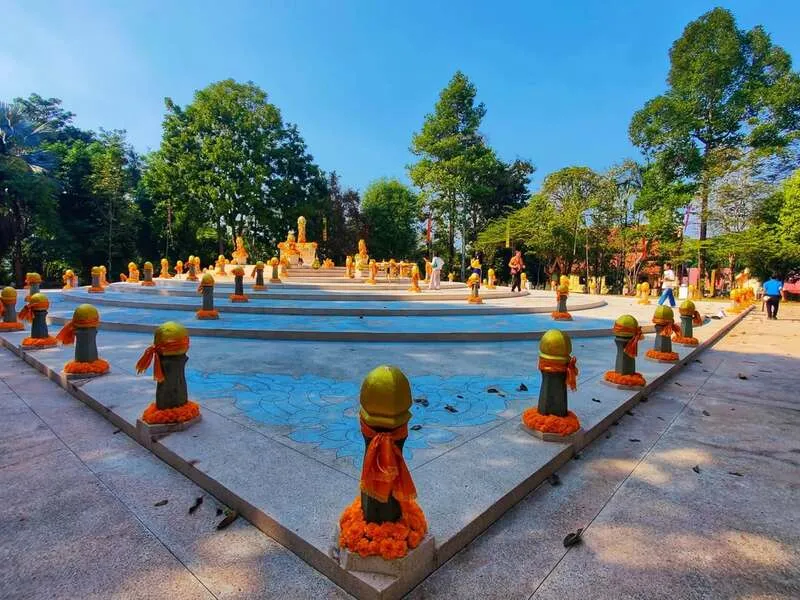
One of the most distinctive aspects of the site is its layout. At the center stands the main pillar, surrounded by 108 satellite pillars arranged across a raised ceremonial plaza. This design is not random. The entire structure is based on an ancient cosmological model. The main pillar represents Mount Meru, the sacred cosmic mountain, while the surrounding levels, channels, and outer zone reflect layers of heaven, sacred rivers, and the broader order of the universe according to traditional belief. In other words, this is not simply a monument to be looked at. It is a symbolic landscape designed to embody an entire worldview.
That cosmological interpretation is one reason the place feels so unusual compared with other city shrines in Thailand. Instead of a single enclosed shrine building, Chiang Rai’s city navel pillar unfolds as an open stepped space, allowing visitors to move through the symbolic arrangement more directly. The sense of openness, combined with the tree-lined setting, creates an atmosphere that is both sacred and calm. It is easy to understand why many local people see this place not only as a site of historical remembrance, but also as a place to pray for good fortune, protection, and stability in life.
Visitors often notice colorful cloth ribbons, floral garlands, and fruit offerings placed around the pillars. These are signs of continuing devotion. Local residents and visitors come here to make offerings, ask for blessings, and pay respect to the spiritual center of the city. This living tradition gives the site an active presence in contemporary Chiang Rai. It does not feel like a historical reconstruction or a forgotten monument. Instead, it remains part of the city’s everyday spiritual landscape.
The location also adds to its importance. The city navel pillar stands beside Wat Phra That Doi Chom Thong, one of Chiang Rai’s most significant sacred sites and a place closely associated with the early history of the city. This proximity makes the area especially rewarding for travelers interested in Chiang Rai’s origin story. A visit to the city navel pillar naturally combines with a stop at the temple, allowing the experience to become both historical and religious in a single route.
For travelers who want to understand Chiang Rai beyond its well-known modern attractions, this site is a strong starting point. It explains how deeply the city’s identity is tied to symbolic geography, Lanna belief, and the memory of King Mangrai. It also offers a quieter kind of experience. Unlike more crowded tourist landmarks, the city navel pillar invites visitors to slow down, observe the details of the site, and reflect on how old cosmological ideas were translated into a public sacred space in the modern era.
Architecturally and visually, the site is distinctive. The stepped plaza, the stone-carved pillar forms, and the disciplined arrangement of the 108 surrounding pillars create strong lines and symmetry. When combined with the greenery around the area, the visual effect is both solemn and elegant. For photographers, this means the site offers something quite different from Chiang Rai’s more decorative temples. It provides a minimal but symbolically rich composition that works especially well in morning or late afternoon light.
The city navel pillar is also appealing because it fits easily into a broader city itinerary. After visiting here, travelers can continue to Wat Phra That Doi Chom Thong, Wat Phra Kaew, Wat Phra Singh, King Mengrai Monument, and Chiang Rai Clock Tower without major difficulty. This makes it particularly useful for visitors who want to build a one-day heritage route through central Chiang Rai, combining sacred places, historical sites, and key urban landmarks in a single journey.
In social and cultural terms, the site is a very interesting example of how an old Lanna concept was reinterpreted in modern public space. Although the structure was created in the late 20th century, it remains deeply rooted in much older symbolic traditions. That combination gives the place unusual cultural value. It is at once modern and ancient, ceremonial and lived-in, historical and still spiritually active. Few places in Chiang Rai represent that blend as clearly as this one does.
For visitors who enjoy meaningful travel, the Chiang Rai City Navel Pillar is a destination that rewards attention. It may not be the largest or most famous site in the city, but it offers a powerful sense of place. It helps explain how Chiang Rai understands itself — not only as a provincial center in northern Thailand, but as a city with a symbolic heart, a founder remembered through ritual and civic identity, and a cultural worldview still visible in its sacred landscape.
The atmosphere here also makes it suitable for a short restorative stop. The surrounding trees, the wide open plaza, and the measured layout of the pillars create a calm environment that feels different from busier temple compounds. Some visitors spend only a few minutes here to make an offering and take photographs, while others prefer to walk slowly through the area and continue onward to the nearby temple. Either way, the site adds depth to a Chiang Rai visit without requiring much extra travel time.
Another reason this place stands out is that it allows visitors to feel Chiang Rai through symbolism rather than spectacle. There are no flashy displays, no large museum galleries, and no dramatic visual effects. Instead, its power comes from form, belief, and continuity. The city navel pillar is meaningful because it still functions as the spiritual center it was meant to represent. For travelers who want to encounter the quieter, more rooted side of Chiang Rai, this is one of the most worthwhile places to visit.
Getting There The Chiang Rai City Navel Pillar is located next to Wat Phra That Doi Chom Thong on Tri Rat Road in Rop Wiang Subdistrict, Mueang Chiang Rai District. It is easy to reach from central Chiang Rai by private car, local taxi, or hired transport. Because it is close to the temple and connected to the city’s main sightseeing routes, it can be combined easily with Wat Phra Kaew, Wat Phra Singh, King Mengrai Monument, and Chiang Rai Clock Tower in a single city trip. The access path to the stepped plaza is clear and convenient for visitors.
| Name | Chiang Rai City Navel Pillar |
| Location | Near Wat Phra That Doi Chom Thong, Tri Rat Road, Rop Wiang Subdistrict, Mueang Chiang Rai District, Chiang Rai |
| Address | 25 Tri Rat Road, Rop Wiang, Mueang Chiang Rai, Chiang Rai 57000 |
| Coordinates | 19.91414747, 99.82229233 |
| Highlights | The symbolic spiritual center of Chiang Rai, featuring one main pillar surrounded by 108 satellite pillars based on traditional Lanna cosmology |
| History | Built in 1987 to honor King Rama IX on his 60th birthday and to commemorate King Mangrai, the founder of Chiang Rai |
| Name Origin | “City Navel” refers to the symbolic center of the city in Lanna belief, representing the sacred heart of the community |
| Distinctive Features | A stepped cosmological plaza with a central sacred pillar, 108 surrounding pillars, and a peaceful tree-lined setting |
| Travel Information | Easy to reach from Chiang Rai city center by private car, local taxi, or hired transport; conveniently combined with nearby temples and landmarks |
| Current Status | Open for visits and worship |
| Open Days | Daily |
| Opening Hours | 06:00 – 17:00 |
| Fees | Free Admission |
| Facilities | Worship plaza, access pathway, offering area, shaded surroundings, and direct connection to Wat Phra That Doi Chom Thong |
| Main Areas / Zones | Central pillar, 108 satellite pillars, stepped cosmological plaza, offering and ribbon-tying area |
| Main Contact Number | Wat Phra That Doi Chom Thong 053-716055 |
| Official Website / Official Page | Amazing Thailand, Chiang Rai travel information |
| Nearby Tourist Attractions | 1) Wat Phra That Doi Chom Thong 100 m 2) Wat Phra Kaew Chiang Rai 2 km 3) Wat Phra Singh Chiang Rai 3 km 4) King Mengrai the Great Monument 3 km 5) Chiang Rai Clock Tower 4 km |
| Nearby Restaurants | 1) Chivit Thamma Da 1 km Tel. 065-7057994 2) Melt In Your Mouth 1 km Tel. 089-6354441 3) Manorom 2 km Tel. 092-3737666 4) Por Jai Khao Soi 3 km Tel. 053-717272 5) Salung Kham 4 km Tel. 053-717192, 053-602155 |
| Nearby Accommodations | 1) Nak Nakara Hotel 2 km Tel. 053-717700 2) Le Patta Hotel 3 km Tel. 053-600680, 081-3574579 3) Rasa Boutique Hotel 3 km Tel. 053-717454 4) Baan Warabordee 3 km Tel. 053-754488 5) The Riverie by Katathani 4 km Tel. 053-607999 |
Frequently Asked Questions (FAQ)
Q: Where is the Chiang Rai City Navel Pillar located?
A: It is located near Wat Phra That Doi Chom Thong on Tri Rat Road in Rop Wiang Subdistrict, Mueang Chiang Rai District.
Q: When was the Chiang Rai City Navel Pillar built?
A: It was built in 1987 to honor King Rama IX and to commemorate King Mangrai, the founder of Chiang Rai.
Q: Why are there 108 surrounding pillars?
A: The 108 satellite pillars are part of the sacred cosmological symbolism of the site and represent completeness and spiritual significance.
Q: What are the opening hours?
A: It is open daily from 06:00 to 17:00.
Q: Is there an entrance fee?
A: No. Admission is free.
Q: What nearby places can I visit after the City Navel Pillar?
A: You can continue to Wat Phra That Doi Chom Thong, Wat Phra Kaew, Wat Phra Singh, King Mengrai Monument, and Chiang Rai Clock Tower on the same city route.
 Category: ●Art, Culture and Heritage
 Group: ●Landmarks and Memorials
Last Update : 5 MonthAgo
 Last Update : 5 MonthAgo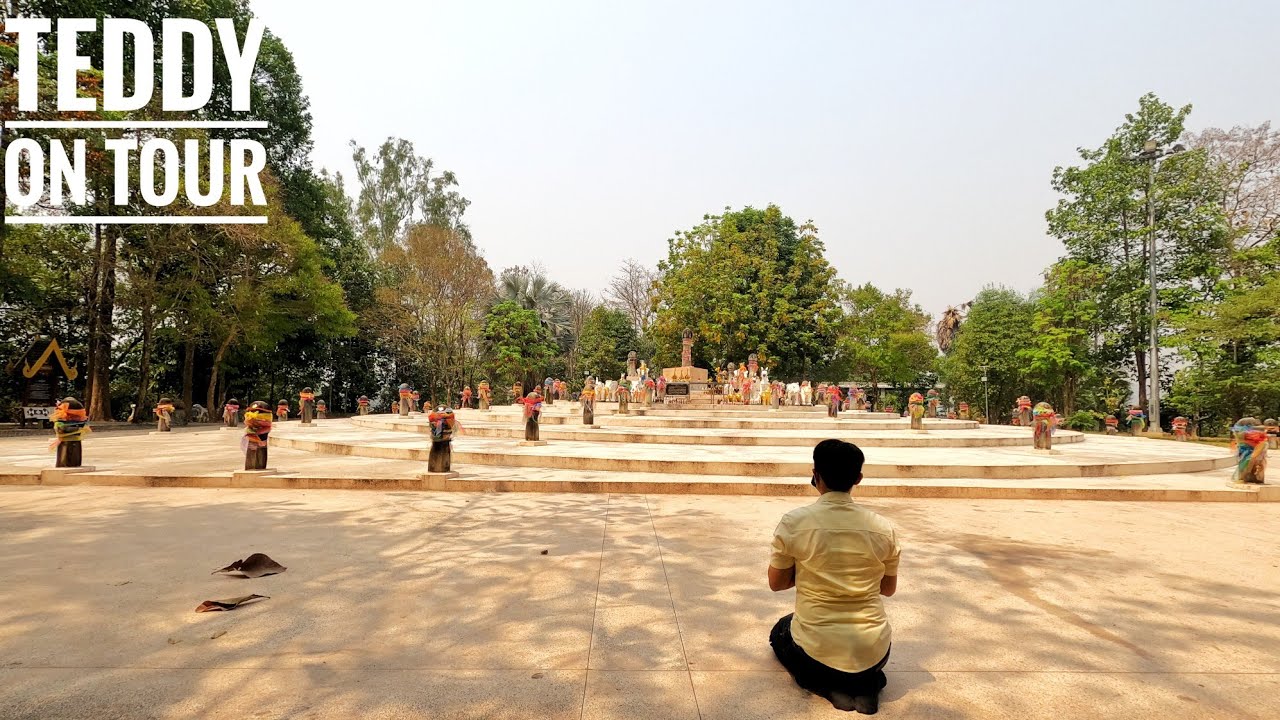
 Click to Access the Navigation Map GPS
Chiang Rai City Navel Pillar Map
Recommend

 Historical Sites and Monuments(3)
Landmarks and Memorials(7)
Historical Sites and Monuments(3)
Landmarks and Memorials(7)
 Art, Craft Centres, Tradition(6)
 Museums(8)
 Historic Homes and Cities(1)
 Educational Places
 Museum for Study(1)
 Library(1)
 Educational Gardens, Farm(3)
 Places of Worship
 Temple(38)
 Other Sacred Sites(5)
 Research and Development
 Royal Project(9)
 Suburban Living
 Village, Community(16)
 Local Market(5)
 Nature and Wildlife
 National Parks and Marine Reserves(18)
 Mountain (Doi)(20)
 Dam, Reservoir, Lake(8)
 Waterfalls(16)
 Hot Springs(6)
 Caves(8)
 River, Canal(10)
 Sea, Beach(1)
 Other natural attractions(3)
 Entertainment and Agricultural
 Animal camps and shows(1)
 Farms, Parks and Ecotourism(9)
 Shopping
 Shopping and Night Market(2)
 Call Customer Service in Tourism
 Call Customer Service in Tourism(1)
 Travel Articles, Recipes
 Travel Review, Food Review(1)
 Food Menu, North Recipes(1)


