
lovethailand home >North Travel Attractions >Chiang Rai Travel Attractions >Chiang Saen >Ban Saeo > Phalad Waterfall
TL;DR: Phalad Waterfall is located at Ban Pa Tueng, Moo 5, Ban Saeo Subdistrict, Chiang Saen District, Chiang Rai Province, open Daily, hours 08:00 - 17:00.

Phalad Waterfall
Open Days: Daily
Opening Hours: 08:00 - 17:00
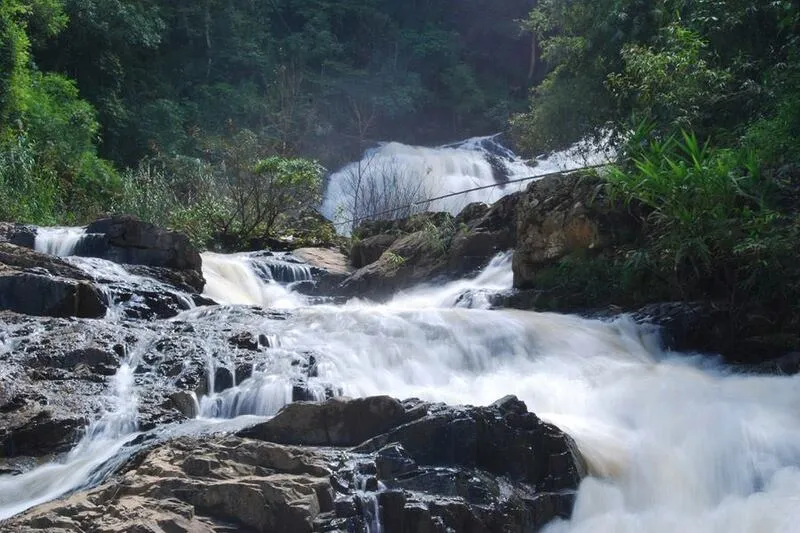
Phalad Waterfall is located in Ban Pa Tueng, Moo 5, Ban Saeo Subdistrict, Chiang Saen District, Chiang Rai Province. It is a natural attraction that reveals another side of Chiang Rai very clearly. This is not only the Chiang Rai of major check-in spots or famous attractions known nationwide, but also a quieter, more peaceful, greener side that remains closely connected to the way of life of the local community. The waterfall is a stream flowing down from the valley, passing over natural rock layers and descending in stages amid shaded trees and the moisture of the mountain forest. As a result, the overall atmosphere feels refreshing from the moment visitors enter the area. Although it is not a gigantic waterfall, it has a distinct charm that makes nature lovers feel they have truly come to rest, truly seen nature, and truly experienced the simple character of a place that has not been overly turned into a commercial tourist site.
The first outstanding feature that makes Phalad Waterfall especially appealing is how easy it is to reach. The access road is concrete all the way, so visitors can drive ordinary cars in without worrying about rough terrain like many other waterfalls that require high-clearance vehicles or a long walk. Compared with waterfalls in many mountainous parts of northern Thailand, this convenience is a major advantage, especially for families traveling with children or elderly relatives, travelers looking for a relaxing stop during a trip, or groups of friends who want a natural destination that is easy to reach and does not require too much time. The fact that this is a waterfall you can truly get to without difficulty makes it ideal for a relaxed trip while still feeling worthwhile, because as soon as you arrive, you are met with tree shade, the sound of flowing water, and a noticeably cooler atmosphere.
Phalad Waterfall is formed by a stream flowing down from the valley across natural rock layers, giving the waterfall a continuous flow and a rhythm of its own. It is not a single dramatic waterfall plunging straight off a tall cliff. Instead, it feels more closely connected to the character of an upstream mountain stream. This makes the waterfall feel softer and more inviting. Visitors can clearly see the textures of rock, water, and the lines of trees along both sides. Especially on days when the water is clear or after a short break in the rain, the water looks clean and lively. In some parts, the stream crashes against the rocks in white foam, while in others it glides smoothly and reflects the filtered light beneath the trees. Altogether, this makes the place feel dynamic and full of charm at all times.
According to local information and descriptions used to introduce this attraction, the most beautiful point of Phalad Waterfall is the uppermost level. This is the part that leaves the strongest impression on many visitors because it offers the clearest view of the water and the fullest sense of the surrounding natural atmosphere. This area feels still, quiet, and slightly more open in its view of the surrounding landscape than the lower level. Standing there and listening to the water, visitors can clearly feel the cool mist and moisture in the air. Those who enjoy photographing nature often capture images with strong depth, thanks to the water lines, rock formations, and overhanging trees that naturally help compose the frame. It is therefore no surprise that the upper level has become the visual highlight of Phalad Waterfall for many who come here.
What gives Phalad Waterfall value beyond being just a place to relax is its role as a water source for the Ban Pa Tueng community. The water from this waterfall supports local residents both in agriculture and in everyday domestic use. That means this waterfall is not merely a scenic backdrop for photographs or a cool stop for visitors. It is part of the living foundation of the people in the area. Knowing that the natural landscape you are looking at has real meaning for the community adds another layer to the visit, because visitors are not simply admiring a beautiful natural scene, but also witnessing a resource that is genuinely important to the livelihoods of the village.
This relationship between the waterfall and the community gives the place a different atmosphere from attractions created purely for leisure. Phalad Waterfall still carries a strong sense of being “nature that is truly in use.” This feeling is reflected in the way the area is maintained, in the access route, and in the moderate level of orderliness throughout the site. It has not been developed to the point of feeling rigid, but it has also not been left inaccessible or neglected. This balance helps visitors feel that the area still belongs to the community, and that tourism is only one role layered onto the original life of the place rather than replacing it altogether.
Another element that adds to the unique atmosphere of Phalad Waterfall is the presence of Samnak Song Namtok Phalad, a monastic retreat located nearby. Its presence means the area is not defined only by nature, but also by a quiet spiritual dimension. From the moment they arrive, visitors may feel that the overall atmosphere is calm, not crowded like large tourist attractions, and filled with a kind of stillness that invites people to sit, rest, and slow down. Having a religious space close to the waterfall also softens the atmosphere of the surroundings and naturally encourages many visitors to preserve the peace of the place.
When considering the natural character and overall atmosphere together, Phalad Waterfall is especially well suited to people who enjoy quiet destinations and do not want crowds. Many people like waterfalls but do not enjoy squeezing through large numbers of tourists, nor do they want places filled with shops and noise that overwhelm the sounds of nature. This place responds well to that kind of traveler because it still strongly preserves the feeling of forest, stream, and mountain landscape. Once you walk into the area, what you hear most clearly is the sound of water, wind, and nature rather than commercial activity. This quietness makes a visit to Phalad Waterfall feel like stepping out of everyday life into a place where time slows down noticeably.
As a place to unwind, Phalad Waterfall is very flexible. Visitors can come for a short stop of half an hour to an hour to enjoy the scenery, take photos, and sit for a while, or they can stay longer to soak in the atmosphere more deeply. A place like this suits solo travelers, couples, and small groups alike. Visiting alone offers peace and space to think or rest. Visiting as a couple gives the feeling of strolling and talking together in nature. Visiting as a family works well too, because it is not difficult to bring children or older adults here. One of Phalad Waterfall’s strengths is that it does not force visitors into any one kind of activity. Instead, it allows each person to use the space in the way that feels most comfortable.
For those who enjoy photography, Phalad Waterfall offers beautiful scenes in a very natural way, without the need for much staging. The rock layers play an important compositional role because they give the moving water more rhythm and dimension than a waterfall that drops in a single uninterrupted line. In addition, the shade of the surrounding trees softens the light, especially in the morning. On cloudy days or just after rain, the deep green of the forest contrasts strongly with the white of the water, creating a vivid yet soothing image. In the afternoon, when the light grows gentler, the waterfall area feels even quieter, making it particularly suitable for nature photography that emphasizes mood rather than spectacle.
Within the broader context of Chiang Saen District, Phalad Waterfall expands the image of local tourism in a very meaningful way. Chiang Saen is often associated first with the ancient city, the Golden Triangle, Wat Phra That Pha Ngao, and historical learning sites along the Mekong River. Yet on another level, Chiang Saen also has a good amount of beautiful and usable natural space. Phalad Waterfall represents that natural side of Chiang Saen. It helps make a trip feel less focused only on ruins and heritage sites by adding a place to breathe, to be quiet, and to spend time with a stream, a forest, and a real community water source.
There are several ways to plan a real trip here. Starting from Chiang Saen town, travelers might first visit the Chiang Saen National Museum or Wat Phra That Pha Ngao, then drive to Phalad Waterfall later in the morning or afternoon to relax. Or they might choose to begin with nature and end the day with views around the Golden Triangle. Because the waterfall is not too far from these major attractions, it works very well as an inserted stop in a one-day itinerary rather than always needing a full day of its own. That flexibility makes it easy for travelers to plan their time well and use the day efficiently.
In terms of seasonality, Phalad Waterfall has a different charm at different times of year. In the rainy season, the stream looks fuller and more energetic, and the surrounding forest becomes especially lush, creating a cool and humid atmosphere. Visitors should, however, be more careful about slippery rocks and walkways. In the cool season, the main advantages are pleasant temperatures, easy walking, and clearer conditions for photography because rain is less likely to interfere. In summer, although the water level may naturally decrease somewhat, the shade of the forest and the moisture of the stream still make the waterfall a good place to cool down, especially for those who do not want to stay too long in open, sun-exposed areas.
Safety in the area is another important consideration. Even though the route in is convenient, the spaces close to the waterfall naturally have wet surfaces and slippery rocks, especially after rainfall or during periods of stronger flow. Visitors should wear shoes with good grip and avoid running on the rocks. Families bringing young children should supervise them closely and choose suitable places if they want to play in the water, staying away from areas where the current is too strong. For those who want to walk up to the upper level, moving slowly and carefully is essential. The beauty of the place should always be enjoyed together with safe use of the area.
Getting There is one of the main reasons why this place suits such a broad range of travelers. From Chiang Saen, visitors can drive conveniently into Ban Saeo Subdistrict and continue to Ban Pa Tueng. The route is concrete all the way, which means normal passenger vehicles can access the area without requiring four-wheel drive or specialized off-road vehicles. As you get closer to the waterfall, the surroundings gradually shift from village roads to greener terrain, so the journey itself has a noticeable emotional transition, moving from everyday community space into a slower, more natural environment.
If traveling from Chiang Rai city, it is worth planning the timing in advance and perhaps combining the visit with Chiang Saen or the Golden Triangle area to make the trip more worthwhile. The distance from Chiang Rai city is significant, but the road is generally manageable. Once in Chiang Saen, there are far more choices for restaurants and accommodation, allowing visitors to stay in town and make a comfortable round trip to the waterfall. This arrangement works especially well for those who want to enjoy nature without needing to stay right next to the site itself.
Because Phalad Waterfall does not have the full commercial infrastructure of a major tourist destination directly on site, a little preparation helps make the visit more comfortable. Bringing drinking water, snacks, or a towel if you plan to get into the water can be useful, as is checking the weather beforehand, particularly in the rainy season. At the same time, this simplicity is part of the site’s appeal, because it allows visitors to experience nature without too many buildings or activities interrupting the feeling of the place.
Another important point is travel etiquette. Since the area includes a nearby monastic retreat and holds importance for the community, dressing respectfully, keeping noise levels low, and maintaining cleanliness are all naturally appropriate. Visitors should also avoid littering or damaging plants around the waterfall, because this water source has real significance for local residents. Helping take care of the place is not only about being a good traveler, but also about respecting both the natural environment and the community that looks after it.
For travelers who like places that feel “not too famous but easy to reach,” Phalad Waterfall is a clear match. It offers quietness, greenery, and a genuine natural atmosphere without demanding a difficult journey. That is what gives places like this so much value today, when many travelers are seeking more balanced experiences. They do not necessarily want a place that feels exaggerated or overpromoted. They want a place that feels good when they arrive, works well in real life, and has a real story behind it. Phalad Waterfall offers exactly that.
Phalad Waterfall is also well suited as a pause point for people spending several days in Chiang Rai. On trips that involve a lot of driving, temple visits, viewpoints, and multiple stops in succession, sitting quietly beside a waterfall for a while can rebalance the rhythm of travel. After the stimulation and movement of a busy itinerary, the stillness and calm of a place like this can be exactly what makes a trip feel complete. Even though it does not shout for attention, this kind of place can play a very important role in a well-designed itinerary.
When the beauty of the flowing water, the convenience of the concrete road, the importance of the waterfall as a community water source, and the peace brought by the nearby monastic retreat are all considered together, Phalad Waterfall becomes a destination with a very complete kind of charm. It does not need to try to be the biggest waterfall or the most heavily visited one. Instead, it has genuine value for people who are drawn to places that speak through simplicity. For anyone who wants to see the natural side of Chiang Saen, step away from urgency, and visit a place that still has real meaning in the lives of local people, Phalad Waterfall is a highly suitable destination.
| Name | Phalad Waterfall |
| Location | Ban Pa Tueng, Moo 5, Ban Saeo Subdistrict, Chiang Saen District, Chiang Rai Province |
| Address | Route between Ban Pa Tueng Moo 5 and Ban Huai Kwan Moo 9, Ban Saeo Subdistrict, Chiang Saen District, Chiang Rai Province 57150 |
| Reference Coordinates | Reference point from the local development plan: X0624093 Y2236584 |
| Summary | A natural waterfall in Ban Pa Tueng community, with water flowing from the mountain valley. Its upper tier is the main highlight, the atmosphere is shady and peaceful, the concrete road provides easy access, and it remains an important water source for the community. |
| Highlights | The upper tier is the most beautiful part of the waterfall. A nearby monastic retreat adds to the calm atmosphere, making the site ideal for quiet nature travel and relaxation. |
| Distinctive Features | A mountain stream flowing over natural rock layers, with plenty of tree cover, cool air, and access for all types of vehicles. |
| Travel Information | Drive from Chiang Saen town into Ban Saeo and Ban Pa Tueng. The road is concrete all the way and convenient throughout the year. |
| Current Status | Open to visitors as usual |
| Open Days | Daily |
| Opening Hours | 08:00 - 17:00 |
| Caretaker | Ban Saeo Subdistrict Municipality |
| Main Contact Number | 053-181241, 053-181242 |
| Official Website / Official Page | www.bansaeo.go.th |
| Nearby Tourist Attractions | 1. Wat Phra That Pha Ngao, about 24 km. Tel. 053-777151 2. Chiang Saen National Museum, about 24 km. Tel. 053-777102 3. House of Opium Museum, about 31 km. Tel. 053-784060 4. Hall of Opium, Golden Triangle Park, about 31 km. Tel. 053-784444 ext. 114 5. Wat Chedi Luang, Chiang Saen, about 24 km. |
| Nearby Restaurants | 1. Rim Khong Restaurant, Chiang Saen, about 31 km. Tel. 053-160845, 081-9931061 2. 3 Ying, Chiang Saen, about 24 km. Tel. 053-777040 3. Fah Mai Restaurant, about 24 km. Tel. 053-650572 4. Dé Balcony Chiang Saen Cafe & Restaurant, about 24 km. Tel. 053-777300, 084-6150241 5. Jungle Cafe, Chiang Saen Branch, about 24 km. Tel. 085-6949092 |
| Nearby Accommodations | 1. A Hotel Budget Chiang Saen, about 24 km. Tel. 053-651117, 061-7823399 2. Siam Triangle Hotel, about 31 km. Tel. 053-651115 3. Imperial Golden Triangle Resort, about 31 km. Tel. 053-784001 4. Pak-Ping-Rim-Khong B&B, about 24 km. Tel. 053-650151 5. Gin's Maekhong View Resort & Spa, about 25 km. Tel. 053-650847 |
Frequently Asked Questions (FAQ)
Q: Where is Phalad Waterfall located?
A: It is located in Ban Pa Tueng, Moo 5, Ban Saeo Subdistrict, Chiang Saen District, Chiang Rai Province.
Q: Is Phalad Waterfall difficult to reach?
A: No. It is easy to reach because the access road is concrete all the way, and all types of vehicles can get there.
Q: What is the highlight of Phalad Waterfall?
A: The highlight is the upper tier of the waterfall, which is the most beautiful part, with a shady and peaceful atmosphere and a nearby monastic retreat.
Q: Why is Phalad Waterfall important to the community?
A: It is a water source that local residents in Ban Pa Tueng use for both agriculture and daily household needs.
Q: When is the best time to visit Phalad Waterfall?
A: The best time is during the rainy season to early winter, when the water is most beautiful and the forest around the waterfall is especially green.
Q: Who should I contact for more information?
A: You can contact Ban Saeo Subdistrict Municipality at 053-181241 and 053-181242.
 Category: ●Nature and Wildlife
 Group: ●Waterfalls
Last Update : 4 MonthAgo
 Last Update : 4 MonthAgo
 Click to Access the Navigation Map GPS
Phalad Waterfall Map
Recommend

 Art, Culture and Heritage
 Historical Sites and Monuments(3)
 Landmarks and Memorials(7)
 Art, Craft Centres, Tradition(6)
 Museums(8)
 Historic Homes and Cities(1)
 Educational Places
 Museum for Study(1)
 Library(1)
 Educational Gardens, Farm(3)
 Places of Worship
 Temple(38)
 Other Sacred Sites(5)
 Research and Development
 Royal Project(9)
 Suburban Living
 Village, Community(16)
 Local Market(5)
 National Parks and Marine Reserves(18)
 Mountain (Doi)(20)
 Dam, Reservoir, Lake(8)
Waterfalls(16)
Dam, Reservoir, Lake(8)
Waterfalls(16)
 Hot Springs(6)
 Caves(8)
 River, Canal(10)
 Sea, Beach(1)
 Other natural attractions(3)
 Entertainment and Agricultural
 Animal camps and shows(1)
 Farms, Parks and Ecotourism(9)
 Shopping
 Shopping and Night Market(2)
 Call Customer Service in Tourism
 Call Customer Service in Tourism(1)
 Travel Articles, Recipes
 Travel Review, Food Review(1)
 Food Menu, North Recipes(1)


