
lovethailand home >North Travel Attractions >Chiang Rai Travel Attractions >Mae Chan >Maechan > Doi Nang Non
TL;DR: Doi Nang Non is located at Pong Pha area, Mae Sai District, Chiang Rai Province, open Open Daily, hours Scenic Viewing Available All Day.
Doi Nang Non
Open Days: Open Daily
Opening Hours: Scenic Viewing Available All Day
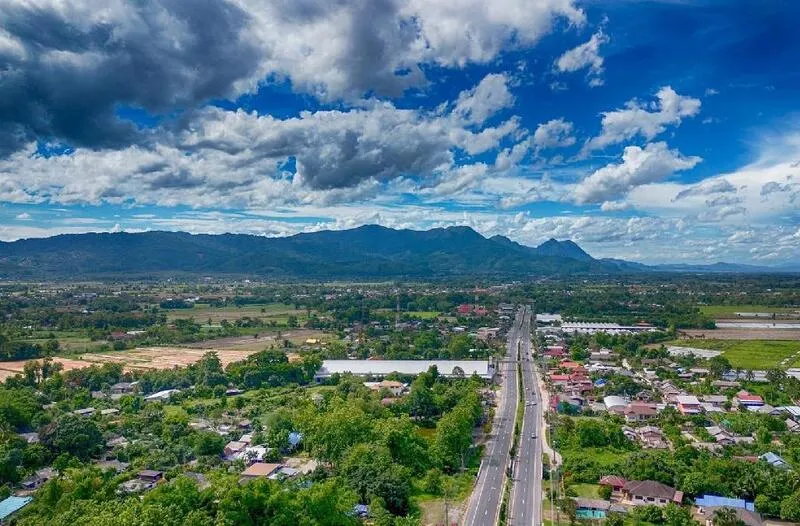
Doi Nang Non Viewpoint / Doi Nang Non Mountain Range is one of Chiang Rai’s most distinctive scenic landscapes, combining geography, natural beauty, and cultural storytelling in a single place. The mountain range is famous for its silhouette, which resembles a woman lying on her back, and this visual impression is exactly what gave rise to the name “Doi Nang Non.” From Mae Sai District and nearby areas, visitors can clearly see the long outline of the ridge stretching across the horizon like the form of a reclining woman.
From a geographical perspective, the Doi Nang Non range forms part of a north–south mountain belt connected to the border zone between Shan State in Myanmar and Chiang Rai in northern Thailand. This makes the mountain range more than just a scenic backdrop. It is also a natural boundary, an ecological corridor, and an important physical feature that has shaped settlement patterns and land use in the plains and foothills below.
The appeal of Doi Nang Non is not limited to its dramatic shape. It is also strongly tied to local legend and cultural memory. For many travelers, the mountain is not simply a place to photograph but a landscape with narrative depth. This combination of beauty and storytelling gives the area a distinct atmosphere and helps explain why it remains one of the most recognized mountain forms in Chiang Rai.
The upper part of the wider mountain zone is linked with Doi Tung, home to Wat Phra That Doi Tung, one of the most important sacred sites in northern Thailand. The area is also associated with the royal work of the Princess Mother, whose development projects transformed highland communities in Chiang Rai. In this sense, Doi Nang Non belongs to a larger cultural landscape rather than existing as an isolated mountain attraction.
The highest point of the Doi Nang Non range is Pha Chang Mub, which rises to about 830 meters above sea level, while the plains around Mae Sai sit at an average elevation of around 400 meters. This elevation contrast gives the mountain a powerful visual presence. It stands out clearly from the town and surrounding countryside, especially during morning and evening light when the ridgelines become more defined.
The surrounding foothill zone is equally significant. The Sai River flows through the upper part of the area and contributes to the geography of the Mae Sai plain. The western side of the mountain is higher, while the land gradually slopes eastward into agricultural areas extending toward Chiang Saen. To the south, the landscape connects with Mae Chan and Mae Fa Luang districts. Together, these features show how closely the mountain range is tied to both ecology and human settlement.
Geologically, Doi Nang Non is a limestone mountain range, which explains the presence of multiple caves throughout the area. The most famous cave zone is Tham Luang–Khun Nam Nang Non, internationally known from the rescue of the Wild Boars youth football team. The limestone character of the mountain creates a distinctive landscape of cliffs, caves, ridges, and slopes, making it attractive to general visitors, nature travelers, and people interested in landforms.
As a tourist destination, the “Doi Nang Non viewpoint” is appealing because it allows travelers to see the reclining mountain profile in a broad and satisfying way. Several points around Mae Sai, especially in Pong Pha Subdistrict, offer clear views of the mountain form. These viewpoints are suitable for photography, sightseeing, and understanding the geography of the border area at the same time.
One of the strongest charms of visiting Doi Nang Non is that the mountain works as a “storytelling landscape.” Many people do not come here to climb a peak but to observe the form of the mountain, learn how it fits into the wider setting, and appreciate the atmosphere of a border district where a great limestone ridge dominates the horizon. This makes the experience very different from a typical hilltop viewpoint.
Its location near Mae Sai adds even more interest. Mae Sai is Thailand’s northernmost district and an active border town, so visitors can easily combine mountain sightseeing with cave tourism, cultural stops, and local market exploration. This overlap between natural landscape and border-town life gives the area far more variety than a single-stop scenic destination.
In the early morning, Doi Nang Non often appears especially calm and refreshing. During the cool season or after rain, the ridgeline stands out beautifully in soft light, and on some days a thin layer of mist may linger near the foothills. In the evening, the mountains turn into darker layered forms against the sky, which makes the area very rewarding for travelers who enjoy quiet landscape photography.
For photographers, this is a strong destination because it supports multiple visual styles: wide mountain panoramas, mountain-and-sky compositions, landscapes that combine the ridge with fields or settlements, and scenes where cloud and mist add softness to the frame. The beauty here is not based on dramatic built features, but on line, form, light, and atmosphere.
Because the range is made of limestone and filled with cave systems, Doi Nang Non is also excellent for travelers who enjoy learning through landscapes. The mountain’s form, the way the slopes descend, and the relationship between caves, water, and settlement patterns all provide clues to how geography shapes daily life in this part of Chiang Rai. This is why the destination works well for both scenic tourism and educational travel.
The mountain range also carries a strong connection to recent shared memory because of the Tham Luang rescue. Although the viewpoint itself is not the cave entrance, the wider landscape is deeply associated with that event. Many travelers therefore want to see both the mountain form and the cave area in order to better understand the real geography behind a place they already know by name.
Accessibility is another advantage. Unlike mountain viewpoints that require long uphill walks, the Doi Nang Non landscape can be appreciated relatively easily from the Mae Sai area and roads near Pong Pha. This makes it suitable for travelers with limited time, families, and visitors planning to combine several attractions in one day.
Getting There From Chiang Rai city, travelers can take Highway No. 1 north toward Mae Sai. Once in the Pong Pha area or near Tham Luang–Khun Nam Nang Non, the mountain range becomes visible from several viewpoints. Those driving from Bangkok commonly use the northern route via Nakhon Sawan, Lampang, Phayao, and Chiang Rai before continuing north to Mae Sai.
For travelers who do not want to drive from Bangkok, the most convenient option is to fly to Mae Fah Luang Chiang Rai International Airport and then continue by rental car or local transport to Mae Sai. This saves considerable time and makes it easier to focus on sightseeing within Chiang Rai. From Mae Sai, it is straightforward to continue to the mountain-viewing area and related natural attractions.
Although the original information emphasizes the mountain range itself, travelers should ideally allow at least half a day to a full day for the surrounding area. Doing so makes it easier to understand how the mountain, caves, foothills, and border-town environment all connect. Spending more time here reveals why Doi Nang Non is not just a photogenic ridge, but one of the defining landscapes of northern Chiang Rai.
In terms of atmosphere, Doi Nang Non suits travelers who appreciate nature in a simple and unhurried way. There is no need for elaborate activities. Watching the mountain line, feeling the breeze, and observing the shift of light on the limestone ridge is already enough to make the visit rewarding. For people who prefer quiet scenery over crowded attractions, this area has strong appeal.
The destination can also be combined easily with other sites in Mae Sai and Mae Chan, such as Wat Tham Pla, Doi Tung Royal Villa, Mae Fah Luang Garden, and Mae Sai border market areas. This allows visitors to design a varied itinerary that includes nature, culture, and border-town life without excessive travel time.
Facilities in the wider area are better than in many remote mountain viewpoints because the landscape lies close to communities and major roads. Restaurants, cafés, and accommodations can be found without too much difficulty. Even so, visitors planning to enter managed natural attractions nearby should still check the latest opening details before traveling.
Overall, Doi Nang Non Viewpoint / Doi Nang Non Mountain Range is a Chiang Rai destination with layered appeal. Its geography is striking, its cultural associations are strong, its limestone structure creates a distinctive environment, and its connection to Mae Sai, Tham Luang, and Doi Tung gives it unusual depth as a travel destination. For anyone wanting to understand Chiang Rai through mountains, borders, and landscapes with stories, Doi Nang Non is an excellent place to include in the journey.
| Name | Doi Nang Non Viewpoint / Doi Nang Non Mountain Range |
| Summary | A major limestone mountain range in the Mae Sai–Pong Pha area of Chiang Rai, famous for its reclining-woman silhouette and its connection with Tham Luang–Khun Nam Nang Non |
| Location | Pong Pha area, Mae Sai District, Chiang Rai Province |
| Highlights | Reclining-woman mountain silhouette, limestone landscape, border-town scenery, and proximity to the Tham Luang area |
| History / Landscape Character | A north–south border mountain range in northern Chiang Rai, formed mainly of limestone with multiple caves; highest point at Pha Chang Mub, about 830 m above sea level |
| Distinctive Features | Ideal for wide mountain viewing, geographic learning, and combining with nearby cave, border, and Doi Tung attractions |
| Travel Information | From Chiang Rai city, take Highway No. 1 north to Mae Sai, then continue toward Pong Pha or the Tham Luang–Khun Nam Nang Non zone |
| Current Status | Still recognized as one of Mae Sai’s important landscape attractions and part of the wider natural tourism zone of Pong Pha |
| Fees | No public viewing fee found for the mountain-viewing landscape itself |
| Caretaker | Pong Pha Subdistrict Administrative Organization |
| Main Contact Number | Pong Pha SAO: 053-646627, 086-4497934 |
| Official Website / Official Page | www.pongpha.go.th |
| Nearby Tourist Attractions | 1. Tham Luang–Khun Nam Nang Non Forest Park about 3 km 2. Pha Chang Mub Viewpoint about 22 km 3. Doi Tung Royal Villa about 18 km 4. Mae Fah Luang Garden about 18 km 5. Mae Sai Border Market about 12 km |
| Nearby Restaurants | 1. Huen Him Doi Lanna Restaurant about 9 km 2. TEVA Valley Resort Restaurant about 11 km Tel. 052-050988 3. Cafe View Doi Nang Non about 8 km |
| Nearby Accommodations | 1. The One Resort Chiang Rai about 10 km Tel. 053-709358, 081-8839571 2. TEVA Valley Resort about 11 km Tel. 052-050988 3. Baan Suan Resort Mae Sai about 13 km 4. Pornprasert Place about 11 km Tel. 053-646666 5. Orchid Hotel Mae Sai about 12 km Tel. 053-731266 |
Frequently Asked Questions (FAQ)
Q: Where is Doi Nang Non?
A: It is in the Mae Sai and Pong Pha area of Chiang Rai Province and can be clearly seen from zones near Tham Luang and the surrounding foothills.
Q: What is the main highlight of Doi Nang Non?
A: The main highlight is the mountain silhouette that resembles a reclining woman, together with its limestone landscape and its strong link to the Tham Luang area.
Q: What kind of trip is it suitable for?
A: It is suitable for scenic viewing, landscape photography, geographic learning, and combining with nearby natural and cultural attractions.
Q: Is there an entrance fee?
A: No public viewing fee was found for the mountain-viewing landscape itself, but travelers should check specific nearby attractions individually.
Q: When is the best time to visit?
A: Morning and late afternoon are especially good because the light makes the ridgelines more visible and the weather is usually more pleasant.
Q: What can be combined with a Doi Nang Non trip?
A: Travelers can combine it with Tham Luang–Khun Nam Nang Non, Doi Tung Royal Villa, Mae Fah Luang Garden, and Mae Sai town attractions.
 Category: ●Nature and Wildlife
 Group: ●Mountain (Doi)
Last Update : 6 MonthAgo
 Last Update : 6 MonthAgo
 Click to Access the Navigation Map GPS
 Art, Culture and Heritage
 Historical Sites and Monuments(3)
 Landmarks and Memorials(7)
 Art, Craft Centres, Tradition(6)
 Museums(8)
 Historic Homes and Cities(1)
 Educational Places
 Museum for Study(1)
 Library(1)
 Educational Gardens, Farm(3)
 Places of Worship
 Temple(38)
 Other Sacred Sites(5)
 Research and Development
 Royal Project(9)
 Suburban Living
 Village, Community(16)
 Local Market(5)
 National Parks and Marine Reserves(20)
Mountain (Doi)(20)
National Parks and Marine Reserves(20)
Mountain (Doi)(20)
 Dam, Reservoir, Lake(8)
 Waterfalls(16)
 Hot Springs(6)
 Caves(8)
 River, Canal(10)
 Sea, Beach(1)
 Other natural attractions(3)
 Entertainment and Agricultural
 Animal camps and shows(1)
 Farms, Parks and Ecotourism(9)
 Waterpark(1)
 Shopping
 Shopping and Night Market(2)
 Call Customer Service in Tourism
 Call Customer Service in Tourism(1)
 Travel Articles, Recipes
 Travel Review, Food Review(1)
 Food Menu, North Recipes(1)


