
lovethailand home >North Travel Attractions >Chiang Rai Travel Attractions >Chiang Khong >Rim Khong > Ban Had Bai
TL;DR: Ban Had Bai is located at Village 1, Rim Khong Subdistrict, Chiang Khong District, Chiang Rai, open Open Daily, hours The village can be visited throughout the day, while community activities.

Ban Had Bai
Open Days: Open Daily
Opening Hours: The village can be visited throughout the day, while community activities should be arranged in advance
Ban Had Bai is one of Chiang Rai’s most distinctive cultural destinations for travelers who want more than a scenic stop. It is a riverside Tai Lue village in Chiang Khong District where local life, woven textiles, traditional customs, and the atmosphere of the Mekong still shape everyday life in a very visible way. Instead of being a place designed only for tourism, Ban Had Bai remains a real living community, which is exactly what gives it depth and charm.
The village is located in Rim Khong Subdistrict, Chiang Khong District, Chiang Rai Province, along the Mekong River corridor between Chiang Saen and Chiang Khong. This location gives Ban Had Bai a special character. Travelers do not come here only to see a village. They come to experience the landscape of the Mekong, the culture of a Tai Lue community, and the slower rhythm of life that still defines many river settlements in northern Thailand.
What makes Ban Had Bai especially memorable is its strong Tai Lue identity. The Tai Lue are a Tai ethnic group with a rich cultural heritage that can be seen in language, dress, ritual life, weaving traditions, and community customs. In Ban Had Bai, these traditions are not decorative leftovers from the past. They are still woven into everyday life. That is why the village feels authentic rather than staged.
The best-known cultural feature of the village is its Tai Lue weaving. Ban Had Bai is widely recognized for locally woven textiles, and weaving is one of the most important traditional skills in the community. The textiles are not only sold as products. They are part of the village’s identity and one of the clearest ways to understand local heritage. Watching the weaving process helps visitors appreciate the patience, detail, and knowledge carried by each textile piece.
Local weaving in Ban Had Bai is deeply connected to seasonal life. After the harvest season or during periods when agricultural work becomes lighter, women in the village traditionally devote more time to weaving. This makes textile production both a cultural practice and an income source. The village is especially known for Tai Lue handwoven skirts and woven patterns that reflect inherited knowledge from earlier generations.
The designs themselves are part of what makes the weaving tradition so fascinating. Tai Lue woven fabrics in Ban Had Bai include detailed patterns and decorative techniques passed down through generations. These are not mass-made souvenir items. They reflect a long tradition of craftsmanship and aesthetic values that remain rooted in community life. For travelers interested in handmade textiles, Ban Had Bai offers one of the most meaningful weaving experiences in the Chiang Khong area.
Ban Had Bai also carries a deeper historical identity. Community records describe the village as a settlement linked to migration stories from Xishuangbanna and other Mekong-connected areas before the people eventually settled in the present location. This background gives the village a broader cultural context. It is part of the historical movement of Tai peoples along the Mekong and part of the long cultural geography of the upper Mekong basin.
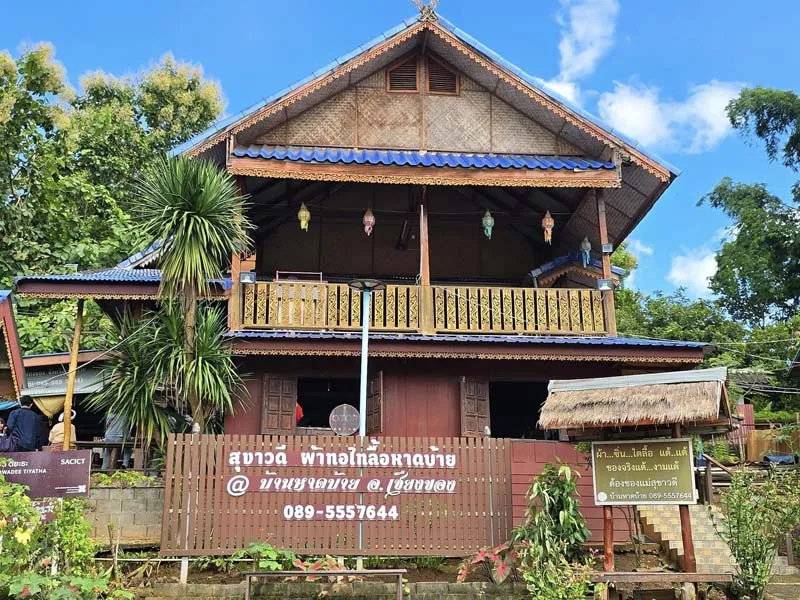
Another reason the village stands out is its Mekong riverside atmosphere. The scenery here is simple, open, and calming. Wooden houses, temple spaces, woven fabrics, river views, and community life come together in a way that feels gentle and unforced. Morning visits are good for soft light and fresh air. Late afternoon is especially appealing for riverside walks and warm tones over the Mekong. Even without a packed schedule, simply spending time in the village can feel deeply restorative.
One of the most memorable ways to arrive is by long-tail boat from Tha Ruea Bak. This route is one of the strongest travel highlights connected with Ban Had Bai. Instead of going directly by road, visitors can travel by boat along the Mekong and enjoy the views on both riverbanks during the journey. The trip takes around 1 hour, and the river scenery becomes part of the destination itself. For many travelers, this is one of the main reasons Ban Had Bai feels different from other cultural villages.
The boat journey adds another layer to the experience. It allows visitors to engage with the Mekong not just as a backdrop, but as a travel corridor that still shapes movement, scenery, and local identity. Mountain views, riverside settlements, open sky, and shifting light all help create a relaxed and cinematic approach to the village. For anyone interested in slow travel, this approach is especially rewarding.
Once in the village, travelers can spend time walking through the community, observing local architecture, learning about weaving, buying handmade fabrics, and taking part in community-based tourism activities when arranged in advance. Ban Had Bai works especially well for travelers who want an immersive experience rather than a checklist-style visit. Homestays, local food, riverside life, and craft learning can all become part of the trip.
Wat Had Bai is another important part of the village landscape. The temple functions as a cultural and spiritual center for the community and reflects the deep relationship between Tai Lue local life and religious tradition. It also helps visitors understand that Ban Had Bai is not just a craft village. It is a complete community with ritual life, social structure, and shared places that remain central to local identity.
The village also continues to host cultural activities and public events connected with Tai Lue identity, including local cultural walking street events and merit-making festivals related to weaving traditions. This is important because it shows that Ban Had Bai’s cultural life is not frozen in the past. It remains active, shared, and visible in current community life.
For travelers seeking meaningful cultural tourism in Chiang Rai, Ban Had Bai is an excellent choice. It suits people who enjoy handwoven textiles, riverside communities, slow travel, local heritage, and photography. It is also a good destination for travelers who prefer smaller places with stronger character rather than major tourist sites that feel commercial or crowded.
The village can be visited in many seasons because its main appeal is not limited to one short natural event. During the cool season, the weather is more comfortable and the Mekong landscape feels especially pleasant. During the rainy season, the village and surrounding countryside can appear greener and softer. In either case, travelers planning boat access should check local conditions in advance.
If you want a fuller experience, Ban Had Bai works well as either a half-day cultural stop or an overnight community stay. Day visitors can focus on the village, weaving, and river scenery. Overnight visitors can go further by joining community activities, tasting local food, and experiencing the quieter rhythm of the village after regular day travel ends.
Getting There can be done either by road or by boat. The most distinctive route is taking a long-tail boat from Tha Ruea Bak, which takes about 1 hour and gives travelers a beautiful view of both sides of the Mekong along the way. By road, Ban Had Bai is around 30 km from the Chiang Khong District Office area. A private car or rental car is the most practical option for land travel, and visitors planning community activities or homestay experiences should contact the village in advance.
Overall, Ban Had Bai is one of Chiang Rai’s most rewarding cultural destinations for travelers who want to experience Tai Lue heritage in a real village setting. It offers beautiful handwoven textiles, Mekong scenery, meaningful local traditions, and a peaceful riverside atmosphere that leaves a lasting impression. If you are looking for a slower, deeper, and more human side of Chiang Rai, Ban Had Bai deserves a place on your itinerary.
| Name | Ban Had Bai |
| Location | Village 1, Rim Khong Subdistrict, Chiang Khong District, Chiang Rai |
| Address | Ban Had Bai, Moo 1, Rim Khong Road, Rim Khong, Chiang Khong, Chiang Rai 57140 |
| Highlights | Tai Lue riverside community, Tai Lue weaving, long-tail boat access from Tha Ruea Bak, Mekong scenery, homestay experiences, and community-based tourism |
| History | A Tai Lue community with migration roots connected to Xishuangbanna and the Mekong cultural region, later settling in the present Ban Had Bai area |
| Name Origin | The village developed in a riverside sandbank area along the Mekong and became known as Ban Had Bai |
| Distinctive Features | Peaceful Mekong riverside setting, visible Tai Lue identity, traditional houses, weaving groups, temple-centered community life, and local cultural events |
| Travel Information | About 30 km from Chiang Khong District Office by road, or about 1 hour by long-tail boat from Tha Ruea Bak |
| Current Status | Still active as a cultural tourism community with weaving, community travel coordination, and recurring Tai Lue cultural events |
| Open Days | Open Daily |
| Opening Hours | The village can be visited throughout the day, while community activities should be arranged in advance |
| Facilities | Community homestays, Tai Lue weaving learning area, village walking space, Mekong riverside viewpoints, Wat Had Bai, and pre-arranged community activities |
| Main Areas / Zones | Tai Lue weaving group, Wat Had Bai, Mekong riverside area, community homestay zone, and cultural walking street event area |
| Main Contact Number | Community coordinator 088-495-5884, 097-920-4906 / Rim Khong SAO 0-5316-0664 |
| Official Website / Official Page | Ban Had Bai OTOP Community Tourism page, Ban Had Bai Tai Lue Weaving Group page, and Rim Khong Subdistrict Administration Organization |
| Nearby Tourist Attractions | 1) Wat Had Bai – about 0.5 km 2) Tha Ruea Bak – about 8 km 3) Hat Sai Thong, Ban Had Bai – about 1 km 4) Kaeng Pha Dai – about 14 km 5) Chiang Khong Giant Catfish Museum – about 29 km |
| Nearby Restaurants | 1) Ban Had Bai Tai Lue Local Food Community Enterprise – about 0.5 km 2) Rim Khong Restaurant, Chiang Khong – about 29 km. Tel. 053-655-099 3) Rim Khong Chiang Khong Restaurant – about 29 km. Tel. 081-716-2663 4) Krua Rim Nam, Chiang Khong – about 29 km. Tel. 053-655-680 5) House Chiang Khong – about 30 km. Tel. 098-332-6777 |
| Nearby Accommodations | 1) Had Bai Rim Khong Homestay – about 0.5 km 2) Huen Narisara Homestay – about 1 km 3) Baan Rim Nam Hotel Chiang Khong – about 29 km. Tel. 081-884-4586, 053-655-680 4) Namkhong Riverside Hotel – about 30 km. Tel. 064-351-4141 5) Mon Nan Fah Homestay Chiang Khong – about 24 km. Tel. 082-585-6340, 061-425-5858 |
Frequently Asked Questions (FAQ)
Q: Where is Ban Had Bai located?
A: Ban Had Bai is in Rim Khong Subdistrict, Chiang Khong District, Chiang Rai Province. It is a Tai Lue village along the Mekong River.
Q: What is Ban Had Bai best known for?
A: The village is best known for its Tai Lue cultural identity, handwoven textiles, riverside atmosphere, and community-based tourism experiences.
Q: Can I travel to Ban Had Bai by boat?
A: Yes. One of the best ways to visit is by long-tail boat from Tha Ruea Bak, which takes about 1 hour and offers scenic Mekong views along the route.
Q: Is Ban Had Bai suitable for an overnight stay?
A: Yes. The community has homestay-style travel options, and staying overnight gives visitors more time to enjoy local life and riverside atmosphere.
Q: What kind of travelers would enjoy Ban Had Bai?
A: It is especially suitable for travelers interested in culture, handwoven textiles, ethnic heritage, riverside communities, photography, and slow travel.
Q: Should I contact the community in advance?
A: Yes, especially if you want to join community activities, observe weaving in a more organized way, or book a homestay experience.
 Category: ●Suburban Living
 Group: ●Village, Community
Last Update : 7 MonthAgo
 Last Update : 7 MonthAgo
 Click to Access the Navigation Map GPS
Ban Had Bai Map
Recommend

 Art, Culture and Heritage
 Historical Sites and Monuments(3)
 Landmarks and Memorials(7)
 Art, Craft Centres, Tradition(6)
 Museums(8)
 Historic Homes and Cities(1)
 Educational Places
 Museum for Study(1)
 Library(1)
 Educational Gardens, Farm(3)
 University
 Autonomous Universities(1)
 Rajamangala University of Technology(1)
 Rajabhat University(1)
 Places of Worship
 Temple(38)
 Other Sacred Sites(5)
 Research and Development
 Royal Project(9)
Village, Community(16)
Royal Project(9)
Village, Community(16)
 Local Market(5)
 Nature and Wildlife
 National Parks and Marine Reserves(20)
 Mountain (Doi)(20)
 Dam, Reservoir, Lake(8)
 Waterfalls(16)
 Hot Springs(6)
 Caves(8)
 River, Canal(10)
 Sea, Beach(1)
 Other natural attractions(3)
 Entertainment and Agricultural
 Animal camps and shows(1)
 Farms, Parks and Ecotourism(9)
 Waterpark(1)
 Shopping
 Shopping and Night Market(2)
 Call Customer Service in Tourism
 Call Customer Service in Tourism(1)
 Travel Articles, Recipes
 Travel Review, Food Review(1)
 Food Menu, North Recipes(1)


