
lovethailand home >North Travel Attractions >Chiang Rai Travel Attractions >Chiang Saen >Wiang > Wat Sangkha Kaeo Don Han
TL;DR: Wat Sangkha Kaeo Don Han is located at Wiang Subdistrict, Chiang Saen District, Chiang Rai Province, open Every day, hours 08.00 - 17.00.

Wat Sangkha Kaeo Don Han
Open Days: Every day
Opening Hours: 08.00 - 17.00
Wat Sangkha Kaeo Don Han is an important archaeological site in Chiang Saen District, Chiang Rai Province. It stands along the Chiang Saen–Chiang Khong riverside road near the Chiang Saen District Office in Wiang Subdistrict. What makes this place remarkable is not only that it is an ancient abandoned temple within the old city of Chiang Saen, but also that it is a site where highly significant archaeological evidence has been discovered. The most notable finds include incised drawings on bricks and fragments of mural paintings, both of which offer unusually deep insight into the artistic world and religious devotion of the past. For anyone looking for the shortest possible answer, Wat Sangkha Kaeo Don Han is a Chiang Rai destination well suited to travelers who enjoy history, old cities, and authentic archaeological traces that can still be seen on site.
According to local legend, the temple was founded by King Lavachakkaraj in the early 12th Buddhist century. However, when the evidence found at the site is considered, scholars believe that the visible remains standing today date to no later than the 21st Buddhist century. This contrast between legend and archaeological evidence gives Wat Sangkha Kaeo Don Han a particularly compelling historical character. Visitors do not simply encounter a story preserved in chronicles or local belief, but also see how physical evidence can expand, refine, and sometimes reshape our understanding of the past.
What makes Wat Sangkha Kaeo Don Han especially important in academic terms is the excavation work carried out by the Fine Arts Department, which uncovered a large body of evidence. Among the most striking finds are incised images on bricks depicting scenes from the Vessantara Jataka, such as Prince Vessantara walking through the forest and Jujaka standing before him. These images are extraordinary because of how they were made: they were drawn onto the bricks before firing, rather than painted onto walls afterward like later temple murals. This detail makes Wat Sangkha Kaeo Don Han a key site for studying art, construction materials, and religious belief all at once.
Its importance becomes even greater when one considers that the bricks bearing these images were later used in the construction of walls and then covered with plaster. They were not created to be openly displayed for viewers in the way later mural paintings were. This has led scholars to interpret the images as part of a devotional act or merit-making process rather than as decoration intended for public viewing. In other words, the meaning of these images may lie more in the faith of the builders than in visual presentation. That is precisely why Wat Sangkha Kaeo Don Han is more than an ordinary abandoned monument: it reflects a worldview in which devotion could be embedded even within construction materials that were ultimately concealed from sight.
In addition to the brick panels, fragments of mural paintings that had fallen from the vihara walls were also found. Although these pieces survive only in broken condition, parts of the colors and figures can still be seen. Only 2 tones were used—vermilion and red. This may seem like a minor detail, but in art historical terms it is extremely valuable because it helps clarify the range of coloring techniques and image-making methods used in ancient Lanna temples. Wat Sangkha Kaeo Don Han is therefore an important learning site where the story of art is reconstructed through fragments and traces rather than through fully preserved masterpieces alone.
Seen within the broader context of Chiang Saen, Wat Sangkha Kaeo Don Han is one of the monuments that helps complete the picture of this old Mekong riverside city. Chiang Saen is not defined only by major temples and famous chedis. It also preserves abandoned temples that still hold crucial pieces of the past within their soil layers and brick walls. This site is therefore highly suitable for travelers who want to understand Chiang Saen as an integrated historical landscape rather than simply visit a few major landmarks and move on.
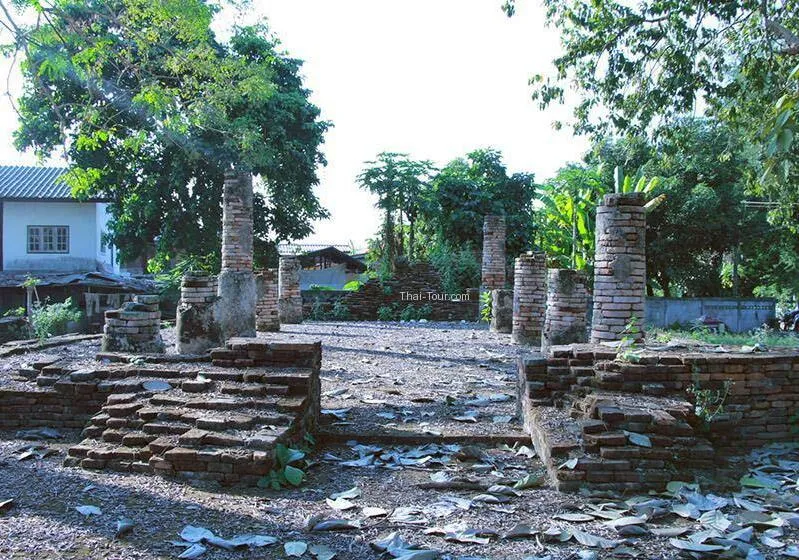
Today, the site survives as an open-air archaeological ruin within Chiang Saen town. The remains of building foundations and brick wall lines are still clearly visible. The atmosphere is generally quiet and far less crowded than at larger temple attractions. As a result, the experience here is not about grand, fully intact architecture. Instead, it lies in slowly walking around the vihara foundations, brick lines, and structural remains while imagining the buildings that once stood there. Travelers who enjoy studying places carefully and reading subtle details in the landscape often find Wat Sangkha Kaeo Don Han especially rewarding.
Its location along the Chiang Saen–Chiang Khong riverside road, close to the center of the district, also makes it very easy to visit. Travelers exploring Chiang Saen by car can include Wat Sangkha Kaeo Don Han in the same route as Wat Phra That Chom Kitti, Wat Pa Sak, Wat Phra Buat, Wat Chedi Luang, and the Chiang Saen National Museum. Its strength lies not only in its academic value, but also in the fact that it is genuinely accessible as part of a well-planned 1-day historical itinerary in Chiang Saen.
Another reason the site is appealing to culturally minded travelers is that it helps answer larger questions about temple building in the past. How did people of earlier times understand sacred imagery? Why were some images made on bricks before firing? Why were those bricks then built into walls and hidden under plaster? And how much can the craftsmanship of one abandoned temple reveal about Buddhist literature such as the Vessantara Jataka? These questions make a visit to Wat Sangkha Kaeo Don Han much more than a simple walk through old ruins. It becomes a way of reading the meaning of the past through evidence actually excavated from the same ground.
For visitors who enjoy photography, the site offers the mood of old bricks, tree shadows, and restrained architectural traces rather than towering stupas or highly ornate monuments. The images captured here tend to feel calm, understated, and deeply connected to the passage of time. It is particularly suitable for travelers seeking the quieter side of historic Chiang Saen and for those who prefer documentary-style photography or ancient architectural details over brightly colored landmark shots.
In terms of educational travel, Wat Sangkha Kaeo Don Han pairs especially well with the Chiang Saen National Museum. The temple gives visitors the experience of seeing evidence in its original landscape, while the museum explains the broader history of Chiang Saen and Lanna art in a wider interpretive frame. Even for visitors with limited time, combining this site with nearby monuments such as Wat Phra That Chom Kitti and Wat Pa Sak is already worthwhile for anyone who wants to know Chiang Saen beyond the usual tourist perspective.
Visitors should explore the site with care, since it is an open archaeological area with many old brick remains. Walking respectfully, avoiding climbing on the ruins, and not touching the walls or archaeological traces unless necessary are all important ways to help preserve the monument. The strength of Wat Sangkha Kaeo Don Han lies in the authenticity of these remains. The better they are protected, the more clearly the site can continue to express its historical value.
Getting There is easy from Chiang Saen town. Follow the Chiang Saen–Chiang Khong riverside road within Wiang Subdistrict. The site is near the Chiang Saen District Office and not far from Wat Phra That Chom Kitti. Travelers using a private car can stop by very conveniently while exploring the old city. Those staying within Chiang Saen town can also use local transport or plan a multi-temple route in a single day, since the distances between the district’s important historical sites are not very great.
In summary, Wat Sangkha Kaeo Don Han is a Chiang Rai destination particularly suitable for travelers interested in history, ancient cities, and archaeological evidence of strong academic value. Its appeal does not rest on monumental structures that survive in complete form, but on the evidence that opens a window onto past beliefs, craftsmanship, and Buddhist literary culture through bricks and mural fragments found on site. For anyone who wants to experience Chiang Saen in a way that is thoughtful, historically grounded, and rich in atmosphere, Wat Sangkha Kaeo Don Han deserves a clear place in the itinerary.
| Name | Wat Sangkha Kaeo Don Han |
| Location | Wiang Subdistrict, Chiang Saen District, Chiang Rai Province |
| Address | Chiang Saen–Chiang Khong riverside road, Wiang Subdistrict, Chiang Saen District, Chiang Rai Province, near the Chiang Saen District Office |
| Coordinates | 20.2784009797, 100.087964997 |
| Highlights | Ancient monument in Chiang Saen, incised brick images from the Vessantara Jataka, mural fragments, and an archaeological site of major academic importance |
| History | Legend attributes the temple to King Lavachakkaraj in the early 12th Buddhist century, while archaeological evidence suggests the visible remains date to no later than the 21st Buddhist century |
| Name Origin | The site is known as Wat Sangkha Kaeo Don Han in archaeological and artistic records related to Chiang Saen |
| Distinctive Features | An abandoned open-air temple site with building foundations, brick wall lines, and rare artistic evidence preserved on bricks |
| Travel Information | Accessible from Chiang Saen town via the Chiang Saen–Chiang Khong riverside road in Wiang Subdistrict; easy to combine with nearby historical sites in a single itinerary |
| Current Status | An abandoned temple and archaeological site that remains accessible within the historic area of Chiang Saen |
| Open Days | Every day |
| Opening Hours | No site-specific opening-hours notice found |
| Main Contact Number | 053-777-081 |
| Nearby Tourist Attractions | 1) Wat Phra That Chom Kitti, about 1 km 2) Wat Pa Sak, about 2 km 3) Wat Phra Buat, about 2 km 4) Chiang Saen National Museum, about 2 km 5) Wat Chedi Luang, Chiang Saen, about 2 km |
| Nearby Restaurants | 1) The Terrace Chiang Saen, about 3 km, Tel. 061-686-7773 2) Mekong Pizza, about 3 km, Tel. 083-915-4750 3) Krua Fa Mai Rim Khong, about 3 km 4) Krua Huen Sabai Dee Chiang Saen, about 3 km 5) Le Khwa Cafe Bistro Bed & Breakfast, about 4 km, Tel. 091-499-9291 |
| Nearby Accommodations | 1) Siam Triangle Hotel Chiang Saen, about 3 km, Tel. 053-651115 2) A Hotel Budget Chiang Saen, about 3 km, Tel. 053-651117 3) Pak-Ping-Rim-Khong Bed & Breakfast, about 3 km, Tel. 053-650151 4) One Budget Hotel Chiangsaen, about 4 km, Tel. 080-075-4988 5) Athita Hotel Chiang Saen, about 4 km, Tel. 063-426-9464 |
Frequently Asked Questions (FAQ)
Q: Where is Wat Sangkha Kaeo Don Han located?
A: Wat Sangkha Kaeo Don Han is located on the Chiang Saen–Chiang Khong riverside road in Wiang Subdistrict, Chiang Saen District, Chiang Rai Province, near the Chiang Saen District Office.
Q: What is the most important highlight of Wat Sangkha Kaeo Don Han?
A: Its most important highlight is the discovery of incised brick images related to the Vessantara Jataka, along with mural fragments of exceptional academic value.
Q: How old is Wat Sangkha Kaeo Don Han?
A: Local legend links the temple to the early 12th Buddhist century, but archaeological evidence suggests that the visible remains date to no later than the 21st Buddhist century.
Q: Why is this site important in academic terms?
A: The finds here help explain historical craftsmanship, construction methods, and religious belief, especially because the images were made on bricks before firing, which is extremely rare.
Q: Is Wat Sangkha Kaeo Don Han still an active temple?
A: No. It is now an abandoned temple and open-air archaeological site within the old city area of Chiang Saen.
Q: How much time should visitors allow for the site?
A: A short visit usually takes around 20–40 minutes, but if you combine it with other nearby historical sites in Chiang Saen, it is best to allow at least half a day.
Q: What kind of traveler would enjoy this site most?
A: It is especially suitable for travelers interested in archaeology, the old city of Chiang Saen, abandoned Lanna temples, and history-focused travel in Chiang Rai.
Tel : 053650803
 Tel : 053650803
 Category: ●Places of Worship
 Group: ●Temple
Last Update : 3 MonthAgo
 Last Update : 3 MonthAgo
 Click to Access the Navigation Map GPS
Wat Sangkha Kaeo Don Han Map
Recommend

 Art, Culture and Heritage
 Historical Sites and Monuments(3)
 Landmarks and Memorials(7)
 Art, Craft Centres, Tradition(6)
 Museums(8)
 Historic Homes and Cities(1)
 Educational Places
 Museum for Study(1)
 Library(1)
 Educational Gardens, Farm(3)
Temple(38)
Educational Gardens, Farm(3)
Temple(38)
 Other Sacred Sites(5)
 Research and Development
 Royal Project(9)
 Suburban Living
 Village, Community(16)
 Local Market(5)
 Nature and Wildlife
 National Parks and Marine Reserves(18)
 Mountain (Doi)(20)
 Dam, Reservoir, Lake(8)
 Waterfalls(16)
 Hot Springs(6)
 Caves(8)
 River, Canal(10)
 Sea, Beach(1)
 Other natural attractions(3)
 Entertainment and Agricultural
 Animal camps and shows(1)
 Farms, Parks and Ecotourism(9)
 Shopping
 Shopping and Night Market(2)
 Call Customer Service in Tourism
 Call Customer Service in Tourism(1)
 Travel Articles, Recipes
 Travel Review, Food Review(1)
 Food Menu, North Recipes(1)


