
lovethailand home >North Travel Attractions >Chiang Rai Travel Attractions >Muang Chiang Rai >Wiang > Wat Chedi Chet Yot
TL;DR: Wat Chedi Chet Yot is located at Wiang Subdistrict, Mueang Chiang Rai District, Chiang Rai Province, open Daily, hours 08.00 – 17.00. Highlights include Seven-spired stupa, Lanna heritage, royal temple status, long restoration history.

Wat Chedi Chet Yot
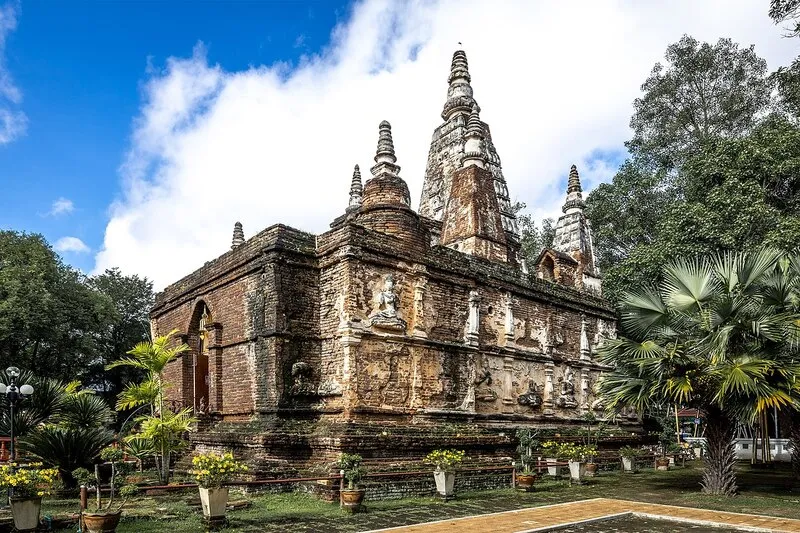
Open Days: Daily
Opening Hours: 08.00 – 17.00
Wat Jet Yod is a third-class royal temple located in Mueang Chiang Rai District, Chiang Rai Province. It is one of the city’s most historically important temples, valued for its Lanna heritage, royal status, and long-standing significance to local Buddhist communities. Many visitors first recognize Wat Jet Yod because of its distinctive seven-spired stupa, but the temple offers much more than a single iconic monument. It is a place where Chiang Rai’s early history, periods of abandonment, local restoration efforts, and present-day religious life all come together in one setting.
This makes Wat Jet Yod more than simply a place for worship or a stop on a sightseeing route. It is a cultural and historical site that allows visitors to understand Chiang Rai through architecture, legends, restoration history, and living religious practice. For travelers interested in northern Thai temples, Lanna history, or cultural tourism in the city, Wat Jet Yod is one of the best places to visit because it combines accessibility with depth.
Historical interpretation suggests that Wat Jet Yod may have been built during the Lanna Kingdom, or possibly even before King Mangrai formally founded Chiang Rai. If that interpretation is correct, the temple would be one of the oldest surviving religious traces in the area. In practical terms, this means the site is not only important because it is old, but because it may reflect the religious life of the community before Chiang Rai became a major political center.
Like many temples in northern Thailand, Wat Jet Yod passed through a long period of decline. After the Burmese invasions, the temple was abandoned and left in poor condition. Once a temple loses the support and regular activity of the surrounding community, buildings deteriorate, stupas weaken, and the religious rhythm of the site is interrupted. Wat Jet Yod experienced exactly such a phase, which is why its later restoration was so meaningful.
A major turning point came during the reign of King Rama III, when Chiang Rai was restored. Prince Mahotaraprathet of Chiang Mai led local people back to rebuild the city, and Wat Jet Yod was restored alongside that larger effort. At the time, both the temple buildings and the stupa were in a severely damaged state. The restoration was therefore not just a construction project, but also a spiritual and communal revival.
Phra Khru Kantha Kandhavangso played a crucial role by encouraging villagers to help restore the temple from 1843 onward. This is an important detail because it shows that the survival of Wat Jet Yod was shaped by local faith as much as by formal authority. The temple returned to life through the cooperation of monks and laypeople, a pattern deeply rooted in the religious culture of Lanna society.
On 31 May 1978, Wat Jet Yod was officially designated as a royal temple. This status confirms the temple’s importance in religion, history, and public life. For visitors today, that recognition helps frame the site correctly: Wat Jet Yod is not simply a neighborhood temple, but a place of recognized significance within Chiang Rai’s religious and cultural landscape.
The name “Jet Yod,” meaning “seven spires,” is explained through more than one local tradition. One legend says that during restoration work, the foundations of seven stupas were discovered in a row, leading to the name. Another says that seven abandoned temple sites once stood in the area and were eventually consolidated into one temple, with a seven-spired stupa built to represent that history. Some accounts also connect the name to Wat Ched Yot in Chiang Mai, suggesting an intentional northern religious association.
These legends do more than explain the temple’s name. They show how local communities preserve identity through storytelling. Whether the name came from seven stupa bases or seven former temple sites, the number seven is central to the temple’s image and memory. Because the name corresponds so clearly to the architecture, Wat Jet Yod is easy to remember and stands out strongly among temples in Chiang Rai.
The seven-spired stupa is the temple’s defining landmark. Architecturally, it reflects Lanna artistic values and symbolic religious design. Spiritually, it acts as the focal point for prayer, merit-making, and reverence. This combination of visual uniqueness and sacred meaning gives the stupa its enduring power. Visitors may arrive because of its appearance, but they often stay longer because of the atmosphere and historical significance surrounding it.
An important recent event took place on 19 January 2022, when lightning struck the stupa. The outer white-painted concrete surface on levels one through five cracked and peeled away, exposing the brickwork inside. Although the overall structure did not suffer major damage, the incident reminded the public of the vulnerability of historic monuments to natural forces. It also renewed public attention toward the temple and highlighted the need for continued preservation.
From a heritage perspective, the lightning strike was significant because it revealed more of the temple’s structural layers and encouraged broader discussion about restoration and conservation. Even though the event was unwanted, it helped many people see Wat Jet Yod not just as an old temple, but as a cultural monument that requires care and thoughtful stewardship.
For travelers, Wat Jet Yod is especially convenient because it is located in Mueang Chiang Rai District. It can be easily included in a one-day city itinerary together with Chiang Rai Clock Tower, Wat Phra Kaew, Wat Rong Suea Ten, Chiang Rai Walking Street, and Oub Kham Museum. This practicality makes it a strong choice for visitors who want meaningful cultural experiences without needing to travel far outside the city.
At the same time, convenience is not the temple’s only strength. Despite being in the city, Wat Jet Yod retains a calm and reflective atmosphere. It does not feel rushed or overly commercial. Visitors can walk slowly, study the stupa, absorb the historical setting, and appreciate the temple as both a sacred place and a living monument. This quiet depth is one of the qualities that makes Wat Jet Yod stand out from more superficial sightseeing stops.
For those interested in Lanna history, Wat Jet Yod offers an especially layered experience. Its story includes early northern state formation, warfare and abandonment, local restoration under monastic leadership, royal recognition, and a recent conservation-related event that brought the temple back into public focus. In many ways, the temple mirrors the historical path of Chiang Rai itself.
Getting There Wat Jet Yod is easy to reach from central Chiang Rai. By private car, local taxi, or ride-hailing service, the journey usually takes around 10–15 minutes depending on traffic. Because the temple is within the city area, it works well as part of a flexible half-day or full-day cultural itinerary.
| Name | Wat Jet Yod |
| Overview | An important royal temple in Chiang Rai featuring the distinctive seven-spired stupa, closely associated with Lanna history, the restoration of Chiang Rai, and continuing Buddhist devotion. |
| Location | Wiang Subdistrict, Mueang Chiang Rai District, Chiang Rai Province |
| Highlights | Seven-spired stupa, Lanna heritage, royal temple status, long restoration history |
| History / Period | Believed to date back to the Lanna period, possibly before the founding of Chiang Rai; later abandoned after Burmese invasions and restored from 1843 onward |
| Name Origin | Linked either to the discovery of seven stupa bases or the consolidation of seven abandoned temple sites into one temple |
| Current Status | Third-class royal temple and an active place of worship |
| Open Days | Daily |
| Opening Hours | 08.00 – 17.00 |
| Entrance Fee | Free |
| Abbot | Phra Khru Pariyattikovit |
| Travel Information | Easily accessible from Chiang Rai city center in around 10–15 minutes by car, taxi, or ride-hailing service |
| Nearby Tourist Attractions | 1. Chiang Rai Clock Tower – 2 km 2. Wat Phra Kaew Chiang Rai – 2 km 3. Wat Rong Suea Ten – 3 km 4. Chiang Rai Walking Street – 2 km 5. Oub Kham Museum – 3 km |
| Nearby Restaurants | 1. Chivit Thamma Da – 3 km, Tel. 081-984-2925 2. Lu Lam Chiang Rai – 3 km, Tel. 053-748-223 3. Khao Soi Nang Lae – 5 km 4. Sanam Kila Larb – 2 km 5. Krua Chiang Rai – 3 km |
| Nearby Accommodations | 1. The Riverie by Katathani – 3 km, Tel. 053-607-999 2. Le Méridien Chiang Rai Resort – 4 km, Tel. 053-603-333 3. Nak Nakara Hotel – 2 km, Tel. 053-717-700 4. Wiang Inn Hotel – 2 km 5. Baan Jaru Hotel – 2 km |
Frequently Asked Questions (FAQ)
Q: Where is Wat Jet Yod located?
A: Wat Jet Yod is located in Wiang Subdistrict, Mueang Chiang Rai District, Chiang Rai Province, with convenient access from the city center.
Q: When was Wat Jet Yod built?
A: It is believed to have been established during the Lanna period, and possibly even before Chiang Rai was formally founded.
Q: Why is it called Wat Jet Yod?
A: Local traditions explain the name through the discovery of seven stupa bases or the merging of seven abandoned temple sites into one temple.
Q: Is there an entrance fee?
A: No. Visitors can enter the temple free of charge.
Q: What happened to the stupa in 2022?
A: Lightning struck the seven-spired stupa on 19 January 2022, causing parts of the outer concrete surface to crack and peel, though the core structure remained intact.
Q: How much time should I spend at Wat Jet Yod?
A: Most visitors spend around 45 minutes to 1 hour, though history and architecture enthusiasts may wish to stay longer.
Tel : 053711385
 Tel : 053711385
 Category: ●Places of Worship
 Group: ●Temple
Last Update : 6 MonthAgo
 Last Update : 6 MonthAgo
 Click to Access the Navigation Map GPS
Wat Chedi Chet Yot Map
Recommend

 Art, Culture and Heritage
 Historical Sites and Monuments(3)
 Landmarks and Memorials(7)
 Art, Craft Centres, Tradition(6)
 Museums(8)
 Historic Homes and Cities(1)
 Educational Places
 Museum for Study(1)
 Library(1)
 Educational Gardens, Farm(3)
Temple(38)
Educational Gardens, Farm(3)
Temple(38)
 Other Sacred Sites(5)
 Research and Development
 Royal Project(9)
 Suburban Living
 Village, Community(16)
 Local Market(5)
 Nature and Wildlife
 National Parks and Marine Reserves(18)
 Mountain (Doi)(20)
 Dam, Reservoir, Lake(8)
 Waterfalls(16)
 Hot Springs(6)
 Caves(8)
 River, Canal(10)
 Sea, Beach(1)
 Other natural attractions(3)
 Entertainment and Agricultural
 Animal camps and shows(1)
 Farms, Parks and Ecotourism(9)
 Shopping
 Shopping and Night Market(2)
 Call Customer Service in Tourism
 Call Customer Service in Tourism(1)
 Travel Articles, Recipes
 Travel Review, Food Review(1)
 Food Menu, North Recipes(1)


