
TL;DR: Wat Phra Buat is located at Wiang Subdistrict, Chiang Saen District, Chiang Rai, open Every Day, hours Open All Day.

Wat Phra Buat
Open Days: Every Day
Opening Hours: Open All Day
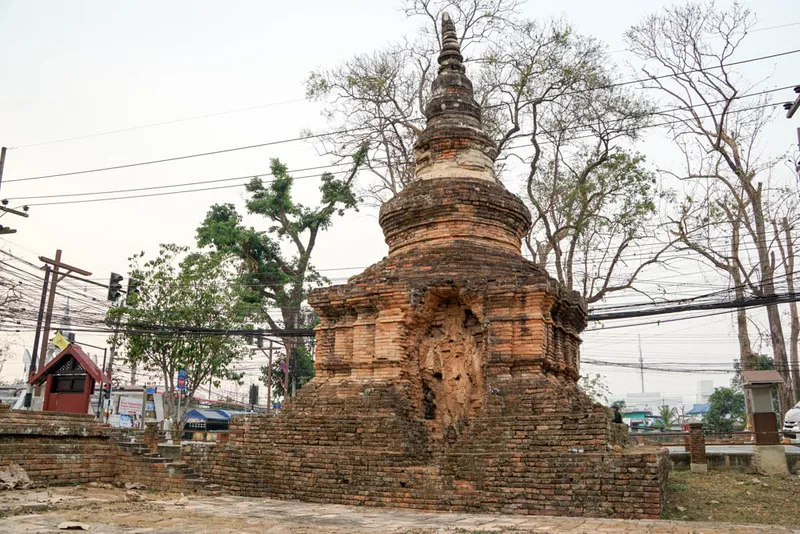
Wat Phra Buat is an important ancient monument in Chiang Saen, Chiang Rai, located directly opposite Wat Mung Mueang in Wiang Subdistrict. In the shortest possible summary, this is a Lanna-period ruined temple with strong chronicle-based historical significance and a highly interesting chedi structure, because the outer circular chedi encloses an older inner chedi. For travelers interested in old Chiang Saen, temple ruins, and northern Thai architectural history, Wat Phra Buat is one of the most rewarding stops in the ancient city.
One of the first things that makes Wat Phra Buat interesting is its setting. It stands in the middle of Chiang Saen town along Highway 1016 on the southern side of the road, with Wat Mung Mueang directly across from it. Because of this close spatial relationship, it has long been suggested that the two sites may once have formed a single temple complex. Even before looking at the architecture, the site already invites visitors to think about how the old sacred landscape of Chiang Saen may have been organized in earlier centuries.
Wat Phra Buat appears in Chronicle Collection Volume 61, which states that it was built by King Kue Na around B.E. 1889. The chronicle describes the construction of a chedi, viharn, and Buddha image called Phra Buat in the center of Chiang Saen. This is important because it links the monument directly to royal patronage in the Lanna world and shows that Chiang Saen was already a major religious and political center at that time. The site therefore carries both architectural and historical significance.
Another major historical layer comes from the Yonok Chronicle, which records that around B.E. 2260 Chiang Saen suffered a major flood, after which Wat Phra Buat subsided into the ground. This detail helps explain why the monument is remembered not only as a temple ruin, but also as a site marked by environmental change and urban transformation. In a city like Chiang Saen, with its long relationship to the Mekong basin and alluvial terrain, this kind of story is especially meaningful.
The name “Wat Phra Buat” itself is a later formal designation used when ancient monuments in Chiang Saen were systematically named. The title was taken from Chronicle Collection Volume 61. This means the modern name is part of the heritage classification process, not merely a casual local label. For cultural travelers, this adds another dimension to the site, showing how modern conservation work helps shape the way historical places are remembered and presented.
The main structures within the site are the viharn and the chedi. The viharn measures 13 metres wide and 20 metres long and faces east. Inside it is a pedestal base once used to enshrine a stucco Buddha image. These dimensions suggest that Wat Phra Buat was not a minor shrine, but a substantial religious complex. Its east-facing orientation also follows broader Buddhist planning traditions found across the region.
The most remarkable feature of Wat Phra Buat is its circular Pagan-style chedi built of brick and stucco, probably dating to around the 20th Buddhist century. What makes it especially important is that the outer chedi was built to cover an earlier inner chedi. This layered construction is archaeologically significant because it reveals more than one historical phase and allows scholars to read architectural change through the monument itself.
The outer chedi appears to have been added in the late 20th or early 21st Buddhist century. Its base consists of three square tiers, the lowest measuring 8 metres on each side, supporting two lotus-base levels in a Lanna recessed-plan form. Above that rise another three lotus-base tiers decorated with double mouldings, followed by a small circular dome, a twelve-angled square harmika, umbrella shaft, and the remaining upper elements. The finial has disappeared. These details make Wat Phra Buat an excellent place for understanding the fusion of Lanna and Pagan stylistic influences.
Inside the outer structure is the earlier inner chedi, a prasat-type monument with its relic chamber set relatively low on a short base. It has niches on all four sides containing Buddha images. This hidden inner monument is one of the most intriguing aspects of the site. The Fine Arts Department removed parts of the outer layer so that visitors can see the stucco Buddha images belonging to the earlier structure. This turns the monument into a visible lesson in historical layering rather than a single-phase ruin.
The chedi of Wat Phra Buat has also been interpreted as representing an early phase in the spread of Theravada Buddhism of the Lankan tradition from Sukhothai into the upper north, while also showing the influence of circular Pagan-style stupas. That makes the monument important not only within Chiang Saen, but in the wider story of religious and artistic exchange in mainland Southeast Asia. For travelers interested in architecture, this is exactly the kind of site that reveals how styles moved and evolved across regions.
Today the site is an abandoned ancient monument that has already been excavated, restored, and landscaped. Grass covers much of the ground, and there are informational signs for visitors. Although weeds can still appear in some areas, the overall condition allows for comfortable exploration. Because the monument is in the center of Chiang Saen, it is especially easy to include in an old-city walking, cycling, or driving route.
The atmosphere of Wat Phra Buat is quiet and understated. Unlike more prominent temple destinations, it does not overwhelm with scale. Instead, it rewards attention to structure, form, and historical context. The circular chedi, the remains of the viharn, and the relationship with Wat Mung Mueang across the road all create a distinctly archaeological experience. This is one of the reasons it appeals strongly to travelers who enjoy thoughtful cultural exploration rather than quick sightseeing.
Its location also makes it practical to visit with other major sites in Chiang Saen, including Wat Mung Mueang, Wat Chedi Luang, Chiang Saen National Museum, Wat Phra Chao Lan Thong, and Wat Pa Sak. Because distances are short, visitors can build a half-day or full-day itinerary around the old city very easily. Wat Phra Buat works particularly well as part of a route focused on temple ruins and Lanna urban history.
Getting There is very easy. The site is in Chiang Saen town on Highway 1016, directly opposite Wat Mung Mueang. Travelers arriving by private car can stop there conveniently, while those staying in the old city may also explore the area by bicycle or on foot for parts of the route. Because many Chiang Saen monuments are located close together, Wat Phra Buat fits naturally into any old-city heritage circuit.
Overall, Wat Phra Buat is one of Chiang Rai’s most rewarding lesser-known historical attractions. It combines royal Lanna history, chronicle tradition, flood memory, and unusual layered chedi architecture in one accessible place. For travelers who want a deeper understanding of Chiang Saen beyond the most famous stops, this ancient monument deserves a clear place on the itinerary.
| Name | Wat Phra Buat |
| Location | Wiang Subdistrict, Chiang Saen District, Chiang Rai |
| Address | Highway 1016, Wiang, Chiang Saen, Chiang Rai 57150, opposite Wat Mung Mueang |
| Coordinates | 20.273859, 100.082075 |
| Highlights | Ancient monument in central Chiang Saen, circular Pagan-style chedi, inner hidden chedi, large viharn remains, opposite Wat Mung Mueang |
| History | Lanna period monument attributed to King Kue Na around B.E. 1889; later said to have subsided after the great Chiang Saen flood around B.E. 2260 |
| Name Origin | The modern name was assigned later from Chronicle Collection Volume 61 during the formal naming of Chiang Saen ancient monuments |
| Distinctive Features | The site includes a 13 x 20 metre viharn and an outer circular chedi that encloses an earlier inner prasat-style chedi |
| Travel Information | Located in central Chiang Saen on Highway 1016, easy to visit by car, bicycle, or as part of an old-city temple route |
| Current Status | Restored and landscaped ancient monument open daily to visitors |
| Open Days | Every Day |
| Opening Hours | Open All Day |
| Fees | No Admission Fee |
| Main Contact Number | 053-777-081 |
| Nearby Tourist Attractions | 1) Wat Mung Mueang – about 0.1 km 2) Wat Chedi Luang Chiang Saen – about 0.3 km 3) Chiang Saen National Museum – about 0.7 km 4) Wat Phra Chao Lan Thong – about 1 km 5) Wat Pa Sak – about 1 km |
| Nearby Restaurants | 1) The Terrace Chiang Saen – about 3 km, Tel. 061-686-7773 2) Mekong Pizza – about 3 km, Tel. 083-915-4750 3) Krua Fa Mai Rim Khong – about 3 km 4) Huen Sabaidee – about 3 km 5) Le Quar Cafe Bistro Bed & Breakfast – about 4 km, Tel. 091-499-9291 |
| Nearby Accommodations | 1) Siam Triangle Hotel Chiang Saen – about 3 km, Tel. 053-651115 2) Pak-Ping-Rim-Khong Bed & Breakfast – about 3 km, Tel. 053-650151 3) One Budget Hotel Chiangsaen – about 4 km 4) A Hotel Budget Chiang Saen – about 4 km 5) Athita Hotel Chiang Saen – about 4 km |
Frequently Asked Questions (FAQ)
Q: Where is Wat Phra Buat located?
A: Wat Phra Buat is in Wiang Subdistrict, Chiang Saen District, Chiang Rai, directly opposite Wat Mung Mueang on Highway 1016.
Q: Who built Wat Phra Buat?
A: Historical chronicles attribute the temple to King Kue Na around B.E. 1889.
Q: What is the main highlight of Wat Phra Buat?
A: Its most distinctive feature is the circular Pagan-style outer chedi that encloses an earlier inner chedi.
Q: Is there an entrance fee?
A: No. Visitors can enter free of charge.
Q: Is Wat Phra Buat related to Wat Mung Mueang?
A: It has been suggested that the two monuments may once have formed a single temple complex.
Q: How long should I plan for a visit?
A: Around 20 to 40 minutes is enough for the site itself, but more time is useful if you are also exploring nearby old-city monuments.
Q: What kind of travelers will enjoy Wat Phra Buat?
A: It is especially suitable for travelers interested in Lanna history, temple ruins, archaeology, and Chiang Saen’s ancient urban landscape.
 Tel : 053650803
Category: ●Places of Worship
 Category: ●
Group: ●Temple
 Group: ●
 Last Update : 1 WeekAgo
 Click to Access the Navigation Map GPS
 Art, Culture and Heritage
 Historical Sites and Monuments(
 Landmarks and Memorials(
 Art, Craft Centres, Tradition(
 Museums(
 Historical Houses and The Ancient City(
 Educational Places
 Museum for Study(
 Library(
 Educational Gardens, Farm(
 University
 Other religious and spiritural sites(
 Research and Development
 Royal Project(
 Suburban Living
 Village, Community(
 Local Market(
 Nature and Wildlife
 National Parks and Marine Reserves(
 Mountain (Doi)(
 Dam, Reservoir, Lake(
 Waterfalls(
 Hot Springs(
 Caves(
 River, Canal(
 Sea, Beach(
 Other natural attractions(
 Entertainment and Agricultural
 Animal camps and shows(
 Farm, Parks, Gardens and Ecotourism(
 Shopping
 Shopping and Night Market(
 Call Customer Service in Tourism
 Call Customer Service in Tourism(
 Travel Articles, Recipes
 Travel Review, Food Review(
 Food Menu, North Recipes(


