
lovethailand home >North Travel Attractions >Chiang Rai Travel Attractions >Muang Chiang Rai >Wiang > Wat Ming Muang
TL;DR: Wat Ming Muang is located at 196 Trairat Road, Wiang, Mueang Chiang Rai, Chiang Rai 57000, open Daily, hours 08.00 – 16.30.

Wat Ming Muang
Open Days: Daily
Opening Hours: 08.00 – 16.30
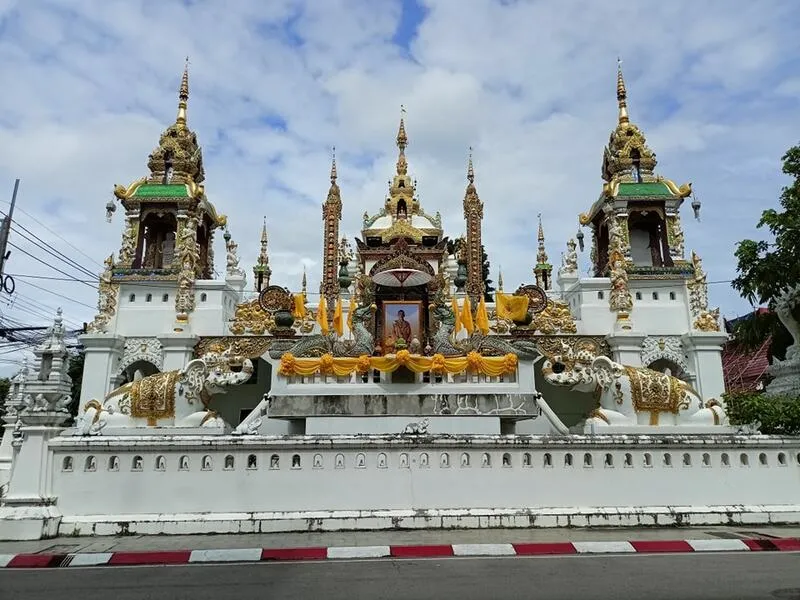
Wat Ming Mueang is one of the most historically significant temples in the heart of Chiang Rai. Located at 196 Trairat Road in Wiang Subdistrict, Mueang Chiang Rai District, the temple stands within the old urban area of the city, close to several major landmarks and historic routes. For travelers, this makes it extremely accessible. For anyone interested in Lanna history, Buddhist art, or old-city culture, it makes the temple especially rewarding. Wat Ming Mueang is not simply a beautiful temple to photograph. It is a place where history, legend, sacred architecture, and local memory continue to overlap in a very visible way.
The temple is widely known for its elegant blend of Tai Yai and Lanna artistic traditions. This mixed identity is immediately noticeable in the architecture, decorative details, and visual atmosphere of the temple grounds. Even though it is located in the city center, the interior of the temple compound feels calm and composed. Visitors entering from the surrounding streets often notice how quickly the mood changes. Traffic noise fades, the layered carvings begin to stand out, and the setting shifts from urban movement to a more reflective pace. That contrast is part of the temple’s appeal.
Wat Ming Mueang is also known by another important local name: Wat Chang Moob, which means the Temple of the Crouching Elephant. This name comes from local historical tradition linked to King Mangrai, the founder of Chiang Rai and one of the most important rulers in the history of the Lan Na Kingdom. According to long-preserved local accounts, the temple was associated with the royal elephant of King Mangrai. During important ceremonial processions involving the Emerald Buddha, a royal elephant would crouch and wait at the temple so the sacred image could be transferred in the procession route. Because of that, local people came to know the temple as Wat Chang Moob, a name that still carries strong meaning today.
The historical depth of Wat Ming Mueang goes even further. The temple is believed to be around 800 years old, roughly as old as the city of Chiang Rai itself. In earlier periods, the area around the temple was home to a Shan or Tai Yai community, and because of the Burmese-style religious art and objects found there, the temple was once called Wat Ngiao. This older identity matters because it explains why the temple still carries such a strong artistic connection to Shan and Burmese forms. Rather than being a purely Lanna temple, Wat Ming Mueang reflects the layered cultural exchanges that shaped northern Thailand over many centuries.
During restoration work on the temple’s ancient chedi and other structures, important discoveries were made. Inscriptions in old Burmese script were found on silver plates, and these inscriptions helped identify the founder of the temple. Historical research based on the inscriptions and chronicles indicates that the temple was founded by Chao Nang Tala Mae Sri, a consort of King Mangrai. She is said to have had royal lineage from Hongsawadi. This gives the temple exceptional significance because it connects the site directly to the royal world of early Chiang Rai and to broader relations between Lan Na and Burmese courts.
The temple is also associated with another important royal woman in local tradition: Uwa Ming Chom Mueang, also known in local memory as Queen Thep Kham Klai, the mother of King Mangrai. Traditions describe her as a woman of great importance who came to practice dhamma at this temple regularly. According to the temple’s own history, she came twice each year for religious ceremonies: once on the full moon of Visakha Bucha and once on the full moon associated with the Yi Peng festival. During these occasions, she would light lamps in worship of the sacred chedi. Today, this tradition contributes to the temple’s identity as a place deeply linked not only to the founding of Chiang Rai, but also to royal devotion and merit-making.
Wat Ming Mueang’s importance increased further because of its position near one of the historic gates of old Chiang Rai. The area around the temple is associated with the old city gate known by several names, including Pratu Kai Dam and Pratu Khua Dam. The crossroads nearby is still known locally as Si Yaek Khua Dam. This means the temple is not just historically old in isolation; it is part of the historic urban fabric of Chiang Rai. Travelers walking through the area are not merely visiting a single monument, but stepping into a zone where old routes, defensive structures, religious places, and community life once connected directly.
One of the most fascinating features in the temple is the old sacred well, known as Nam Bo Chang Moob. Located near the eastern gate of the temple, the well is designed in a Tai Yai style and covered with a decorative structure featuring crouching elephant figures. In the past, this well served people entering and leaving the city. Travelers would stop there to drink water, wash their faces, and prepare themselves before moving onward. Because of this, the well has both practical and symbolic importance. It was part of everyday life, but it was also believed to be auspicious. For modern visitors, it is one of the clearest surviving elements that connects the temple to the rhythms of the old city.
The principal Buddha image of the temple is Luang Por Phra Si Ming Mueang. This image is a lacquered and gilded Chiang Saen Singha 1 style Buddha with a long restoration history and an age of more than 400 years. The image is especially admired for its refined form and for the lotus-bud finial carved from a local Lanna stone known as kaew pong kham. For travelers interested in Buddhist art, this is one of the temple’s key highlights. It combines religious importance with strong art-historical value.
The main chedi of the temple, known as Phra That Ming Mueang, is another highly significant monument. Before restoration, the structure reflected a more fully Burmese form, but later restoration brought it back into balance with Lanna principles while retaining Burmese-style umbrella details. This makes the chedi a strong visual symbol of the temple’s dual heritage. It is not simply decorative. It embodies the temple’s long story of cultural interaction, adaptation, and preservation.
The viharn is equally memorable. It is essentially a Tai Yai hall adapted with Lanna influences, richly decorated with gold-on-lacquer carvings, cosmological ceiling motifs, and a remarkable series of hamsa forms. Visitors who enjoy architectural detail will find a lot to study here. Even those without specialist knowledge usually notice that the temple’s beauty comes not from scale alone, but from refinement. Wat Ming Mueang is a temple of detail, proportion, and atmosphere.
For travelers exploring central Chiang Rai, the temple works especially well because of its location. Wat Phra Kaew is very close, the Chiang Rai Clock Tower is nearby, and several other old-city temples and museums can easily be added to the same route. This makes Wat Ming Mueang an ideal stop on a walking or short-drive heritage circuit. It is suitable for visitors with limited time, but it is even better for those willing to slow down and read the temple more carefully.
Another reason the temple stands out is that it still functions as a living religious space rather than only as a preserved historical attraction. Devotees continue to come for worship, merit-making, and reverence toward the Buddha image and relics. Current public information also identifies the abbot as Phra Kru Sophon Silpakom, which reflects the continuity of temple administration into the present. This active religious role gives the site greater authenticity for visitors, because what they encounter is not a disconnected monument but a place that still matters in everyday religious life.
Getting There Wat Ming Mueang is very easy to reach. It is located on Trairat Road in the old center of Chiang Rai, close to the Khua Dam intersection and not far from the Chiang Rai Clock Tower. By car or local transport, the trip from the Clock Tower usually takes only a few minutes. On foot, it is also manageable for travelers exploring the city center. Because of this convenience, the temple is especially suitable for half-day city itineraries, temple walks, or short cultural routes through Chiang Rai.
The official public tourism information currently indicates that the temple is open daily from 08.00 to 16.30 and that admission is free. This makes it accessible to all types of visitors, including families, independent travelers, and those exploring the city on a flexible schedule. The publicly listed contact number currently associated with the temple is 053-716960, which is useful for visitors who prefer to confirm details in advance.
Wat Ming Mueang is therefore much more than just another city temple. It is a historical temple tied to the origins of Chiang Rai, a place shaped by Tai Yai and Lanna art, a site connected to the memory of King Mangrai, a temple with an ancient sacred well, and a beautifully preserved stop within the old city. Travelers who want a richer understanding of Chiang Rai should not overlook it. It offers beauty, history, atmosphere, and accessibility in one place.
| Name | Wat Ming Mueang |
| Summary | An ancient temple in central Chiang Rai, around 800 years old, known for its Tai Yai and Lanna architecture, Phra That Ming Mueang, the sacred old well, and strong links to the history of King Mangrai and old Chiang Rai |
| Location | 196 Trairat Road, Wiang, Mueang Chiang Rai, Chiang Rai 57000 |
| Highlights | Lacquered wooden viharn, Luang Por Phra Si Ming Mueang, Phra That Ming Mueang, Nam Bo Chang Moob, Tai Yai and Lanna artistic details |
| History | An ancient temple believed to be as old as Chiang Rai itself, linked to Chao Nang Tala Mae Sri, King Mangrai, and the old city traditions of Chiang Rai |
| Name Origin | Also known as Wat Chang Moob, or the Temple of the Crouching Elephant, from the local tradition of the royal elephant waiting there during sacred processions |
| Distinctive Features | A central Chiang Rai temple where Burmese-Shan and Lanna traditions meet, with relics, historic architecture, and an ancient sacred well |
| Travel Information | Located in the old city center of Chiang Rai, close to the Clock Tower and easy to reach by car, local transport, or walking |
| Current Status | Open for worship and visits |
| Open Days | Daily |
| Opening Hours | 08.00 – 16.30 |
| Fees | Free admission |
| Latest Abbot | Phra Kru Sophon Silpakom |
| Main Contact Number | 053-716960 |
| Nearby Tourist Attractions | 1. Wat Phra Kaew Chiang Rai 0.3 km 2. Wat Phra Singh Chiang Rai 0.7 km 3. Chiang Rai Clock Tower 0.8 km 4. Wat Klang Wiang 0.9 km 5. Hilltribe Museum 1.4 km |
| Nearby Restaurants | 1. EAT KUNDA 0.1 km 2. Barrab Restaurant 0.8 km โทร. 094-812-6670 3. Chivit Thamma Da 2.1 km โทร. 081-984-2925 4. Melt In Your Mouth 2.3 km โทร. 062-023-0549 5. Lu Lum Chiang Rai 2.6 km โทร. 053-748-223 |
| Nearby Accommodations | 1. Sooknirund Hotel 0.5 km โทร. 053-798-788 2. Hi Chiangrai Hotel 0.8 km โทร. 053-716-699 3. Wiang Inn Hotel 0.9 km โทร. 053-711-533 4. Nak Nakara Hotel 1.2 km โทร. 053-717-700 5. The Riverie by Katathani 2.1 km โทร. 053-607-999 |
Frequently Asked Questions (FAQ)
Q: Where is Wat Ming Mueang located?
A: It is located at 196 Trairat Road in Wiang Subdistrict, Mueang Chiang Rai District, in the old center of Chiang Rai.
Q: What is Wat Ming Mueang known for?
A: It is known for its ancient history, Tai Yai and Lanna architecture, Phra That Ming Mueang, Luang Por Phra Si Ming Mueang, and the sacred old well called Nam Bo Chang Moob.
Q: Why is it also called Wat Chang Moob?
A: The name comes from the local tradition that a royal elephant once crouched at the temple while waiting for a sacred procession involving the Emerald Buddha.
Q: Is there an entrance fee?
A: No. Admission is free.
Q: Is Wat Ming Mueang easy to visit from central Chiang Rai?
A: Yes. It is very close to the Chiang Rai Clock Tower and other old-city attractions, so it fits easily into a central Chiang Rai walking or short-drive itinerary.
Q: What time should visitors go?
A: Morning and late afternoon are especially pleasant because the weather is softer and the light makes the temple’s woodwork and gold details look especially beautiful.
Tel : 053711089
 Tel : 053711089
 Category: ●Places of Worship
 Group: ●Temple
Last Update : 5 MonthAgo
 Last Update : 5 MonthAgo
 Click to Access the Navigation Map GPS
Wat Ming Muang Map
Recommend

 Art, Culture and Heritage
 Historical Sites and Monuments(3)
 Landmarks and Memorials(7)
 Art, Craft Centres, Tradition(6)
 Museums(8)
 Historic Homes and Cities(1)
 Educational Places
 Museum for Study(1)
 Library(1)
 Educational Gardens, Farm(3)
Temple(38)
Educational Gardens, Farm(3)
Temple(38)
 Other Sacred Sites(5)
 Research and Development
 Royal Project(9)
 Suburban Living
 Village, Community(16)
 Local Market(5)
 Nature and Wildlife
 National Parks and Marine Reserves(18)
 Mountain (Doi)(20)
 Dam, Reservoir, Lake(8)
 Waterfalls(16)
 Hot Springs(6)
 Caves(8)
 River, Canal(10)
 Sea, Beach(1)
 Other natural attractions(3)
 Entertainment and Agricultural
 Animal camps and shows(1)
 Farms, Parks and Ecotourism(9)
 Shopping
 Shopping and Night Market(2)
 Call Customer Service in Tourism
 Call Customer Service in Tourism(1)
 Travel Articles, Recipes
 Travel Review, Food Review(1)
 Food Menu, North Recipes(1)


