
TL;DR: Wat Phra That Doi Khao Kwai Kaew is located at Doi Khao Kwai, Rob Wiang, Mueang Chiang Rai, Chiang Rai, open Daily, hours 05:00 – 19:30.
Wat Phra That Doi Khao Kwai Kaew
Open Days: Daily
Opening Hours: 05:00 – 19:30
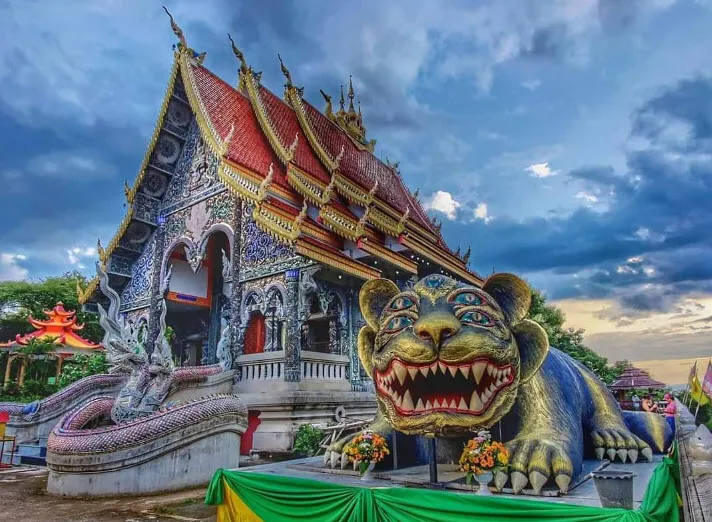
Wat Phra That Doi Khao Kwai Kaew is one of Chiang Rai’s most distinctive temples because it brings together several layers of meaning in a single place. It is an old sacred site, a hilltop viewpoint overlooking the city, and a temple closely tied to northern Thai folklore, especially the legend of the Four-Eared, Five-Eyed creature and the story of the White Crystal-Horned Buffalo. For travelers, this means the visit is not only about sightseeing. It is also about understanding how local faith, Lanna storytelling, and the landscape of Chiang Rai have been woven together for centuries.
The temple stands on Doi Khao Kwai in Rob Wiang Subdistrict, Mueang Chiang Rai District, not far from the city center. That location is part of what makes it so appealing. It feels elevated, calm, and removed from the busy town below, yet it is still easy to reach. Once you arrive at the upper temple grounds, the atmosphere changes immediately. The air feels more open, the surroundings are quieter, and the view stretches across Chiang Rai in a way that gives the place a strong sense of stillness. Many visitors come here to pay respect to the relic, ask for blessings, and enjoy the panorama in the same trip.
According to local tradition, the temple is more than 1,000 years old. The story most often associated with its foundation says that Phaya Dhammikarat, a ruler connected with ancient Chiang Rai, had the temple built after receiving sacred relics brought by monks who came to spread Buddhism in the Lanna region. The relic enshrined here is believed in local tradition to be part of the Buddha’s left little finger and wrist area. Because of that belief, the stupa became a highly respected place of worship and has remained important to local devotees ever since. Even for visitors who come mainly for the view or the folklore, this religious dimension is central to the identity of the site.
One of the temple’s strongest cultural associations is the legend of the Four-Eared, Five-Eyed creature, known in Thai as “Maeng Si Hu Ha Ta.” In northern folklore, this mysterious being is said to eat burning charcoal and excrete gold, which is why it became connected with abundance, prosperity, and good fortune. At the temple, this legend is not treated as a distant myth. It remains part of the living devotional atmosphere. Visitors often stop to pay respect, make offerings, and pray for success in work, finances, and personal life. This is one reason the temple continues to attract both traditional worshippers and newer spiritual travelers interested in Chiang Rai’s sacred culture.
The other important legend linked to the temple is that of the White Buffalo with crystal-like horns, which helps explain the name “Doi Khao Kwai Kaew.” In local storytelling, the hill and its sacred identity became associated with a miraculous buffalo whose horn was discovered and regarded as something extraordinary. These stories are not simply decorative folklore added afterward. They shape the way people interpret the temple today. The place is seen not only as a Buddhist site but also as a cultural landscape where local memory, myth, and spiritual symbolism remain visible.
Architecturally, the main stupa reflects the Lanna artistic world. The present form shows the result of repeated restoration across different periods, so what visitors see today is both historical and devotional. The temple grounds are not vast, but that works to their advantage. The important areas feel close together and easy to explore at a slow pace. The stupa, the prayer points related to the Four-Eared, Five-Eyed legend, and the open terrace-like areas for taking in the city view all contribute to a visit that feels compact yet meaningful. Rather than rushing through the site, it is best experienced gradually.
The temple is also connected with an annual water-pouring ceremony for the stupa during the full moon of the 8th northern lunar month, which corresponds to Visakha Bucha. This tradition shows that Wat Phra That Doi Khao Kwai Kaew is still part of Chiang Rai’s living ritual calendar. During such occasions, the atmosphere becomes especially meaningful because the temple is experienced not just as a scenic place, but as a center of community faith. Travelers interested in cultural tourism often find this dimension particularly valuable, since it reveals how religious practice continues to shape the life of the site.
The hilltop viewpoint is another major reason to visit. From the temple grounds, you can look out over Chiang Rai in broad, open layers. During the day, the landscape feels expansive and airy. In the late afternoon, the softer light makes the city below appear calmer and more photogenic. After sunset, the urban lights begin to glow, creating a very different mood from the daytime scene. Because of this, the best visiting time depends on your purpose. Early morning suits those who want quiet and a devotional atmosphere, while late afternoon is ideal for photography and city views.
Getting to the temple is relatively straightforward if you are staying in Chiang Rai city. The site is close enough to the center to make a short side trip, but the final approach goes uphill. A private car or hired vehicle is the most convenient option. The road is drivable, yet some sections are steep, so careful driving is important. Large buses are not recommended for the climb. Travelers without their own vehicle can hire a local car or ride service from the city and arrange the return trip in advance, since this is not an area with constant public transport passing by throughout the day.
As with any active temple, modest clothing and respectful behavior are appropriate. Even though Wat Phra That Doi Khao Kwai Kaew has become known for its legends and for wish-making related to prosperity, the core identity of the place remains that of a sacred Buddhist temple with long-standing importance to local people. Visitors who take time to appreciate both the spiritual and cultural layers of the site usually come away with a richer impression. For anyone looking for a Chiang Rai temple that combines history, folklore, city views, and a strong sense of local faith, this is one of the most rewarding places to include in an itinerary.
| Name | Wat Phra That Doi Khao Kwai Kaew |
| Location | Doi Khao Kwai, Rob Wiang, Mueang Chiang Rai, Chiang Rai |
| Address | 690 Moo 24, Doi Khao Kwai Road, Rob Wiang, Mueang Chiang Rai, Chiang Rai 57000 |
| Coordinates | 19.885833, 99.810500 |
| Highlights | Sacred Buddhist relic, Four-Eared Five-Eyed legend, panoramic Chiang Rai city view, hilltop temple atmosphere near the city center |
| History | Ancient temple with a local history of around 1,000 years, traditionally associated with Phaya Dhammikarat and later restorations in subsequent periods |
| Name Origin | Linked to the legend of the White Crystal-Horned Buffalo and the sacred hill known as Doi Khao Kwai Kaew |
| Distinctive Features | Lanna-style stupa, sacred folklore, city viewpoint, living spiritual atmosphere |
| Travel Information | Best reached by private car or hired vehicle from Chiang Rai city. The hill road is relatively steep, so careful driving is recommended. Large vehicles are not suitable for the final ascent. |
| Current Status | Open for worship and cultural visits |
| Open Days | Daily |
| Opening Hours | 05:00 – 19:30 |
| Fees | No admission fee |
| Facilities | Temple grounds, parking area, viewpoint, worship areas |
| Main Areas / Zones | Main stupa, Four-Eared Five-Eyed worship point, viewpoint terrace, temple grounds on the hilltop |
| Abbot / Caretaker | Phra Khru Suman Chediyarak (Kruba Sanong Sumano) |
| Main Contact Number | 095-146-4650 |
| Official Website / Official Page | Facebook: Wat Phra That Doi Khao Kwai / Si Hu Ha Ta Wat Phra That Doi Khao Kwai Kaew Chiang Rai |
| Nearby Tourist Attractions | 1) Den Ha Fresh Market, around 3 km 2) Wat Chetupon, around 3 km 3) Central Chiang Rai, around 3 km 4) Wat Chiang Yuen, around 3 km 5) Chiang Rai Walking Street, around 5 km |
| Nearby Restaurants | 1) Krua Aroi Yaek Doi Khao Kwai, around 1 km, Tel. 095-049-1556 2) Krua Ratree, around 2 km, Tel. 098-376-1154 3) Tossakan Yum Raberd, around 2 km, Tel. 061-321-3419 4) Somtam Puang (Tam Pai Rueai), around 2 km, Tel. 096-307-5052 5) Lu Lum Rob Wiang, around 5 km, Tel. 053-748-223 |
| Nearby Accommodations | 1) Central Guesthouse Chiang Rai, around 1 km, Tel. 06-5523-6066 2) La Maison Blanche Chiang Rai, around 1 km, Tel. 090-974-1499 3) Thanya Baan Bon Doi, around 1 km, Tel. 089-555-9946, 088-985-2027 4) Chom Chiangrai Hotel, around 2 km, Tel. 098-724-6987, 082-424-1964, 053-602-642 5) Pan Kled Villa Eco Hill Resort, around 2 km, Tel. 053-717-552, 053-718-288 |
Frequently Asked Questions (FAQ)
Q: Is Wat Phra That Doi Khao Kwai Kaew far from Chiang Rai city?
A: No. It is quite close to the city center and can be visited conveniently by private car or hired transport.
Q: What is the main highlight of the temple?
A: Its main highlights are the sacred relic, the Four-Eared Five-Eyed legend, and the panoramic city view from the hilltop.
Q: Is there an entrance fee?
A: No. Visitors can enter, worship, and enjoy the atmosphere without an admission fee.
Q: What is the best time to visit?
A: Morning is ideal for a quiet spiritual atmosphere, while late afternoon is excellent for views and photography.
Q: Can large vehicles go all the way up to the temple?
A: The uphill road is not suitable for large vehicles. Small cars and standard private vehicles are a much better choice.
Q: Why is the temple associated with the Four-Eared Five-Eyed legend?
A: The temple is one of the important sacred places linked to this well-known Lanna legend, which is associated with prosperity, abundance, and blessings.
Category: ●Places of Worship
 Category: ●
Group: ●Temple
 Group: ●
 Last Update : 6 DayAgo
 Click to Access the Navigation Map GPS
 Art, Culture and Heritage
 Historical Sites and Monuments(
 Landmarks and Memorials(
 Art, Craft Centres, Tradition(
 Museums(
 Historical Houses and The Ancient City(
 Educational Places
 Museum for Study(
 Library(
 Educational Gardens, Farm(
 University
 Other religious and spiritural sites(
 Research and Development
 Royal Project(
 Suburban Living
 Village, Community(
 Local Market(
 Nature and Wildlife
 National Parks and Marine Reserves(
 Mountain (Doi)(
 Dam, Reservoir, Lake(
 Waterfalls(
 Hot Springs(
 Caves(
 River, Canal(
 Sea, Beach(
 Other natural attractions(
 Entertainment and Agricultural
 Animal camps and shows(
 Farm, Parks, Gardens and Ecotourism(
 Shopping
 Shopping and Night Market(
 Call Customer Service in Tourism
 Call Customer Service in Tourism(
 Travel Articles, Recipes
 Travel Review, Food Review(
 Food Menu, North Recipes(


