
lovethailand home >North Travel Attractions >Chiang Rai Travel Attractions >Wiang Kaen >Muang Yai > Buffalo Blessing Ceremony
TL;DR: Buffalo Blessing Ceremony, Chiang Rai attractions : Art, Culture and Heritage, Art, Craft Centres, Tradition.
Buffalo Blessing Ceremony
Open Days: Held seasonally after the rice-growing period, depending on each host community in Wiang Kaen District
Opening Hours: Ceremony time depends on the local host community, usually after the animals and ritual items are prepared
The Buffalo Blessing Ceremony, known locally in northern Thailand as Hong Khwan Khwai, is one of the most meaningful agrarian traditions in Wiang Kaen District, Chiang Rai. It reflects the deep bond between farming communities and the buffaloes that once served as the main force behind ploughing, rice cultivation, and seasonal agricultural labor. In a district shaped by rice fields, mountain landscapes, and long-standing village traditions, this ritual preserves a worldview in which animals are not treated as mere working property, but as living beings worthy of gratitude and respect.
The saying that “where there is a rice field, there must be buffalo; where there are buffalo, there is rice” captures the essence of this relationship. For generations, buffaloes helped farmers plough the land, prepare the soil, and make farming more efficient. Because of that, villagers did not see buffaloes only as labor animals. They regarded them as benefactors of the household. The Buffalo Blessing Ceremony emerged from this understanding. Once the farming season ended, families held a ritual to thank the animals, ask forgiveness for any pain or hardship caused during work, and symbolically restore the animals’ wellbeing.
In Wiang Kaen, the tradition is deeply rooted in old agricultural culture. Before animal labor became common, farming relied much more heavily on hand tools and human effort. When buffaloes were introduced into ploughing and rice production, they transformed the speed and efficiency of farming. The animals became indispensable to village life. Over time, this practical dependence evolved into a moral relationship, and the blessing ritual became a cultural expression of gratitude, compassion, and accountability.
What makes the ceremony especially distinctive is the belief that buffaloes possess “khwan,” or spiritual vitality, just as humans do. Villagers traditionally believe that a buffalo’s khwan can weaken, become disturbed, or even leave after hard labor, fear, or exhaustion. The ceremony is therefore a way of calling the animal’s khwan back, restoring balance and strength. In local belief, buffaloes are said to have roughly 10–12 points of khwan on the body, and because they work hard and have rough, thick hair, their khwan is thought to be easily unsettled.
The ritual is also an act of apology. Farmers acknowledge that during the ploughing season they may have scolded, pushed, or struck the animals while trying to complete agricultural work. The ceremony provides a formal and emotional way to ask forgiveness. This is why the tradition is more than a charming rural custom. It is an ethical practice that teaches gratitude toward those who provide labor and reminds people of their responsibility toward animals that sustain human life.
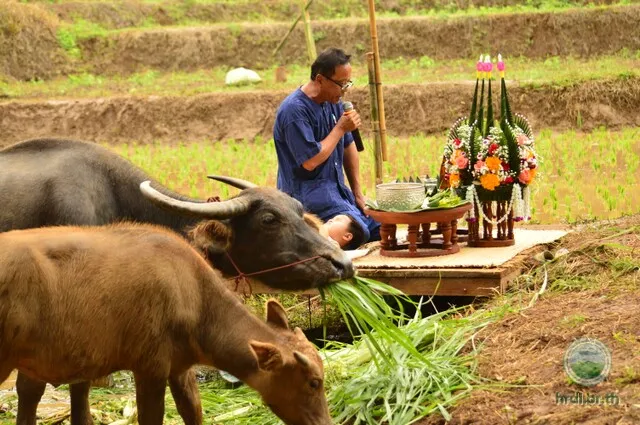
The sequence of the ceremony is simple but full of symbolic meaning. Ritual offerings are prepared, including a bai sri arrangement, flowers, candles, thread for tying to the buffalo’s horns, fresh grass, sticky rice, boiled chicken, liquor, local sweets, and herbal water made from turmeric and som poi. These offerings are placed near the buffalo pen or ritual area. The owner then bathes the buffalo, cleans it carefully, and ties it gently to a post or prepared place for the blessing.
After that, a ritual specialist or respected elder — often called a village teacher or ceremonial guide — performs the blessing. The ritual includes chanting, calling back the buffalo’s khwan, removing misfortune, and asking that the animal remain healthy, peaceful, and protected from illness. A sacred thread is tied to the buffalo’s horns, and turmeric-som poi water is sprinkled over the body as part of the blessing. The ceremony ends by feeding the buffalo fresh grass as a reward and a final act of appreciation. This final moment is especially meaningful because it shows that the ritual is not only symbolic; it includes real care.
From an ethical perspective, the tradition highlights three core values. First is gratitude: farmers remember that the buffalo helped produce food and sustain the household. Second is compassion: the washing, decorating, blessing, and feeding of the buffalo show emotional care and respect. Third is remorse: the ritual openly acknowledges that the animal may have been made to suffer through hard work. Few agricultural traditions express these values so directly and so beautifully.
Although modern agricultural technology has reduced the role of buffaloes in many areas, the ceremony still matters today. In Wiang Kaen, it survives as a reminder of an older relationship between people, land, and animals. Even where buffaloes are no longer the main source of labor, the ceremony continues to hold cultural value because it preserves an ethic of care and gratitude that communities still want younger generations to understand. In that sense, the ceremony remains highly relevant in the present.
For cultural travellers, this tradition offers a very different kind of experience from large-scale festivals or performance-oriented events. It is intimate, grounded, and closely tied to daily village life. It reveals northern Thai culture not through spectacle, but through moral meaning, ritual practice, and the small details of farming life. Visitors who want to understand Chiang Rai beyond scenic viewpoints and mainstream attractions will find this tradition especially powerful.
The ceremony also reflects the communal nature of Wiang Kaen’s rural culture. It is not only the concern of one family. Elders, ritual leaders, neighbors, and household members may all be involved in preparing offerings, arranging the ritual, and preserving the tradition. That shared participation reinforces the social fabric of the community. The ritual therefore blesses not only the buffalo, but also the relationship between people in the village.
Wiang Kaen itself is an excellent setting for this cultural understanding. The district is known for its mountain scenery and highland attractions such as Phu Chi Fa, Doi Pha Tang, Phu Chi Dao, Doi Pha Mon, and Kaeng Pha Dai. Learning about the Buffalo Blessing Ceremony while travelling through these landscapes allows visitors to connect the natural beauty of the district with the agricultural life and cultural memory that shaped it. This makes a trip to Wiang Kaen much richer and more human.
Seen through a modern lens, the Buffalo Blessing Ceremony is also an important reminder of respectful coexistence between humans and other living beings. It teaches that labor should not be taken for granted and that gratitude should be expressed, not only felt. This is one reason the tradition still resonates even in a world where machinery increasingly replaces animal power. The values behind the ritual remain timeless.
For that reason, the Buffalo Blessing Ceremony of Wiang Kaen should be understood as both cultural heritage and a moral lesson. It teaches people to remember those who help them, to apologize when they have caused suffering, and to value the unseen labor behind everyday food and survival. If younger generations continue to learn from it, the ritual will remain alive not merely as folklore, but as a meaningful part of Thailand’s living rural culture.
Getting There To explore the cultural and agricultural life of Wiang Kaen District, travellers can drive from Chiang Rai city via Chiang Khong or Thoeng into Wiang Kaen. The district is connected to several major natural attractions, including Phu Chi Fa and Doi Pha Tang. Because the Buffalo Blessing Ceremony is not a fixed daily attraction, visitors who wish to witness or study it directly should contact local administrative or cultural offices in advance for timing and community coordination.
| Name | Buffalo Blessing Ceremony (Hong Khwan Khwai) |
| Location | Agricultural communities in Wiang Kaen District, Chiang Rai |
| Overview | A traditional post-harvest ritual in which farmers thank buffaloes, ask forgiveness, and call back the animals’ spiritual vitality after hard agricultural work |
| Highlights | Buffalo bathing, ritual thread tying, khwan-calling rite, herbal water sprinkling, and feeding fresh grass as a reward |
| History | A long-standing agricultural tradition that developed when buffaloes became central to ploughing and rice farming in northern rural communities |
| Name Origin | “Su Khwan” or “Hong Khwan” refers to calling the buffalo’s khwan or spiritual vitality back into a state of balance, health, and auspiciousness |
| Distinctive Features | Reflects gratitude, compassion, and remorse toward buffaloes as vital partners in traditional farming life |
| Travel Information | Reach Wiang Kaen from Chiang Rai via Chiang Khong or Thoeng; visitors should coordinate in advance with local offices because this is a seasonal community tradition, not a daily staged attraction |
| Current Status | Still recorded and preserved as a living agricultural and cultural ritual in northern Thailand |
| Open Days | Seasonal, after the rice-growing period |
| Opening Hours | Depends on the host community’s ceremony schedule |
| Facilities | Usually held in village ritual spaces, buffalo pens, or agricultural household areas depending on the host community |
| Main Areas / Zones | Buffalo pen area, bai sri preparation area, sacred thread and blessing space, post-ritual feeding area |
| Caretaker | Agricultural communities in Wiang Kaen together with local ritual elders and district cultural offices |
| Main Contact Number | Wiang Kaen District Office 053-608219, 053-608220, Por SAO 053-602742, 093-1401193, Chiang Rai Provincial Cultural Office 053-150169 |
| Official Website / Official Page | Por Subdistrict Administrative Organisation, Chiang Rai Provincial Cultural Office, Wiang Kaen District Office |
| Nearby Tourist Attractions | 1. Phu Chi Fa 28 km 2. Doi Pha Tang 32 km 3. Kaeng Pha Dai 18 km 4. Phu Chi Dao 35 km 5. Doi Pha Mon 39 km |
| Nearby Restaurants | 1. Wiang Kaen Station 2 km 2. Caffa Roasting House 3 km Tel. 053-160968, 082-6941465 3. Poonpoon Made-to-Order Restaurant 2 km Tel. 097-947-8779 4. Phasuk Restaurant, Pha Tang 32 km Tel. 081-7840117, 062-5823259 5. Chic Cafe 3 km Tel. 095-772-0896 |
| Nearby Accommodations | 1. Baan Romfah 26 km Tel. 088-9386330, 089-8355187 2. Baan Rabiangfah 26 km Tel. 081-8855721, 089-8768565 3. Pha Tang Phumhok Resort 32 km Tel. 091-8242266 4. Pha Tang Hill Resort 32 km Tel. 083-7824433 5. Rai Phu Fah, Phu Chi Fa 27 km Tel. 081-8165452, 087-8166262 |
Frequently Asked Questions (FAQ)
Q: What is the Buffalo Blessing Ceremony?
A: It is a traditional post-harvest ritual in which farmers thank buffaloes, ask forgiveness, and restore the animals’ spiritual balance after a season of agricultural labor.
Q: Why are buffaloes so important in Wiang Kaen’s tradition?
A: Buffaloes were once the main source of labor for ploughing and rice cultivation, so villagers regarded them as animals of great value and gratitude.
Q: When is the ceremony usually held?
A: It is usually performed after the farming season, and recent cultural explanations link it to the 9th month of the northern lunar calendar after harvest.
Q: What happens during the ritual?
A: The buffalo is bathed, tied for the blessing, honored with offerings, called back spiritually through ritual, sprinkled with herbal water, and finally rewarded with fresh grass.
Q: What values does this tradition represent?
A: It reflects gratitude, compassion, and remorse toward animals that helped support farming households.
Q: Can tourists attend the ceremony?
A: Yes, but it is best to coordinate with local offices or communities in advance because this is not a fixed daily attraction.
Q: What can travellers visit after exploring this cultural theme in Wiang Kaen?
A: Nearby highlights include Phu Chi Fa, Doi Pha Tang, Kaeng Pha Dai, Phu Chi Dao, and Doi Pha Mon.
 Category: ●Art, Culture and Heritage
 Group: ●Art, Craft Centres, Tradition
Last Update : 2 MonthAgo
 Last Update : 2 MonthAgo
 Historical Sites and Monuments(3)
 Landmarks and Memorials(7)
Art, Craft Centres, Tradition(6)
Landmarks and Memorials(7)
Art, Craft Centres, Tradition(6)
 Museums(8)
 Historical Houses and The Ancient City(1)
 Educational Places
 Museum for Study(1)
 Library(1)
 Educational Gardens, Farm(3)
 Places of Worship
 Temple(38)
 Other religious and spiritural sites(5)
 Research and Development
 Royal Project(9)
 Suburban Living
 Village, Community(16)
 Local Market(5)
 Nature and Wildlife
 National Parks and Marine Reserves(18)
 Mountain (Doi)(20)
 Dam, Reservoir, Lake(8)
 Waterfalls(16)
 Hot Springs(6)
 Caves(8)
 River, Canal(10)
 Sea, Beach(1)
 Other natural attractions(3)
 Entertainment and Agricultural
 Animal camps and shows(1)
 Farm, Parks, Gardens and Ecotourism(9)
 Shopping
 Shopping and Night Market(2)
 Call Customer Service in Tourism
 Call Customer Service in Tourism(1)
 Travel Articles, Recipes
 Travel Review, Food Review(1)
 Food Menu, North Recipes(1)


