
lovethailand home >North Travel Attractions >Kamphaeng Phet Travel Attractions >Muang Kamphaeng Phet >Nakhon Chum > Nop Phra Len Phleng Festival
TL;DR: Nop Phra Len Phleng Festival, open Held annually around the full moon of the 3rd lunar month, or Makha Bucha Day, hours Varies by daily program and activity schedule.
Nop Phra Len Phleng Festival
Open Days: Held annually around the full moon of the 3rd lunar month, or Makha Bucha Day; in 2026, the festival is scheduled for 27 February – 8 March 2026
Opening Hours: Varies by daily program and activity schedule
Nop Phra Len Phleng Festival in Kamphaeng Phet is one of the province’s most meaningful cultural traditions, rooted in the Buddhist faith and historical memory of the Sukhothai period. The festival is held around the full moon of the 3rd lunar month, or Makha Bucha Day, with Wat Phra Borommathat, a royal temple in Nakhon Chum, serving as the spiritual center of the tradition. For visitors, this is not just a provincial fair. It is a living cultural event where Buddhist devotion, ancient city history, local music, traditional processions, community markets, and festive performances come together in one experience.
The name of the festival combines two important ideas. “Nop Phra” means paying deep respect to a sacred Buddhist relic, while “Len Phleng” refers to folk singing, musical play, and traditional entertainment. Together, the name reflects the character of the event: people first gather to worship the Buddha’s relics and make merit, then celebrate through song, performance, and communal festivity. This combination gives the festival a rare balance of solemnity and joy, making it one of the most distinctive cultural events in northern lower Thailand.
The historical background of Nop Phra Len Phleng is closely associated with King Lithai, also known as Phra Maha Thammaracha I of Sukhothai. He is remembered as a ruler who strongly supported Buddhism and played an important role in the development of Nakhon Chum. According to local historical tradition, sacred relics from Sri Lanka were enshrined at Wat Phra Borommathat, together with a Bodhi tree connected to the Buddhist world. This made the temple a highly revered spiritual site. The act of traveling to worship the relics was therefore more than a local religious practice; it connected Kamphaeng Phet to the wider Buddhist world and to the cultural legacy of Sukhothai.
In earlier times, when the full moon of the 3rd lunar month arrived, rulers, city officials, villagers, and communities from surrounding areas would travel in ceremonial processions to worship the relics at Nakhon Chum. These journeys were not easy. People traveled on foot or by traditional means such as elephants, horses, ox carts, and other local transport. They brought offerings, dressed according to their roles and status, and moved together as a collective act of faith. After making merit and paying respect at the temple, many stayed overnight. As people gathered from different communities, folk music, singing contests, and local performances naturally followed. This is how worship and celebration became inseparable parts of the same tradition.
The festival is important because it keeps alive the cultural memory of Kamphaeng Phet as an ancient city linked to Nakhon Chum, Chakangrao, and the Sukhothai cultural sphere. Kamphaeng Phet is not merely a stop along the Ping River; it is a historic city with old temples, inscriptions, fortifications, sacred sites, and a deep Buddhist heritage. Nop Phra Len Phleng helps younger generations understand that their province has a long and meaningful past. Instead of presenting history only through books or museum displays, the festival transforms history into a public experience through processions, costumes, music, rituals, and real historic spaces.
The modern revival of Nop Phra Len Phleng began in 1983, when Kamphaeng Phet Province restored the tradition as an annual provincial event. The revived festival included a simulated royal-style procession, worship at the Phra Borommathat Chedi, candlelight activities, folk performances, and local cultural displays. This revival was significant because it allowed a tradition with ancient roots to return to public life. Today, local authorities, temples, schools, cultural groups, performers, community organizations, and residents all take part in preserving and presenting the festival to new generations and visitors.
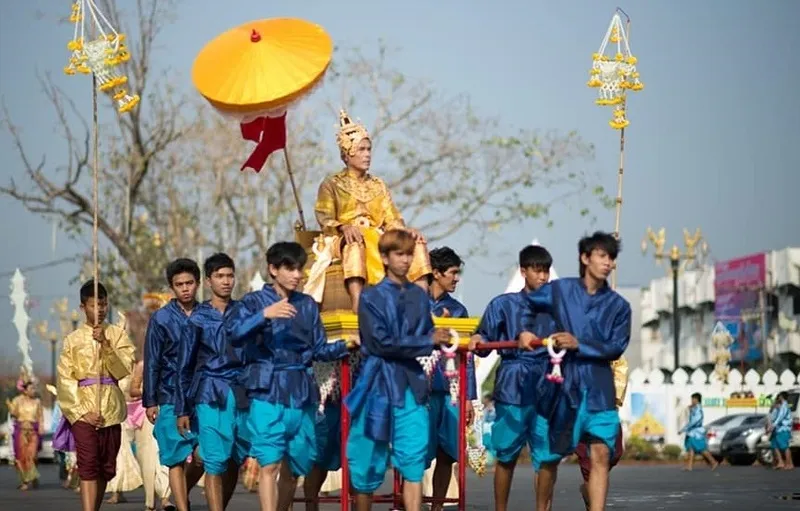
The religious and ceremonial aspects of the festival usually begin with rituals honoring sacred figures and historical rulers, especially King Lithai. These rites create an auspicious opening for the festival and remind participants of the deep connection between Buddhism and the history of Kamphaeng Phet. The ceremonial procession is one of the major highlights. It recreates the atmosphere of an ancient journey to worship the relics, with participants wearing traditional clothing and carrying symbolic offerings. When the procession moves through the city and toward sacred sites, visitors can see local history presented in a vivid, accessible, and memorable form.
Another major highlight is the light-and-sound performance that tells the story of Kamphaeng Phet’s history. These performances use music, lighting, narration, costumes, and historic settings to bring the past to life. For travelers unfamiliar with the province, the show is an excellent way to understand the historical importance of the area before visiting its ancient temples and ruins. It turns historical information into an emotional and visual experience, helping visitors connect more deeply with the old city, the Ping River, and the spiritual landscape of Nakhon Chum.
The “Len Phleng” element is equally important. Folk singing and musical play reflect the creativity, wit, language, and social rhythm of Thai communities. Traditional performers rely on quick thinking, memory, humor, and poetic expression. While modern stage formats may be more organized than in the past, the core spirit remains the same: music and words are used to build a lively relationship between performers and audiences. This is why the festival is not only a religious event. It is also a celebration of local language, performance, and communal joy.
Wat Phra Borommathat in Nakhon Chum is the spiritual heart of the festival. The temple is an old and highly respected site in Kamphaeng Phet, centered on the Phra Borommathat Chedi. Visitors should allow time to walk quietly around the temple grounds, pay respect to the relics, and appreciate the temple’s role in local identity. The temple is not simply a backdrop for the event; it is the reason the tradition exists. Understanding the role of Wat Phra Borommathat allows travelers to see the festival as a living expression of faith rather than only a colorful public fair.
Other important areas connected with the festival include Kamphaeng Phet Historical Park and the old district office activity area in town. These places help link the ancient city, the present-day province, and local community life. A well-planned visit can include Wat Phra Borommathat and Nakhon Chum during the day, followed by Kamphaeng Phet Historical Park, Kamphaeng Phet National Museum, the City Pillar Shrine, and the evening festival atmosphere. This route gives visitors both cultural depth and festive enjoyment in a single trip.
For travelers interested in Thai traditions, Nop Phra Len Phleng is an excellent example of northern lower Thailand’s cultural identity. It reflects the meeting point of Sukhothai heritage, Ping River communities, Buddhist devotion, and local performing arts. The festival answers an important cultural question: how does a historic city remember and share its past? In Kamphaeng Phet, the answer can be seen through ritual, music, dress, procession, temple space, and the participation of local people. This makes the festival valuable for tourists, students, families, cultural researchers, and anyone interested in Thailand beyond its mainstream destinations.
Inside the festival, visitors may find religious ceremonies, merit-making, candlelight rituals, historic processions, traditional dress, cultural performances, folk singing, exhibitions, local food, OTOP products, handicrafts, retro-style markets, Red Cross activities, and concerts on selected nights. The variety makes the festival suitable for many types of travelers. Families can introduce children to history through real activities. Cultural travelers can observe ritual and performance traditions. Photographers can capture costumes, processions, evening lights, and the golden chedi. Food lovers can explore local dishes and community products around the festival area.
Visitors should dress respectfully, especially when entering temple grounds or joining religious activities. Comfortable shoes are recommended because the festival covers several areas and often requires walking. Those who want to photograph the procession or watch the main performances should arrive early to find a suitable viewing spot. On opening days, weekends, and performance nights, traffic and parking can be busy, so it is wise to plan arrival and departure times carefully.
Getting There is convenient by private car or interprovincial bus. Travelers driving from Bangkok can follow the northern route through Nakhon Sawan toward Kamphaeng Phet, then continue to Nakhon Chum or the festival areas in town. Those traveling by bus can get off at Kamphaeng Phet Bus Terminal and continue by local transport, taxi, or ride service to Wat Phra Borommathat and nearby activity areas. Travelers staying in the city can easily combine the festival with Kamphaeng Phet Historical Park, the National Museum, Nakhon Chum, and riverside dining.
The best time to experience the festival is usually late afternoon to evening, when the atmosphere becomes lively with lights, markets, performances, and crowds. However, visitors who want a quieter temple experience should visit Wat Phra Borommathat in the morning or late afternoon before the busiest hours. Since the detailed program may change from year to year, travelers should check the official provincial schedule before visiting, especially if they want to see the opening ceremony, procession, or major light-and-sound performance.
What makes Nop Phra Len Phleng memorable is that visitors are not simply watching a show. They are entering the cultural memory of Kamphaeng Phet. The golden chedi is not only a beautiful landmark; it is a spiritual center that people have revered for generations. Folk singing is not merely entertainment; it is a living form of community expression. The procession is not just decorative; it recreates the movement of faith across time. For travelers who want to understand Kamphaeng Phet more deeply, this festival offers one of the most complete cultural experiences in the province.
To enjoy the festival properly, visitors should plan at least one full day. Those with more time should stay overnight in Kamphaeng Phet to experience both the historic sites during the day and the festival atmosphere at night. During the day, explore the temple, museum, and historical park. In the evening, walk through the festival, watch performances, enjoy local food, and observe how the community presents its heritage. Travelers interested in history may benefit from reading about King Lithai, Nakhon Chum, and Wat Phra Borommathat before the trip, as this background will make the festival far more meaningful.
Nop Phra Len Phleng is therefore much more than an annual festival. It is a gateway to understanding Kamphaeng Phet through faith, history, performance, local food, and community life. The event shows how an old tradition can remain relevant in the present while preserving its essential meaning: paying respect to the Buddha’s relics, remembering the city’s roots, and allowing music and communal joy to continue from generation to generation.
| Name | Nop Phra Len Phleng Festival, Kamphaeng Phet |
| Location / Main Festival Areas | Wat Phra Borommathat Royal Temple in Nakhon Chum, Kamphaeng Phet Historical Park, and the activity area in front of the old Mueang Kamphaeng Phet District Office |
| Main Ritual Address | Wat Phra Borommathat Royal Temple, 15 Moo 3, Nakhon Chum Subdistrict, Mueang Kamphaeng Phet District, Kamphaeng Phet 62000, Thailand |
| Coordinates | 16.502997, 99.479280 |
| Festival Period | Around the full moon of the 3rd lunar month, or Makha Bucha Day, usually in February or early March |
| 2026 Schedule | 27 February – 8 March 2026 |
| Highlights | Historic procession, worship at the sacred relic chedi, candlelight rituals, folk singing, light-and-sound performances, retro markets, local products, and Red Cross activities |
| History | Rooted in the Sukhothai period and associated with King Lithai; the modern festival was formally revived by Kamphaeng Phet Province in 1983 |
| Name Origin | “Nop Phra” means paying respect to sacred Buddhist relics, while “Len Phleng” refers to folk singing and community musical play after the merit-making ceremony |
| Distinctive Features | A rare festival combining Buddhist ritual, ancient city history, folk performance, and living community culture |
| Travel Information | Accessible by private car via the northern route to Kamphaeng Phet, or by interprovincial bus to Kamphaeng Phet Bus Terminal followed by local transport to Nakhon Chum and festival areas |
| Current Status | An important annual provincial festival that continues to preserve local faith, history, and cultural identity |
| Abbot / Caretaker | Phra Methee Wachiraphusit, Abbot of Wat Phra Borommathat Royal Temple |
| Main Contact Number | Wat Phra Borommathat Tel. 055-616228-9, 055-616366 |
| Nearby Tourist Attractions | 1. Nakhon Chum Amulet-Making Learning Center, about 0.5 km 2. Kamphaeng Phet City Pillar Shrine, about 1.3 km 3. Kamphaeng Phet Historical Park, about 1.5 km 4. Kamphaeng Phet National Museum, about 1.5 km 5. Phra Isuan Shrine, about 1.5 km 6. Wat Chang Rop, about 3.8 km |
| Nearby Restaurants | 1. 27 Mar Cafe / Krua Khun Krit, about 0.2 km, Tel. 082-780-5129, 086-347-9293 2. Baan Rim Nam Restaurant, about 0.3 km 3. New Burger, about 0.5 km 4. Tasty Restaurant, about 0.9 km 5. Kuay Teow Tao Homemade Noodles, about 0.9 km 6. Old Police Station Pad Thai Wrapped in Egg, about 1.3 km |
| Nearby Accommodations | 1. Baan Din Baramee Resort, about 1.3 km, Tel. 081-474-9885 2. Scenic Riverside Resort, about 1.4 km 3. Praepimpalai Thai Spa & Resort / La Riva Boutique Hotel, about 1.7 km, Tel. 089-707-1360, 055-722-411 4. HOP INN Kamphaeng Phet, about 2.8 km, Tel. 02-080-2222 5. The Room Hotel Kamphaengphet, about 3.5 km, Tel. 080-008-1507 |
Frequently Asked Questions (FAQ)
Q: When is the Nop Phra Len Phleng Festival held?
A: It is held annually around the full moon of the 3rd lunar month, or Makha Bucha Day, usually in February or early March. The exact schedule should be checked each year before traveling.
Q: Why is Nop Phra Len Phleng important?
A: It is an important cultural tradition of Kamphaeng Phet that preserves Buddhist faith, Sukhothai-period history, and the living heritage of Nakhon Chum.
Q: What does the name Nop Phra Len Phleng mean?
A: “Nop Phra” means paying respect to sacred Buddhist relics, while “Len Phleng” refers to folk singing and musical play that traditionally followed the religious gathering.
Q: Where are the main festival areas?
A: The main areas include Wat Phra Borommathat Royal Temple in Nakhon Chum, Kamphaeng Phet Historical Park, and the activity area in front of the old Mueang Kamphaeng Phet District Office.
Q: Who should visit this festival?
A: The festival is ideal for travelers interested in Thai traditions, Buddhist culture, Sukhothai history, folk performances, local food, and heritage travel.
Q: What should visitors wear to the festival?
A: Visitors should dress respectfully, especially when entering temple grounds or joining religious activities. Comfortable walking shoes are also recommended.
Q: Can visitors combine the festival with nearby attractions?
A: Yes. The festival can be combined with Kamphaeng Phet Historical Park, Kamphaeng Phet National Museum, the City Pillar Shrine, Phra Isuan Shrine, and Nakhon Chum community areas.
Q: How long should travelers spend at the festival?
A: One full day is enough for the main highlights, but staying overnight allows visitors to explore the historic sites during the day and enjoy the festival atmosphere at night.
 Category: ●Art, Culture and Heritage
 Group: ●Art, Craft Centres, Tradition
Last Update : 4 MonthAgo
 Last Update : 4 MonthAgo
 Click to Access the Navigation Map GPS
Nop Phra Len Phleng Festival Map
Recommend

 Historical Sites and Monuments(4)
 Landmarks and Memorials(1)
Art, Craft Centres, Tradition(4)
Landmarks and Memorials(1)
Art, Craft Centres, Tradition(4)
 Museums(4)
 Historic Homes and Cities(1)
 Places of Worship
 Temple(25)
 Other Sacred Sites(8)
 Research and Development
 Royal Project(2)
 Suburban Living
 Village, Community(2)
 Local Market(2)
 Nature and Wildlife
 National Parks and Marine Reserves(4)
 Mountain (Doi)(2)
 Dam, Reservoir, Lake(4)
 Waterfalls(4)
 Hot Springs(1)
 River, Canal(3)
 Bays and Beaches(2)
 Other natural attractions(1)
 Entertainment and Agricultural
 Farms, Parks and Ecotourism(5)
 Waterpark(1)
 Shopping
 Shopping and Night Market(1)


