
lovethailand home >North Travel Attractions >Kamphaeng Phet Travel Attractions >Phran Kratai >Phran Kratai > Wat Kutikaram
TL;DR: Wat Kutikaram is located at Pa Rerai Road, Phran Kratai Subdistrict, Phran Kratai District, Kamphaeng Phet Province, open Daily, hours 08.00 – 17.00.
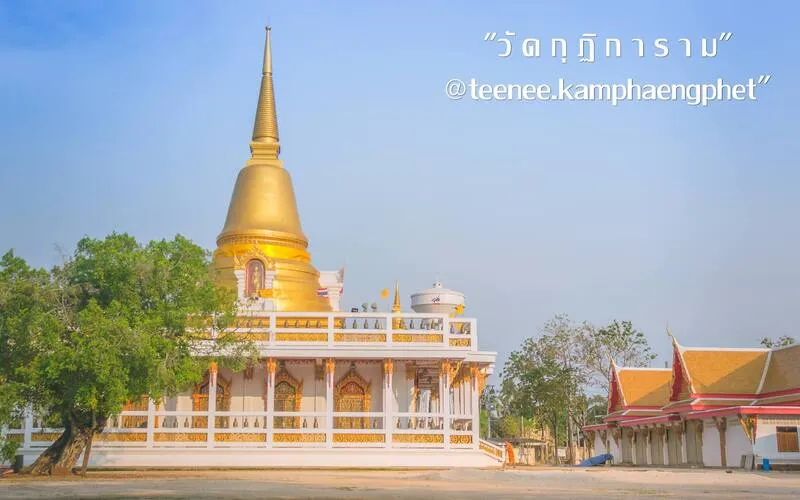
Wat Kutikaram
Open Days: Daily
Opening Hours: 08.00 – 17.00
Wat Kutikaram, also known as Wat Pa Rerai, is an important community Buddhist temple in Phran Kratai District, Kamphaeng Phet Province. Located at No. 114, Moo 10, Pa Rerai Road on the Kamphaeng Phet–Sukhothai route, the temple belongs to the Mahanikaya order and has long served as a center of faith for local people. Its main highlights include a Sukhothai-style inverted bell-shaped chedi enshrining sacred Buddha relics, the revered Buddha images Luang Pho To and Luang Pho Kan, and Nanthawadi Pond, a peaceful local recreation area and the annual Loy Krathong venue of Phran Kratai community.
Wat Kutikaram is meaningful in several dimensions. It is a place for Buddhist worship, monastic education, community ceremonies, local tradition, and cultural tourism. Its location along the Kamphaeng Phet–Sukhothai route makes it accessible for travelers moving between 2 historically important provinces. Visitors can stop here to make merit, pay respect to sacred relics, observe Sukhothai-inspired architecture, and experience the quiet atmosphere of a local Thai temple.
The temple is officially known as Wat Kutikaram, while local people often call it Wat Pa Rerai after its location on Pa Rerai Road. This local name reflects the close relationship between the temple and the Phran Kratai community. In Thai village life, a temple is not only a place of worship. It is also a social and cultural space where people gather for merit-making, festivals, education, and community activities.
The temple covers approximately 26 rai, 3 ngan, and 15 square wa. This spacious area allows the temple to support various activities, including religious ceremonies, monastic education, Buddhist festivals, and community gatherings. The open layout also gives visitors a peaceful walking experience, especially around the chedi, worship areas, and Nanthawadi Pond.
The temple’s early development is connected with Phra Baidika Kan Yasapanyo, who was originally associated with Wat Traiphum in Phran Kratai. Together with disciples and local devotees, he helped establish the temple on a site believed to have been an old temple area. The purpose was to provide a place of worship and Buddhist practice for people on the western side of Phran Kratai. This origin shows how the temple grew from local faith and collective effort.
Wat Kutikaram was historically understood as a temple serving the outer or western side of the community, while Wat Traiphum was regarded as a major temple on another side of Phran Kratai. This relationship shows how temples helped organize religious life across local settlements, allowing people in different parts of the community to access Buddhist practice more conveniently.
In 1933, the temple built an ordination hall measuring 7 meters wide and 11 meters long. It was a brick and plaster structure with timber elements. The hall received its consecrated boundary on 24 October 1939, and the boundary ceremony was held in April 1940. This was an important milestone because a consecrated boundary allows a temple to perform formal monastic acts correctly according to Buddhist discipline.
The most distinctive landmark of Wat Kutikaram is its inverted bell-shaped chedi in Sukhothai style. The chedi enshrines sacred relics of the Buddha and serves as the spiritual center of the temple. Its form is graceful, balanced, and deeply symbolic. For visitors interested in Thai Buddhist architecture, this chedi is one of the most important reasons to visit the temple.
The chedi’s inverted bell form reflects the elegance and simplicity associated with Sukhothai-period Buddhist architecture. Although the temple is located in Phran Kratai, its artistic character connects the site with the wider historical world of Sukhothai and Kamphaeng Phet. The chedi is both an object of devotion and a valuable expression of Thai religious art.
Luang Pho To and Luang Pho Kan are the 2 important Buddha images revered by local people. Luang Pho To conveys a sense of calm dignity, while Luang Pho Kan is strongly associated with local devotion and the memory of respected monks of Phran Kratai. Visitors often pay respect to these Buddha images for blessing, peace of mind, and auspiciousness.
Luang Pho Kan is especially important in local memory because of his association with Phra Khru Winit Wachirakhun, a respected monk known among Phran Kratai devotees. The devotion surrounding Luang Pho Kan and related sacred objects shows how Buddhist faith, local history, and personal memory come together at Wat Kutikaram.
Wat Kutikaram has also played a role in Buddhist education. The temple has been used for the study of Dhamma and Pali by monks and novices. This educational role is important because it helps preserve Buddhist knowledge and trains younger generations of monks in doctrine, discipline, and religious practice. A temple with educational activity contributes not only to worship but also to the continuity of Buddhism.
The temple has also served as an important center for Sangha administration in Phran Kratai District. This role adds to its significance because the temple supports coordination, monastic education, and religious order within the district. It is therefore an institution of both faith and organization within local Buddhist life.
Several important monks have contributed to the development of Wat Kutikaram. Phra Khru Wachira Panyakhun, also known as Luang Pho Prachuap Panyakhamo, was a former abbot remembered as a respected developer monk. Current publicly available cultural data identifies Phra Khru Preecha Wachirathon (Thanom) as the abbot, with Phra Maha Boonsong Yanasamvaro serving as assistant abbot. This continuity of leadership has helped preserve the temple’s role as a living religious center.
Nanthawadi Pond is another important feature of the temple area. Located opposite the temple, it is a scenic and peaceful place for local recreation. The pond adds a natural dimension to the temple visit, allowing visitors to combine worship with relaxation. It is suitable for walking, taking photographs, and spending a calm moment after paying respect at the temple.
Nanthawadi Pond is also used as the annual Loy Krathong venue for the people of Phran Kratai. During the festival, the pond becomes a cultural gathering space where residents and visitors float krathong, join local activities, and celebrate Thai tradition. This makes the temple area important not only in religious terms but also in cultural and social life.
The Loy Krathong celebration at Wat Kutikaram shows how the temple connects Buddhism, water, community, and Thai tradition. The festival allows people of all generations to gather, express gratitude, preserve local culture, and strengthen community bonds. Nanthawadi Pond therefore functions as both a natural landscape and a cultural stage.
For cultural travelers, Wat Kutikaram offers a complete experience. Visitors can see a Sukhothai-style chedi, pay respect to sacred relics, worship Luang Pho To and Luang Pho Kan, learn about local monastic history, and relax by Nanthawadi Pond. These elements make the temple valuable for those interested in Buddhist faith, Thai art, local history, and community tradition.
The atmosphere of Wat Kutikaram is calm and suitable for reflection. It is not only a sightseeing stop but also a place where visitors can slow down, chant, meditate, or simply spend time in a peaceful temple environment. The combination of sacred architecture and a pond landscape makes the visit gentle and memorable.
Wat Kutikaram can be included in a travel route through Phran Kratai District. Nearby places include Phran Kratai Market, Phran Kratai Marble Quarry, Phra Ruang Hot Spring, the Blue Pond, and Kamphaeng Phet Historical Park. This route allows travelers to experience religion, nature, local industry, and historical heritage within the same trip.
A meaningful visit usually takes around 45 minutes to 1 hour. Visitors can begin by paying respect at the chedi and Buddha images, then walk around the temple compound and continue to Nanthawadi Pond. During the Loy Krathong period, visitors should allow more time because the area becomes active with local festival activities.
Getting There is convenient by private car or local transport. From Kamphaeng Phet town, take Highway 101 along the Kamphaeng Phet–Sukhothai route toward Phran Kratai District. The temple is about 26 km from Kamphaeng Phet town. Travelers using public transport can first reach Kamphaeng Phet or Phran Kratai, then continue by local hired vehicle to the temple.
Visitors should dress respectfully because Wat Kutikaram is an active Buddhist temple. It is important to keep quiet near the chedi, ordination hall, and worship areas, avoid touching or climbing on sacred structures, and help keep both the temple compound and Nanthawadi Pond clean. Respectful behavior helps preserve the sacred and cultural value of the site.
Wat Kutikaram is one of the meaningful temples of Phran Kratai District. Its value lies in the Sukhothai-style chedi, sacred Buddha relics, Luang Pho To, Luang Pho Kan, Nanthawadi Pond, Loy Krathong tradition, and its role in Buddhist learning. For travelers visiting Kamphaeng Phet and looking for a quiet cultural temple outside the main city, Wat Kutikaram is a worthwhile destination.
| Name | Wat Kutikaram, also known as Wat Pa Rerai |
| Location | Pa Rerai Road, Phran Kratai Subdistrict, Phran Kratai District, Kamphaeng Phet Province |
| Address | No. 114, Moo 10, Pa Rerai Road, Kamphaeng Phet–Sukhothai Route, Phran Kratai Subdistrict, Phran Kratai District, Kamphaeng Phet 62110, Thailand |
| Coordinates | 16°40'26.3"N 99°35'08.6"E |
| Highlights | Sukhothai-style inverted bell-shaped chedi enshrining sacred Buddha relics, Luang Pho To, Luang Pho Kan, and Nanthawadi Pond |
| History | Established through the faith of Phra Baidika Kan Yasapanyo and local devotees; the old ordination hall was built in 1933, received its consecrated boundary on 24 October 1939, and held the boundary ceremony in April 1940 |
| Name Origin | Wat Kutikaram is the official name, while Wat Pa Rerai is the local name connected with Pa Rerai Road and the temple’s location |
| Distinctive Features | An important Phran Kratai temple with Sukhothai-style architecture, sacred Buddha images, a recreation pond, and a role in Buddhist education |
| Travel Information | Located on Highway 101, the Kamphaeng Phet–Sukhothai route, about 26 km from Kamphaeng Phet town; accessible by private car, local hired vehicle, or local transport through Phran Kratai |
| Current Status | Active Mahanikaya community temple, spiritual center of Phran Kratai, and cultural attraction |
| Open Days | Daily |
| Opening Hours | 08.00 – 17.00 |
| Fees | No admission fee |
| Facilities | Temple courtyard, worship areas, ordination hall, chedi, Nanthawadi Pond, recreation area, and parking space within the temple area |
| Main Areas / Zones | Inverted bell-shaped chedi, Luang Pho To, Luang Pho Kan, ordination hall, Buddhist study area, and Nanthawadi Pond |
| Abbot / Caretaker | Phra Khru Preecha Wachirathon (Thanom) |
| Additional Contact | Kamphaeng Phet Provincial Office of Buddhism, Tel. 055-705-177 to 179 |
| Official Website / Official Page | Information is published by the Kamphaeng Phet Provincial Office of Buddhism and Thailand Tourism Directory |
| Nearby Tourist Attractions | 1. Nanthawadi Pond, about 1 km 2. Phran Kratai Market, about 2 km 3. Phran Kratai Marble Quarry, about 6 km 4. Phra Ruang Hot Spring, about 19 km 5. Blue Pond, about 20 km 6. Kamphaeng Phet Historical Park, about 30 km |
| Nearby Restaurants | 1. Delish Mini Pizza Phran Kratai, about 1 km 2. Restaurants around Phran Kratai Market, about 2 km 3. Café Amazon Phran Kratai Branch, about 3 km 4. Local noodle and made-to-order food shops in Phran Kratai, about 3 km 5. Roadside restaurants along the Kamphaeng Phet–Sukhothai route, about 4 km 6. Restaurants near Phra Ruang Hot Spring, about 19 km |
| Nearby Accommodations | 1. Smile Resort Phran Kratai, about 5 km, Tel. 087-526-4425, 055-741-517 2. Accommodations in Phran Kratai town area, about 5 km 3. Baan Chang Hotel & Coffee House, about 25 km 4. Scenic Riverside Resort Kamphaeng Phet, about 30 km, Tel. 055-722-009 5. The Room Hotel Kamphaengphet, about 31 km, Tel. 062-586-9778 6. Soda Resort Kamphaeng Phet, about 32 km, Tel. 055-711-711, 055-713-123 |
Frequently Asked Questions (FAQ)
Q: Where is Wat Kutikaram located?
A: Wat Kutikaram is located at No. 114, Moo 10, Pa Rerai Road on the Kamphaeng Phet–Sukhothai route, Phran Kratai Subdistrict, Phran Kratai District, Kamphaeng Phet Province.
Q: What is another name for Wat Kutikaram?
A: The temple is also known locally as Wat Pa Rerai, after its location on Pa Rerai Road.
Q: What is Wat Kutikaram famous for?
A: It is famous for its Sukhothai-style inverted bell-shaped chedi enshrining sacred Buddha relics, as well as Luang Pho To, Luang Pho Kan, and Nanthawadi Pond.
Q: How is Wat Kutikaram connected with Loy Krathong?
A: Nanthawadi Pond at the temple is used as the annual Loy Krathong venue for the people of Phran Kratai District.
Q: Who is the abbot of Wat Kutikaram?
A: The abbot is Phra Khru Preecha Wachirathon (Thanom).
Q: Is there an admission fee at Wat Kutikaram?
A: No. There is no admission fee. Visitors can enter for worship, chedi visitation, and relaxation around Nanthawadi Pond daily.
Q: How can visitors get to Wat Kutikaram?
A: Take Highway 101 on the Kamphaeng Phet–Sukhothai route toward Phran Kratai District. The temple is about 26 km from Kamphaeng Phet town.
Q: What nearby places can be visited with Wat Kutikaram?
A: Nearby places include Phran Kratai Market, Phran Kratai Marble Quarry, Phra Ruang Hot Spring, Blue Pond, and Kamphaeng Phet Historical Park.
 Category: ●Places of Worship
 Group: ●Temple
Last Update : 2 WeekAgo
 Last Update : 2 WeekAgo
 Click to Access the Navigation Map GPS
 Art, Culture and Heritage
 Historical Sites and Monuments(4)
 Landmarks and Memorials(1)
 Art, Craft Centres, Tradition(4)
 Museums(4)
 Historical Houses and The Ancient City(1)
Temple(25)
Historical Houses and The Ancient City(1)
Temple(25)
 Other religious and spiritural sites(8)
 Research and Development
 Royal Project(2)
 Suburban Living
 Village, Community(2)
 Local Market(2)
 Nature and Wildlife
 National Parks and Marine Reserves(4)
 Mountain (Doi)(2)
 Dam, Reservoir, Lake(4)
 Waterfalls(4)
 Hot Springs(1)
 River, Canal(3)
 Bays and Beaches(2)
 Other natural attractions(1)
 Entertainment and Agricultural
 Farm, Parks, Gardens and Ecotourism(5)
 Waterpark(1)
 Shopping
 Shopping and Night Market(1)


