
lovethailand home >North Travel Attractions >Kamphaeng Phet Travel Attractions >Khanu Waralaksaburi >Salok Bat > Chom Thong Shrine
TL;DR: Chom Thong Shrine is located at Salok Bat Market, Salok Bat Subdistrict, Khanu Woralaksaburi District, Kamphaeng Phet Province, open Open Daily, hours 08:00–17:00.
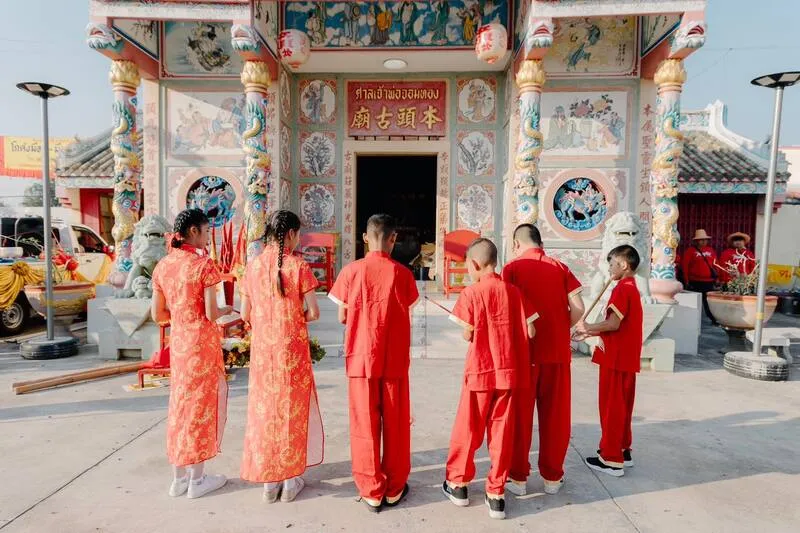
Chom Thong Shrine
Open Days: Open Daily
Opening Hours: 08:00–17:00
Chom Thong Shrine in Kamphaeng Phet Province, also known locally as Chao Pho Chom Thong Shrine, is an important Chinese community shrine in Salok Bat Market, Khanu Woralaksaburi District. Located along the old trading and travel route of Phahonyothin Road, the shrine has long served as a spiritual center for Thai-Chinese residents and local people in Salok Bat. It is a place for worship, blessings, annual ceremonies, Chinese opera, processions, vegetarian festival activities, and community gatherings that continue to preserve the identity of the market.
The origin of Chom Thong Shrine is closely tied to a group of Hainanese Chinese who settled and worked in Salok Bat Market. The founding group included Ko Mui, Ko Klon, Ko Rian, Ko Sun, and Ko Kwang. They wanted to create a shrine where Chinese residents in the market could pay respect, seek protection, and maintain a shared spiritual center. When a large termite mound was found on land belonging to Ko Sun and Ko Kwang, the area was regarded as sacred. The land was then offered for the construction of the shrine, and the shrine building was built over the termite mound.
The original shrine was a simple but meaningful community structure. It was built with plastered brick walls, a wooden roof frame, and tiled roofing. The shrine did not begin as a grand building; it grew from the faith and cooperation of local people. After the shrine was completed, a wandering monk passed through Salok Bat Market. The community invited him to name the shrine, and he gave it the name “Chom Thong,” which has remained in use ever since.
Ko Mui became the first spirit medium of the shrine and played an important role in connecting the faith of the community with Chao Pho Chom Thong. After Ko Mui passed away, the shrine had no continuing medium for a period of time. Around 1977, Saman Premphanphong, also known as Uai, became a later spirit medium. Local belief describes Chao Pho Chom Thong as originally named Dam, a warrior who led troops from Kanchanaburi, passed through Kosamphi, and later came through Ban Salok Bat. This story gives the shrine a distinctive character that blends Chinese shrine tradition, Thai local belief, and the memory of a protective heroic figure.
Salok Bat Market is an important roadside community in Khanu Woralaksaburi District. Because it lies along Phahonyothin Road, the area has long been connected with travel, trade, and movement between central and northern Thailand. Chom Thong Shrine therefore stands not in isolation but within a living market community. Local shopkeepers, travelers, families, and devotees visit the shrine to pray for prosperity, safe travel, good health, success in business, and protection from misfortune.
During Chinese New Year, the Chinese Ghost Festival, and the Vegetarian Festival, the shrine becomes especially active. Local people bring offerings such as duck, chicken, liquor, fruits, food, and other ceremonial items to pay respect to Chao Pho Chom Thong. These rituals show the continuing role of the shrine in daily life. For many families in Salok Bat, the shrine is not only a religious space but also a place of memory, gratitude, and community identity.
The annual Chao Pho Chom Thong Shrine festival is the most important public event connected with the shrine. Traditionally, the festival has been associated with 20–24 December every year, while recent annual events may extend from 18–24 December depending on the year’s program. The festival includes the procession of Chao Pho Chom Thong, Chinese opera, lion dance, dragon dance, Eng Ko performances, stage entertainment, market stalls, and community activities. It is one of the clearest expressions of the living Thai-Chinese culture of Salok Bat.
The procession of Chao Pho Chom Thong is a major highlight of the festival. During the procession, the deity is ceremonially brought out from the shrine to bless the market and the community. The procession includes colorful banners, ritual objects, musicians, performers, dragon and lion dance troupes, and local participants. This public ritual strengthens the connection between the shrine and the surrounding community, while also allowing visitors to experience the energy and beauty of Chinese shrine culture in rural Thailand.
Chinese opera is another important part of the annual festival. In the context of a shrine, opera is not merely entertainment. It is traditionally performed as an offering to the deity and as a way to express gratitude for protection and blessings throughout the year. Visitors who attend the festival can therefore experience both the festive atmosphere of a local fair and the deeper ritual meaning of Chinese performance traditions.
The shrine also plays an important role during the Vegetarian Festival. Food-sharing activities and vegetarian meals reflect the values of compassion, merit-making, discipline, and community support. For the people of Salok Bat, the shrine is a place where faith becomes practical through public service, offerings, and shared meals. This makes Chom Thong Shrine a living cultural institution rather than only a place for private worship.
Today, Chom Thong Shrine stands on Sukhaphiban 9 Road in Salok Bat Market. The area is accessible, active, and closely connected with local shops and roadside businesses. Visitors can pay respect at the shrine, walk around the market, enjoy local food, and continue their journey along Phahonyothin Road. For travelers driving between Bangkok, Nakhon Sawan, Kamphaeng Phet, and northern Thailand, the shrine is a meaningful stop that combines rest, worship, and local culture.
Devotees commonly pray to Chao Pho Chom Thong for business success, prosperity, good fortune, health, safety, and smooth travel. Some people make vows and later return with offerings when their wishes are fulfilled. This ongoing practice shows how deeply the shrine is connected with personal faith, family memory, and the everyday concerns of local people. It also explains why the shrine remains active across generations.
Getting There is convenient by private car because Salok Bat Market is located along Phahonyothin Road. From Kamphaeng Phet town, drive south toward Khanu Woralaksaburi District for about 50 km, then enter Salok Bat Market and continue to the Sukhaphiban 9 Road area. Travelers coming from Nakhon Sawan toward the north can also stop at Salok Bat along the same route. Those using public transport can get off in the Salok Bat area and continue by local transport or on foot depending on the exact drop-off point.
The best time to visit depends on the purpose of the trip. For a quiet worship experience, visit in the morning or during ordinary weekdays. For a lively cultural experience, visit during the annual festival in December, Chinese New Year, the Chinese Ghost Festival, or the Vegetarian Festival. During festival days, Salok Bat becomes more crowded, colorful, and energetic, with processions, performances, food stalls, and devotees gathering around the shrine.
Visitors should behave respectfully inside the shrine. Dress politely, speak quietly, place offerings only in designated areas, and avoid disturbing people who are praying. If unfamiliar with Chinese shrine rituals, visitors can observe local worshippers or politely ask shrine caretakers for guidance. Photography should also be done with respect, especially during ceremonies or when devotees are making offerings.
For cultural travelers, Chom Thong Shrine is valuable because it reveals the history of Hainanese Chinese settlement in Salok Bat. The shrine shows how migrant communities created sacred spaces, maintained rituals, organized festivals, and formed a shared identity in a market town. It is therefore not only a place for blessings but also a living record of local history and Thai-Chinese heritage in Kamphaeng Phet.
A visit to Chom Thong Shrine can be combined with other stops in the Salok Bat and Khanu Woralaksaburi area. Travelers may visit Salok Bat Market, the local bus stop area, Good Farm Cafe, nearby restaurants, and natural attractions such as Khao Nor–Khao Kaeo in Nakhon Sawan. This makes the shrine a suitable stop for those driving along Phahonyothin Road who want to add a meaningful cultural experience to their journey.
In summary, Chom Thong Shrine in Kamphaeng Phet Province is one of the most important cultural landmarks of Salok Bat Market. Its founding story, Hainanese Chinese roots, termite mound origin, spirit-medium tradition, annual festival, Chinese opera, vegetarian activities, and continuing role in local worship make it a living shrine of faith and memory. For travelers interested in Thai-Chinese culture, local festivals, and roadside market communities, Chom Thong Shrine is a worthwhile destination in Khanu Woralaksaburi District.
| Name | Chom Thong Shrine / Chao Pho Chom Thong Shrine, Salok Bat |
| Location | Salok Bat Market, Salok Bat Subdistrict, Khanu Woralaksaburi District, Kamphaeng Phet Province |
| Address | Sukhaphiban 9 Road, Moo 1, Salok Bat Subdistrict, Khanu Woralaksaburi District, Kamphaeng Phet 62140 |
| Highlights | Historic Chinese community shrine founded by Hainanese Chinese residents of Salok Bat Market, with an annual Chao Pho Chom Thong festival |
| History | Founded by a group of Hainanese Chinese in Salok Bat Market, with the original shrine built over a large sacred termite mound |
| Name Origin | The name “Chom Thong” was given by a wandering monk who passed through Salok Bat Market after the shrine was built |
| Distinctive Features | A Thai-Chinese community shrine with a founding story connected to a sacred termite mound, early brick-and-plaster structure, wooden roof frame, and tiled roof |
| Travel Information | From Kamphaeng Phet town, drive south along Phahonyothin Road for about 50 km to Salok Bat Market, then enter the Sukhaphiban 9 Road area |
| Current Status | An active community shrine open for worship, with annual ceremonies and local festival activities |
| Open Days | Open Daily |
| Opening Hours | 08:00–17:00 |
| Facilities | Worship area, festival area, nearby market shops, and roadside parking spaces depending on market conditions |
| Main Areas / Zones | Main shrine hall, worship area, offering area, and Salok Bat Market festival zone |
| Related Traditions | Annual Chao Pho Chom Thong festival in December, deity procession, Chinese opera, lion dance, dragon dance, Eng Ko performance, Chinese New Year, Chinese Ghost Festival, and Vegetarian Festival |
| Caretaker | Chao Pho Chom Thong Shrine Committee and Salok Bat Market Community |
| Local Contact Number | Salok Bat Municipality Tel. 055-771-328 ext. 128 |
| Nearby Tourist Attractions | 1. Salok Bat Market – 0 km 2. Salok Bat Bus Stop Area – 1 km 3. Good Farm Cafe, Khanu Woralaksaburi – 8 km, Tel. 055-772-200 4. Khao Nor–Khao Kaeo, Nakhon Sawan – 25 km 5. Thao Saen Pom Shrine, Wat Wang Phra That – 35 km |
| Nearby Restaurants | 1. Khrua Ban Thung Nai – 2 km, Tel. 062-956-5466 2. Lung Wai Country Restaurant – 3 km, Tel. 055-870-676, 098-775-4844 3. Lung Wai Khuen Thin, Salok Bat – 3 km, Tel. 055-741-505, 098-775-4844 4. Good Farm Cafe – 8 km, Tel. 055-772-200 5. Café Amazon, Salok Bat Service Station – 2 km |
| Nearby Accommodations | 1. Salok Bat Resort – 2 km, Tel. 055-772-370 2. Kerd Larb Resort – 3 km, Tel. 081-832-3381 3. Khanu Resort – 4 km 4. P. Paradise Hotel, Kamphaeng Phet – 45 km 5. Navarat Heritage Hotel, Kamphaeng Phet – 50 km, Tel. 081-533-5799 |
Frequently Asked Questions (FAQ)
Q: Where is Chom Thong Shrine located?
A: Chom Thong Shrine, also known as Chao Pho Chom Thong Shrine, is located in Salok Bat Market on Sukhaphiban 9 Road, Salok Bat Subdistrict, Khanu Woralaksaburi District, Kamphaeng Phet Province.
Q: What is the origin of Chom Thong Shrine?
A: The shrine was founded by Hainanese Chinese residents of Salok Bat Market, including Ko Mui, Ko Klon, Ko Rian, Ko Sun, and Ko Kwang. It was originally built over a large termite mound that the community regarded as sacred.
Q: When is the annual Chao Pho Chom Thong festival held?
A: The annual festival is traditionally associated with 20–24 December, while some recent programs extend from 18–24 December depending on the year.
Q: What can visitors see during the annual festival?
A: Visitors can see the Chao Pho Chom Thong procession, Chinese opera, lion dance, dragon dance, Eng Ko performances, stage entertainment, local stalls, and community ceremonies.
Q: What do people usually pray for at Chom Thong Shrine?
A: People commonly pray for business success, good fortune, health, safe travel, protection, and smooth progress in life.
Q: How can travelers get to Chom Thong Shrine?
A: From Kamphaeng Phet town, drive south along Phahonyothin Road for about 50 km to Salok Bat Market, then continue to the Sukhaphiban 9 Road area.
Q: What nearby places can be combined with a visit?
A: Nearby places include Salok Bat Market, the Salok Bat bus stop area, Good Farm Cafe, Khao Nor–Khao Kaeo, and other stops along the Khanu Woralaksaburi route.
 Category: ●Places of Worship
 Group: ●Other Sacred Sites
Last Update : 5 MonthAgo
 Last Update : 5 MonthAgo
 Click to Access the Navigation Map GPS
 Art, Culture and Heritage
 Historical Sites and Monuments(4)
 Landmarks and Memorials(1)
 Art, Craft Centres, Tradition(4)
 Museums(4)
 Historic Homes and Cities(1)
 Temple(25)
Other Sacred Sites(8)
Temple(25)
Other Sacred Sites(8)
 Research and Development
 Royal Project(2)
 Suburban Living
 Village, Community(2)
 Local Market(2)
 Nature and Wildlife
 National Parks and Marine Reserves(4)
 Mountain (Doi)(2)
 Dam, Reservoir, Lake(4)
 Waterfalls(4)
 Hot Springs(1)
 River, Canal(3)
 Bays and Beaches(2)
 Other natural attractions(1)
 Entertainment and Agricultural
 Farms, Parks and Ecotourism(5)
 Waterpark(1)
 Shopping
 Shopping and Night Market(1)
 Travel Articles, Recipes
 Travel Review, Food Review(1)


