
lovethailand home >North Travel Attractions >Kamphaeng Phet Travel Attractions >Muang Kamphaeng Phet >Khanathi > Ban Khon Tai Museum
TL;DR: Ban Khon Tai Museum is located at Wat Prasat, Moo 2, Ban Khon Tai, Khonthi Subdistrict, Mueang Kamphaeng Phet District, Kamphaeng Phet Province, open Daily, hours 09.00 – 18.00.
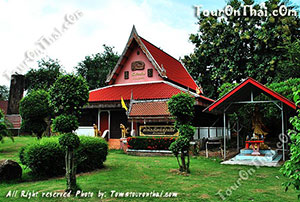
Ban Khon Tai Museum
Open Days: Daily
Opening Hours: 09.00 – 18.00
Ban Khon Tai Museum in Kamphaeng Phet Province, also known as Wat Prasat Local Museum, is a small but highly valuable cultural learning site located inside Wat Prasat, Moo 2, Ban Khon Tai, Khonthi Subdistrict, Mueang Kamphaeng Phet District. The museum preserves Buddhist images, antiquities, porcelain, Benjarong ceramics, local tools, and cultural objects connected with the ancient town of Khonthi. Many of these objects are several hundred years old, with historical links to the Sukhothai and Ayutthaya periods, making the museum an important stop for travelers interested in local history, Buddhist art, archaeology, and community heritage.
This is not a large urban museum, but its value lies in its local context. Ban Khon Tai Museum grew from the relationship between the temple, the village, and the historical landscape of Khonthi. The objects displayed here are meaningful because they remain close to the place where they belong. Visitors can see how antiquities, Buddhist faith, temple life, and local memory are connected within one living community.
Ban Khon Tai is located in Khonthi Subdistrict, an area associated with the ancient town of Khonthi. Wat Prasat stands within this historical zone, which is connected with the wider history of the Sukhothai kingdom. Khonthi is mentioned in the context of King Ramkhamhaeng’s inscription dated 1292, showing that this area was part of an important historical network in the Sukhothai period. For this reason, Ban Khon Tai and Wat Prasat are more than ordinary village sites; they represent a local historical landscape that preserves traces of an ancient community, Buddhist belief, and regional cultural routes.
The name Ban Khon Tai is closely linked with Ban Khon and Khonthi, names that reflect the identity of this old settlement. Wat Prasat has long served as a spiritual and cultural center of the community. Within the temple grounds are important Buddhist images, a vihara, museum buildings, and cultural objects collected from the area. This makes the site suitable for visitors who want to understand local history in relation to national history.
Wat Prasat is an old temple in Ban Khon Tai. One of its important sacred features is the vihara that enshrines Luang Pho To, a large principal Buddha image respected by the local community. The temple also preserves Buddhist images and antiquities dating to the Sukhothai and Ayutthaya periods. Because the museum is located inside the temple, visitors experience both religious and historical dimensions in one place. A visit here can combine merit-making, temple exploration, and learning about the ancient town of Khonthi.
The museum displays a wide range of objects, including Buddha images in different postures, Sukhothai-style Buddhist sculptures, Ayutthaya-period images, a walking Buddha image, blue-and-white porcelain, Benjarong ceramics, local tools, household objects, and items related to traditional ways of life. These objects are not valuable only because of their age. They also tell stories about faith, trade, craftsmanship, daily life, and the relationship between Ban Khon Tai and the broader cultural world in different historical periods.
One of the most remarkable highlights associated with Wat Prasat and Ban Khon Tai Museum is the Sukhothai-style walking Buddha image, which is more than 700 years old. Its graceful posture reflects the elegance of Sukhothai art, especially the flowing body line, gentle step, and serene expression. Such Buddhist art represents not only technical craftsmanship but also religious ideals and spiritual beauty.
Sukhothai art is known for its calmness, refinement, and sense of life. The walking Buddha is one of the clearest expressions of this artistic identity because it presents the Buddha in motion rather than in a static seated or standing posture. When visitors see a walking Buddha image at Ban Khon Tai Museum, they can better understand why Sukhothai art remains one of the most admired forms of Thai Buddhist sculpture.
In addition to Buddhist images, the ceramics and old vessels in the museum help explain daily life and cultural exchange in the past. Blue-and-white porcelain and Benjarong ceramics show artistic taste, household use, and connections with wider trade and cultural networks. Small objects such as bowls, jars, and domestic items help complete the picture of an ancient community. They reveal that the people of the past lived with religion, craft, food culture, household routines, and social relationships.
Another important part of the museum relates to tools and household objects once used by local people. Fishing tools, basketry, traditional containers, and Thai herbal medicine texts reflect the practical knowledge of earlier generations. Fishing tools show the importance of rivers and water sources. Basketry reflects the use of bamboo and natural materials. Herbal medicine texts reveal local knowledge of health care and the transmission of wisdom within the community.
Ban Khon Tai Museum therefore has value on two levels. First, it is important for archaeology and Buddhist art because it preserves ancient images, religious objects, ceramics, and antiquities. Second, it is important for social and cultural history because it presents everyday objects connected with local livelihoods. Together, these two levels show how religion, art, household life, occupation, and community identity are intertwined.
The museum also plays an important role in preserving community heritage. Many objects found around Ban Khon Tai and the ancient town of Khonthi are valuable for historical study. Without local preservation, such objects could be lost, damaged, or separated from their original context. By keeping them inside the temple museum, the community helps protect its own heritage while allowing younger generations and visitors to learn from it.
For cultural travelers, Ban Khon Tai Museum offers a deeper view of Kamphaeng Phet beyond the famous historical park. It is a community-level historical site that remains quiet, modest, and closely connected with local life. Visitors can see that culture is not found only in large museums or world heritage zones. It also exists in village temples, local museum rooms, display cases, and the memories of people who continue to live around these places.
A good way to explore the site is to begin by understanding Wat Prasat as the center of the area. Visitors can pay respect to the important Buddha images in the vihara before moving into the museum building to view the antiquities. This order helps explain the relationship between the temple and the objects on display. The Buddhist images are not separated from their sacred setting, while the local tools remain connected to the daily life of the surrounding community.
Visitors interested in Thai art should observe the details of each Buddha image, including facial features, body proportions, robe style, posture, and material. These details help reveal differences between artistic periods. Sukhothai images often appear graceful and balanced, while later styles may show different artistic preferences and religious contexts. Looking closely at these details makes the museum visit richer and more meaningful.
Visitors interested in local life should pay attention to the tools and household objects. These items often tell powerful stories about everyday people. Fishing tools reveal a close relationship with water. Basketry reflects natural materials and manual skill. Household containers show eating and storage practices. Herbal medicine texts reveal community-based health knowledge shaped by observation, experience, and transmission across generations.
For families and students, Ban Khon Tai Museum is a practical learning site. Children can see real objects rather than only reading about history in textbooks. Buddha images, ceramics, farming tools, fishing equipment, and local household items make history easier to understand. A visit to the actual place also helps young visitors realize that history is close to daily life and connected with communities that still exist today.
For general travelers, the appeal of this museum lies in its quiet and unhurried atmosphere. The temple setting makes the experience different from visiting a large formal museum. Visitors can walk slowly, pay respect to the Buddha images, observe old objects, and experience the calm rhythm of a local community. This type of travel is suitable for those who enjoy historical places that are not crowded and want to see the cultural roots of Kamphaeng Phet up close.
Ban Khon Tai Museum can also be included in a wider cultural route around Kamphaeng Phet. Travelers may begin at Wat Prasat and Ban Khon Tai Museum to understand the ancient town of Khonthi, then continue to other nearby temples before heading into Kamphaeng Phet town to visit Kamphaeng Phet National Museum, Kamphaeng Phet Provincial Museum Commemorating the Golden Jubilee, and Kamphaeng Phet Historical Park. This route connects community history with the province’s larger historical landscape.
Local museums like Ban Khon Tai Museum are important because they decentralize historical knowledge. People do not need to learn about the past only from major institutions. They can also learn from temples, villages, and local museums that preserve their own evidence. The presence of a museum inside Wat Prasat turns the temple into both a religious place and a center for cultural preservation.
Visitors should remember that many objects in the museum are old and historically valuable. They should avoid touching objects without permission, avoid moving anything, avoid using flash where inappropriate, and maintain respectful behavior inside the temple grounds. Such manners help protect the museum and ensure that local heritage remains available for future generations.
Groups should contact the temple or Khonthi Subdistrict Administrative Organization before visiting. A local museum inside a temple may operate differently from a large public museum, and advance contact helps make the visit smoother. It also allows caretakers to arrange access and provide suitable information for visitors.
Getting There is most convenient by private car. From Kamphaeng Phet town, drive toward Khonthi Subdistrict for about 22 km. The destination is Wat Prasat, Ban Khon Tai, Moo 2, Khonthi Subdistrict, Mueang Kamphaeng Phet District. Travelers using public transportation should first arrive in Kamphaeng Phet town and then continue by local transport or hired vehicle to Khonthi.
The best time to visit is in the morning or late afternoon when the weather is more comfortable for walking around the temple and museum. Travelers who want to continue into Kamphaeng Phet town should plan the route carefully. A good itinerary is to visit Wat Prasat and Ban Khon Tai Museum in the morning, then spend the afternoon exploring museums and historical sites in town.
Photography should be done respectfully. The temple has a calm atmosphere and meaningful religious elements, but visitors should avoid disturbing worshippers, climbing on old structures, or moving objects for photographs. Responsible photography helps preserve the dignity and safety of the place.
Ban Khon Tai Museum is also important as evidence of community participation in heritage preservation. The temple and local community protect objects, tell stories, and open the space for learning. When antiquities remain close to their original community, their meaning is not separated from the people and landscape that shaped them.
In a broader view, Ban Khon Tai Museum adds depth to the cultural map of Kamphaeng Phet Province. Kamphaeng Phet is not only about city walls, old temples, and world heritage sites. It also includes small communities that preserve their own stories through temples and local museums. The ancient town of Khonthi, Ban Khon Tai, and Wat Prasat are therefore important parts of Kamphaeng Phet’s historical identity.
A visit to this museum is best suited to travelers who appreciate slow, thoughtful, and respectful cultural travel. Visitors can see antiquities connected with Sukhothai and Ayutthaya art, learn about local livelihoods through everyday tools, pay respect at an old temple, and understand how preservation can happen within a village community. Ban Khon Tai Museum shows that heritage is not only kept by large institutions, but also by temples and local people who value their past.
In summary, Ban Khon Tai Museum in Kamphaeng Phet is a compact yet highly meaningful cultural attraction. Located inside Wat Prasat, it preserves Buddhist images, antiquities, ceramics, local tools, and historical evidence connected with the ancient town of Khonthi and the Sukhothai period. For travelers who want to understand Kamphaeng Phet through community history, temple culture, Buddhist art, and local heritage, this museum is a worthwhile stop that reveals the province’s cultural roots in a tangible way.
| Name | Ban Khon Tai Museum / Wat Prasat Local Museum |
| Location | Wat Prasat, Moo 2, Ban Khon Tai, Khonthi Subdistrict, Mueang Kamphaeng Phet District, Kamphaeng Phet Province |
| Address | Wat Prasat, Moo 2, Ban Khon Tai, Khonthi Subdistrict, Mueang Kamphaeng Phet District, Kamphaeng Phet 62000, Thailand |
| Highlights | A local museum inside an ancient temple, preserving Buddha images, antiquities, blue-and-white porcelain, Benjarong ceramics, local tools, and cultural evidence from the ancient town of Khonthi |
| History | Located within Wat Prasat in Ban Khon Tai, inside the historical area of ancient Khonthi, which is connected with Sukhothai history and King Ramkhamhaeng’s inscription dated 1292. The museum was established in 2003. |
| Name Origin | The name Ban Khon Tai Museum relates to the Ban Khon Tai community, while Wat Prasat Local Museum refers to the temple where the museum is located. |
| Distinctive Features | A local museum preserving objects from the ancient town of Khonthi, including Sukhothai and Ayutthaya Buddha images, ceramics, and local household tools |
| Important Sacred Objects | Luang Pho To, a Sukhothai-style walking Buddha image, ancient Buddha images, and Buddhist art objects |
| Main Areas / Zones | Wat Prasat temple grounds, Luang Pho To vihara, museum building, Buddhist image and antiquity display, ceramic display, and local lifestyle object display |
| Travel Information | From Kamphaeng Phet town, travel by car toward Khonthi Subdistrict for about 22 km. The museum is located inside Wat Prasat, Ban Khon Tai, Moo 2. Travelers using public transport should continue from Kamphaeng Phet town by local vehicle or hired transport. |
| Current Status | Open as a local learning site within Wat Prasat |
| Open Days | Daily |
| Opening Hours | 09.00 – 18.00 |
| Fees | Free admission |
| Caretaker | Temple and local community, together with Khonthi Subdistrict Administrative Organization |
| Main Contact Number | 055 740 020, 055 867 667 |
| Nearby Tourist Attractions | 1. Wat Prasat Ban Khon Tai, about 0 km 2. Ancient Town of Khonthi, about 1 km 3. Wat Kharuehabodi Song (Wat Tha Phutsa), about 12 km 4. Wat Khong Phai, about 15 km 5. Kamphaeng Phet National Museum, about 24 km 6. Kamphaeng Phet Historical Park, about 25 km |
| Nearby Restaurants | 1. Yang Na 120, Ban Pho Phatthana, Khonthi, about 5 km, Tel. 088-174-5186, 080-005-3064 2. Chor Cham Boat Noodle, Kamphaeng Phet – Tha Makhuea Road, about 10 km, Tel. 061-684-7966 3. Krua Mae Somchit, about 22 km, Tel. 086-549-1097, 081-533-8192 4. Thammarat Phochana, about 24 km, Tel. 055-714-247, 088-228-5449 5. Kamphaeng Phet Phochana (Nai Ya), about 24 km, Tel. 055-713-035 |
| Nearby Accommodations | 1. King Thong Resort Kamphaeng Phet, Khonthi, about 8 km 2. Grand The Room Hotel, about 22 km 3. The Room Hotel Kamphaeng Phet, about 22 km 4. The Resort Kamphaengphet, about 23 km 5. Navarat Heritage Hotel, about 24 km 6. Chakungrao Riverview Hotel, about 24 km, Tel. 055-714-900-4 |
Frequently Asked Questions (FAQ)
Q: Where is Ban Khon Tai Museum located?
A: It is located inside Wat Prasat, Moo 2, Ban Khon Tai, Khonthi Subdistrict, Mueang Kamphaeng Phet District, Kamphaeng Phet Province.
Q: What can visitors see at Ban Khon Tai Museum?
A: Visitors can see Sukhothai and Ayutthaya Buddha images, a walking Buddha image, antiquities, blue-and-white porcelain, Benjarong ceramics, local tools, and objects related to the ancient town of Khonthi.
Q: What are the museum’s opening days and hours?
A: The museum is open daily from 09.00 to 18.00.
Q: Is there an admission fee?
A: No. Admission is free.
Q: Why is Wat Prasat Ban Khon Tai important?
A: Wat Prasat is located in the ancient Khonthi area and is connected with Sukhothai history. It preserves important Buddhist images and antiquities of the local community.
Q: How far is Ban Khon Tai Museum from Kamphaeng Phet town?
A: It is about 22 km from Kamphaeng Phet town.
Q: Who should visit Ban Khon Tai Museum?
A: It is suitable for history lovers, travelers interested in Sukhothai art, families, students, and visitors who want to understand local community heritage in Kamphaeng Phet.
Q: What nearby attractions can be combined with a visit?
A: Nearby and connected attractions include the Ancient Town of Khonthi, Wat Kharuehabodi Song, Wat Khong Phai, Kamphaeng Phet National Museum, and Kamphaeng Phet Historical Park.
 Category: ●Art, Culture and Heritage
 Group: ●Museums
Last Update : 4 MonthAgo
 Last Update : 4 MonthAgo
 Click to Access the Navigation Map GPS
Ban Khon Tai Museum Map
Recommend

 Historical Sites and Monuments(4)
 Landmarks and Memorials(1)
 Art, Craft Centres, Tradition(4)
Museums(4)
Art, Craft Centres, Tradition(4)
Museums(4)
 Historic Homes and Cities(1)
 Places of Worship
 Temple(25)
 Other Sacred Sites(8)
 Research and Development
 Royal Project(2)
 Suburban Living
 Village, Community(2)
 Local Market(2)
 Nature and Wildlife
 National Parks and Marine Reserves(4)
 Mountain (Doi)(2)
 Dam, Reservoir, Lake(4)
 Waterfalls(4)
 Hot Springs(1)
 River, Canal(3)
 Bays and Beaches(2)
 Other natural attractions(1)
 Entertainment and Agricultural
 Farms, Parks and Ecotourism(5)
 Waterpark(1)
 Shopping
 Shopping and Night Market(1)


