
lovethailand home >Central Travel Attractions >Bangkok Travel Attractions >Ratchathewi >Mak Ka San > Wat Ditsahongsaram
TL;DR: Wat Ditsahongsaram is located at Makkasan, Ratchathewi District, Bangkok, open Daily, hours 05.00 – 18.00.
Wat Ditsahongsaram
Open Days: Daily
Opening Hours: 05.00 – 18.00
Wat Ditsahongsaram, widely known by local people as Wat Makkasan, is a historic Buddhist temple in Makkasan, Ratchathewi District, Bangkok. It is located at 509 Phetchaburi Road in a central urban area connected with Pratunam, Ratchathewi, Phaya Thai, Nana, Asok, and Khlong Saen Saep. The temple is a private Buddhist monastery under the Mahanikaya order and remains an active religious site. Monks reside here, Buddhist activities continue throughout the year, and local devotees come for merit-making, alms-giving, sermons, Kathin ceremonies, and community religious events. Its identity is shaped by its name history, which connects Khlong Bang Kasan, Makkasan Railway Station, and the later official name Wat Ditsahongsaram.
Wat Ditsahongsaram is suitable for visitors who want to pray, make merit, learn about an old city temple, and experience a local Bangkok monastery in the Makkasan area. Although the surrounding district is filled with Phetchaburi Road traffic, commercial buildings, rail infrastructure, the Airport Rail Link, expressways, Khlong Saen Saep, and busy business zones, the temple still provides a religious space where people can pause, worship, and participate in Buddhist practice. It is a meaningful stop for Bangkok residents who want a temple along their daily route and for travelers interested in the older layers of Makkasan before it became a major transport hub.
The name Wat Ditsahongsaram reflects the changing geography and social history of the area. The temple was originally called Wat Bang Kasan, after Khlong Bang Kasan, the canal that passed near the temple. Later, after Makkasan Railway Station was built in the area, local people began calling it Wat Makkasan because the temple stood close to the station and community using that name. In 1942, Nai Dit and Nang Sa donated additional land to the temple, and the temple name was changed to Wat Ditsahongsaram. The current name therefore preserves the memory of local donors as well as the temple’s gradual transition into a formal urban religious institution.
The temple was founded in 1833 during the early Rattanakosin period. Its roots are connected with the canal-side community of old Makkasan before Phetchaburi Road and modern rail systems transformed the district. In the past, canals served as routes of travel, sources of water, and the structural center of local communities. The old name Wat Bang Kasan is therefore important geographic evidence. It shows that the history of Makkasan began not only with roads and railways, but also with canals, settlement, and Buddhist monastic life.
Wat Ditsahongsaram received its consecrated boundary in 1847, allowing the ordination hall to function fully as a formal space for Buddhist monastic acts. The temple now covers about 10 rai and 40 square wah and is registered as temple number 1101203001. These details confirm its clear religious and administrative status. Wat Ditsahongsaram is not merely a local nickname on a map, but a formally registered Buddhist temple with a long record of establishment, consecrated boundary, resident monks, and active religious use.
The temple’s location is especially interesting because it sits where Phetchaburi Road, Khlong Saen Saep, the Makkasan community, and Bangkok’s modern rail network meet. Many people passing through the area see only traffic, hotels, railway lines, towers, and stations. Wat Ditsahongsaram reveals an older cultural layer beneath that modern infrastructure. The temple works as a cultural anchor for the old community while the surrounding city continues to change rapidly.
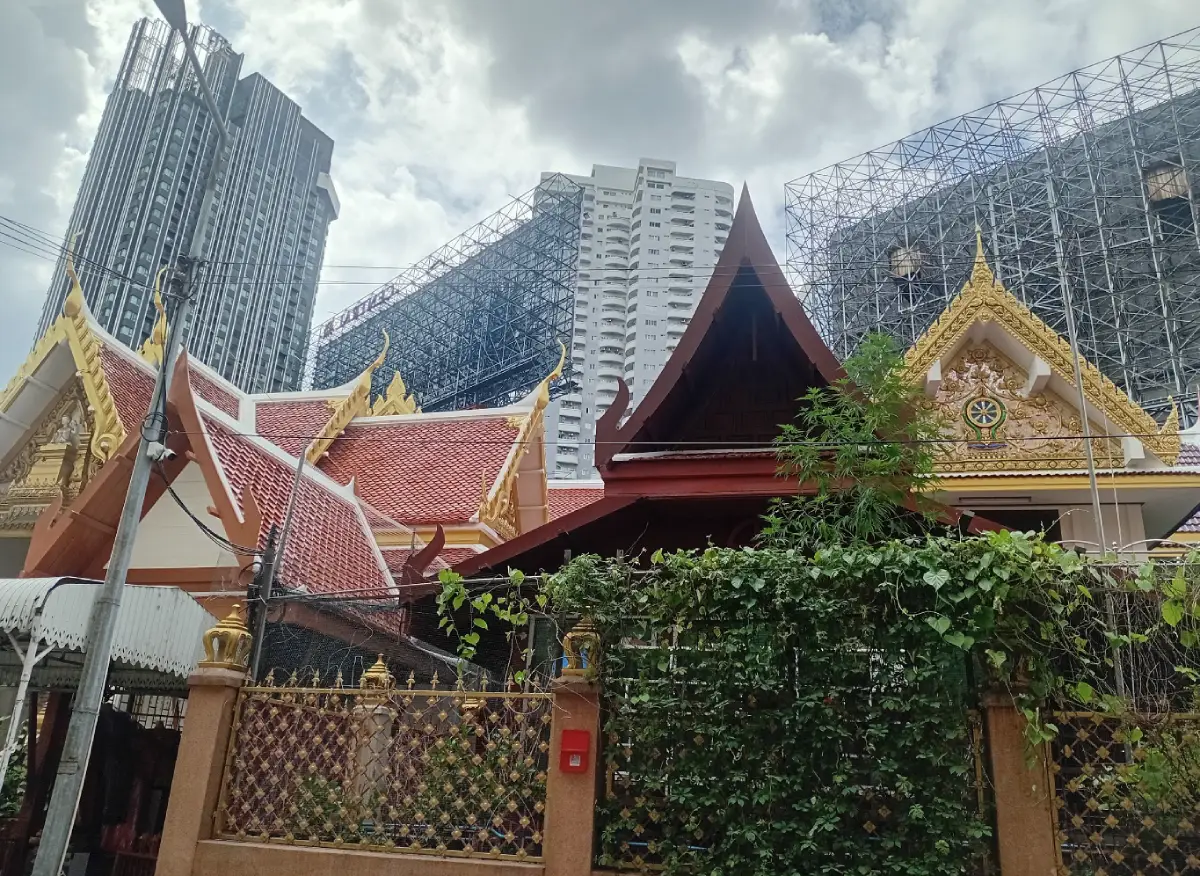
The ordination hall is the most important building in Wat Ditsahongsaram. It measures about 8 meters wide and 25 meters long. Built of brick and plaster, it has traditional Thai roof decorations, including chofa, bai raka, and hang hong elements. The windows are decorated with gilded lacquer patterns. Inside the hall is a replica of Phra Buddha Chinnarat with a lap width of about 68 inches. For visitors, the ordination hall is the proper starting point for worship. It allows them to pay respect to the principal Buddha image and experience the atmosphere of an old urban temple in Makkasan.
The Phra Buddha Chinnarat replica inside the ordination hall is central to the temple’s devotional life. Phra Buddha Chinnarat is one of the most revered Buddha images in Thai society, and the replica at Wat Ditsahongsaram gives local people in Makkasan a place to worship this important image without traveling far. The Maravijaya posture symbolizes the Buddha’s victory over temptation and obstacles before enlightenment. For many devotees, paying respect to this image is associated with steadiness, inner strength, and the ability to overcome difficulties.
The temple also has a viharn housing Luang Pho Samrit, another important Buddha image within the compound. Devotees often pay respect here after worshipping the principal Buddha image in the ordination hall. The viharn gives the temple a clear worship sequence: begin with the principal Buddha image, continue to Luang Pho Samrit, and then proceed to merit-making or other religious activities inside the temple.
The Ratchathewi District Office records an important bronze Buddha image in the Maravijaya posture as one of the temple’s significant sacred objects. This reflects the role of the Buddha image as a spiritual center for both the temple and the surrounding community. The Maravijaya posture is commonly found in Thai ordination halls because it represents determination, patience, and victory through Dharma. This makes it especially meaningful for visitors praying for mental clarity and strength in daily life.
The history of the temple also includes a serious urban memory from the reign of King Rama IV. Historical accounts associate the area with the execution of important prisoners, including Khun Suwan and Chao Chom Choi. This history should be approached with respect rather than curiosity for its own sake. Today, Wat Ditsahongsaram is a religious and community space, while this historical layer helps visitors understand that old Bangkok sites often served many roles, including religious, administrative, transport, and social functions.
The current abbot of Wat Ditsahongsaram is Phra Khru Sunthon Phatthanawimon. The temple continues to organize religious and community activities with Ratchathewi District, including summer novice ordination programs, Kathin ceremonies, and Bangkok’s community-temple initiatives. These recent activities confirm that Wat Ditsahongsaram is still a living temple, not merely an old religious site preserved in name.
The summer novice ordination program at Wat Ditsahongsaram shows the temple’s educational role. Children and youth who participate learn discipline, simple living, chanting, Buddhist teachings, and basic religious practice. For a dense urban district like Makkasan, the temple functions as an important learning space beyond the classroom, helping to cultivate moral awareness within the community.
Wat Ditsahongsaram is also connected with Wat Ditsahongsaram School and Health Center 2 Wat Makkasan, located within or near the temple compound. This relationship between temple, school, and public health service makes the temple more than a place of worship. It also functions as a community hub for religion, education, health, and public activity. This is a strong example of how a Bangkok temple adapts to a changing city while retaining its Buddhist role.
The atmosphere of Wat Ditsahongsaram differs from Bangkok’s major tourist temples. It is not defined by grand scale or spectacle, but by the character of an old local monastery. Visitors may see people stopping by before work, elderly residents making merit on Buddhist holy days, students and community members passing through the area, monks following their daily routines, and devotees offering Sangkhathan or joining ceremonies. This everyday religious life gives the temple its quiet value.
The temple’s location near Khlong Saen Saep connects it with one of Bangkok’s active water transport routes. Visitors can link a temple visit with canal boat travel, especially from Pratunam, Asok, Ramkhamhaeng, and other areas along the canal. The availability of road, rail, canal boat, and walking connections makes Wat Ditsahongsaram one of the more accessible local temples in central Bangkok.
For cultural travel, Wat Ditsahongsaram can be combined with the Thai Labour Museum, Nai Lert Park Heritage Home, Erawan Shrine, Pratunam, Wat Aphai Thayaram, Phaya Thai Palace, and Victory Monument. These sites are connected by Phetchaburi Road, Ratchawithi Road, canal boats, rail systems, and buses. A route built around these places helps visitors understand Bangkok through religion, labor history, urban development, commerce, and public transport rather than through famous landmarks alone.
For merit-making, Wat Ditsahongsaram supports the core practices of Thai Buddhism: worshipping the Buddha, offering Sangkhathan, giving alms, listening to sermons, joining Kathin ceremonies, and participating in Buddhist holy day activities. Visitors with limited time can worship in the ordination hall and viharn in a short visit. Those who want to experience the local community atmosphere should come in the morning or on a Buddhist holy day.
Major Buddhist days such as Makha Bucha, Visakha Bucha, Asanha Bucha, Buddhist Lent, and the end of Buddhist Lent are important times for the temple. Devotees come to make merit, listen to Dharma, and join traditional ceremonies. City temples such as Wat Ditsahongsaram are especially important on these days because they allow people living and working in central Bangkok to maintain Buddhist practice without traveling far.
Visitors should observe the temple as a religious space embedded in the city. It stands beside a major road, near a canal, close to public transport, and near school and health facilities. People entering and leaving the temple may include devotees, students, workers, public health visitors, monks, and local residents. Visiting this temple is therefore not an escape from the city, but a chance to see how a Thai temple continues to operate within the city’s living structure.
A typical visit to Wat Ditsahongsaram takes about 30 minutes to 1 hour. A short visit is enough for worship and merit-making. Visitors interested in the ordination hall, viharn, community setting, and the temple’s name history from Bang Kasan to Makkasan and Ditsahongsaram should allow more time. A good route begins at the ordination hall, continues to the viharn of Luang Pho Samrit, then moves through the merit-making areas and surrounding community spaces.
Visitors should dress modestly and behave respectfully in the temple compound. Revealing clothing should be avoided. Voices should be kept low inside the ordination hall. Visitors should not disturb monks or people performing religious acts, and photography should be done with care. Anyone wishing to join a specific temple activity or offer Sangkhathan should choose an appropriate time and contact the temple directly for activity-specific arrangements.
Getting There is convenient in several ways. By car, use Phetchaburi Road and head to number 509 in Makkasan. Buses serving the area include routes 11, 23, 38, 60, 62, 69, 72, 93, 113, and 514. Visitors can also connect by Khlong Saen Saep canal boat, especially from piers linked with Pratunam and the Makkasan area. Rail-based access is possible via Airport Rail Link Makkasan Station, MRT Phetchaburi Station, or BTS Phloen Chit Station, then continuing by bus, taxi, or another local connection to Phetchaburi Road.
The best time to visit Wat Ditsahongsaram is in the morning. The weather is cooler, and the time is suitable for merit-making, alms-giving, and Sangkhathan offerings. Visitors who want a quieter experience should come on a weekday after the morning rush hour, because traffic around Phetchaburi Road and Makkasan can be heavy in peak periods. Those who want to see community religious life should visit on Buddhist holy days or major Buddhist festivals.
Wat Ditsahongsaram is an old city temple with value on several levels: its name history connects Khlong Bang Kasan and Makkasan Railway Station, its ordination hall preserves traditional Thai temple architecture, its sacred images include a Phra Buddha Chinnarat replica and Luang Pho Samrit, and its current role connects monks, school, public health service, local residents, and the Ratchathewi District community. For visitors seeking a Bangkok temple near Phetchaburi Road, Makkasan, Pratunam, or Ratchathewi, Wat Ditsahongsaram is a worthwhile stop that reveals how religion, community, and urban life continue to coexist in central Bangkok.
| Name | Wat Ditsahongsaram |
| Common Name | Wat Makkasan |
| Location | Makkasan, Ratchathewi District, Bangkok |
| Address | 509 Phetchaburi Road, Makkasan, Ratchathewi, Bangkok 10400, Thailand |
| Coordinates | 13.74899, 100.55098 |
| Temple Type | Private Buddhist Temple Under The Mahanikaya Order |
| Temple Registration | Temple Registration Number 1101203001, Founded In B.E. 2376 / 1833, Consecrated Boundary Granted In B.E. 2390 / 1847 |
| Temple Area | About 10 Rai And 40 Square Wah |
| Highlights | Old Makkasan temple, traditional ordination hall, Phra Buddha Chinnarat replica, Luang Pho Samrit, bronze Buddha image in the Maravijaya posture, location near Khlong Saen Saep, and active local community role |
| History | Founded in 1833. The temple was originally named Wat Bang Kasan, later known as Wat Makkasan after the railway station and district, and renamed Wat Ditsahongsaram in 1942 after Nai Dit and Nang Sa donated additional land to the temple. |
| Name Origin | Wat Bang Kasan referred to Khlong Bang Kasan. Wat Makkasan came from the local district and railway station. Wat Ditsahongsaram preserves the names of Nai Dit and Nang Sa, donors who gave land to the temple in 1942. |
| Key Evidence | Ordination hall about 8 x 25 meters, brick and plaster structure, chofa, bai raka, hang hong roof decoration, gilded lacquer window patterns, and a Phra Buddha Chinnarat replica with a lap width of about 68 inches |
| Sacred Images / Shrines | Phra Buddha Chinnarat Replica, Bronze Buddha Image In The Maravijaya Posture, And Luang Pho Samrit In The Viharn |
| Artistic Features | Traditional Thai ordination hall, chofa, bai raka, hang hong roof elements, gilded lacquer window decoration, and the principal Buddha image modeled after Phra Buddha Chinnarat |
| Traditions / Rituals | Alms-giving, Sangkhathan offerings, Buddhist sermons, Kathin ceremonies, Buddhist holy day activities, and summer novice ordination program |
| Main Areas / Zones | Ordination hall, Luang Pho Samrit viharn, merit-making area, Sangkhathan offering area, alms-giving area, monk residences, Wat Ditsahongsaram School, Health Center 2 Wat Makkasan, and parking area |
| Abbot / Caretaker | Phra Khru Sunthon Phatthanawimon |
| Current Status | Active private Buddhist temple with resident monks, religious services, merit-making, community activities, and cooperation with Ratchathewi District Office |
| Open Days | Daily |
| Opening Hours | 05.00 – 18.00 |
| Admission Fee | No Published Admission Fee |
| Facilities | Parking, toilets, merit-making areas, Sangkhathan offering area, religious activity spaces, school in the temple area, and nearby public health center |
| Main Contact Number | 02-251-3507 |
| Travel Information | By car, use Phetchaburi Road and head to 509 Makkasan. Bus routes serving the area include 11, 23, 38, 60, 62, 69, 72, 93, 113, and 514. Visitors can also connect by Khlong Saen Saep canal boat, Airport Rail Link Makkasan Station, MRT Phetchaburi Station, or BTS Phloen Chit Station. |
| Nearby Tourist Attractions | 1. Thai Labour Museum, About 1 Km 2. Nai Lert Park Heritage Home, About 1 Km 3. Central Embassy, About 1 Km 4. Erawan Shrine, About 2 Km 5. Pratunam, About 2 Km 6. Victory Monument, About 3 Km |
| Nearby Restaurants | 1. Na Aroon Restaurant, About 0.3 Km, Tel. 02-254-8880 2. Krua Makkasan, About 0.7 Km, Tel. 095-554-9884 3. Krua Sawoei Rim Khlong, About 1 Km, Tel. 02-252-2815 4. Makkasan Coffee Shop, About 1.5 Km, Tel. 02-890-9000, 02-253-0510 5. DHAMAKA Indian Restaurant, About 1.5 Km, Tel. 062-886-2656 6. Go-Ang Pratunam Chicken Rice, About 2 Km, Tel. 02-252-6325, 061-656-9659 |
| Nearby Accommodations | 1. AriyasomVilla, About 0.3 Km, Tel. 02-254-8880 2. Bangkok Palace Hotel, About 1.5 Km, Tel. 02-890-9000, 02-253-0510 3. Centara Watergate Pavilion Hotel Bangkok, About 2 Km, Tel. 02-625-1234 4. Mercure Bangkok Makkasan, About 2 Km, Tel. 02-115-3333 5. FX Hotel Metrolink Makkasan, About 2 Km, Tel. 02-652-9000 6. Lancaster Bangkok, About 2.5 Km, Tel. 02-262-8000 |
Frequently Asked Questions (FAQ)
Q: Where Is Wat Ditsahongsaram Located?
A: Wat Ditsahongsaram is located at 509 Phetchaburi Road, Makkasan, Ratchathewi District, Bangkok 10400, near Khlong Saen Saep, Pratunam, and central Makkasan.
Q: What Are The Opening Days And Hours Of Wat Ditsahongsaram?
A: Wat Ditsahongsaram is open daily from 05.00 to 18.00.
Q: Does Wat Ditsahongsaram Have Another Name?
A: Yes. Local people commonly call it Wat Makkasan. Its original name was Wat Bang Kasan, connected with Khlong Bang Kasan in the old Makkasan area.
Q: What Is The History Of Wat Ditsahongsaram?
A: The temple was founded in 1833. It was originally called Wat Bang Kasan, later known as Wat Makkasan, and renamed Wat Ditsahongsaram in 1942 after Nai Dit and Nang Sa donated additional land to the temple.
Q: What Sacred Images Can Visitors Worship At Wat Ditsahongsaram?
A: Important sacred images include the Phra Buddha Chinnarat replica, the bronze Buddha image in the Maravijaya posture, and Luang Pho Samrit in the viharn.
Q: How Can Visitors Reach Wat Ditsahongsaram By Public Transport?
A: Visitors can use buses along Phetchaburi Road, including routes 11, 23, 38, 60, 62, 69, 72, 93, 113, and 514. They can also connect by Khlong Saen Saep canal boat, Airport Rail Link Makkasan Station, MRT Phetchaburi Station, or BTS Phloen Chit Station.
Q: What Kind Of Visit Is Wat Ditsahongsaram Suitable For?
A: It is suitable for prayer, merit-making, Sangkhathan offerings, studying old Makkasan temple history, and creating a central Bangkok route with Pratunam, the Thai Labour Museum, Nai Lert Park Heritage Home, and Ratchathewi attractions.
Q: How Long Should Visitors Spend At Wat Ditsahongsaram?
A: A short worship visit takes about 30 minutes, while visitors who want to see the ordination hall, viharn, and understand the temple’s name history should allow about 1 hour.
 Category: ●Places of Worship
 Group: ●Temple
Last Update : 3 WeekAgo
 Last Update : 3 WeekAgo
 Click to Access the Navigation Map GPS
 Phra Nakhon(24)Dusit(17)Khlong San(7)Khlong Toei(3)Jatujak(2)Don Muang(5)Taling Chan(26)Thon Buri(23)Bangkok Noi(31)Bangkok Yai(13)Bang Kapi(5)Bang Kun Tien(15)Bang Khen(3)Bang Kholam(10)Bang Sue(9)Bang Plad(23)Bang Rak(6)Chom Thong(16)Bung Kum(5)Pra Wet(6)Patum Wan(6)Pom Prap Sattru Phai(11)Paya Thai(1)Pra Kanong(4)Pa Sri Charoen(23)Min Buri(7)Yan Na Wa(8)Ratchathewi(4)Rat Burana(6)Lat Krabang(13)Nong Chok(16)Lat Phrao(4)Sathorn(4)Sam Phan Tha Wong(12)Nong Khaem(7)Huai Khwang(3)Suan Luang(7)Din Daeng(2)Lak Si(1)Sai Mai(8)Khan Na Yao(2)Wang Thong Lang(1)Klong Sam Wa(10)Watthana(2)Bang Na(4)Thawi Watthana(3)Bang Khae(5)Thung Khru(4)Bang Bon(3)


