
lovethailand home >Central Travel Attractions >Bangkok Travel Attractions >Sam Phan Tha Wong >Chakkrawat > Wat Bophit Phimuk Worawihan
TL;DR: Wat Bophit Phimuk Worawihan is located at Chakkrawat Road, Chakkrawat Subdistrict, Samphanthawong District, Bangkok, open Daily, hours 08.00 – 17.00.
Wat Bophit Phimuk Worawihan
Open Days: Daily
Opening Hours: 08.00 – 17.00
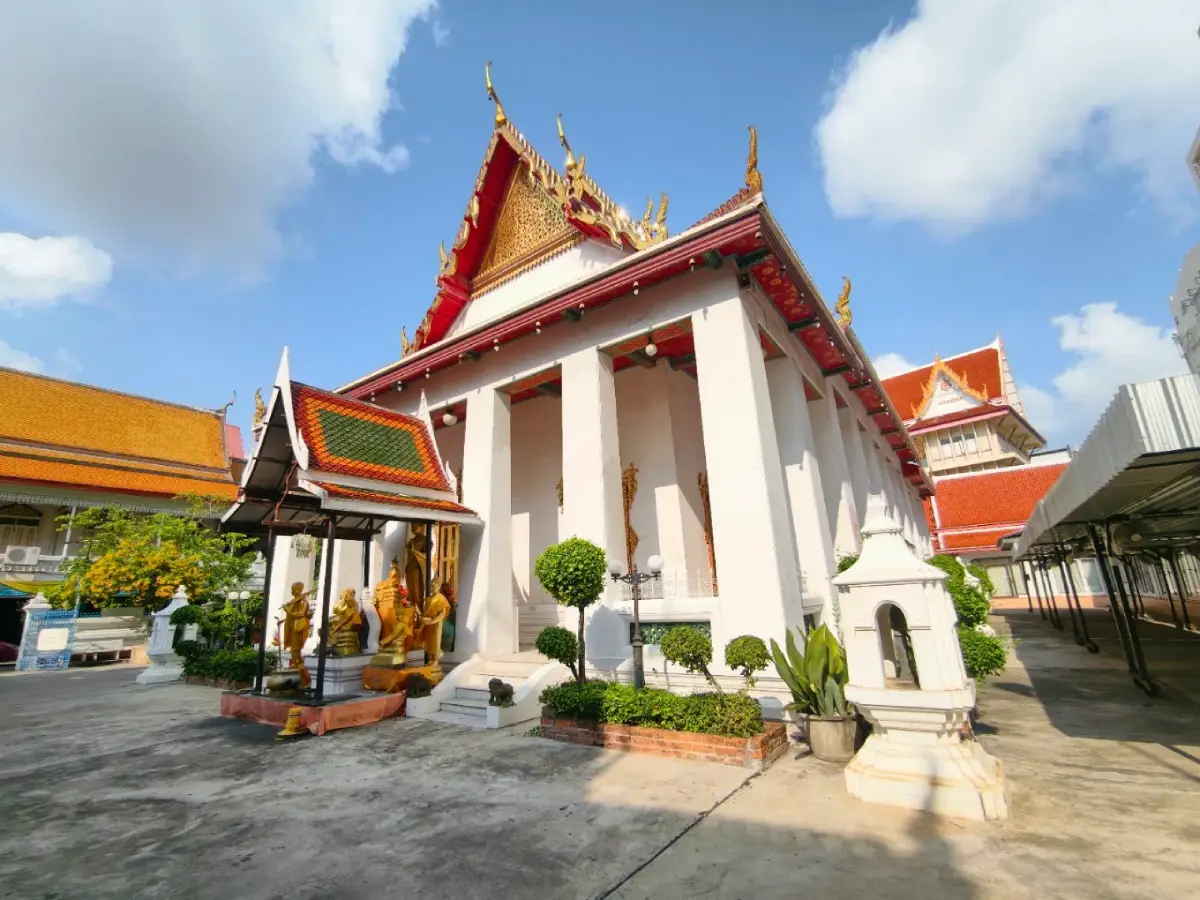
Wat Bophit Phimuk Worawihan, commonly known as Wat Bophit Phimuk, is a second-class royal monastery of the Worawihan rank under the Mahanikaya order. It is located at 266 Chakkrawat Road, Chakkrawat Subdistrict, Samphanthawong District, Bangkok 10100. The temple is a historically important Buddhist site in one of Bangkok’s most vibrant old commercial districts, close to Phahurat, Sampheng, Khlong Ong Ang, Saphan Han, and Yaowarat. Its importance lies in its royal status, its earlier name Wat Choeng Len or Wat Tin Len, its restoration by Krom Phra Ratchawang Bowon Sathan Phimuk during the reign of King Rama I, and its sacred features such as Phra Samphuttha Bophit, the ordination hall, the viharn, the Lankan-style chedi, the walking Buddha image, and important Buddha images inside the temple complex.
The temple has carried several names through history. Its old name was Wat Choeng Len, also known as Wat Tin Len, a name used since the Ayutthaya period. The name reflects the older landscape of the area, where canals, lowland terrain, waterways, and early settlements shaped the urban environment before modern Bangkok expanded around it. In the early Rattanakosin period, the temple was completely restored and received the royal name Wat Bophit Phimuk in honor of Krom Phra Ratchawang Bowon Sathan Phimuk, also known as the Front Palace of the Rear Palace or Wang Lang, who restored the temple and offered it as a royal monastery.
A major chapter in the temple’s history took place around 1785. Somdet Phra Chao Lan Thoe Chao Fa Krom Phra Anurak Devesh, Krom Phra Ratchawang Bowon Sathan Phimuk, restored the old Wat Choeng Len and presented it to King Rama I as a royal monastery. King Rama I accepted the temple and bestowed the name Wat Bophit Phimuk to commemorate the royal figure who had restored it. This act was significant because it took place during the formative years of Bangkok as a new capital, when royal monasteries, the city plan, the Grand Palace, and major religious sites were being established as part of the new Rattanakosin order.
Wat Bophit Phimuk was celebrated together with the celebration of the capital city, the celebration of Wat Phra Si Rattana Satsadaram, and other important monasteries. This placed the temple within the symbolic religious landscape of early Bangkok. However, the first restoration did not last long because brick and mortar were scarce and were needed for the construction of the capital and the royal palaces. Many of the structures restored during that period later had to be repaired, rebuilt, or replaced during the reign of King Rama III.
The reign of King Rama III became another important stage in the temple’s development. Many wooden structures were replaced with brick and stucco buildings, giving the temple more permanent architectural forms. The ordination hall, viharn, chedi, and monastic areas were restored in a manner suitable for a royal monastery. Some parts of the temple also reflect the Thai-Chinese architectural taste common in the reign of King Rama III, especially in the monastic area and buildings associated with the surrounding Chinese commercial communities of Sampheng and Chakkrawat.
The temple is also connected with the social history of early Bangkok. During the reign of King Rama II, a serious cholera outbreak caused many deaths in the capital, and several temple grounds and cemetery areas were used to handle the crisis. Wat Bophit Phimuk appears in this urban memory as one of the places connected with the suffering and public health challenges of the period. This history shows that Thai temples were not only places of worship and merit-making, but also community spaces that supported society during times of hardship.
The location of Wat Bophit Phimuk is one of its strongest advantages for visitors. The temple stands on Chakkrawat Road near Phahurat, Sampheng, Khlong Ong Ang, Saphan Han, Wang Burapha, and Yaowarat. These neighborhoods form one of Bangkok’s most layered old-city zones, with markets, historic shops, schools, temples, shrines, old commercial buildings, canal-side walking routes, and food streets. Visitors can experience the contrast between the calm atmosphere of a royal monastery and the energy of Bangkok’s old trading quarter within a very short walking distance.
The name Wat Bophit Phimuk is also important because it has often been written in different forms. In the past and even today, some spellings have varied, but the accepted form is Wat Bophit Phimuk. For practical navigation and research, visitors should search for Wat Bophit Phimuk Worawihan or Wat Bophit Phimuk. These names align most closely with temple records, tourism listings, and map references.
The main sacred Buddha image of the temple is Phra Samphuttha Bophit, enshrined in the ordination hall. This is the central image of the monastery and should be the first point of worship for visitors. The ordination hall is the most important ritual space for formal Sangha acts and Buddhist ceremonies. As the temple is a royal monastery, visitors should enter the area respectfully, dress modestly, remove shoes where required, speak quietly, and preserve the sacred atmosphere of the space.
In front of the ordination hall is a walking Buddha image. Its elegant posture adds visual grace to the Buddhavasa area and creates a different impression from seated Buddha images in the meditation posture. The walking Buddha form conveys movement, refinement, and spiritual calm. Together with the principal Buddha image and other sacred features, it helps visitors appreciate the variety of Buddhist imagery inside the temple.
Inside the viharn are six Buddha images known as the Buddha images of the viharn. They are stucco images gilded with lacquer and gold leaf, seated in the Mara Vijaya posture in the Rattanakosin style. They are enshrined on the same altar. The differences in facial expressions and details suggest different moments of creation and different artisan traditions. Their arrangement on one side of the viharn makes worship more convenient and creates a strong visual focus for visitors.
Another important sacred object is Phra Phuttha Sila U Thong, a sandstone Buddha image serving as the principal image of the viharn. Although it is not large, it carries artistic value through its material, form, and devotional presence. Sandstone Buddha images have a distinct character when compared with stucco, bronze, or marble images. Visitors interested in Buddhist art should take time to observe this image carefully because it adds historical and artistic depth to the temple.
The Lankan-style chedi stands behind the ordination hall. Its rounded white form completes the Buddhavasa zone and connects the temple with broader Buddhist architectural traditions. Together with the ordination hall, viharn, walking Buddha image, Buddha images in the viharn, and surrounding sacred spaces, the chedi shows that Wat Bophit Phimuk remains a complete royal monastery despite being located in the middle of a dense commercial district.
The atmosphere of Wat Bophit Phimuk is distinctive. Outside the temple are the busy markets of Phahurat and Sampheng, the walking route along Khlong Ong Ang, shops, restaurants, and the gateway toward Yaowarat. Inside the temple, the mood changes to quietness and restraint. This contrast makes the temple ideal for a short cultural stop during a walking route through Bangkok’s old town. It is suitable for visitors who want to combine Buddhist worship, local history, market life, food, and old urban scenery in one trip.
The monastic area of the temple has its own historical interest. The development of monks’ residences and related buildings reflects the long life of the monastery. Some architectural features show Thai-Chinese influence, which fits the temple’s location near Sampheng and Chakkrawat. Wat Bophit Phimuk should therefore be seen not only as a Buddhist site, but also as part of an old urban ecosystem where royal institutions, Thai Buddhism, Chinese commercial communities, and local residents have coexisted for generations.
The list of abbots also reflects the temple’s continuity as a royal monastery. Important abbots include Mom Chao Phra Yanawaraphon, Phra Sirinanthamuni, Phra Sutthiphongmuni, Phra Thammadilok, Somdet Phra Phutthakhosachan, Phra Kawiwong, Phra Thepmuni, and the current abbot, Phra Phrom Wachiranawat, Athon Inthapanyo. This succession of senior monks has helped maintain the temple’s religious, educational, and ceremonial roles through changing periods of Bangkok history.
Today, Wat Bophit Phimuk Worawihan remains an active royal monastery. It continues to have resident monks, Buddhist activities, Kathin ceremonies, and public religious functions. Its current status is not that of an abandoned historical site or a monument visited only for architecture. It is a living monastery where people in Samphanthawong, Phahurat, Sampheng, and nearby old-city neighborhoods continue to worship, make merit, and participate in Buddhist life.
Getting There is convenient by private car, taxi, bus, MRT, and public boat. Set the destination to Wat Bophit Phimuk Worawihan, 266 Chakkrawat Road, Chakkrawat, Samphanthawong, Bangkok, or use the coordinates 13.74164, 100.50192. By road, visitors can approach the temple via Chakkrawat Road, Maha Chai Road, Phahurat Road, Tri Phet Road, Yaowarat Road, Charoen Krung Road, or the Khlong Ong Ang area. Traffic can be heavy, and parking is limited in this old commercial district, so route planning is recommended.
Public transport is a practical choice. Visitors can use MRT Sam Yot and walk or take a short ride to the temple. Ratchawong Pier and Memorial Bridge Pier are useful for those coming by boat. Nearby bus stops around Phahurat, Sampheng, Wang Burapha, Ban Mo, and Saphan Phut connect the temple with other parts of Bangkok. This makes the temple easy to include in an old-town route without needing to drive through crowded market streets.
The best time to visit is from morning to afternoon, when there is enough time to worship, see the ordination hall, explore the viharn, pay respect to the chedi, and continue to nearby markets or attractions. On weekends and festival periods, the nearby markets may be very crowded. Visitors who prefer a quieter experience should arrive in the morning before the surrounding commercial area becomes busier.
Visitors should observe proper temple etiquette. Modest clothing is recommended. Speak quietly, avoid climbing or touching sacred objects unnecessarily, and do not disturb monks or worshippers. Photography should be done respectfully, especially around the ordination hall and viharn. A calm and mindful visit will allow visitors to appreciate the temple’s value more deeply than a quick photo stop.
Wat Bophit Phimuk works well as part of a half-day or full-day old Bangkok itinerary. Visitors can begin at the temple, then continue to Khlong Ong Ang, Saphan Han, Phahurat, Sampheng Market, Wat Chakkrawat Ratchawat Woramahawihan, Memorial Bridge, Pak Khlong Talat, Yaowarat, Wat Mangkon Kamalawat, or Wat Traimit Witthayaram Worawihan. This route combines Buddhist worship, old-market culture, Thai-Chinese history, canal scenery, and food exploration.
The temple’s strength is that its story is often scattered across different sources. Some listings mention only the name and address. Others focus on its royal status, its former name Wat Choeng Len, Phra Samphuttha Bophit, the chedi, or nearby markets. A complete understanding requires connecting the Ayutthaya-period origin, the restoration under King Rama I, the rebuilding under King Rama III, its royal monastery status, sacred objects, current abbot, transportation, nearby restaurants, hotels, and surrounding attractions. This makes the temple a strong subject for a comprehensive cultural travel article.
The area around Wat Bophit Phimuk is rich in food. After visiting the temple, travelers can easily continue to restaurants and old food shops near Saphan Han, Phahurat, Sampheng, and Yaowarat. Nearby options include Mae On Saphan Han Curry Rice, Texas Suki Yaowarat, Hua Seng Hong Yaowarat, Tang Jai Yoo, Guay Jub Nai Ek, and On Lok Yun. This makes the temple suitable for travelers who want to combine merit-making with a classic Bangkok food route.
Accommodation is also convenient because the temple is close to Sam Yot, Yaowarat, Hua Lamphong, Charoen Krung, and the riverside area. Travelers can stay near the old town, Chinatown, the MRT, or the Chao Phraya River depending on their itinerary. Nearby hotels include Cacha Bed Heritage Hotel, Miramar Hotel Bangkok, Grand China Bangkok, ASAI Bangkok Chinatown, Norn Yaowarat Hotel, Shanghai Mansion Bangkok, and The Quarter Hualamphong by UHG. In this part of Bangkok, actual road access and transit connections are more important than straight-line distance because market lanes and traffic can affect travel time.
In conclusion, Wat Bophit Phimuk Worawihan is a historically significant royal monastery in Samphanthawong District. It began as the old Wat Choeng Len or Wat Tin Len from the Ayutthaya period, was restored around 1785 by Krom Phra Ratchawang Bowon Sathan Phimuk, and received its royal name from King Rama I. The temple preserves important sacred features such as Phra Samphuttha Bophit, the ordination hall, the viharn, the walking Buddha image, the Buddha images of the viharn, Phra Phuttha Sila U Thong, and the Lankan-style chedi. Still active today, it is an ideal destination for worship, Buddhist art, royal-monastery history, and old Bangkok exploration around Phahurat, Sampheng, Khlong Ong Ang, and Yaowarat.
| Name | Wat Bophit Phimuk Worawihan, Also Known As Wat Bophit Phimuk |
| Former Name | Wat Choeng Len Or Wat Tin Len |
| Location | Chakkrawat Road, Chakkrawat Subdistrict, Samphanthawong District, Bangkok |
| Address | 266 Chakkrawat Road, Chakkrawat, Samphanthawong, Bangkok 10100, Thailand |
| Coordinates | 13.74164, 100.50192 |
| Temple Type | Second-Class Royal Monastery Of The Worawihan Rank Under The Mahanikaya Order |
| Established | 1688 |
| Wisungkhamsima | 1782 |
| Highlights | A historic royal monastery in the Chakkrawat and Samphanthawong area, formerly known as Wat Choeng Len, restored in the reign of King Rama I and centered around Phra Samphuttha Bophit |
| History | The temple dates back to the Ayutthaya period, was restored around 1785 by Krom Phra Ratchawang Bowon Sathan Phimuk, and received the royal name Wat Bophit Phimuk from King Rama I. |
| Name Origin | The name Wat Bophit Phimuk was bestowed to commemorate Krom Phra Ratchawang Bowon Sathan Phimuk, who restored the old Wat Choeng Len and offered it as a royal monastery. |
| Distinctive Features | An old royal monastery in a historic trading district, with an ordination hall, viharn, chedi, important Buddha images, and Thai-Chinese urban context connected with Sampheng and Chakkrawat |
| Important Sacred Features | Phra Samphuttha Bophit, ordination hall, walking Buddha image, six Buddha images in the viharn, Phra Phuttha Sila U Thong, Buddha images along the viharn cloister, and the Lankan-style chedi |
| Main Areas / Zones | Buddhavasa zone, ordination hall, viharn, chedi, sacred Buddha image areas, Sanghavasa zone, monks’ residences, and royal-monastery religious activity areas |
| Travel Information | Accessible by private car, taxi, bus, MRT, and public boat. Drivers can use Chakkrawat Road, Maha Chai Road, Phahurat Road, Tri Phet Road, Yaowarat Road, or Charoen Krung Road. MRT Sam Yot is a practical rail connection. |
| Current Status | Open as an active royal Buddhist monastery with continuing religious use |
| Open Days | Daily |
| Opening Hours | 08.00 – 17.00 |
| Abbot / Caretaker | Phra Phrom Wachiranawat (Athon Inthapanyo) |
| Main Contact Number | 02-221-8997, 02-622-5343 |
| Nearby Tourist Attractions | 1. Khlong Ong Ang And Saphan Han, about 300 m 2. Phahurat And India Emporium, about 400 m 3. Sampheng Market, about 400 m 4. Wat Chakkrawat Ratchawat Woramahawihan, about 500 m 5. Memorial Bridge, about 700 m 6. Yaowarat, about 900 m 7. Wat Mangkon Kamalawat, about 1 km 8. Wat Traimit Witthayaram Worawihan, about 1.5 km |
| Nearby Restaurants | 1. Mae On Saphan Han Curry Rice, Chakkrawat Branch, about 100 m, Tel. 086-891-8467 2. Texas Suki Yaowarat, about 800 m, Tel. 02-223-9807, 02-623-3298 3. Hua Seng Hong Yaowarat, about 900 m, Tel. 02-222-7053, 02-222-0635 4. Tang Jai Yoo Restaurant, about 1 km, Tel. 02-224-2167 5. Guay Jub Nai Ek Yaowarat, about 1.1 km, Tel. 02-226-4651 6. On Lok Yun, about 1.2 km, Tel. 02-223-9621, 085-809-0835 |
| Nearby Accommodations | 1. Cacha Bed Heritage Hotel, about 600 m, Tel. 02-221-0257 2. Miramar Hotel Bangkok, about 900 m, Tel. 02-222-4191 3. Grand China Bangkok, about 900 m, Tel. 02-224-9977 4. ASAI Bangkok Chinatown, about 1 km, Tel. 02-220-8999 5. Norn Yaowarat Hotel, about 1 km, Tel. 02-043-8866 6. Shanghai Mansion Bangkok, about 1.1 km, Tel. 02-221-2121 7. The Quarter Hualamphong By UHG, about 1.5 km, Tel. 02-092-7999 |
Frequently Asked Questions (FAQ)
Q: Where is Wat Bophit Phimuk Worawihan located?
A: Wat Bophit Phimuk Worawihan is located at 266 Chakkrawat Road, Chakkrawat Subdistrict, Samphanthawong District, Bangkok 10100, near Phahurat, Sampheng, Khlong Ong Ang, and Yaowarat.
Q: What are the opening days and hours of Wat Bophit Phimuk Worawihan?
A: Wat Bophit Phimuk Worawihan is open daily from 08.00 to 17.00.
Q: What was the former name of Wat Bophit Phimuk Worawihan?
A: The temple was formerly known as Wat Choeng Len or Wat Tin Len, names used since the Ayutthaya period before the temple received the royal name Wat Bophit Phimuk during the reign of King Rama I.
Q: Why is Wat Bophit Phimuk Worawihan historically important?
A: It is a second-class royal monastery of the Worawihan rank with roots in the Ayutthaya period. It was restored by Krom Phra Ratchawang Bowon Sathan Phimuk and received its royal name from King Rama I.
Q: What are the important sacred features inside the temple?
A: Important features include Phra Samphuttha Bophit, the ordination hall, the walking Buddha image, six Buddha images in the viharn, Phra Phuttha Sila U Thong, Buddha images along the viharn cloister, and the Lankan-style chedi.
Q: Who is the abbot of Wat Bophit Phimuk Worawihan?
A: The abbot is Phra Phrom Wachiranawat, Athon Inthapanyo.
Q: Can visitors reach Wat Bophit Phimuk Worawihan by public transport?
A: Yes. Visitors can use MRT Sam Yot and continue on foot or by a short local ride. They can also use public boats via Ratchawong Pier or Memorial Bridge Pier and continue toward Chakkrawat Road.
Q: What places can be visited near Wat Bophit Phimuk Worawihan?
A: Nearby places include Khlong Ong Ang, Saphan Han, Phahurat, Sampheng Market, Wat Chakkrawat Ratchawat Woramahawihan, Memorial Bridge, Yaowarat, Wat Mangkon Kamalawat, and Wat Traimit Witthayaram Worawihan.
 Category: ●Places of Worship
 Group: ●Temple
Last Update : 1 MonthAgo
 Last Update : 1 MonthAgo
 Click to Access the Navigation Map GPS
Wat Bophit Phimuk Worawihan Map
Recommend

 Phra Nakhon(24)Dusit(17)Khlong San(7)Khlong Toei(3)Jatujak(2)Don Muang(5)Taling Chan(26)Thon Buri(23)Bangkok Noi(31)Bangkok Yai(13)Bang Kapi(5)Bang Kun Tien(15)Bang Khen(3)Bang Kholam(10)Bang Sue(9)Bang Plad(23)Bang Rak(6)Chom Thong(16)Bung Kum(5)Pra Wet(6)Patum Wan(6)Pom Prap Sattru Phai(11)Paya Thai(1)Pra Kanong(4)Pa Sri Charoen(23)Min Buri(7)Yan Na Wa(8)Ratchathewi(4)Rat Burana(6)Lat Krabang(13)Nong Chok(16)Lat Phrao(4)Sathorn(4)Sam Phan Tha Wong(12)Nong Khaem(7)Huai Khwang(3)Suan Luang(7)Din Daeng(2)Lak Si(1)Sai Mai(8)Khan Na Yao(2)Wang Thong Lang(1)Klong Sam Wa(10)Watthana(2)Bang Na(4)Thawi Watthana(3)Bang Khae(5)Thung Khru(4)Bang Bon(3)


