
lovethailand home >Central Travel Attractions >Ang Thong Travel Attractions >Muang Ang Thong >Sala Daeng > Wat Sang Kratai
TL;DR: Wat Sang Kratai is located at Sala Daeng Subdistrict, Mueang Ang Thong District, Ang Thong 14000, Thailand, open Daily, hours 08.00 – 17.00.
Wat Sang Kratai
Open Days: Daily
Opening Hours: 08.00 – 17.00
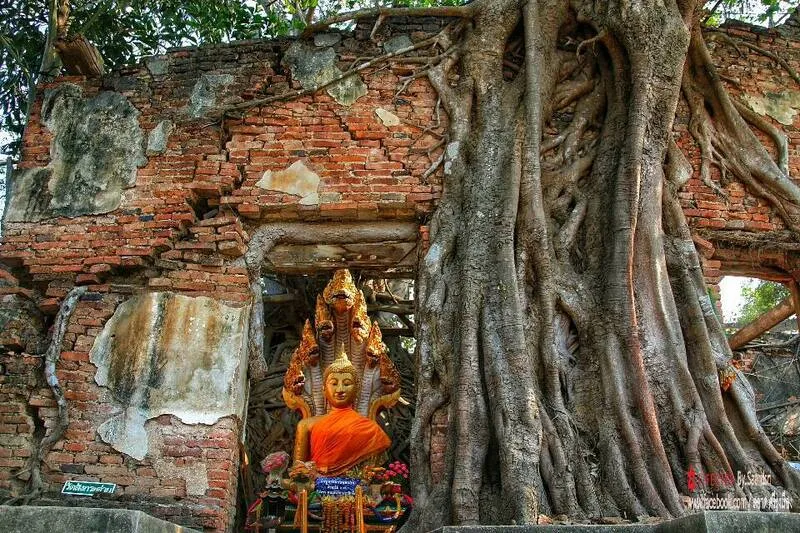
Wat Sang Kratai (formerly known as Wat Sam Kratai) in Sala Daeng Subdistrict, Ang Thong Province, is one of the Central Thailand destinations where “nature” and “sacred architecture” coexist in the most striking way. The old ordination hall is enveloped by 4 bodhi trees whose roots wrap and brace the building like 4 natural pillars at the corners. At the same time, there is a memorable viewpoint through a window opening where the main Buddha image inside aligns perfectly in the frame. This visual has become an iconic impression for many visitors and is the main reason Wat Sang Kratai is often described as a “must-stop” when traveling in Ang Thong.
Wat Sang Kratai is located in Sala Daeng Subdistrict, Ang Thong Province, not far from the town center. It is therefore suitable for a half-day visit or as one stop in a temple-hopping and city exploration itinerary. The highlight here is not the grandeur of a large, fully active monastery with resident monks, but rather the quiet charm of a “deserted temple site” where significant remnants remain for visitors to explore slowly and read the past through what still physically exists on the ground.
Local accounts and multiple travel sources consistently note that Wat Sang Kratai was formerly called “Wat Sam Kratai,” and that it is an ancient temple associated with early settlement in the Sala Daeng area. What makes this story feel “tangible” is not a broad claim of age, but the fact that the old ordination hall still retains enough proportion and structural form to be observed. Even though time has pushed the building out of regular use and left it weathered, the site remains readable as a once-functioning sacred space.
The heart of Wat Sang Kratai is the “old ordination hall” that has become a provincial landmark precisely because 4 bodhi trees have grown around it and embraced it. The roots act like a natural bracing framework, gripping the walls and key structural zones near the corners so neatly that it feels as if nature intentionally designed the fit. This is not merely a photogenic backdrop. It is a living scene that allows visitors to witness the relationship between “religious architecture” and “nature” at close range in a way that is rarely seen at ordinary temples.
Standing near the hall, you can still read traces of craftsmanship in the brick, plaster, and window openings. At the same time, the tightly wrapped roots create a new surface that no human designed: organic lines that grew little by little until they became part of the building itself. Many visitors describe this as seeing “change over time” in its most direct form. The temple may have stopped its former role as a monastery with resident monks, but it has not disappeared from the city’s memory. It continues to function as a silent historical witness and a cultural learning site in the present.
Another unmissable viewpoint is the “window opening” of the old hall. If you stand at the right spot and look through the opening, the main Buddha image inside aligns perfectly within your line of sight. The Buddha framed by an aged window and surrounded by bodhi roots outside becomes an image with both artistic depth and a calm, contemplative atmosphere. For those focused on photography, it is best to take your time, keep a respectful distance, avoid climbing, avoid leaning on the window edges, and stay away from areas that could risk damage to the structure.
A commonly repeated detail about the old hall is that it is arranged as a 3-chamber space: the central chamber houses the principal Buddha image, with 2 smaller Buddha images also placed within the building. Even if visitors cannot enter the interior at all times, viewing from outside still provides a clear sense of the original layout and helps explain that this was once a carefully organized ritual space.
Today, Wat Sang Kratai is widely described as a site with “no resident monks,” making it better suited to cultural travel and documentary-style photography than to visitors looking for the full range of temple activities found at an active monastery. Even so, basic temple etiquette still applies. Dress modestly, keep your voice low, do not leave trash, do not move bricks, plaster fragments, or any materials, and avoid pulling or forcefully touching the bodhi roots. Small actions that seem harmless can accumulate into real damage over time.
There are 2 practical ways to plan a satisfying visit. The first is a short stop of about 30–60 minutes to walk around the old hall, capture the window viewpoint, and fully appreciate how the roots embrace the structure. The second is to include Wat Sang Kratai as part of a serious Ang Thong day trip, pairing it with major temples and learning sites in the province, such as temples known for giant Buddha images, famous reclining Buddha temples, or local museums. This type of route lets you see Ang Thong through both contemporary temple culture and older historical remnants in a single day.
The best time to visit is in the morning or late afternoon, when the natural light is softer and gives the brick, plaster, and roots a more dimensional, photogenic texture. Midday heat in the Central Plains can be intense. If you must visit during strong sun, bring drinking water, a hat, or an umbrella, and allow enough time to walk slowly and safely, especially on uneven ground or where loose brick fragments may be present, which is common at deserted temple sites.
Getting There You can reach Wat Sang Kratai from the Asia Highway (Highway 32) by heading into Ang Thong town, crossing the Chao Phraya River bridge, then continuing straight toward the area near the provincial prison zone. Watch for signs indicating “Wat Sang Kratai” in the Sala Daeng area. When you see the sign, turn into the lane associated with Sala Daeng Municipality and continue for about 500 meters to reach the temple. Traveling by car or motorbike is the most convenient option, as the final approach is within a community road network and it is easy to continue onward to other city attractions.
On arrival, it is best to begin from a point where you can see the whole ordination hall at once to “read the overall picture” of how the bodhi roots embrace the building. Then walk around slowly to observe details from different angles, especially the corner-root contact points and the window viewpoint that frames the Buddha image inside. This approach helps you capture both wide and storytelling angles while respecting the site and avoiding unnecessary proximity to fragile areas.
Wat Sang Kratai is ideal for travelers who enjoy cultural destinations that are “quiet but full of stories.” It is a place where visiting a temple is not only about worship, but also about seeing the layers of time in a town, understanding how a temple’s role can change, and witnessing how nature can become seamlessly integrated into a sacred structure. If you are looking for a uniquely photogenic and distinctive Ang Thong stop, Wat Sang Kratai is well worth seeing in person.
| Place Name | Wat Sang Kratai (Deserted Temple Site) |
| Address | Sala Daeng Subdistrict, Mueang Ang Thong District, Ang Thong 14000, Thailand |
| Summary | An ancient temple site now considered deserted, famous for its old ordination hall embraced by 4 bodhi trees whose roots naturally brace the structure. A signature viewpoint through a window opening frames the main Buddha image inside. Close to Ang Thong town and ideal for cultural travel and photography. |
| Highlights | Old ordination hall wrapped by 4 bodhi trees like 4 natural corner pillars, rare nature–architecture fusion, window viewpoint that frames the Buddha image perfectly, quiet atmosphere for cultural exploration and photography. |
| Recorded Historical Notes | Formerly known as “Wat Sam Kratai”; recorded locally as an ancient temple site in Sala Daeng; associated in some records with a founder named “Thuat Ti Chandanasewi” (mother of Phra Hatsakan); currently described as having no resident monks. |
| Name Origin | Recorded former name “Wat Sam Kratai,” currently known as “Wat Sang Kratai.” |
| Current Status | Deserted temple site; visited as a local cultural attraction/learning spot. |
| Open Days | Daily |
| Opening Hours | 08.00 – 17.00 |
| Fees | No official entrance fee information found (commonly visited free of charge). |
| Facilities | Walking and photography area within the temple grounds (bring water/hat during strong sun). |
| Caretaker / Abbot (Latest) | Deserted temple site; no resident abbot. Local coordination at Sala Daeng Municipality: Tel. 035-613-920 |
| Nearby Tourist Attractions (Driving Distance) | 1) Wat Ton Son (Mueang Ang Thong) – approx. 4 km 2) National Museum / Ang Thong town learning zone – approx. 3 km 3) Wat Khun Inthapramun (Reclining Buddha) – approx. 22 km 4) Wat Chaiyo Worawihan – approx. 16 km 5) Wat Muang (Giant Buddha) – approx. 20 km |
| Popular Restaurants Nearby (Driving Distance) | 1) Lek Ban Ro – approx. 4 km – Tel. 035-612-070 2) Niramit Restaurant – approx. 3 km – Tel. 035-631-052, 081-852-4777 3) Pinto Restaurant – approx. 18 km – Tel. 035-662-589, 085-182-5479 4) Laila Chicken Biryani (Halal) – approx. 18 km – Tel. 081-946-3632 5) Bohk Toh Restaurant – approx. 6 km – Tel. 065-275-1898 |
| Popular Accommodations Nearby (Driving Distance) | 1) Bualuang Hotel (Ang Thong) – approx. 4 km – Tel. 035-611-116, 035-611-800 2) Bualuang Boutique Resort – approx. 7 km – Tel. 081-495-8884, 035-949-850 3) Suphorn Grand Hotel – approx. 5 km – Tel. 081-551-2828 4) Rim Chon Resort – approx. 4 km – Tel. 035-851-577 5) Panpree Resort (Ang Thong) – approx. 18 km – Tel. 035-632-678, 089-744-5384 |
Frequently Asked Questions (FAQ)
Q: What days is Wat Sang Kratai open?
A: It is open daily.
Q: What are the opening hours of Wat Sang Kratai?
A: The usual visiting hours are 08.00 – 17.00.
Q: Where is Wat Sang Kratai located?
A: It is in Sala Daeng Subdistrict, Mueang Ang Thong District, Ang Thong Province, close to the town center.
Q: What is the main highlight of Wat Sang Kratai?
A: The old ordination hall wrapped by 4 bodhi trees, whose roots naturally brace the building, plus the window viewpoint that frames the main Buddha image inside.
Q: Is Wat Sang Kratai an active temple with resident monks?
A: It is widely described as a deserted temple site today, so it does not function like an active monastery with resident monks.
Q: How long should I plan to spend at Wat Sang Kratai?
A: Most visitors spend about 30–60 minutes to walk around, take photos, and enjoy the atmosphere without rushing.
Q: What should I be careful about when visiting a deserted temple site?
A: Avoid climbing or leaning on fragile structures, watch for uneven ground and loose bricks, dress modestly, keep noise low, do not leave trash, and do not move any material from the site.
Tel : 035613920
 Tel : 035613920
 Category: ●Places of Worship
 Group: ●Temple
Last Update : 8 MonthAgo
 Last Update : 8 MonthAgo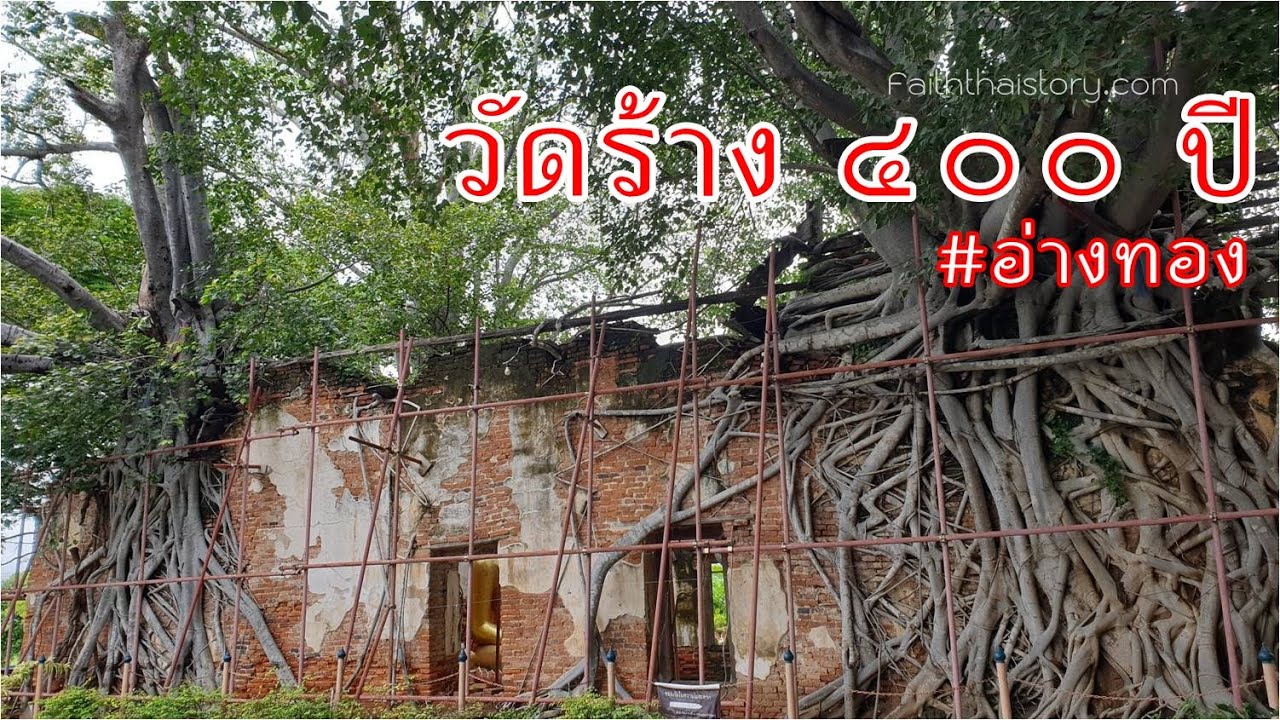
 Click to Access the Navigation Map GPS
Wat Sang Kratai Map
Recommend

 Art, Culture and Heritage
 Landmarks and Memorials(2)
 Royal Palace(1)
 Art, Craft Centres, Tradition(2)
 Museums(2)
 Historic Homes and Cities(1)
 Educational Places
 Educational Gardens, Farm(1)
Temple(64)
Educational Gardens, Farm(1)
Temple(64)
 Other Sacred Sites(4)
 Research and Development
 Royal Project(2)
 Suburban Living
 Village, Community(16)
 Local Market(1)
 Floating Market(1)
 Nature and Wildlife
 River, Canal(5)
 Other natural attractions(3)
 Entertainment and Agricultural
 Farms, Parks and Ecotourism(4)
 Outdoor and Adventure Activities(1)
 Shopping
 Shopping and Night Market(1)
 Travel Articles, Recipes
 Travel Review, Food Review(1)
 Central Thai Cuisine, Central Thai food recipes(1)


