
TL;DR: Wat Lan Chang is located at Moo 2, Rural Highway AT.7069, Lak Kaeo Subdistrict, Wiset Chai Chan District, Ang Thong 14110, open Open daily, hours 06:00 – 18:00.
Wat Lan Chang
Open Days: Open daily
Opening Hours: 06:00 – 18:00
Wat Lan Chang is located in Moo 2, Lak Kaeo Subdistrict, Wiset Chai Chan District, Ang Thong Province. It is an old temple in the central river-basin community that has been closely tied to local people for a long time. Although it is not a large temple with nationwide fame like some of Ang Thong’s best-known temples, the charm of Wat Lan Chang lies in its simplicity, tranquility, and genuine identity as a community temple. Visitors who arrive here often immediately sense the atmosphere of a rural temple that has gently preserved the original roots of the community, whether in terms of religion, shared memory, or stories passed down through many generations.
If Wat Lan Chang is viewed only as a place for Buddhist rituals, its full value may still not be completely understood. In reality, the temple has always served a role far beyond that. It is a center of faith, a spiritual refuge for local people, a venue for merit-making ceremonies and traditions, a gathering place where community members meet and support one another, and a space that clearly reflects the rural way of life in Wiset Chai Chan District. Visitors therefore come not only to pay respect to the Buddha, but also to witness the living relationship between temple and community.
The area of Lak Kaeo Subdistrict and the surroundings of Wat Lan Chang form an agricultural community in the lowland plains, historically connected to canals and local transport routes. The landscape of rice fields, embankments, rural roads, and houses spread out at modest distances creates a peaceful and friendly atmosphere typical of traditional Ang Thong. Most residents of Lak Kaeo are tied to agriculture, small-scale trade, and community activities centered on the temple. For this reason, when speaking of Wat Lan Chang, it is impossible to separate the temple from the history of Lak Kaeo itself.
Although Lak Kaeo may not have a long written chronicle like a major ancient town, the identity of this community is clear as a rural settlement that grew from the fertility of the river plain. The names of villages, canals, and temples in the surrounding area all reflect the roots of settlement based on water and rice fields. Earlier generations used canals as travel routes, farmland as their livelihood, and the temple as a place for rituals, education in earlier times, and community meetings during important occasions. Wat Lan Chang is deeply intertwined with this local historical landscape.
According to recorded information, Wat Lan Chang is a royal-chartered local temple under the Mahanikaya sect and was established in 1899. This shows that the temple has existed for well over a century. It is therefore not merely a sacred site for people today, but also a place that has carried the traces of faith since at least the late reign of King Rama V. Over time, the temple has been cared for, restored, and improved through the support of the community and the clergy, gradually becoming the spiritual center of the people of Lak Kaeo as it remains today.
Another piece of information confirming the temple’s development is that it received royal consecrated boundary status on June 12, 1999. This event is important in terms of the temple’s formal standing, as it reflects that the area for monastic rites was officially recognized. It also marks another milestone showing that Wat Lan Chang has not remained only a historically old temple, but has continued to play an active and meaningful role in the community into the present era.
What makes the name of Wat Lan Chang distinctive and memorable is the story behind the name “Lan Chang,” which local residents have long passed down. They say that in the past this area was once a place where wild elephants walked through or rested while moving across the natural landscape surrounding the community. This oral memory may not always appear in detailed official documents from every period, yet it remains deeply rooted in local awareness. The name “Lan Chang” therefore does more than indicate a location; it preserves a shared memory of the community.
In a local context, the word “lan” can also suggest an open area used communally, a yard for activities, a resting ground, or a place where people or animals gather. When combined with the word “chang,” meaning elephant, it gives the temple’s name a rich narrative dimension and strong imagery. For local people, this is not merely a proper name, but a cultural clue that reveals the relationship between humans and nature in the past. Wat Lan Chang is therefore a fine example of a Thai temple whose name tells the story of its place without needing lengthy explanation.
One of the features visitors often notice upon arriving at Wat Lan Chang is the elephant statues placed around the ordination hall. This detail carries important symbolic meaning, as it allows the story associated with the temple’s name to appear not only in oral tradition, but also in tangible artistic form. These elephant statues function both as symbols and as vessels of memory, linking the physical space of the temple with the legend of the community in a concrete way.
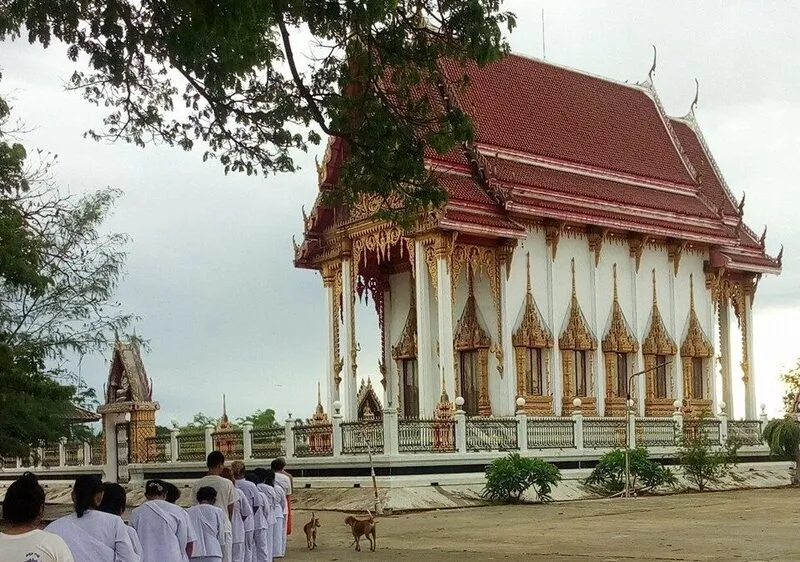
The ordination hall of Wat Lan Chang is graceful in the style of traditional Thai temple architecture. Although it does not emphasize grandeur on the scale of major tourist temples, it conveys a sense of stability, peace, and restraint typical of a central Thai community temple. The structure and decorative details reflect the dedication of the people who have helped maintain the temple over different periods. The beauty of Wat Lan Chang does not come from extravagance, but from simplicity rooted in the genuine faith of the community.
Inside the ordination hall is the principal Buddha image, which serves as the spiritual focus for villagers and visitors who come to make merit. Some may assume that principal Buddha images in rural temples look similar, but when one experiences the atmosphere in person, it becomes clear that the “sacredness” of such an image often comes more from the relationship between people and place than from scale or fame. Many elderly residents grew up visiting this temple from childhood and hold memories of making merit here with parents and grandparents. It is therefore unsurprising that the principal Buddha image of Wat Lan Chang holds deep emotional meaning.
Another interesting community story is the way local people regard Wat Lan Chang as truly being “the temple of the home.” The meaning of this phrase goes deeper than simply describing a temple near one’s house. It refers to a temple in which people feel personally involved: they join in merit-making, help care for the temple, co-host events, and take responsibility for ensuring that it continues to endure. In many rural central Thai communities, the strength of a temple does not come from large budgets, but from the small yet continuous faith of many people. Wat Lan Chang is one such example.
The way of life in Lak Kaeo, both in the past and in the present, is clearly tied to the rice-growing cycle and merit-making traditions. After harvest season or during major Buddhist festivals, the temple often becomes especially lively. People dress simply, bring food trays or offerings into the temple, children run around the temple grounds, elders sit talking beneath the trees, and announcements about merit-making events can be heard through the temple’s loudspeakers. These images show that Wat Lan Chang is still a living place, not merely a site for photography-based tourism.
Wat Lan Chang also plays a role in the traditional relationship between “temple, home, and school,” which has long been a significant social structure in Thai communities. Near the temple is Wat Lan Chang Rattanarat Rangsan School, which clearly reflects that the temple’s role here is not limited to religion, but is also connected to education and the moral upbringing of young people. The temple and school are close not only physically, but also in social function. This is a notable feature of rural central Thai communities that have preserved traditional bonds well.
In terms of atmosphere, Wat Lan Chang feels different from larger tourist temples crowded with visitors, because this place moves at its own pace. The quietness of the area allows visitors to hear the wind, birds, and the sounds of temple activities more clearly than in an urban temple. Walking slowly around the ordination hall, looking at the elephant statues, feeling the breeze from the open grounds, and then pausing to pay respect inside the hall is an experience better suited to those seeking calm rather than spectacle.
The appeal of Wat Lan Chang lies in the balance of everything. The temple does not try to be more than what it is, yet it remains beautiful because it has preserved the essence of a community temple in full: faith, quietness, ties to rice fields and rural roads, shared memories, and a space for merit-making events that continue without interruption. For travelers who enjoy discovering places with stories rather than fame, Wat Lan Chang is a destination of real value.
In terms of local history, Wiset Chai Chan District itself is an area rich in important temples and old communities. This means that Wat Lan Chang does not stand in isolation, but is part of a wider Buddhist cultural network in Ang Thong. Not far from the temple are Wat Muang, Wat Khun Inthapramun, Wat Chaiyo Worawihan, and the historic community area of San Chao Rong Thong Market. A visit to Wat Lan Chang can therefore be extended into a one-day cultural itinerary, beginning with a community temple rich in local stories and continuing to other major destinations in the province.
When considered in terms of symbolic meaning, Wat Lan Chang is also an interesting place that reflects traditional Thai community thought. In other words, the temple is not separate from daily life, but embedded within it. The temple’s name is tied to the original landscape, temple activities are tied to the community calendar, its buildings are tied to the faith of local people, and those who care for the temple are individuals whom villagers know in everyday life. The presence of Wat Lan Chang is therefore like a confirmation that the social structure centered on the temple still holds meaning in some Thai communities today.
For those interested in the history of Lak Kaeo, looking at Wat Lan Chang as a starting point makes the community easier to understand, because the temple functions like a cultural map of the area. Lak Kaeo may not receive much attention in mainstream tourism promotion, but when viewed through Wat Lan Chang, it becomes clear that the area holds considerable cultural capital, including local storytelling, place names, agricultural life, and the continuity of community traditions. A journey to Wat Lan Chang is therefore a way of accessing “another side of Ang Thong” that is closer to local life than simply checking in at famous landmarks.
Another image often found at rural temples like Wat Lan Chang is that the temple still serves as a place of emotional comfort when the community faces hardship, whether personal sorrow, economic challenges, or periods of social transition. Many people still choose to come to the temple to sit quietly, pay respect to the Buddha, make merit, or speak with monks. This is a simple but very important role, because it allows the temple to remain a genuine spiritual refuge, rather than merely a cultural symbol left standing without function.
The abbot and resident monks therefore play an important role in sustaining both religious activities and the temple’s relationship with the community. According to the most recently updated public information, Wat Lan Chang is under the care of Phra Athikan Sukphot Sukkhawatthano. This reflects that the temple continues to function actively and has not become an abandoned site left only in memory. The continued appearance of temple activities and merit-making announcements on public channels further confirms that the surrounding community remains engaged with the temple.
During important festivals such as Songkran, robe-offering ceremonies, kathin, or annual merit-making events, Wat Lan Chang often becomes especially vibrant. Images of bathing Buddha images, pouring water to ask blessings from elders, villagers gathering together, and people preparing food collectively all highlight the value of the temple as a community center. These traditions may appear ordinary to those familiar with them, but in truth they are cultural capital that helps keep the community cohesive and are something many places are gradually losing.
Wat Lan Chang is therefore especially suitable for those who enjoy in-depth cultural travel without rushing and who want to understand the “meaning of a place” more than simply looking for attractive photo spots. Visitors can take time to walk around the ordination hall, pay respect to the principal Buddha image, observe the elephant statues surrounding the temple, speak with local people, and watch the rhythm of life around the temple. If one comes on a day when the temple is hosting merit-making activities or villagers are present, the atmosphere of a true community temple becomes even clearer than on an ordinary day.
From the perspective of conservation, Wat Lan Chang is a good example of a place that deserves attention as a community-level cultural heritage site. Its value does not lie in fame, but in the continuity of the relationship between people and place. Temples of this kind are often overlooked compared with major landmarks, yet they are in fact an essential foundation of local identity. If such community temples were to weaken one day, what would be lost would not be only religious buildings, but also the structure of shared memory and local attachment.
For writers, researchers, or those interested in local culture, Wat Lan Chang is also a strong example for studying the meaning of place names and the transmission of community stories. A temple name connected to a large animal in the original landscape, such as “elephant,” reveals many things: the memory of the place in the past, a naming tradition centered on nature, and the way communities use stories to preserve their identity. These aspects make Wat Lan Chang far more interesting than simply being a stop for paying respect to the Buddha along the way.
Traveling to Wat Lan Chang today is much more convenient than in the past. The temple stands along a local road connected to the main routes of Wiset Chai Chan District. Those driving from Ang Thong town can reach it without difficulty. As one enters Lak Kaeo Subdistrict, the atmosphere on both sides of the road gradually shifts from denser community areas to scenes of rice fields, houses, and countryside roads. This gradual transition of landscape helps prepare visitors to enter the atmosphere of the temple naturally.
From Bangkok, those driving can head into Ang Thong and continue toward Wiset Chai Chan District, then enter Lak Kaeo Subdistrict by following local signs or navigation systems. Once near the temple, the rural roads are generally smooth and easy to travel, with communities scattered along the way. Those relying on public transportation can first travel to Ang Thong town or Wiset Chai Chan District and then continue by local transport or hired vehicle for the final stretch to the temple.
One advantage of planning a trip to Wat Lan Chang is that it connects easily with nearby attractions. Those interested in temple visits may combine it with Wat Muang, Wat Khun Inthapramun, and Wat Chaiyo Worawihan in a single day. Those who enjoy historic community atmospheres can also continue on to San Chao Rong Thong Market. Planning a route in this way makes Wat Lan Chang not just a standalone destination, but part of a wider cultural travel network in Ang Thong with greater experiential depth.
For those seeking peace and quiet, Wat Lan Chang is ideal to visit in the early morning or late morning, when the light is still soft, the weather is not yet too hot, and the temple grounds feel especially open and airy. Arriving at this time makes it easier to appreciate the details of the ordination hall, the elephant statues, and the surrounding space. If one intends to photograph the atmosphere of a rural temple, the morning light and the lines of fields around the temple help bring the story of the place into sharper focus.
On the other hand, if one visits during a merit-making event, another dimension of Wat Lan Chang becomes visible: the dimension of a “living” community temple. It is not only architecture or silence, but the sight of people coming and going, temporary kitchens, villagers’ cars lined up, and the sounds of greeting and mutual help among local people. This kind of atmosphere makes Wat Lan Chang even more meaningful, because it shows clearly that the temple is still truly the heart of the community.
In summary, Wat Lan Chang is a temple with multiple layers of value at the same time. The first is religious value as a place for merit-making and paying respect to the principal Buddha image. The second is historical value as an old temple established in 1899. The third is cultural value as a place that preserves the story of “Lan Chang” and reflects the relationship between community and nature. The final layer is social value as a center of life for the people of Lak Kaeo up to the present day.
For these reasons, Wat Lan Chang deserves to be written about in detail, not simply as one temple in Ang Thong, but as a place that beautifully reflects the way of life of a central Thai community. If you are drawn to temples with real meaning, local stories, tranquility, and the opportunity to experience local life at close range, Wat Lan Chang is a destination not to be overlooked. And once you have visited, you may find that its true charm lies in a quiet simplicity that gradually settles into memory rather than in any sudden spectacle.
Getting There Wat Lan Chang is convenient to reach by private car. Head toward Wiset Chai Chan District in Ang Thong Province, then turn into Lak Kaeo Subdistrict via the local roads. The temple is situated along Rural Highway AT.7069. The surrounding area is made up of local communities and agricultural land, making it easy to locate with navigation apps. If traveling from Ang Thong town, the journey takes only a short time, and the temple can easily be included in the same itinerary as Wat Muang, Wat Khun Inthapramun, or San Chao Rong Thong Market.
| Name | Wat Lan Chang |
| Address | Moo 2, Rural Highway AT.7069, Lak Kaeo Subdistrict, Wiset Chai Chan District, Ang Thong 14110 |
| Summary | An old temple in Lak Kaeo that clearly reflects the relationship between the temple, the agricultural community, and the local story associated with “Lan Chang.” |
| Highlights | A temple name linked to wild-elephant lore, elephant statues around the ordination hall, and a peaceful community-temple atmosphere that remains meaningful to local people |
| Temple Type | Royal-chartered local temple under the Mahanikaya sect |
| Historical Background | Established in 1899 and granted royal consecrated boundary status on June 12, 1999 |
| Name Origin | Local people say this area was once a place where wild elephants passed through or rested, so it came to be called “Lan Chang,” and the temple adopted the same name |
| Principal Buddha Image | The principal Buddha image inside the ordination hall of Wat Lan Chang, which serves as the spiritual focus for local residents of Lak Kaeo and nearby areas |
| Current Abbot / Caretaker | Phra Athikan Sukphot Sukkhawatthano |
| Key Features | Traditional Thai ordination hall, elephant statues around the hall, rural community atmosphere, and space for merit-making and temple activities |
| Getting There | Drive to Wiset Chai Chan District, then continue into Lak Kaeo Subdistrict via local roads. The temple lies along AT.7069 and connects easily with nearby attractions |
| Current Status | The temple remains active with ongoing religious and community activities, and public announcements for merit-making events continue to appear |
| Nearby Tourist Attractions | 1. San Chao Rong Thong Market – approx. 9 km 2. Wat Muang – approx. 11 km 3. Wat Khun Inthapramun – approx. 14 km 4. Wat Chaiyo Worawihan – approx. 23 km 5. Wat Ton Son, Ang Thong – approx. 22 km |
| Popular Restaurants Nearby | 1. Ruen Rab Kwan – approx. 12 km. Tel. 061-997-8987 2. Niramit – approx. 17 km. Tel. 035-631-052, 081-852-4777 3. The Lao Cafe & Steak Wiset Chai Chan – approx. 21 km. Tel. 095-845-2987, 081-994-1752, 080-760-7500 4. Pinto – approx. 24 km. Tel. 035-662-589, 085-182-5479 5. Flamingo Cafe & Restaurant – approx. 26 km. Tel. 089-160-4373 |
| Popular Accommodations Nearby | 1. Blue House Ang Thong – approx. 23 km. Tel. 080-640-9465 2. Bualuang Hotel Ang Thong – approx. 24 km. Tel. 080-922-4040, 035-611-116 3. Ratchapruek Apartment Ang Thong – approx. 24 km. Tel. 035-614-144, 092-918-6034 4. Suphorn Grand Hotel Ang Thong – approx. 26 km. Tel. 081-551-2828 5. Malai Thong Hotel Ang Thong – approx. 27 km. Tel. 081-874-1322, 096-698-9551 |
Frequently Asked Questions (FAQ)
Q: Where is Wat Lan Chang located?
A: Wat Lan Chang is located in Moo 2, Lak Kaeo Subdistrict, Wiset Chai Chan District, Ang Thong Province, along Rural Highway AT.7069.
Q: What is the history of Wat Lan Chang?
A: Wat Lan Chang is a Mahanikaya temple established in 1899 and granted royal consecrated boundary status on June 12, 1999.
Q: Why is it called Wat Lan Chang?
A: Local people say that in the past this area was once a place where wild elephants passed through or rested, so it became known as “Lan Chang,” and the temple adopted that name.
Q: What are the highlights of Wat Lan Chang?
A: The highlights include the story associated with wild elephants, elephant statues around the ordination hall, a peaceful atmosphere, and the temple’s continuing role as a true community temple in Lak Kaeo.
Q: What type of travel is Wat Lan Chang suitable for?
A: It is ideal for cultural travel and temple visits, especially for those who enjoy community temples, peaceful surroundings, and local stories rather than mainstream tourist spots.
Q: How do I get to Wat Lan Chang?
A: You can drive from Ang Thong town or Wiset Chai Chan District into Lak Kaeo Subdistrict. The temple is located along AT.7069 and is easy to find using navigation apps.
Q: What can I visit after Wat Lan Chang?
A: You can continue your trip to San Chao Rong Thong Market, Wat Muang, Wat Khun Inthapramun, Wat Chaiyo Worawihan, and Wat Ton Son in Ang Thong on the same day.
 Category: ●Places of Worship
 Group: ●Temple
 Last Update : 4 WeekAgo
 Click to Access the Navigation Map GPS
 Art, Culture and Heritage
 Landmarks and Memorials(
 Royal Palace(
 Art, Craft Centres, Tradition(
 Museums(
 Historical Houses and The Ancient City(
 Educational Places
 Educational Gardens, Farm(
 Other religious and spiritural sites(
 Research and Development
 Royal Project(
 Suburban Living
 Village, Community(
 Local Market(
 Floating Market(
 Nature and Wildlife
 River, Canal(
 Other natural attractions(
 Entertainment and Agricultural
 Farm, Parks, Gardens and Ecotourism(
 Outdoor and Adventure Activities(
 Shopping
 Shopping and Night Market(
 Travel Articles, Recipes
 Travel Review, Food Review(
 Central Thai Cuisine, Central Thai food recipes(


