
lovethailand home >Central Travel Attractions
>Ang Thong Travel Attractions >Wiset Chai Chan
>Huai Khan Hae Lon
> Wat Huai khan Laen
TL;DR: Wat Huai khan Laen is located at Huai Khan Laen Subdistrict, Wiset Chai Chan District, Ang Thong 14110, open Open Daily, hours 08:00 – 17:00.
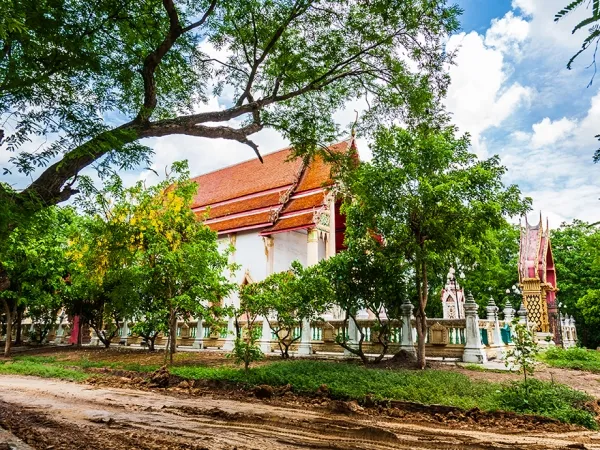
Wat Huai khan Laen
Open Days: Open Daily
Opening Hours: 08:00 – 17:00
Wat Huai Khan Laen is located in Huai Khan Laen Village, Huai Khan Laen Subdistrict, Wiset Chai Chan District, Ang Thong 14110. It is a long-established community temple in Thailand’s central plains, deeply connected to local life over generations. The key object of faith is “Luang Pho Ong Yai”, a revered Buddha image that locals regularly come to pay respects to on important Buddhist days such as Visakha Bucha Day, the Buddhist Lent period, and annual merit-making festivals. The temple includes the essential monastic structures, including an ordination hall and a sermon hall, and continues to serve as a hub for merit-making, listening to Dhamma teachings, and community activities. It suits visitors who want a calm temple stop, a real-life “working” central-Thai community temple experience, and a quiet break while traveling in Ang Thong. Most visitors typically spend around 30 – 60 minutes here, or longer if they wish to sit quietly and take in the atmosphere.
Wat Huai Khan Laen is located in Huai Khan Laen Village, Huai Khan Laen Subdistrict, Wiset Chai Chan District, Ang Thong 14110. The temple has long been a spiritual anchor for local residents and offers a clear, tangible meaning of what a “community temple” truly is. Its importance is not limited to major merit-making days. People return here whenever they want to calm the mind, make merit, or meet one another within a pace of life that is not overly rushed. Temples like this matter both as sacred places and as shared community spaces that quietly sustain relationships and mutual trust over time.
The wider setting of Wiset Chai Chan and surrounding subdistricts in Ang Thong sits within the central plains, shaped by agriculture, waterways, and village communities where mutual support has traditionally been strong. Homes and farmland tend to be near local roads and canals, which once functioned as the lifeblood of everyday movement and trade. When a settlement becomes stable, a temple is commonly established to serve as the village center – for religious rites, learning, transmitting beliefs, and creating a place where people can do good together. Wat Huai Khan Laen reflects this central-Thai pattern clearly: it has grown alongside the village in a natural way and continues to hold its role steadily even as the outside world changes rapidly.
In terms of history, Wat Huai Khan Laen is described as an old temple with roots reaching back to earlier times, with local understanding suggesting it may have taken shape in the early Rattanakosin period or possibly even earlier. While official founding details are not widely published in the same way as for major royal temples or prominent city monasteries, the “age” of a community temple is often best read through the continuity of practice – recurring merit-making, festivals, and rituals repeated year after year without interruption. This continuity is a strong social record showing that the site has long served as a center of faith, and that the community has deliberately preserved this spiritual space for future generations.
One reason Wat Huai Khan Laen is well known among locals and visitors is “Luang Pho Ong Yai”, a Buddha image held in especially high reverence. For the community, Luang Pho Ong Yai is not simply a statue placed within the temple grounds, but a focal point that brings a sense of steadiness and reassurance when people come to pay respects. Many visitors set their intention for health, family well-being, smoothness in work and livelihood, or the strength to get through difficult periods with a steadier heart. A revered Buddha image like this makes the temple more than a place for ceremonies; it becomes a quiet, ongoing space of emotional support for the community.
On important Buddhist occasions such as Visakha Bucha Day, Makha Bucha Day, Asalha Bucha Day, and during the Buddhist Lent and post-Lent periods, the temple atmosphere becomes noticeably livelier. Villagers come to make merit, offer alms, listen to Dhamma, or join ceremonies in line with local tradition. Community temples in the central plains are distinctive because merit-making is not only a ritual but a collective effort. People help set up spaces, prepare food, arrange communal kitchens, manage offerings, and welcome those who attend. This shared work becomes a practical form of social capital that strengthens the community and helps the temple remain a genuine village center.
As visitors enter the grounds of Wat Huai Khan Laen, they often feel a calmness typical of community temples that have not been over-shaped into purely touristic venues. This calm arises naturally from the place itself: people come here to make merit and train the mind, so the pace slows down, voices soften, and the overall environment gently encourages inner stillness. A temple that is still actively used in everyday life can feel different from a major city temple. Visitors see real local rhythms – simple merit-making corners, attention to cleanliness, shaded trees maintained over time, and the friendly presence of people who know the place well.
The core structures at Wat Huai Khan Laen include an ordination hall, which is the sacred space for important rites, and a sermon hall, which functions as a flexible communal area supporting a wide range of activities. Many community temples keep a simple but meaningful ordination hall, because it is where people come to pay respects, make aspirations, and participate in life milestones – ordinations, memorial merit-making, and key ceremonies across the Buddhist calendar. The sermon hall strengthens the temple’s role as a true community center, because it can host gatherings, sermons, merit-making events, and organized village activities in a practical, structured way.
The temple’s role within the village goes beyond ritual practice. It includes sharing Dhamma, encouraging learning, and providing community activities that build cohesion. The temple is a place where children and youth learn respectful conduct in sacred spaces, absorb the value of giving through merit-making, and practice discipline through activities shared with older community members. Adults and elders use the temple as a place to rest the mind, meet others, and keep a spiritual rhythm within everyday life. In this way, the temple functions like a quiet, enduring system of community care that does not need publicity to be effective.
From a cultural-travel perspective, Wat Huai Khan Laen is best suited to a “temple stop and community learning” style of visit rather than fast-paced sightseeing. Visitors can spend time absorbing the atmosphere, paying respects to Luang Pho Ong Yai, and observing how central-Thai community temples organize their spaces – typically orderly, understated, and designed for real use. This kind of visit offers a different outcome than photography-focused travel: it brings calm and a clearer understanding of how the temple and village remain closely connected, which is part of Ang Thong’s softer, more genuine cultural appeal.
The most comfortable time to visit is in the morning, when the air is usually cooler and the atmosphere is calmer, making it well suited to paying respects, setting one’s intention, and walking around slowly. Afternoon visits can work well as a merit-making stop during travel. If the aim is deep quiet, avoiding major festival times can help maintain a more still atmosphere. However, if visitors want to understand local culture, visiting on a merit-making day provides a valuable chance to see community cooperation and the lived reality of a village temple.
Appropriate temple etiquette begins with modest dress and avoiding overly short or tight clothing. Visitors should keep their voices at a reasonable level, avoid cutting through areas where ceremonies are taking place, and show respect to monks and those practicing meditation or Dhamma. If taking photos, choosing angles that do not disturb others is important, and it is best to avoid photographing in ways that may affect sacredness or the privacy of worshippers. Respectful conduct helps ensure the visit is a positive experience both for visitors and for the community that maintains the temple as a living place of faith.
For those who wish to make merit, community temples typically allow several forms of merit-making, from simple donations and offering alms, to making offerings such as Sangha donations, joining festival merit-making, or becoming a sponsor for certain temple activities on special occasions. If someone needs to arrange a specific form of merit-making – dedicating merit to the deceased, funeral chanting, or coordinating ceremonial matters – contacting the temple in advance can help keep arrangements orderly and aligned with monastic schedules, while also ensuring convenience without disrupting temple routines.
Overall, Wat Huai Khan Laen is an old community temple in Wiset Chai Chan that clearly reflects the relationship between religion and village life. Its standout feature is Luang Pho Ong Yai as a central object of faith, alongside a calm, straightforward atmosphere that offers visitors “peace of mind” more than grandeur. A visit here suits travelers seeking Ang Thong in a merit-making and cultural mode, and those who want to experience the sincere quietness of a central-Thai village temple that remains closely tied to its community.
Getting There From Ang Thong city, head toward Wiset Chai Chan District, then continue into Huai Khan Laen Subdistrict and follow local roads into Huai Khan Laen Village to reach Wat Huai Khan Laen. From Bangkok, a common route is Highway 32 through Phra Nakhon Si Ayutthaya into Ang Thong, then continue toward Wiset Chai Chan District before entering Huai Khan Laen Subdistrict. Using navigation and searching “Wat Huai Khan Laen Ang Thong” can help reduce confusion and select the most suitable route at that time.
| Place Name | Wat Huai Khan Laen |
| Summary | A long-established community temple in Huai Khan Laen Subdistrict, Wiset Chai Chan District, Ang Thong. It serves as a local spiritual and merit-making hub and is known for “Luang Pho Ong Yai”, a highly revered Buddha image. The temple includes an ordination hall and a sermon hall supporting ceremonies, Dhamma listening, and community activities in a calm setting. |
| Address | Huai Khan Laen Subdistrict, Wiset Chai Chan District, Ang Thong 14110 |
| Highlights | Luang Pho Ong Yai as the main object of faith, a calm and shaded community-temple atmosphere, and essential structures such as the ordination hall and sermon hall suitable for merit-making, Dhamma listening, and quiet reflection while traveling in Ang Thong. |
| Abbot / Temple Head (Latest) | Phra Khru Si Panya Wat (Thuwan) |
| Contact Number | 035-629-336 |
| Current Status | Open to the public for merit-making, worship, and visits. |
| Nearby Tourist Attractions (Approx. Distance) | 1) Wat Muang (Luang Pho Yai) – approx. 15 km 2) Wat Khun Inthapramun – approx. 18 km 3) Sala Chao Rong Thong Market – approx. 12 km 4) Wat Chaiyo Worawihan – approx. 26 km 5) Ang Thong Town Area (Market / Riverside Zone) – approx. 25 km |
| Popular Restaurants Nearby (Approx. Distance + Phone) | 1) Samoe Jai Garden Restaurant – approx. 14 km – 035-622-755 2) Niramit Restaurant – approx. 11 km – 081-852-4777 3) Dr.Steak (Wiset Chai Chan) – approx. 12 km – 035-632-145 4) Rueanrubkwan – approx. 14 km – 061-997-8987 5) Pad Cham Boat Noodles – approx. 16 km – 097-456-5351 |
| Popular Accommodations Nearby (Approx. Distance + Phone) | 1) Wiset Sabay Resort – approx. 12 km – 081-587-5993 2) Patamanan Residence – approx. 14 km – 095-505-1935 3) Jumbo Villa Resort – approx. 14 km – 085-944-1244 4) Meedee Resort – approx. 16 km – 094-131-8081 5) MOR MOR Resort (Ang Thong) – approx. 28 km – 085-698-3681 |
Frequently Asked Questions (FAQ)
Q: Where is Wat Huai Khan Laen located?
A: Wat Huai Khan Laen is in Huai Khan Laen Village, Huai Khan Laen Subdistrict, Wiset Chai Chan District, Ang Thong 14110.
Q: What is the main highlight of Wat Huai Khan Laen?
A: The key highlight is “Luang Pho Ong Yai”, a highly revered Buddha image, along with the calm, shaded atmosphere of a real-life community temple.
Q: What kind of visit is Wat Huai Khan Laen best for?
A: It suits a calm merit-making and cultural stop in Ang Thong, especially for visitors who want a quiet temple experience connected to local village life rather than a rushed sightseeing style.
Q: How much time should I plan for a visit?
A: Most visitors plan around 30 – 60 minutes for worship and walking around, and longer if they want to sit quietly and absorb the atmosphere.
Q: What is a good time of day to visit?
A: Morning is usually cooler and calmer, while afternoons work well as a merit-making stop during a day trip in Wiset Chai Chan.
Q: Is there a contact phone number for the temple?
A: Yes. The listed contact number is 035-629-336.
Q: What etiquette should visitors follow?
A: Dress modestly, keep voices low, respect ceremonial areas, and avoid disturbing monks or people practicing meditation or Dhamma.
 Category: ●Places of Worship
 Group: ●Temple
 Last Update : 2 MonthAgo
 Click to Access the Navigation Map GPS
 Art, Culture and Heritage
 Landmarks and Memorials(
 Royal Palace(
 Art, Craft Centres, Tradition(
 Museums(
 Historical Houses and The Ancient City(
 Educational Places
 Educational Gardens, Farm(
 Other religious and spiritural sites(
 Research and Development
 Royal Project(
 Suburban Living
 Village, Community(
 Local Market(
 Floating Market(
 Nature and Wildlife
 River, Canal(
 Other natural attractions(
 Entertainment and Agricultural
 Farm, Parks, Gardens and Ecotourism(
 Outdoor and Adventure Activities(
 Shopping
 Shopping and Night Market(
 Travel Articles, Recipes
 Travel Review, Food Review(
 Central Thai Cuisine, Central Thai food recipes(


