
lovethailand home >Central Travel Attractions >Ang Thong Travel Attractions >Pa Mok >Phong Pheng > Wat Phichan Sophon (Wat Mon)
TL;DR: Wat Phichan Sophon (Wat Mon) is located at Phong Pheng Subdistrict, Pa Mok District, Ang Thong Province, Thailand, open Daily, hours 08:00 – 17:00.
Wat Phichan Sophon (Wat Mon)
Open Days: Daily
Opening Hours: 08:00 – 17:00
Wat Phichan Sophon (Wat Mon) in Ang Thong Province is a temple that clearly reflects the long-standing relationship between the Mon people and Thai history at the local level. Stories of settlement, state protection, and collective memories of war have been preserved in the temple’s landscape—from its former name that openly declared the identity of its founders, to the Mon-style chedi that symbolizes the community’s attachment to its original homeland and its enduring faith in a new land. For this reason, the temple is not only a place for merit-making, but also a community monument that safeguards traces of shared memory through architecture, rituals, and oral narratives.
The heart of Wat Phichan Sophon lies in its role as a “temple of dedication”. Local tradition links its origins to the making of merit dedicated to Mon ancestors who died in wartime in the Chao Phraya river basin. Many Mon communities migrated into areas under Ayutthaya’s protection, and during conflicts with Hongsawadi, some Mon volunteers fought alongside the Ayutthaya forces. The losses suffered by the community were transformed into a sacred place—so that merit-making would have a firm home in the new world, and so that the community’s memories could endure.
The temple’s original name was “Wat Mon”, directly reflecting the identity of its founders. The naming story mentions writing the name in Mon script and having a spirit medium read it aloud until the temple received a name that represented the founding community. Over time, the temple was renamed “Wat Phichan Sophon” as part of the modernization and standardization of temple names, yet the original name remains strongly rooted in local memory. Having both an official name and a community-used name shows that this sacred place operates in two worlds at once: the world of the state and the world of the community.
The temple’s most distinctive highlight is its Mon-style chedi, built collectively by the Mon community and revered as a center of faith in the area. In Mon culture, a chedi often functions as the ceremonial core and as a symbol of community identity. Therefore, the presence of a Mon chedi here is not only architectural beauty, but also a visual language of form that tells the story of its builders. It stands as a cultural marker, showing that this community has deep roots and continues to preserve those roots through a sacred space.
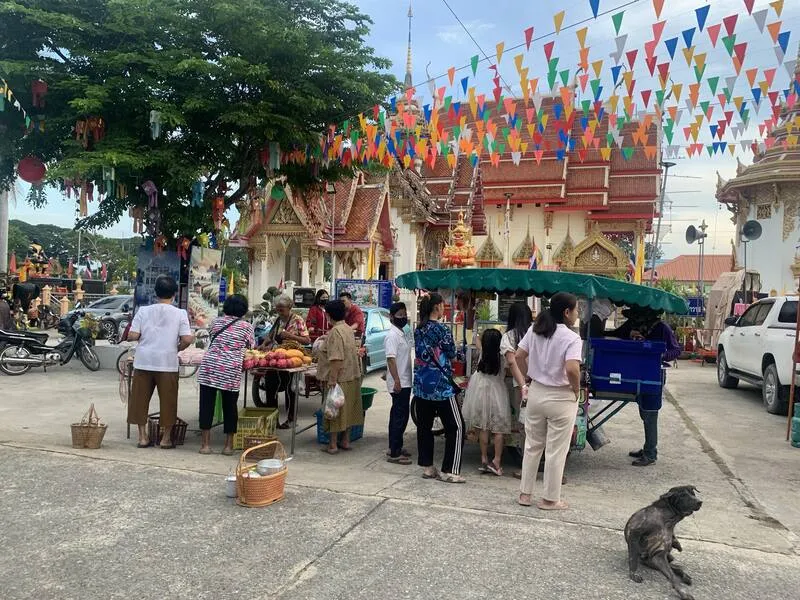
Walking through the temple grounds, visitors can sense the typical layout of a Central Thai temple that supports both religious functions and community life—including an ubosot, sermon hall, chanting hall, and shared spaces that host merit-making throughout the year. The temple’s importance lies in being a living community center, because people continue to make merit and use the space regularly. This continuity ensures that shared memory is not kept only in stories, but remains actively practiced in everyday life.
Another element that clarifies the temple’s identity is the continuity of care through the succession of abbots, which reflects ongoing maintenance and development of the sacred space to suit each era. Wat Phichan Sophon is therefore not only an old temple, but a place that has been consistently cared for so that faith remains strong, and so that key features like the Mon chedi continue to serve as the spiritual anchor of the community.
Visiting Wat Phichan Sophon suits cultural travelers, those interested in Ayutthaya-era history at the local scale, and anyone who wants to see how Mon identity has been expressed in Thailand through architecture and community narratives. It is recommended to explore slowly: begin with paying respects in the main worship buildings, then proceed to the Mon chedi. Observe how worship spaces are arranged, how people move through the site, and the surrounding atmosphere—all of which help explain how this temple functions both as sacred ground and as a shared space of community memory.
Getting There If traveling by private car, set your map pin to “Wat Phichan Sophon” and take the main route into Pa Mok District, Ang Thong Province. Then follow local roads into Phong Pheng Subdistrict and continue along community routes to the temple. Along the way, you will pass river-basin scenery and older settlements, which provide helpful context for understanding the temple. Travelers coming from Ang Thong town or nearby Ayutthaya can plan Wat Phichan Sophon as one stop on a temple route, then continue to other major temples in the province within the same day.
To visit respectfully, dress modestly, keep noise to a minimum in the ubosot zone and ritual areas, follow the temple’s guidelines, and give priority to locals making merit—especially on important Buddhist days. Because this is clearly a community temple, cultural travel here is best approached with understanding and respect, rather than treating the site only as a photo stop.
| Name | Wat Phichan Sophon (Wat Mon) |
| Address | Phong Pheng Subdistrict, Pa Mok District, Ang Thong Province, Thailand |
| Place Summary | A historic Mon-rooted temple in Ang Thong, formerly known as “Wat Mon”, featuring a Mon-style chedi as a key landmark and preserving community narratives connected to Thai history. |
| Highlights | Mon-style chedi and Mon heritage narratives, a living community temple atmosphere, ideal for cultural and local-history travel. |
| Period | Ayutthaya era (recognized as established as a temple in 2275 BE) with continuous development to the present. |
| Site History | Founded by the Mon community as a center for religious life and shared memory; later renamed “Wat Phichan Sophon” in the modern era. |
| Key Evidence | The Mon-style chedi, the temple’s community-centered layout, and the continuity of care and development through monastic and community stewardship. |
| Name Origin | Originally called “Wat Mon” to reflect the founding community; later renamed “Wat Phichan Sophon” in the modern era. |
| Abbot (Latest) | Phra Khru Sophon Thammavichan (Songphon Amsukaro) |
| Open Days | Daily |
| Opening Hours | 08:00 – 17:00 |
| Current Status | Open for visits and merit-making during operating hours. |
| Nearby Tourist Attractions (Driving Distance) | 1) Wat Muang (Wiset Chai Chan) – 25 km 2) Wat Khun Inthapramun (Pho Thong) – 22 km 3) Rong Thong Shrine Market – 17 km 4) Ang Thong City Museum – 28 km 5) Ban Bang Sadet Royal Court Doll Center – 12 km |
| Popular Restaurants Nearby (Driving Distance) | 1) Pae Rim Nam Pa Mok – 7 km – Tel. 062-936-2249 2) Pinto Restaurant – 12 km – Tel. 035-662-589 3) Lamoonnee – 10 km – Tel. 081-999-9834 4) Krua Kai Chon Pa Mok – 9 km – Tel. 035-662-576 5) Baanmaeoon Cafe (Branch 1) – 8 km – Tel. 086-129-9994 |
| Popular Accommodations Nearby (Driving Distance) | 1) Suphorn Grand Hotel (Ang Thong) – 26 km – Tel. 081-551-2828 2) Bualuang Hotel – 25 km – Tel. 035-611-116 3) Bualuang Boutique Resort – 24 km – Tel. 081-495-8884 4) MOR MOR Resort Ang Thong – 27 km – Tel. 085-698-3681 5) Ban Rim Nam Ang Thong – 24 km – Tel. 083-694-3855 |
Frequently Asked Questions (FAQ)
Q: Is Wat Phichan Sophon the same place as Wat Mon?
A: Yes. “Wat Phichan Sophon” is the temple’s current official name, while “Wat Mon” is its original name that locals still commonly use.
Q: What is the main highlight inside the temple?
A: The key highlight is the Mon-style chedi, which represents Mon heritage and helps visitors understand the identity of the temple’s founding community.
Q: What type of trip is this temple best suited for?
A: It is best suited for cultural travel and local-history exploration, especially for visitors interested in temple routes and community heritage in the Chao Phraya basin.
Q: Who is the current abbot of Wat Phichan Sophon?
A: Phra Khru Sophon Thammavichan (Songphon Amsukaro).
Q: How much time should I plan for a visit?
A: Plan at least 45–90 minutes to pay respects, explore key features, and experience the surrounding community atmosphere.
Q: Are there any etiquette rules I should follow?
A: Dress modestly, keep noise low, avoid disturbing monks, and follow the temple’s guidelines—especially during ceremonies or busy merit-making times.
 Category: ●Places of Worship
 Group: ●Temple
Last Update : 4 MonthAgo
 Last Update : 4 MonthAgo
 Click to Access the Navigation Map GPS
Wat Phichan Sophon (Wat Mon) Map
Recommend

 Art, Culture and Heritage
 Landmarks and Memorials(2)
 Royal Palace(1)
 Art, Craft Centres, Tradition(2)
 Museums(2)
 Historic Homes and Cities(1)
 Educational Places
 Educational Gardens, Farm(1)
Temple(64)
Educational Gardens, Farm(1)
Temple(64)
 Other Sacred Sites(4)
 Research and Development
 Royal Project(2)
 Suburban Living
 Village, Community(16)
 Local Market(1)
 Floating Market(1)
 Nature and Wildlife
 River, Canal(5)
 Other natural attractions(3)
 Entertainment and Agricultural
 Farms, Parks and Ecotourism(4)
 Outdoor and Adventure Activities(1)
 Shopping
 Shopping and Night Market(1)
 Travel Articles, Recipes
 Travel Review, Food Review(1)
 Central Thai Cuisine, Central Thai food recipes(1)


