
lovethailand home >Central Travel Attractions >Ang Thong Travel Attractions >Muang Ang Thong >Pho Sa > Thai Traditional House Model
TL;DR: Thai Traditional House Model is located at Example Recommended Point (Thai House Carpentry): 65/ก Moo 5, Bang Pla Kot, Pa Mok, Ang Thong 14130, open Daily, hours 09:00 – 17:00.

Thai Traditional House Model
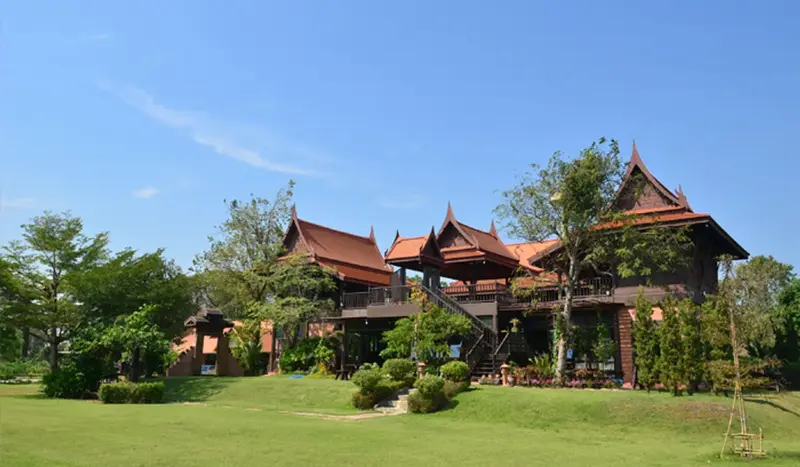
Open Days: Daily
Opening Hours: 09:00 – 17:00
Thai Traditional House Model – A craft route for Thai house construction and palm-wood furniture (Ayutthaya – Pa Mok – Phosa, Ang Thong) is a cultural travel experience that introduces authentic Thai carpentry, from making “Thai traditional house components” and assembling real wooden structures to viewing Thai house scale models and palm-wood furniture in Ang Thong. It is especially connected to the Ayutthaya – Pa Mok road corridor and the Phosa area, where skilled craftsmanship has been passed down for generations. This route suits architecture enthusiasts, lovers of Thai wooden houses, woodcraft collectors, and anyone who wants to see living craftsmanship in real practice.
Thai Traditional House Model – A craft route for Thai house construction and palm-wood furniture (Ayutthaya – Pa Mok – Phosa, Ang Thong) is not merely a photo stop or a souvenir-shopping area. It is a place where the “craft of building Thai wooden houses” remains part of everyday local life in a tangible way. Put plainly, its charm lies in seeing that a Thai house is not created only from drawings, but from understanding timber, proportions, structural forces, and the methods that make a home comfortable in the hot, humid climate of Thailand’s Central Plains. Ang Thong is known as a long-standing center for carpenters, house assemblers, and makers of Thai-house components, so it is no surprise that along the Ayutthaya – Pa Mok route and around Phosa you can find workshops, wood factories, and display points where Thai house models can be viewed and purchased.
Visiting this Thai-house craft route in Ang Thong feels like stepping into a field classroom of Thai architecture, because what you see is not an isolated “pretty display” of parts, but real work backed by practical reasoning: selecting timber, preparing wood, aligning grain direction, tongue-and-groove joinery, mortise-and-tenon work, finishing surfaces, and assembling a strong frame without relying excessively on screws or metal fasteners. At the heart of Thai wooden houses is the system of interlocking joinery and raised-floor construction to manage water and humidity. This wisdom fits the Central Plains landscape exceptionally well, which is why it remains valuable today—for restoring old houses, building new Thai-style houses, and producing home decor that carries a genuine Thai character.
When people hear “Thai traditional house components,” they may think only of gable roofs or wide eaves. In a carpenter’s world, components mean every piece that allows an entire house to come together in harmony: posts, beams, joists, floors, wall panels, doors, windows, ventilation panels, and also details many overlook, such as moldings, slats, balustrades, handrails, staircases, verandas, and decorative elements like finials and fascia boards. The difficulty is not only making them look “Thai,” but ensuring every element aligns with Thai-house proportions and that the assembled structure truly “works”—bearing loads, ventilating well, withstanding sun and rain, and preserving the elegance of Thai lines.
What makes this route especially compelling is seeing the carpenter’s thinking behind Thai woodworking. Fine craftsmanship is not only about carving motifs; it is about precision in angles, clean joints, and building pieces that last without warping or twisting. Experienced carpenters know which wood should go where, what properties are needed for load-bearing parts, and how to orient grain in wall or floor boards so seasonal expansion and contraction does not cause problems. This knowledge does not come only from memorizing manuals, but from hands-on work and real troubleshooting—which is exactly why places where you can still see authentic craft in action carry high cultural value.
Beyond full-scale Thai-house work, the most accessible and popular highlight for many visitors is the “Thai traditional house model,” a scaled representation of Thai-house beauty designed for tabletop display or home decoration. What makes house models from a craft community special is that they are not produced like toys. They are built with real understanding of structure and proportion, so you can clearly see details that reflect authentic Thai houses: gables, verandas, staircases, ventilation panels, and other elements that give Thai houses a distinct personality. These models become a bridge that helps younger generations visualize Thai architecture more closely without needing land to build a full house, and they are also collectibles for architecture lovers and meaningful gifts with a story.
Another key theme along this route is “palm-wood furniture,” often mentioned together with Ang Thong craftsmanship because palm wood is a local material with a distinctive tone and surface feel. Its grain patterns can be pronounced and it gives a warm, Thai-wood aesthetic. High-quality palm-wood furniture requires proper wood selection, appropriate drying or seasoning, and smooth finishing that highlights the grain without ruining the material’s character. Palm-wood pieces commonly appear as practical furniture—tables, chairs, cabinets, beds, shelving—as well as home decor that brings a Thai-modern atmosphere. This suits homes that want Thai identity without feeling overly nostalgic, and it also fits resorts or restaurants seeking a warm, natural-wood ambience.
From a traveler’s perspective, touring this Thai-house model and woodworking route feels different from visiting a museum because you can see “things being made.” You see wood offcuts, smell timber, observe tools and assembly work, and speak with people who do the craft for a living. If you go deeper, conversations with carpenters reveal why Thai houses suit Thailand’s climate: raised floors for airflow, extended eaves for sun-and-rain protection, carefully balanced openings to catch breezes, and timber materials that handle humidity well in certain contexts. For photographers, this route offers strong visual storytelling through wood details and structural lines.
The history of Ang Thong’s craft areas can be understood as a “craft community” that grew alongside Central Plains life shaped by water and land trade. When there was demand to build houses, pavilions, temples, floating houses, or repair wooden structures, carpentry became a highly important occupation. Skill was passed down through apprenticeships, assisting elders, and real project work until local standards of craftsmanship formed. Later, as interest returned in heritage-home preservation and Thai-style construction, communities that already had deep craft roots naturally gained even more attention. The Ayutthaya – Pa Mok route, linking historical zones and living communities, became a corridor where people often pass and encounter Thai-house craft. Meanwhile, Phosa in Mueang Ang Thong District connects to craft and commerce in the province, supporting production, sales, and product development within close proximity.
One important point for visitors is that “Thai traditional house models” and “Thai-house components” in Ang Thong usually do not refer to a single, pinned location. Instead, they describe a “zone” and a “route” with multiple makers and multiple stops. A good approach is to begin at a site that displays information clearly, then continue to workshops or factories that match your interests—full-scale house assembly, Thai-house design, collectible house models, or palm-wood furniture for everyday use. This helps you gain knowledge and find items that truly match your needs, without the visit feeling like superficial shopping.
If you want the visit to feel truly worthwhile as a learning experience, try observing three things while you walk. First, house proportions—roof pitch, eave projection, and underfloor height. Second, the joinery system—tenons, grooves, and corner joints that allow the structure to lock naturally. Third, surface texture and wood grain, because grain suggests material properties and also reveals finishing methods. Each is evidence that the craft is made with understanding, not only to imitate an image. Once you start noticing these points, you will understand why Thai-house carpentry and wooden furniture often differ in price from mass-produced items, and why people who love craft will travel to see authentic work.
When buying Thai-house models or Thai-style wooden decor, what makes items from craft sources more reliable is detail that stays faithful to real houses—the rhythm of balusters, the density of slats, staircase form, and the overall balance between the main house volume and the veranda. When these details are made with care, the model looks “alive” and does not resemble generic ready-made decor. Material and finishing also matter. Good work avoids messy glue, avoids nail marks that ruin clean lines, and keeps edges neatly finished to reduce splinters and breakage. If you are purchasing as a gift, choosing a model with a clear story—such as a common Central Plains Thai-house type or one with a distinctive veranda—adds value beyond appearance.
For those interested in palm-wood furniture, the main things to look for are dense material, smooth surfaces, and clean corner assembly. Well-made pieces have tight joints and wood alignment that does not visually mislead. Finishes should highlight the grain rather than hide it under opaque paint. In terms of form, palm-wood furniture often suits a Thai-modern direction: simple shapes with warm line rhythms, rather than rigid industrial geometry. High-quality palm-wood pieces fit homes that want tasteful Thai identity and work well in reception areas or relaxation corners where a natural feel matters.
This route also suits visitors interested in &ldquo+practical conservation,” because Thai houses are not only cultural objects to display but also a system for living with climate and landscape. If you are planning a resort, a cafe, or an activity venue that aims for a Thai atmosphere, seeing real craft helps you decide which forms to use, what to adapt for modern use, and what to be careful about—moisture management, floor elevation, ventilation, and selecting wood appropriate to the site. Once you see real work, you will recognize that authentic Thai identity comes from structure and proportion, not from heavy ornamental decoration alone.
If you have one day and want a well-rounded trip combining craft, culture, and food, you can use this route as the main theme and then continue to major temples or landmarks in Ang Thong in the afternoon. Ang Thong offers temples known for large Buddha images, long histories, and community markets reflecting Central Plains life. This creates a day with multiple layers: architectural knowledge, local food culture, and everyday community rhythms. For photographers, the sequence of craft in the morning and temples later often yields beautiful light and a balanced set of detail and atmosphere.
What makes craft-based travel memorable is witnessing skilled labor and patience. A single wooden item passes through many steps: measuring, cutting, planing, sanding, assembling, and surface finishing. Some pieces require test assembly first to confirm angles and proportions, and only then are fine details perfected. Seeing this process helps you understand why Thai craft deserves support—it is knowledge accumulated through time and experience, not something that can be accelerated in the short term. In an era when many people seek high-quality Thai identity again, living craft communities become even more meaningful.
Another important dimension is the historical and cultural linkage between Ayutthaya, Pa Mok, and Ang Thong. This route connects more than roads; it connects a Central Plains world shaped by trade and craft. Pa Mok is known for important temples and riverside communities, while Ang Thong is known for multiple craft traditions. In this context, “Thai traditional houses” as part of the province’s image makes cultural sense and ensures the trip is not about an isolated object but about reading the “identity of the town” through living craft.
For families, this trip is ideal for helping children understand what Thai houses are made of. Children see that a house is not only a finished building, but a system of components and skilled labor. They learn basic terms such as posts, beams, floors, walls, roofs, verandas, and why Thai houses are raised. Thai-house models are especially effective learning tools because children can see structure in miniature and connect it to real examples, particularly when adults narrate the story alongside. It becomes a gentle way to spark interest in Thai culture without forcing memorization.
For visitors who intend to purchase—whether house models, palm-wood furniture, or Thai-style decorative components—it is important to measure your destination space clearly and take photos of where the item will be placed or installed. Many Thai woodcraft products can be customized in size or detail. Preparing this information helps conversations with craftsmen move faster and leads to advice that matches real use. Good craftsmen prioritize practical function, not only looks, so clear requirements usually result in a better long-term fit, reducing the need for later modifications.
Overall, “Thai traditional house models – Thai-house components – palm-wood furniture” along the Ayutthaya – Pa Mok route and around Phosa in Ang Thong offers a tangible way to appreciate Thai value. It shows that Thai charm is not only sacred sites or delicious food, but also craft knowledge that makes Thai houses comfortable, transforms ordinary wood into elegant structures, and allows Thai identity to move forward in new forms without losing its roots. If you want a trip that delivers both inspiration and knowledge, this route is a strong answer for Ang Thong.
Getting There If starting from Ayutthaya, take the Ayutthaya – Pa Mok road into Pa Mok District, Ang Thong. Then continue toward Bang Pla Kot Subdistrict to visit recommended craft points/workshops for Thai-house carpentry. You can also extend the route into Ang Thong town and the Phosa area to browse palm-wood furniture and visit key provincial attractions in a single day. Travel is best by private car or van, and you should use navigation apps by searching for the specific workshop/business name or coordinates to reach each stop accurately.
| Place Name | Thai Traditional House Model – Thai House Carpentry and Palm-Wood Furniture Route (Ayutthaya – Pa Mok – Phosa, Ang Thong) |
| Address | Example Recommended Point (Thai House Carpentry): 65/ก Moo 5, Bang Pla Kot, Pa Mok, Ang Thong 14130 |
| Coordinates | 14.5177566, 100.4661492 |
| Place Summary | A cultural craft route in Ang Thong featuring Thai-house carpentry, Thai-house components, Thai traditional house models, and palm-wood furniture, suited to architecture lovers, woodcraft enthusiasts, and those interested in Central Plains craftsmanship. |
| Key Highlights | See authentic Thai-house joinery and structural craftsmanship, view and shop detailed Thai-house models, explore Thai-modern palm-wood furniture, and easily connect the trip to Ang Thong temples and community markets. |
| Brief History | Ang Thong has long been known for skilled Thai-house carpentry and component-making passed down through generations, later developed into Thai-house models and palm-wood furniture products along the Ayutthaya – Pa Mok corridor and related craft areas of the province. |
| Open Days | Daily |
| Opening Hours | 09:00 – 17:00 |
| Fees | No admission fee (shops/community areas); costs depend on custom orders or purchases. |
| Current Status | Open for visits and shopping in the craft community zone; contact is recommended for workshop viewing or custom-order consultations. |
| Contact Numbers | Example Recommended Point (Thai House Carpentry): 062-893-2879, 084-364-9655 Reference for Craft Route (Additional Source): 081-849-1563, 081-815-5453, 081-847-2288 Example Palm-Wood Furniture/Wood Supplier: 088-788-5521 |
| Nearby Tourist Attractions With Distance | 1. Talat San Chao Rong Thong – 15 km 2. Wat Muang (Phra Phuttha Mahanawamin Sakkayamuni Si Wiset Chai Chan) – 18 km 3. Wat Khun Inthapramun – 22 km 4. Wat Chaiyo Worawihan – 30 km 5. Ban Bang Sadet Royal Dolls Center – 28 km |
| Popular Restaurants Nearby | 1. Lek Ban Roh – 26 km, Tel. 035-612-070 2. Into Farm – 45 km, Tel. 092-729-4433 3. Pizza A.T. Garden – 12 km, Tel. 080-909-2206 4. Niramit – 16 km, Tel. 035-631-052, 081-852-4777 5. Flamingo Cafe & Restaurant – 32 km, Tel. 089-160-4373 |
| Popular Accommodations Nearby | 1. Bualuang Boutique Resort (Ang Thong) – 20 km, Tel. 035-949-850, 081-495-8884 2. Rim Chon Resort – 24 km, Tel. 035-611-527 3. Ratchaphruek DC Resort Ang Thong – 22 km, Tel. 035-610-800 4. Bualuang Hotel (Ang Thong) – 19 km, Tel. 035-611-116, 080-922-4040 5. Angthong Hotel – 23 km, Tel. 035-611-767 |
Frequently Asked Questions (FAQ)
Q: Where is the Thai house model and carpentry craft route in Ang Thong located?
A: You can find it along the Ayutthaya – Pa Mok road corridor and related areas in Ang Thong, especially around Pa Mok District and nearby zones, including the Phosa area which connects to local craft and product sales.
Q: What will I mainly see when I visit?
A: You will see Thai-house components and carpentry work, detailed Thai traditional house models, and value-added products such as palm-wood furniture and Thai-style wooden home decor.
Q: How are Thai traditional house models different from general decor items?
A: Models from craft sources follow real-house proportions and structural details more closely, with careful workmanship that creates depth and a more authentic Thai-house character than typical mass-produced decor.
Q: What kinds of use are palm-wood furniture best suited for?
A: It suits homes that want a warm, natural-wood atmosphere. It works well in reception corners, living rooms, and semi-outdoor areas that aim for a Thai-modern tone, with distinctive color and grain as key features.
Q: If I want to buy or place a custom order, how should I prepare?
A: Measure your destination space, prepare photos of the placement/installation area, and set a rough budget so you can discuss requirements clearly with craftsmen. Contact ahead if you want to view workshop work or consult on custom orders.
Q: How much time should I plan for this route?
A: For a comfortable visit focused on viewing and shopping, plan about 1.5 – 3 hours. If you want detailed discussions for custom work, allow additional time depending on each stop.
 Category: ●Art, Culture and Heritage
 Group: ●Historic Homes and Cities
Last Update : 5 MonthAgo
 Last Update : 5 MonthAgo
 Click to Access the Navigation Map GPS
Thai Traditional House Model Map
Recommend

 Landmarks and Memorials(2)
 Royal Palace(1)
 Art, Craft Centres, Tradition(2)
 Museums(2)
Historic Homes and Cities(1)
Museums(2)
Historic Homes and Cities(1)
 Educational Places
 Educational Gardens, Farm(1)
 Places of Worship
 Temple(64)
 Other Sacred Sites(4)
 Research and Development
 Royal Project(2)
 Suburban Living
 Village, Community(16)
 Local Market(1)
 Floating Market(1)
 Nature and Wildlife
 River, Canal(5)
 Other natural attractions(3)
 Entertainment and Agricultural
 Farms, Parks and Ecotourism(4)
 Outdoor and Adventure Activities(1)
 Shopping
 Shopping and Night Market(1)
 Travel Articles, Recipes
 Travel Review, Food Review(1)
 Central Thai Cuisine, Central Thai food recipes(1)


