
lovethailand home >North Travel Attractions >Tak Travel Attractions >Um Phang >Nong Luang > Kroi Salak Tradition
TL;DR: Kroi Salak Tradition, Tak attractions : Art, Culture and Heritage, Art, Craft Centres, Tradition.
Kroi Salak Tradition
Open Days: Held According To Each Temple’s Annual Schedule, Usually From The Full Moon Of The Twelfth Northern Lunar Month To Kiang Dap
Opening Hours: Morning To Afternoon, According To The Annual Temple And Community Schedule
Kuai Salak, also known as Kin Kuai Salak, Tan Kuai Salak, or Salak Phat in Tak Province, is an important northern Thai Buddhist merit-making tradition. It is based on the offering of prepared donation sets to monks through a lottery system, without specifying in advance which monk will receive which offering. This practice reflects generosity, non-attachment, gratitude to ancestors, and community unity. In Tak Province, the tradition is still practiced at many temples, including temples in Mueang Tak, Ban Tak, Sam Ngao, Mae Sot, and Mae Ramat Districts.
The word Kuai refers to a basket or container used to hold offerings, while Salak refers to a lot, number, or slip used in the drawing process. Together, Kuai Salak means a donation basket or offering set assigned by lottery. The key principle is that the donor gives without choosing the recipient. This makes the offering spiritually meaningful because it trains the donor to give with a pure mind, without attachment to status, personal preference, or expectation.
Although the tradition is shared with the wider Lanna cultural region, each community in Tak has its own local style. Some temples hold the event after the Buddhist Lent period, while others arrange it according to the readiness of the temple, villagers, and invited monks. What remains consistent is the community spirit. Families prepare offering sets, decorate them beautifully, cook food, set up communal food stalls, invite monks from different temples, and gather to take part in the ceremony.
Once the temple announces the date of the Kuai Salak event, devotees begin preparing their offerings. Each family, group, or community may create one or more offering sets. These usually include dry food, rice, sweets, fruit, household goods, medicine, cloth, monk supplies, and monetary donations. Some families prepare the offering in memory of deceased relatives, while others dedicate it for prosperity, good health, and blessings for the household.
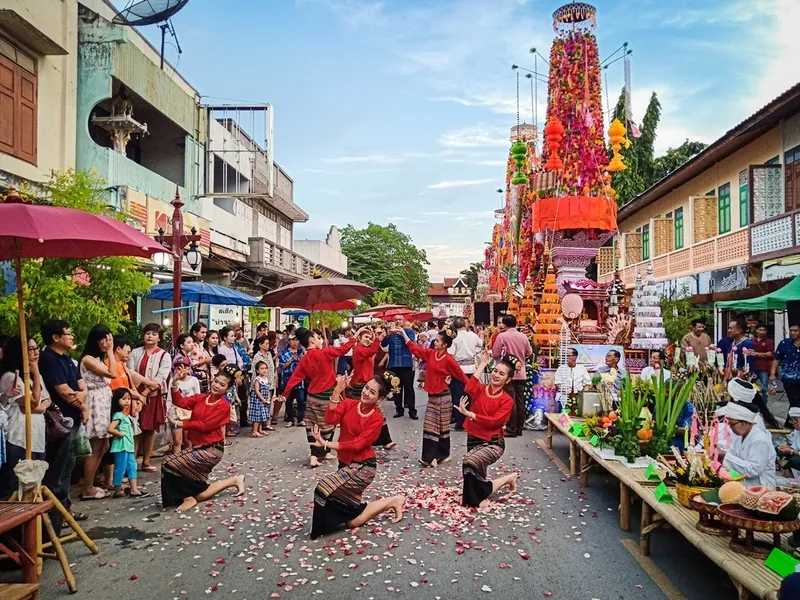
The visual beauty of the tradition lies in the decorated offering sets. Villagers place the offerings inside baskets or specially prepared containers, often decorating them as miniature Thai houses, tiered pavilions, lotus forms, or other auspicious shapes. These offering structures are arranged around the ordination hall or temple grounds. The result is a colorful display of faith, craftsmanship, and local creativity.
On the day of the event, the temple becomes a lively community space. People arrive early to help arrange the offerings, prepare food, receive invited monks, and assist elderly visitors. Food stalls or communal kitchens are often set up to feed guests. This is one reason the tradition is remembered not only as a religious ceremony, but also as a day of hospitality, reunion, and shared labor.
When the invited monks arrive, they gather in the ordination hall or ceremonial area for chanting and blessing. The chanting creates an auspicious beginning for the event and prepares the community for the main ritual: the drawing of lots. The monks then draw numbers or names that correspond to the offering sets. Each monk receives the offering assigned by the lot, and the donor receives blessings and merit in return.
The lottery system is the heart of the tradition. Because the donor does not choose the receiving monk, the act becomes an offering to the Sangha as a whole rather than to one specific individual. This reflects an important Buddhist value: true generosity is free from personal attachment. The ritual also teaches humility, equality, and trust in the merit-making process.
After the offerings are assigned, donors and relatives often help transport the offering set to the temple of the monk who received it. In some places this becomes a joyful small procession. People help carry or load the offering, talk, laugh, and continue the merit-making atmosphere beyond the host temple. This part of the tradition strengthens relationships between temples, villages, and families.
Kuai Salak is also closely connected with ancestor remembrance. Many people dedicate their offering to parents, grandparents, teachers, relatives, or benefactors who have passed away. The offering becomes a physical expression of gratitude. Through this act, the living remember the dead, continue family merit, and affirm the value of gratitude within Buddhist and northern Thai culture.
In Tak Province, the tradition is practiced in many temples. Cultural records mention temples such as Wat Phra Borommathat, Wat Mae Ya, Wat Wang Mo, Wat San Pa Lan, Wat Chonprathan Rangsan, Wat Don Mun, Wat Chiang Thong, Wat San Pa Phong, Wat Don Mun Chai, and Wat Mae Charoa. For this article, Wat San Pa Phong in Hua Diat Subdistrict, Mueang Tak District, is used as the reference venue because it is one of the temples in Tak where the Salak Phat or Tan Kuai Salak tradition has been observed in recent years.
Wat San Pa Phong is located in the old Hua Diat community of Mueang Tak District. It is not far from important cultural attractions in Tak town, such as the King Taksin the Great Shrine, Tak City Museum, Wat Sitalaram, and the Rattanakosin 200th Anniversary Bridge. This makes it convenient for cultural travelers to combine the Kuai Salak event with other historical and riverside attractions in the city.
For visitors, the value of attending Kuai Salak lies in seeing a living Buddhist tradition rather than a staged performance. Visitors can observe families preparing offerings, the arrangement of decorated baskets, the communal food stalls, the chanting, the lottery drawing, the offering ceremony, and the transport of the offering sets. These details show how northern Thai Buddhist culture is sustained through practical community participation.
Travelers should check the annual schedule with the temple or local authorities before visiting because the event date varies from temple to temple. Unlike fixed national festivals, Kuai Salak depends on local temple calendars, community readiness, and the availability of invited monks. Visiting on the correct day allows travelers to see the complete ceremony from preparation to offering and blessing.
Visitors should dress respectfully because the event takes place in a temple. Polite behavior is important during chanting, the drawing of lots, and the presentation of offerings. Photography is possible in appropriate areas, but visitors should avoid obstructing monks, donors, or ceremonial movement. Respectful observation helps preserve the dignity of the tradition and maintains a good relationship with the local community.
Those who wish to make merit may ask the temple committee what items are suitable for donation. Common offerings include dry food, rice, drinking water, monk supplies, medicine, cloth, or monetary contributions. Each temple may manage offerings differently, so visitors should follow local instructions. This ensures that the donation is useful and fits the ritual order.
The tradition also carries educational value. It teaches generosity, non-attachment, gratitude, and community cooperation through real practice. Children learn by watching adults prepare offerings, decorate baskets, serve food, and participate in the ceremony. Elders pass down knowledge of ritual procedures, while younger generations help with physical preparation and hospitality. This makes Kuai Salak a community classroom of Buddhist culture.
Kuai Salak also preserves local craftsmanship. Each offering set reflects the care and creativity of the donor. Some are simple, some are elaborate, but all carry the intention to give. The beauty of the tradition is not measured by the price of the offering, but by the sincerity, effort, and faith placed into it.
Overall, Kuai Salak or Kin Kuai Salak in Tak Province is a meaningful northern Thai Buddhist tradition that combines merit-making, ancestor remembrance, non-selective giving, temple hospitality, local artistry, and community solidarity. For travelers interested in Thai traditions and northern Buddhist culture, attending a Kuai Salak ceremony in Tak offers a clear and memorable view of living Lanna heritage.
| Name | Kuai Salak / Kin Kuai Salak / Tan Kuai Salak, Tak Province |
| Location / Main Venue | Held at many temples in Tak Province; this table uses Wat San Pa Phong, Hua Diat Subdistrict, Mueang Tak District, as the reference venue |
| Address | Wat San Pa Phong, Ban Hua Diat, Hua Diat Subdistrict, Mueang Tak District, Tak 63000, Thailand |
| Festival Period | Generally held from the full moon of the twelfth northern lunar month to Kiang Dap, depending on each temple’s annual schedule |
| Highlights | Decorated offering baskets, chanting, monks drawing lots, non-selective offering, communal food stalls, and transporting offering sets to monks’ temples |
| Importance | A Buddhist merit-making tradition for non-selective giving, ancestor dedication, personal blessings, and community unity |
| History / Culture | A Lanna Buddhist tradition practiced in many Tak communities, known locally as Kuai Salak, Kin Kuai Salak, Tan Kuai Salak, or Salak Phat |
| Name Origin | Kuai refers to a basket or container, while Salak refers to a lot or slip used to assign offerings to monks by lottery |
| Distinctive Features | Donors prepare decorated offering sets and monks draw lots to receive them, emphasizing generosity without choosing the recipient |
| Main Rituals | Announcing the date, preparing offering sets, arranging them around the temple, setting up food stalls, inviting monks, chanting, drawing lots, presenting offerings, receiving blessings, and delivering offerings to monks’ temples |
| Main Materials | Baskets, decorated containers, dry food, rice, sweets, fruit, monk supplies, cloth, medicine, monetary offerings, flowers, flags, and lottery slips |
| Travel Information | Travel to Mueang Tak District and continue to Hua Diat Subdistrict. Private car, motorcycle, or local transport is convenient |
| Current Status | Still practiced in many temples of Tak Province, with exact annual dates depending on each temple and local community |
| Open Days | According to each temple’s annual schedule, generally during the traditional Kuai Salak season |
| Opening Hours | Morning to afternoon, according to the temple and community schedule |
| Fees | No admission fee for the festival area |
| Facilities | Temple grounds, ceremonial area, food stalls, donation area, toilets, and basic community services in Mueang Tak |
| Abbot / Caretaker | Phra Khru Sunthon Wiriyanuyok, abbot of Wat San Pa Phong / Wat San Pa Phong / Tak Provincial Office of Buddhism / Tak Municipality |
| Main Contact Number | Wat San Pa Phong, Tel. 055-513-207 / Tak Provincial Office of Buddhism, Tel. 055-513-188 / Tak Municipality, Tel. 0-5551-8888 |
| Official Website / Official Page | https://tak.onab.go.th / https://www.tessabantak.go.th |
| Nearby Tourist Attractions | 1. Wat San Pa Phong, about 0 km 2. King Taksin the Great Shrine, about 2 km 3. Tak City Museum, about 2 km 4. Wat Sitalaram / Wat Nam Hak, about 3 km 5. Rattanakosin 200th Anniversary Bridge, about 4 km |
| Nearby Restaurants | 1. Dib Dee Restaurant, about 2 km, Tel. 088-424-3265 2. The Loft Restaurant & Coffee, about 3 km, Tel. 080-044-1133 3. Ban Kieng Nam Restaurant, about 4 km, Tel. 055-894-069, 081-953-9441 4. Rim Ping Terrace at Viang Tak Riverside Hotel, about 4 km, Tel. 055-512-507-8 5. Mae Ping Restaurant, about 6 km |
| Nearby Accommodations | 1. Berich Hotel, about 2 km 2. Hop Inn Tak, about 3 km 3. Soho Boutique Hotel, about 3 km 4. Viang Tak Riverside Hotel, about 4 km, Tel. 055-512-507-8, 081-887-2905 5. Ping View Restaurant & Resort, about 4 km |
Frequently Asked Questions (FAQ)
Q: What is Kuai Salak?
A: Kuai Salak, also called Kin Kuai Salak or Tan Kuai Salak, is a northern Thai Buddhist tradition in which donors prepare offering baskets and monks draw lots to receive them.
Q: When is Kuai Salak held in Tak Province?
A: It is generally held from the full moon of the twelfth northern lunar month to Kiang Dap, although the exact date depends on each temple.
Q: Why is the lottery system important?
A: The lottery system represents non-selective giving. Donors offer to the Sangha without choosing a specific monk, which reflects generosity and non-attachment.
Q: What is usually placed inside a Kuai Salak offering?
A: Common items include dry food, rice, sweets, fruit, monk supplies, cloth, medicine, and monetary offerings.
Q: Is the tradition held only at Wat San Pa Phong?
A: No. It is held at many temples in Tak Province. Wat San Pa Phong is used here as a reference venue because it is one of the temples where the tradition has been observed.
Q: Can travelers attend the ceremony?
A: Yes. Travelers should check the schedule in advance, dress respectfully, and observe or photograph the ceremony without disturbing monks or donors.
Q: What nearby attractions can be visited with the festival?
A: Nearby places include King Taksin the Great Shrine, Tak City Museum, Wat Sitalaram, and the Rattanakosin 200th Anniversary Bridge.
 Category: ●Art, Culture and Heritage
 Group: ●Art, Craft Centres, Tradition
Last Update : 4 MonthAgo
 Last Update : 4 MonthAgo
 Click to Access the Navigation Map GPS
Kroi Salak Tradition Map
Recommend

 Historical Sites and Monuments(2)
 Landmarks and Memorials(3)
Art, Craft Centres, Tradition(6)
Landmarks and Memorials(3)
Art, Craft Centres, Tradition(6)
 Historic Homes and Cities(2)
 Educational Places
 Educational Gardens, Farm(2)
 Places of Worship
 Temple(22)
 Other Sacred Sites(9)
 Suburban Living
 Village, Community(5)
 Local Market(3)
 Nature and Wildlife
 National Parks and Marine Reserves(9)
 Mountain (Doi)(9)
 Dam, Reservoir, Lake(14)
 Waterfalls(23)
 Hot Springs(2)
 Caves(6)
 River, Canal(1)
 Bays and Beaches(1)
 Islands(1)
 Other natural attractions(1)
 Entertainment and Agricultural
 Farms, Parks and Ecotourism(5)
 Outdoor and Adventure Activities(4)


