
lovethailand home >North Travel Attractions >Tak Travel Attractions >Sam Ngao >Sam Ngao > Wat Phra That Kaeng Soi
TL;DR: Wat Phra That Kaeng Soi is located at Ban Na Subdistrict, Sam Ngao District, Tak Province, along the Ping River in the Bhumibol Dam reservoir area, open Daily, hours Open according to boat schedules and water conditions in Bhumibol Dam Reservoir.
Wat Phra That Kaeng Soi
Open Days: Daily
Opening Hours: Open according to boat schedules and water conditions in Bhumibol Dam Reservoir
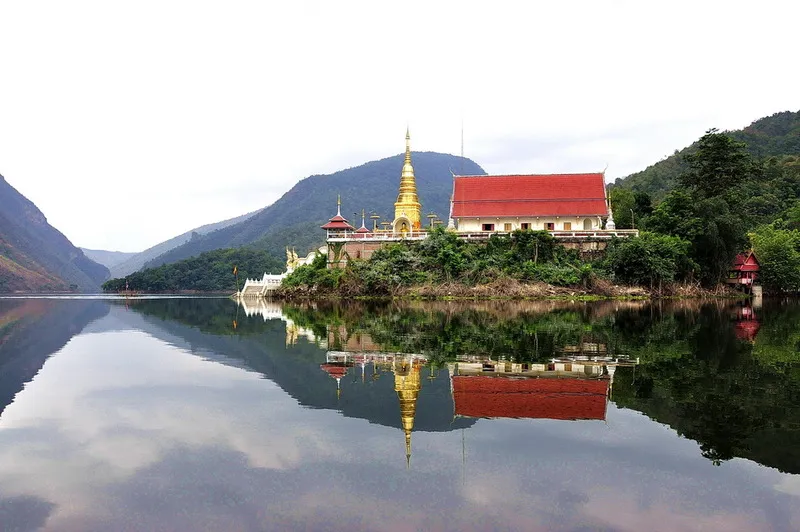
Wat Phra That Kaeng Soi, also known as Wat Phra Borommathat Kaeng Soi, is one of the most historically and spiritually significant temples in Sam Ngao District, Tak Province. Located along the Ping River within the Bhumibol Dam reservoir area, the temple stands among mountains, forested slopes, and the quiet waters of northern Tak. It is an ancient Buddhist sanctuary connected with Lanna history, the legend of sacred relics, the old city of Kaeng Soi, and the annual water-pouring tradition for the sacred stupa. What makes this temple especially distinctive is that it can be reached only by water. Visitors must travel by boat or raft through the Ping River reservoir, making the journey itself part of the pilgrimage experience.
The temple is located in Ban Na Subdistrict, Sam Ngao District, Tak Province, on the edge of the Bhumibol Dam reservoir along the Ping River. In the past, this area was part of an important river route connected with old Lanna communities and settlements along the upper Ping River. After the construction of Bhumibol Dam, the landscape changed dramatically, and many low-lying areas became part of the reservoir. Wat Phra That Kaeng Soi remains one of the most meaningful sacred sites still visible above the water, preserving the memory of an older cultural and religious landscape.
Unlike most temples that can be reached by road, Wat Phra That Kaeng Soi requires careful travel planning. Cars cannot reach the temple directly. Visitors must use a boat or raft service from Bhumibol Dam or another water-route access point connected to the Ping River. The travel time depends on the departure point, type of boat, weather, water level, and the program arranged by the operator. This water-only access gives the temple a rare sense of remoteness and peace. It is a destination for travelers who want more than a quick temple visit and are willing to experience a deeper cultural journey.
The history of Wat Phra That Kaeng Soi is closely associated with the old city of Kaeng Soi, sometimes referred to in local traditions as Mueang Soi. Local legends describe the area as an ancient settlement with communities living along the Ping River. The temple is linked with the belief that the Buddha once passed through this area and left sacred hair relics, which were later enshrined in a stupa. The name “Kaeng Soi” is also connected with local landscape and the abundance of “soi” flowers mentioned in local tradition. These stories give the temple a strong sacred identity that reaches beyond ordinary local history.
Wat Phra That Kaeng Soi is also connected with Queen Chamadevi, the legendary ruler of Hariphunchai and an important figure in the spread of Buddhism in northern Thailand. According to local tradition, Queen Chamadevi once passed along the Ping River route and restored the sacred stupa more than 1,000 years ago. Her association with the temple places Kaeng Soi within the broader cultural sphere of Lanna history, where river routes, Buddhist relics, and royal patronage were closely linked.
Another important figure in the temple’s historical memory is Phaya Patumma Racha, remembered as the last ruler of Kaeng Soi. Local accounts describe him as a ruler who supported the city and restored many Buddhist temples, with traditions mentioning as many as 99 temples in Mueang Soi. Whether read as history, legend, or local memory, this story reflects the former religious importance of the area. It suggests that Kaeng Soi was once a thriving Buddhist center along the Ping River before the modern reservoir landscape transformed the region.
The sacred stupa of Wat Phra That Kaeng Soi is the heart of the temple. It is believed to enshrine the Buddha’s hair relic and relics associated with the left arm of the Lord Buddha. For local communities and pilgrims, this belief gives the site exceptional spiritual value. Visitors come to pay respect, make merit, offer prayers, and take part in the continued preservation of the temple. The journey to the stupa is therefore both physical and spiritual: a passage through water, mountains, and silence toward a sacred place that has been revered for generations.
In the modern era, the temple was significantly restored in 1924 by Khru Ba Chao Sriwichai Sirivichayo, the revered saint of Lanna. His restoration of the sacred stupa and temple grounds helped revive the site and reconnect it with the broader Lanna Buddhist world. For many northern Thai Buddhists, Khru Ba Sriwichai represents devotion, perseverance, and temple restoration. His role at Kaeng Soi adds another important layer to the temple’s spiritual significance.
Later, as the stupa deteriorated over time, another major restoration took place in 1994 under Khru Ba Chao Chaiyawongsa Phatthana Chanthawongso, a spiritual successor in the Lanna saintly tradition. He restored and strengthened the stupa and temple structures, allowing the sacred site to continue serving pilgrims and local communities. The restoration line from Khru Ba Sriwichai to Khru Ba Chaiyawongsa Phatthana is central to the temple’s modern identity and helps explain why the temple remains deeply respected today.
The natural setting is one of the most powerful aspects of visiting Wat Phra That Kaeng Soi. The temple is surrounded by mountains and the waters of Bhumibol Dam reservoir. The boat journey offers views of layered hills, open water, forested slopes, and quiet stretches of the Ping River. As the boat moves farther from the dam area and deeper into the reservoir landscape, the atmosphere gradually becomes quieter and more contemplative. By the time visitors reach the temple, the journey has already prepared them for a peaceful religious experience.
The temple’s main annual tradition is the ceremony known in Thai as “Prเพณีขึ้นไหว้สาสรงน้ำพระบรมธาตุแก่งสร้อย,” the annual pilgrimage and water-pouring ceremony for the sacred relic stupa. It is held around April each year and draws local villagers, devotees from nearby areas, and pilgrims from other provinces. Participants travel by boat or raft to the temple to pay respect and pour water over the sacred stupa as an act of devotion and blessing. This tradition is one of the most important living expressions of faith connected with Wat Phra That Kaeng Soi.
The water-pouring ceremony is meaningful because it combines Buddhist merit-making, Lanna-style devotion, and community memory. The act of pouring water over the sacred stupa symbolizes purification, reverence, and a wish for auspiciousness. Because the temple is remote and accessible only by water, the journey to join the ceremony becomes part of the ritual itself. Families, villagers, and groups of devotees travel together across the reservoir, carrying offerings and shared faith toward the sacred site.
For cultural travelers, Wat Phra That Kaeng Soi offers a layered historical experience. It brings together the legend of the Buddha’s relics, Queen Chamadevi, the old city of Kaeng Soi, Phaya Patumma Racha, Khru Ba Sriwichai, Khru Ba Chaiyawongsa Phatthana, and the changing landscape after the creation of Bhumibol Dam. Few places in Tak Province combine so many themes in one location. The temple is therefore suitable for travelers who want to understand history, faith, landscape, and local memory in a single journey.
Visitors should prepare carefully before traveling. Because the site is remote, it is important to contact a boat or raft operator in advance, confirm the route, check the water level and weather conditions, and allow enough time for the round trip. Useful items include drinking water, sun protection, modest clothing, personal medicine, a waterproof bag for phones and documents, and suitable footwear for getting on and off the boat. Travelers should also help keep the temple and reservoir clean by taking all rubbish back with them.
Respectful behavior is essential. Wat Phra That Kaeng Soi is not only a scenic attraction but also a sacred Buddhist site. Visitors should dress modestly, speak quietly, avoid touching sacred objects without permission, and be considerate during ceremonies. During the annual water-pouring festival, photography should be done respectfully without disturbing worshippers or ritual activities. The temple’s remoteness and sacred character make respectful travel especially important.
The temple can be combined with other attractions around Bhumibol Dam. Travelers may visit Bhumibol Dam, the dam viewpoint, the commemorative park, and nearby dam facilities before or after the boat trip. Those traveling from the Lamphun side may use the Lamphun–Li–Ko route and continue by boat depending on available services. Because restaurants and accommodation are not located directly beside the temple, most practical options are found near Bhumibol Dam, Sam Ngao District, or departure points for boats and rafts.
Wat Phra That Kaeng Soi is especially suitable for travelers interested in old temples, sacred relics, Lanna history, boat journeys, remote Buddhist sites, and quiet nature-based cultural travel. It is not a quick roadside stop. The temple is best experienced slowly, with time allowed for the boat journey, worship, photography, and reflection. Its distance from modern roads is part of its value, preserving a rare sense of stillness that is increasingly difficult to find at more accessible tourist sites.
In summary, Wat Phra That Kaeng Soi is one of the most remarkable sacred sites in Tak Province. It is an ancient temple connected with the Ping River, the old Lanna cultural sphere, Queen Chamadevi, Phaya Patumma Racha, Khru Ba Sriwichai, and Khru Ba Chaiyawongsa Phatthana. Its sacred stupa, annual water-pouring tradition, and boat-only access make it a powerful destination for both pilgrims and cultural travelers. A visit to this temple offers not only a chance to pay respect but also a rare journey into the history, faith, and landscape of the upper Ping River.
| Name | Wat Phra That Kaeng Soi |
| Other Names | Wat Phra Borommathat Kaeng Soi, Wat Phra Borommathat Chao Kaeng Soi |
| Location | Ban Na Subdistrict, Sam Ngao District, Tak Province, along the Ping River in the Bhumibol Dam reservoir area |
| Coordinates | Latitude 17.774811, Longitude 98.858522 |
| Highlights | Ancient riverside temple accessible only by boat, enshrining the sacred Kaeng Soi relic stupa and connected with Lanna legends, Queen Chamadevi, Khru Ba Sriwichai, and Khru Ba Chaiyawongsa Phatthana |
| History | Ancient sacred site of the old Kaeng Soi area, associated with relic legends; restored by Khru Ba Sriwichai in 1924 and later restored by Khru Ba Chaiyawongsa Phatthana in 1994 |
| Name Origin | Linked with local legends of “soi” flowers and the enshrinement of the Buddha’s hair relic in the sacred stupa |
| Distinctive Features | Located in a mountain-and-reservoir landscape where cars cannot reach; visitors must travel by boat or raft |
| Important Sacred Objects | Phra Borommathat Kaeng Soi relic stupa, Kaeng Soi Buddha footprint, relic worship area, and sacred areas within the temple |
| Main Tradition | Annual pilgrimage and water-pouring ceremony for Phra Borommathat Kaeng Soi, held around April each year |
| Travel Information | Accessible only by boat or raft from Bhumibol Dam or connected Ping River water routes; travelers should check boat schedules, water levels, and weather before departure |
| Current Status | Active sacred site and water-based cultural attraction in Sam Ngao District, Tak Province, open according to boat access conditions |
| Open Days | Daily |
| Opening Hours | Open according to boat schedules and water conditions in Bhumibol Dam Reservoir |
| Facilities | Temple worship area, boat landing area according to local conditions, and sacred stupa area; visitors should bring drinking water and essential items |
| Main Areas / Zones | Phra Borommathat Kaeng Soi, Kaeng Soi Buddha Footprint, worship courtyard, and Ping River viewpoint area |
| Caretaker Publicly Listed | Phra Khru Ba Panikon Chaiyaseno |
| Boat / Raft Contact | Pae Phet Mae Ping Tour, Tel. 093-879-9924, 062-914-6554 |
| Nearby Tourist Attractions | 1. Bhumibol Dam Viewpoint, about 70 km by water route 2. Bhumibol Dam, about 70 km by water route 3. Bhumibol Dam Commemorative Park, about 70 km by water route 4. Wat Chonprathan Rangsan, about 72 km by water and road route from Bhumibol Dam 5. Ban Ko, Lamphun Province, about 35 km by water route 6. Doi Tao, Chiang Mai Province, about 60 km by water route |
| Nearby Restaurants | 1. Huen Phu Kaeo Restaurant, Bhumibol Dam, about 70 km by water route, Tel. 089-961-6572 2. Khun Sai Chon Coffee, Bhumibol Dam, about 70 km by water route, Tel. 055-881-211 ext. 4436 3. Krua Marum Somphon, Sam Ngao, about 72 km by water and road route, Tel. 090-681-0799 4. Krua 3 M Restaurant, Bhumibol Dam Entrance Area, about 75 km by water and road route, Tel. 081-888-7694 5. Caffeine Cafe, about 105 km by water and road route, Tel. 095-353-4030, 096-860-2807 |
| Nearby Accommodations | 1. Bhumibol Dam Guesthouse, about 70 km by water route, Tel. 055-881-237 2. Bhumibol Dam Guesthouse via EGAT Bhumibol Dam, about 70 km by water route, Tel. 055-881-211 to 5 ext. 4002, 4009 3. Sooksabai Resort Sam Ngao Tak, about 75 km by water and road route, Tel. 089-166-7368 4. Poonthip Daily And Monthly Rooms Sam Ngao, about 75 km by water and road route, Tel. 080-565-9888, 082-035-1756 5. Rim Thara Resort Tak, about 78 km by water and road route, Tel. 064-419-9155 6. Baan Suan Resort Sam Ngao, about 76 km by water and road route, Tel. 086-679-2759 |
Frequently Asked Questions (FAQ)
Q: Where is Wat Phra That Kaeng Soi located?
A: Wat Phra That Kaeng Soi is located in Ban Na Subdistrict, Sam Ngao District, Tak Province, along the Ping River in the Bhumibol Dam reservoir area.
Q: How can visitors reach Wat Phra That Kaeng Soi?
A: Visitors must travel by boat or raft only, because there is no direct road access to the temple. Boat schedules, water levels, and weather should be checked before departure.
Q: Why is Wat Phra That Kaeng Soi important?
A: It is an ancient sacred site connected with relic legends, the old Kaeng Soi area, Queen Chamadevi, Khru Ba Sriwichai, and the annual water-pouring tradition for the sacred stupa.
Q: What is the connection between Khru Ba Sriwichai and Wat Phra That Kaeng Soi?
A: Khru Ba Sriwichai restored the sacred stupa in 1924, reviving the temple as an important Lanna Buddhist pilgrimage site.
Q: What is the main annual tradition at Wat Phra That Kaeng Soi?
A: The main annual tradition is the pilgrimage and water-pouring ceremony for Phra Borommathat Kaeng Soi, usually held around April each year.
Q: What should visitors prepare before traveling to the temple?
A: Visitors should prepare drinking water, sun protection, modest clothing, personal medicine, waterproof bags, and contact a boat or raft operator in advance.
Q: What nearby attractions can be combined with a visit to Wat Phra That Kaeng Soi?
A: Nearby route-based attractions include Bhumibol Dam, Bhumibol Dam Viewpoint, Bhumibol Dam Commemorative Park, Wat Chonprathan Rangsan, Ban Ko, and Doi Tao depending on the chosen boat route.
Q: Is Wat Phra That Kaeng Soi suitable for foreign travelers?
A: Yes. It is suitable for travelers interested in sacred relic temples, Lanna history, boat journeys, remote Buddhist sites, and quiet nature-based cultural travel.
 Category: ●Places of Worship
 Group: ●Temple
Last Update : 5 MonthAgo
 Last Update : 5 MonthAgo
 Click to Access the Navigation Map GPS
Wat Phra That Kaeng Soi Map
Recommend

 Art, Culture and Heritage
 Historical Sites and Monuments(2)
 Landmarks and Memorials(3)
 Art, Craft Centres, Tradition(6)
 Historic Homes and Cities(2)
 Educational Places
 Educational Gardens, Farm(2)
Temple(22)
Educational Gardens, Farm(2)
Temple(22)
 Other Sacred Sites(9)
 Research and Development
 Royal Project(1)
 Suburban Living
 Village, Community(5)
 Local Market(3)
 Nature and Wildlife
 National Parks and Marine Reserves(11)
 Mountain (Doi)(9)
 Dam, Reservoir, Lake(14)
 Waterfalls(23)
 Hot Springs(2)
 Caves(6)
 River, Canal(1)
 Bays and Beaches(1)
 Islands(1)
 Other natural attractions(1)
 Entertainment and Agricultural
 Farms, Parks and Ecotourism(5)
 Outdoor and Adventure Activities(4)
 Travel Articles, Recipes
 Travel Review, Food Review(1)


