
lovethailand home >North Travel Attractions >Tak Travel Attractions >Muang Tak >Mai Ngam > Wat Mai Ngam Luang
TL;DR: Wat Mai Ngam Luang is located at Ban Mai Ngam, Moo 2, Mai Ngam Subdistrict, Mueang Tak District, Tak Province, open Daily, hours Daytime visits are recommended.
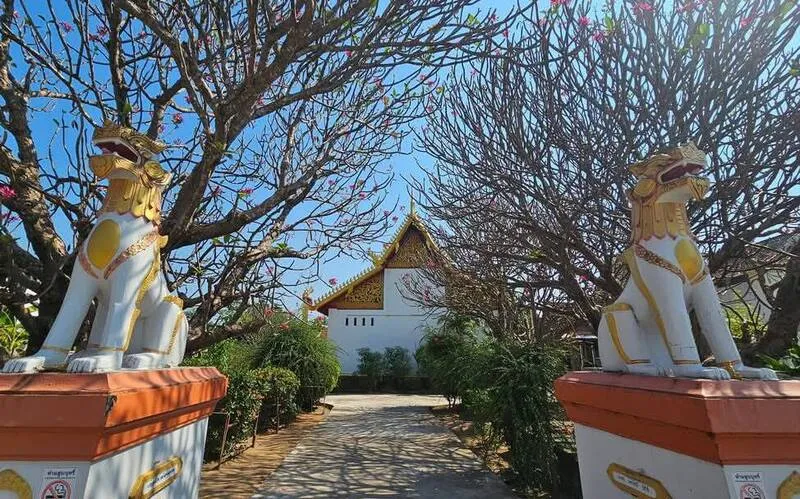
Wat Mai Ngam Luang
Open Days: Daily
Opening Hours: Daytime visits are recommended
Wat Mai Ngam Luang in Tak Province is an old community temple located at No. 5, Ban Mai Ngam, Moo 2, Mai Ngam Subdistrict, Mueang Tak District. Affiliated with the Mahā Nikāya Buddhist order, the temple is known locally by its former name, Wat Tai. It is regarded as the oldest temple in Mai Ngam Subdistrict and has served as a spiritual center for the Ban Mai Ngam community since around 1767. Its value lies not in grand tourist-style architecture, but in its long history, local faith, and close relationship with the everyday life of the community.
Wat Mai Ngam Luang is a good destination for travelers who want to understand the quieter side of Tak Province. Many visitors know Tak for its old town, King Taksin the Great Shrine, the Ping River, and several historic temples in the city center. However, temples in the surrounding subdistricts also reveal important layers of local history. Wat Mai Ngam Luang is one of those places. It shows how Buddhism, village settlement, community identity, and local traditions have developed together over many generations.
The name Mai Ngam comes from a large bodhi tree that once stood beautifully in front of the temple. Its branches spread widely and gracefully, leading local people to call the area Ban Mai Ngam. Later, the name became associated with the temple itself. This origin gives the temple a meaningful connection with nature and Buddhist symbolism. The bodhi tree is deeply linked with the life of the Buddha, so the story of a beautiful bodhi tree in front of the temple adds spiritual and cultural meaning to the name.
The temple was established around 1767 through the joint effort of the people of Ban Mai Ngam. This period was a time of major historical transition in Siam. The fact that local villagers were able to build and maintain a temple during such a period reflects the strength of Buddhist faith within the community. Wat Mai Ngam Luang therefore represents not only a religious site, but also a record of settlement and community organization in Mai Ngam Subdistrict.
The temple land covers 3 rai and 1 ngan, with an additional monastic land plot of 2 rai and 1 ngan. Its boundaries show how closely the temple is connected with the village: to the north are local houses, to the south is a walkway, to the east is private land, and to the west is the Mai Ngam – Market road. This setting clearly shows that the temple belongs within the living fabric of the community rather than being separated from it.
The temple is located on flat land. Its main monastic structures include a sermon hall measuring 10 meters wide and 16 meters long, built in 1957; a chanting hall measuring 20 meters wide and 20 meters long, built in 1930; and one monks’ residence. These structures show the gradual development of the temple over time. The chanting hall reflects the temple’s role in daily religious practice, while the sermon hall supports community merit-making, Buddhist teaching, and local religious gatherings.
The main Buddha image is the temple’s important sacred object. For local worshippers, it is a spiritual focus for merit-making, prayer, and reflection. Visitors should begin their visit by paying respect to the main Buddha image, both as an act of Buddhist courtesy and as a way of honoring the faith of the villagers who have preserved the temple for centuries.
Wat Mai Ngam Luang is closely connected with local traditions, especially the Tan Kuai Salak tradition after the end of Buddhist Lent. This merit-making tradition is found in northern Buddhist culture and is associated with offerings, dedication of merit, and community gathering. Its presence at Wat Mai Ngam Luang shows that the temple continues to function as a living cultural space, not merely as an old religious site.
Other Buddhist activities in Mai Ngam Subdistrict, such as community merit-making and Mahachat sermons, also reflect the role of temples as centers of village life. Wat Mai Ngam Luang is part of this living religious network. It helps preserve Buddhist values, local customs, and social ties within the community.
As the oldest temple in Mai Ngam Subdistrict, Wat Mai Ngam Luang is important for understanding local history. It marks the early development of the village and reflects how local people used Buddhism as a foundation for community life. Temples were not only places for worship; they were also places for education, moral teaching, meetings, festivals, and social support.
Mai Ngam Subdistrict has several temples and monastic sites, including Wat Khao Tham, Wat Tha Chang, Wat Wang Muang, and Wat Mai Ngam Luang. Among these, Wat Mai Ngam Luang stands out as an old foundational temple. Visiting it helps travelers understand the roots of the subdistrict before exploring other religious and natural sites nearby.
Getting There is convenient by private car or local transport from Tak town. Travel toward Mai Ngam Subdistrict and Ban Mai Ngam, Moo 2. The temple is located near the Mai Ngam – Market road. Because it is a community temple rather than a major commercial tourist attraction, private transportation or local assistance is the most practical way to reach it.
The best time to visit is in the morning or late afternoon, when the weather is more comfortable and the temple atmosphere is peaceful. A visit of around 30 minutes to 1 hour is suitable for paying respect to the main Buddha image, observing the sermon hall and chanting hall, and appreciating the quiet village setting.
For cultural travelers, Wat Mai Ngam Luang offers a different kind of value from large historic monuments. Its importance lies in community continuity. It is a temple created by local people, named through a local natural landmark, and maintained as part of village life. This makes the temple especially meaningful for those who want to experience local Buddhist culture in a simple and authentic setting.
The temple can be combined with Wat Khao Tham at Ban Phae, another important site in Mai Ngam Subdistrict. Travelers can begin at Wat Mai Ngam Luang to understand the old community temple, then continue to Wat Khao Tham to see a temple connected with a natural rock hill, a cave, Luang Pho Than Chai, and a scenic viewpoint. Together, the two places show both the village and natural-religious landscape of Mai Ngam.
Wat Mai Ngam Luang can also be added to a wider Tak cultural route with King Taksin the Great Shrine, Wat Bot Mani Si Bun Rueang, Wat Sitalaram, Ban Chin Alley, and the Ping River area. This route helps visitors see Tak through multiple layers: royal history, old town culture, river communities, local temples, and village Buddhism.
Visitors should dress modestly, speak quietly, avoid entering monks’ private areas without permission, and keep the temple clean. If visiting during a merit-making event or local tradition, follow the guidance of temple staff and local residents. Respectful behavior helps preserve the dignity of the temple and maintains good relations between visitors and the community.
Wat Mai Ngam Luang is especially suitable for travelers who appreciate quiet local temples. It is not a place of spectacle, but a place of continuity. Its old history, local name origin, main Buddha image, sermon hall, chanting hall, and role in local traditions make it one of the meaningful community temples of Mueang Tak District.
Overall, Wat Mai Ngam Luang helps complete the cultural picture of Tak Province. Tak is not only a province of famous historic landmarks and mountain routes; it is also made up of village temples that quietly preserve local identity. Visiting Wat Mai Ngam Luang allows travelers to see the roots of Mai Ngam Subdistrict through faith, community memory, and everyday Buddhist life.
| Name | Wat Mai Ngam Luang |
| Location | Ban Mai Ngam, Moo 2, Mai Ngam Subdistrict, Mueang Tak District, Tak Province |
| Address | No. 5, Ban Mai Ngam, Moo 2, Mai Ngam Subdistrict, Mueang Tak District, Tak Province 63000, Thailand |
| Approximate Coordinates / Area | Ban Mai Ngam, Mai Ngam Subdistrict, Mueang Tak District, near the Mai Ngam – Market road |
| Highlights | Oldest temple in Mai Ngam Subdistrict, established around 1767, locally known as Wat Tai, with a main Buddha image and a name origin linked to a large beautiful bodhi tree |
| History | Established as a temple around 1767 through the joint effort of Ban Mai Ngam villagers; regarded as the first old temple in Mai Ngam Subdistrict |
| Name Origin | A large bodhi tree once stood beautifully in front of the temple, leading people to call the area Ban Mai Ngam and later use the name for the temple |
| Distinctive Features | A flatland community temple with a sermon hall, chanting hall, monks’ residence, and a main Buddha image respected by local people |
| Sacred Objects / Key Features | Main Buddha image used as the key sacred object for worship and merit-making |
| Local Tradition | Tan Kuai Salak tradition after the end of Buddhist Lent, along with local Buddhist merit-making activities in Mai Ngam Subdistrict |
| Temple Buildings | Sermon hall measuring 10 meters by 16 meters, built in 1957; chanting hall measuring 20 meters by 20 meters, built in 1930; one monks’ residence |
| Temple Land | Temple land area of 3 rai and 1 ngan, with one additional monastic land plot of 2 rai and 1 ngan |
| Travel Information | From Tak town, travel to Mai Ngam Subdistrict and Ban Mai Ngam, Moo 2. The temple is near the Mai Ngam – Market road and is best reached by private car or local transport. |
| Current Status | Active local Buddhist temple affiliated with the Mahā Nikāya order and still serving as a spiritual center of Ban Mai Ngam community |
| Open Days | Daily |
| Opening Hours | Daytime visits are recommended |
| Facilities | Temple grounds for worship, merit-making, sermon hall, chanting hall, and surrounding village area |
| Main Areas / Zones | Main Buddha image, sermon hall, chanting hall, monks’ residence, and old temple area within Ban Mai Ngam community |
| Abbot / Caretaker | Phra Khru Sathaphon Wira Sunthon, Abbot of Wat Mai Ngam Luang |
| Main Contact Number | 089-9538480 |
| Nearby Tourist Attractions | 1. Wat Khao Tham, Ban Phae, about 3 km 2. King Taksin the Great Shrine, about 7 km 3. Wat Bot Mani Si Bun Rueang, about 8 km 4. Ban Chin Alley, about 9 km 5. Ping River riverside area in Tak town, about 9 km |
| Nearby Restaurants | 1. Tiengna Coffee and Bakery Farm, about 4 km, Tel. 096-805-0363 2. Him Doi Khao Soi, about 5 km, Tel. 081-989-5349 3. Baan Him Doi Fresh Juice & Coffee, about 5 km 4. Pad Thai Trok Ban Chin, about 9 km, Tel. 055-511330 5. TARA Kaffee&Patisserie, about 10 km |
| Nearby Accommodations | 1. Baan Chang Hotel & Coffee House, about 5 km, Tel. 055-512981 2. HOP INN Tak, about 7 km, Tel. 02-0802222 3. White House Hotel Tak, about 8 km, Tel. 099-2347774 4. Berich Hotel Tak, about 9 km, Tel. 082-4446242 5. Viang Tak Riverside Hotel, about 10 km, Tel. 055-512507, 055-512508 |
Frequently Asked Questions (FAQ)
Q: Where is Wat Mai Ngam Luang located?
A: Wat Mai Ngam Luang is located at No. 5, Ban Mai Ngam, Moo 2, Mai Ngam Subdistrict, Mueang Tak District, Tak Province.
Q: When was Wat Mai Ngam Luang established?
A: The temple was established around 1767 and is regarded as the oldest temple in Mai Ngam Subdistrict.
Q: Why is the temple called Wat Mai Ngam Luang?
A: The name comes from a large, beautiful bodhi tree that once stood in front of the temple. Local people called the area Ban Mai Ngam, and the name later became associated with the temple.
Q: What are the main features of Wat Mai Ngam Luang?
A: Important features include the main Buddha image, sermon hall, chanting hall, monks’ residence, and its long history as a community temple.
Q: Who is the abbot of Wat Mai Ngam Luang?
A: The abbot is Phra Khru Sathaphon Wira Sunthon.
Q: What local tradition is connected with Wat Mai Ngam Luang?
A: The temple is connected with the Tan Kuai Salak tradition after the end of Buddhist Lent, along with local Buddhist merit-making activities in Mai Ngam Subdistrict.
Q: How can travelers get to Wat Mai Ngam Luang?
A: From Tak town, travel to Mai Ngam Subdistrict and Ban Mai Ngam, Moo 2. The temple is near the Mai Ngam – Market road and is most convenient by private car or local transport.
Q: What nearby places can be visited with Wat Mai Ngam Luang?
A: Nearby places include Wat Khao Tham, King Taksin the Great Shrine, Wat Bot Mani Si Bun Rueang, Ban Chin Alley, and the Ping River riverside area in Tak town.
 Category: ●Places of Worship
 Group: ●Temple
Last Update : 3 MonthAgo
 Last Update : 3 MonthAgo
 Click to Access the Navigation Map GPS
 Art, Culture and Heritage
 Historical Sites and Monuments(2)
 Landmarks and Memorials(3)
 Art, Craft Centres, Tradition(6)
 Historic Homes and Cities(2)
 Educational Places
 Educational Gardens, Farm(2)
Temple(22)
Educational Gardens, Farm(2)
Temple(22)
 Other Sacred Sites(9)
 Suburban Living
 Village, Community(5)
 Local Market(3)
 Nature and Wildlife
 National Parks and Marine Reserves(9)
 Mountain (Doi)(9)
 Dam, Reservoir, Lake(14)
 Waterfalls(23)
 Hot Springs(2)
 Caves(6)
 River, Canal(1)
 Bays and Beaches(1)
 Islands(1)
 Other natural attractions(1)
 Entertainment and Agricultural
 Farms, Parks and Ecotourism(5)
 Outdoor and Adventure Activities(4)


