
lovethailand home >North Travel Attractions >Tak Travel Attractions >Mae Sot >Tha Sai Luat > Wat Thai Wattanaram
TL;DR: Wat Thai Wattanaram is located at Moo 1, Tha Sai Luat Subdistrict, Mae Sot District, Tak Province, open Daily, hours 07.00 – 17.00.
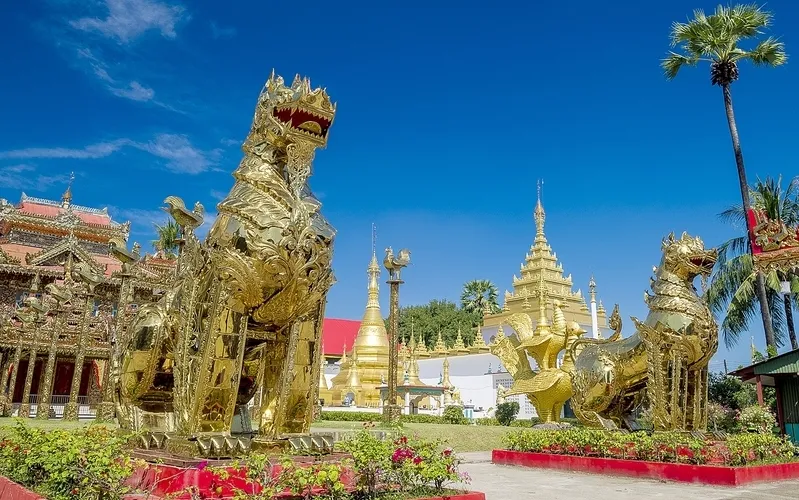
Wat Thai Wattanaram
Open Days: Daily
Opening Hours: 07.00 – 17.00
Wat Thai Wattanaram is one of the most distinctive cultural temples in Mae Sot District, Tak Province. Located in Moo 1, Tha Sai Luat Subdistrict, along Highway 105 before the Thai-Myanmar Friendship Bridge, the temple stands about 5 km from Mae Sot town. It was formerly known as Wat Mae Tao Ngiao or Wat Thai Yai, reflecting its close connection with the Shan or Tai Yai community that settled in the Mae Tao area. Today, the temple is widely known for its Burmese-style architecture, golden viharn, replica of the sacred Maha Muni Buddha image from Mandalay, reclining Buddha, Konawin Chedi, golden hamsa figures, guardian lions, and richly decorated buildings that make it one of the most memorable temples in Mae Sot.
For travelers with limited time in Mae Sot, Wat Thai Wattanaram is one of the best cultural stops because it is located on the same route as Rim Moei Market and the Thai-Myanmar Friendship Bridge. The temple is easy to reach from Mae Sot town, yet it offers a complete experience of faith, art, borderland history, and local identity. Visitors can pay respect to the Maha Muni Buddha replica, admire the golden Burmese-style viharn, walk around the Konawin Chedi, and see the gentle reclining Buddha known for its graceful expression.
The temple was founded through the history of the Tai Yai community in Mae Sot. Local accounts connect the temple with Nai Mung, a Burmese man from Shan State who migrated with his family to Mae Sot. He became the first village headman of Ban Mae Tao and was later granted the royal title Muen At Khamhaeng Han. The foundation of Wat Thai Wattanaram therefore reflects migration, settlement, and the role of Buddhism in preserving community identity. For migrant communities, temples were not only places of worship but also centers for language, ritual, memory, and cultural continuity.
The former name Wat Mae Tao Ngiao is historically meaningful. “Mae Tao” refers to the local area, while “Ngiao” was an older term used for the Shan or Tai Yai people in northern Thailand. The name Wat Thai Yai also reflects the same cultural background. Although the temple is now known as Wat Thai Wattanaram, its old names preserve the memory of the Tai Yai community that helped shape the cultural landscape of Mae Sot before the town became a busy modern border economy.
In 1957, the Ministry of Education officially recognized the temple as a Buddhist temple under the Department of Religious Affairs. This recognition strengthened the temple’s status within Thailand’s religious system while the temple continued to preserve its Burmese and Tai Yai cultural identity. As a result, Wat Thai Wattanaram offers visitors a rare opportunity to see how Thai Buddhist institutions, Shan heritage, and Burmese artistic traditions coexist in one living religious site.
The most important sacred object at Wat Thai Wattanaram is the replica of the Maha Muni Buddha image. The original Maha Muni Buddha image in Mandalay, Myanmar, is one of the most revered Buddha images in Burmese Buddhism. The replica at Wat Thai Wattanaram has become a major focus of devotion for local Buddhists, Tai Yai residents, Myanmar communities, Thai visitors, and travelers who come to Mae Sot. Many people visit the temple to pay respect, make merit, and ask for blessings before continuing their journey to Rim Moei Market, the Thai-Myanmar Friendship Bridge, or other border attractions.
The presence of the Maha Muni replica gives the temple strong cross-border significance. It shows that Buddhist faith travels with people, memory, and cultural identity. A sacred image from Mandalay, re-created and worshipped in Mae Sot, becomes a spiritual bridge between Thailand and Myanmar. For cultural travelers, this makes Wat Thai Wattanaram much more than a beautiful temple. It is a living symbol of religious continuity across the Thai-Myanmar border.
The temple’s architecture is one of its greatest attractions. The golden viharn is richly decorated with Burmese-style patterns, red and gold wall designs, reflective details, carved ornamentation, and multi-tiered roof forms. The overall effect is bright, intricate, and highly distinctive. Visitors who are familiar with central Thai or northern Thai temples will immediately notice the difference. Wat Thai Wattanaram has a visual language closer to temples in Myanmar and Shan cultural areas, making it a valuable place to study borderland Buddhist architecture.
The decorative details throughout the temple reflect Burmese and Tai Yai craftsmanship. The walls, pillars, doorway arches, windows, roof edges, and sacred structures are ornamented with forms that express auspiciousness, guardianship, and devotion. These decorations are not merely beautiful surfaces. They communicate the community’s effort to make the temple a sacred and dignified place. Visitors interested in Buddhist art should take time to look carefully, because the temple functions almost like an open-air classroom for Burmese-style religious art in Thailand.
Other important features include the reclining Buddha known for its gentle expression, the golden Konawin Chedi, the golden hamsa figures, and the guardian lion figures near the viharn. The hamsa is an important symbol in Mon and Burmese cultural traditions, often associated with sacred cities and auspiciousness. The lion figures serve as guardians of the sacred space. Together, these elements create a temple environment that feels deeply connected with Myanmar and Tai Yai artistic heritage.
Wat Thai Wattanaram also reflects the multicultural identity of Mae Sot. The district has long been home to Thai, Tai Yai, Myanmar, Karen, Chinese, and other communities. People have moved across this borderland for trade, work, family, faith, and settlement. The temple expresses this layered identity through architecture, ritual, sacred images, and community use. It is one of the best places in Mae Sot to understand how religion and culture connect people on both sides of the border.
Visitors should take time to explore the temple slowly. A good visit begins with paying respect to the Maha Muni Buddha image inside the main viharn. After that, visitors can walk around to admire the golden architecture, the reclining Buddha, the Konawin Chedi, the hamsa figures, and the decorative details on walls, pillars, doors, and roofs. The temple is especially photogenic, but visitors should remember that it is still an active place of worship, not merely a photo location.
Getting There is easy from Mae Sot town. Take Highway 105 toward Tha Sai Luat Subdistrict and the Thai-Myanmar Friendship Bridge. The temple is located around kilometer marker 84, before reaching the bridge, about 5 km from central Mae Sot. Visitors can travel by private car, rented vehicle, local taxi, or local transport from Mae Sot. Because the temple is on the same route as Rim Moei Market and the border checkpoint, it is easy to include in a half-day cultural itinerary.
The best time to visit is during the morning or late afternoon when the weather is more comfortable and the golden architecture looks especially beautiful in natural light. Visitors should dress modestly, remove shoes before entering sacred buildings, speak quietly, and avoid disturbing worshippers. Photography should be done respectfully, especially inside the viharn or during religious activities.
Wat Thai Wattanaram is suitable for many types of travelers: Buddhist pilgrims, cultural tourists, architecture lovers, photographers, families, and visitors interested in the Thai-Myanmar border. The temple allows travelers to experience a cultural atmosphere that is different from most Thai temples. Its Burmese-style buildings, Tai Yai history, and sacred Maha Muni image make it an important cultural landmark of Mae Sot.
The temple can be combined with nearby attractions such as Rim Moei Market, the Thai-Myanmar Friendship Bridge, the Mae Sot border checkpoint, Phra Wo Shrine, Mae Kasa Hot Spring, and other attractions around Mae Sot. For travelers who want to understand Mae Sot beyond shopping and border trade, Wat Thai Wattanaram offers a deeper view of the town’s spiritual and cultural identity.
In summary, Wat Thai Wattanaram is an important temple of the Tai Yai community in Tha Sai Luat Subdistrict, Mae Sot District, Tak Province. Connected with Nai Mung, later known as Muen At Khamhaeng Han, the temple preserves Burmese and Tai Yai Buddhist culture through its architecture, rituals, and sacred images. Its replica of the Maha Muni Buddha from Mandalay, golden viharn, reclining Buddha, Konawin Chedi, and hamsa symbols make it one of the most culturally significant temples in Mae Sot and a recommended stop for visitors to the Thai-Myanmar border.
| Name | Wat Thai Wattanaram |
| Former Names / Other Names | Wat Mae Tao Ngiao, Wat Thai Yai, Wat Mae Tao |
| Location | Moo 1, Tha Sai Luat Subdistrict, Mae Sot District, Tak Province |
| Address / Landmark | Located on Highway 105, around kilometer marker 84, before the Thai-Myanmar Friendship Bridge, about 5 km from Mae Sot town |
| Highlights | Tai Yai and Burmese-style temple featuring a golden viharn, Maha Muni Buddha replica, reclining Buddha, Konawin Chedi, golden hamsa figures, guardian lions, and ornate Burmese-inspired architecture |
| History | Associated with the Tai Yai community of Ban Mae Tao and Nai Mung, a Burmese man from Shan State who settled in Mae Sot and later received the title Muen At Khamhaeng Han |
| Name Origin | The former names Wat Mae Tao Ngiao and Wat Thai Yai reflect the temple’s connection with the Tai Yai community in the Mae Tao area |
| Distinctive Features | A borderland Buddhist temple strongly influenced by Burmese and Tai Yai art, rituals, and cultural identity |
| Important Sacred Objects | Maha Muni Buddha replica, golden viharn, reclining Buddha, Konawin Chedi, hamsa figures, guardian lion figures, and Burmese-style temple ornaments |
| Main Buddha Image | Maha Muni Buddha replica, modeled after the sacred Maha Muni Buddha image of Mandalay, Myanmar |
| Travel Information | From Mae Sot town, take Highway 105 toward Tha Sai Luat and the Thai-Myanmar Friendship Bridge; the temple is located before the bridge, about 5 km from town |
| Current Status | Active temple and major cultural attraction of Tha Sai Luat and Mae Sot, open for worshippers and visitors interested in Tai Yai and Burmese Buddhist heritage |
| Open Days | Daily |
| Opening Hours | 07.00 – 17.00 |
| Facilities | Temple courtyard, Maha Muni Buddha worship area, viharn, cultural photography areas, and parking space according to local temple conditions |
| Main Areas / Zones | Maha Muni Buddha Viharn, reclining Buddha, Konawin Chedi, golden hamsa figures, guardian lion figures, and Burmese-style architectural areas |
| Local Administrative Contact | Tha Sai Luat Subdistrict Municipality, Tel. 055-563-043 |
| Nearby Tourist Attractions | 1. Rim Moei Market, about 3 km 2. Thai-Myanmar Friendship Bridge, about 4 km 3. Mae Sot Border Checkpoint, about 4 km 4. Mae Sot Airport, about 5 km 5. Phra Wo Shrine, about 18 km 6. Tararak Waterfall, about 28 km |
| Nearby Restaurants | 1. Khraw Nai Suan, about 4 km, Tel. 063-805-1883 2. Krua Chidwana, about 6 km, Tel. 055-532-614 3. Krua Khun Tu, about 7 km, Tel. 055-533-051 4. Khanom Chin Khayum, about 7 km, Tel. 055-533-916, 084-379-8859 5. Kao Phochana, about 7 km, Tel. 055-531-653, 089-533-2497 |
| Nearby Accommodations | 1. HOP INN Mae Sot, about 4 km, Tel. 02-080-2222 2. B2 Mae Sot Boutique & Budget Hotel, about 5 km 3. Irawadee Resort Mae Sot, about 5 km 4. Centara Life Hotel Mae Sot, about 7 km, Tel. 055-532-601-8, 085-480-2291 5. Retro Twin Home @ Mae Sot, about 7 km 6. Baan Rabiangmai Hotel, about 3 km |
Frequently Asked Questions (FAQ)
Q: Where is Wat Thai Wattanaram located?
A: Wat Thai Wattanaram is located in Moo 1, Tha Sai Luat Subdistrict, Mae Sot District, Tak Province, along Highway 105 before the Thai-Myanmar Friendship Bridge, about 5 km from Mae Sot town.
Q: What were the former names of Wat Thai Wattanaram?
A: The temple was formerly known as Wat Mae Tao Ngiao, Wat Thai Yai, and Wat Mae Tao, reflecting its close connection with the Tai Yai community in the Mae Tao area.
Q: Who is associated with the early history of Wat Thai Wattanaram?
A: The temple is associated with Nai Mung, a Burmese man from Shan State who settled in Mae Sot and later received the title Muen At Khamhaeng Han.
Q: What is the most important Buddha image at Wat Thai Wattanaram?
A: The most important Buddha image is the Maha Muni Buddha replica, modeled after the sacred Maha Muni Buddha image of Mandalay, Myanmar.
Q: What are the main highlights of Wat Thai Wattanaram?
A: The main highlights include the golden Burmese-style viharn, Maha Muni Buddha replica, reclining Buddha, Konawin Chedi, golden hamsa figures, guardian lions, and ornate Burmese-style decorations.
Q: How can visitors get to Wat Thai Wattanaram?
A: From Mae Sot town, take Highway 105 toward Tha Sai Luat and the Thai-Myanmar Friendship Bridge. The temple is located before the bridge, around kilometer marker 84, about 5 km from town.
Q: What nearby attractions can be visited with Wat Thai Wattanaram?
A: Nearby attractions include Rim Moei Market, the Thai-Myanmar Friendship Bridge, Mae Sot Border Checkpoint, Mae Sot Airport area, Phra Wo Shrine, and Tararak Waterfall.
Q: What should visitors wear when visiting Wat Thai Wattanaram?
A: Visitors should dress modestly, remove shoes before entering sacred buildings, speak quietly, and take photographs respectfully because the temple is an active place of worship.
 Category: ●Places of Worship
 Group: ●Temple
Last Update : 5 MonthAgo
 Last Update : 5 MonthAgo
 Click to Access the Navigation Map GPS
Wat Thai Wattanaram Map
Recommend

 Art, Culture and Heritage
 Historical Sites and Monuments(2)
 Landmarks and Memorials(3)
 Art, Craft Centres, Tradition(6)
 Historic Homes and Cities(2)
 Educational Places
 Educational Gardens, Farm(2)
Temple(22)
Educational Gardens, Farm(2)
Temple(22)
 Other Sacred Sites(9)
 Research and Development
 Royal Project(1)
 Suburban Living
 Village, Community(5)
 Local Market(3)
 Nature and Wildlife
 National Parks and Marine Reserves(11)
 Mountain (Doi)(9)
 Dam, Reservoir, Lake(14)
 Waterfalls(23)
 Hot Springs(2)
 Caves(6)
 River, Canal(1)
 Bays and Beaches(1)
 Islands(1)
 Other natural attractions(1)
 Entertainment and Agricultural
 Farms, Parks and Ecotourism(5)
 Outdoor and Adventure Activities(4)
 Travel Articles, Recipes
 Travel Review, Food Review(1)


