
lovethailand home >North Travel Attractions >Tak Travel Attractions >Mae Ramat >Mae Ramat > Wat Don Kaew
TL;DR: Wat Don Kaew is located at Mae Ramat District, Tak Province, open Daily, hours Open for daytime religious visits and community worship.
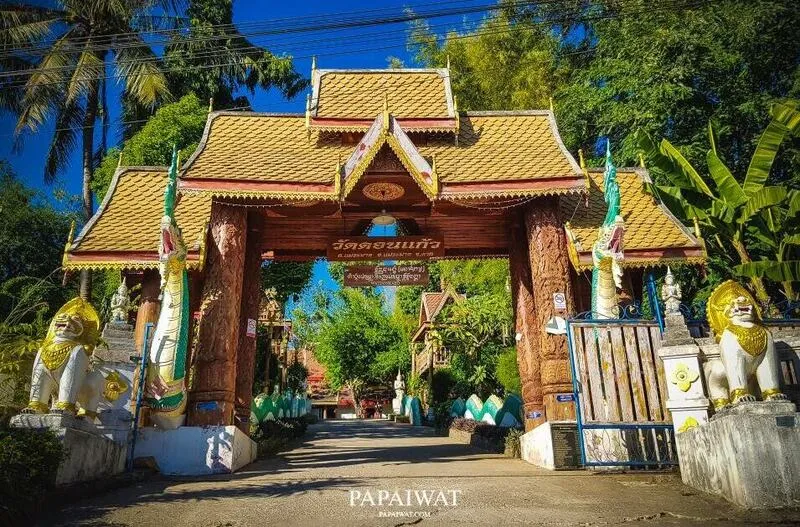
Wat Don Kaew
Open Days: Daily
Opening Hours: Open for daytime religious visits and community worship
Wat Don Kaew in Mae Ramat District, Tak Province, is one of the most culturally significant temples in western Tak. The temple is best known for its large marble Buddha image in the Mara Vichai posture, a Burmese-style masterpiece carved from a single block of marble. With a lap width of about 50 inches, or 1.30 meters, and a height of about 63 inches, or 1.60 meters, this image is regarded as one of the most remarkable marble Buddha images in Thailand. For local Buddhists and cultural travelers, Wat Don Kaew is a meaningful destination that brings together Buddhist devotion, Burmese art, local history, and the legacy of Khru Ba Khao Pi.
The temple is located in Mae Ramat District, not far from the district administrative area. Mae Ramat is a culturally diverse district near the Thai-Myanmar border, with communities connected to Thai, Karen, Burmese, and Lanna traditions. This borderland context is important because Wat Don Kaew reflects more than local Thai Buddhism. Its famous marble Buddha image, brought from Yangon, shows the long cultural relationship between northern Thailand and Myanmar.
The marble Buddha image is the spiritual heart of Wat Don Kaew. It is a Burmese-style Buddha image in the Mara Vichai posture, carved from a single large piece of marble. The smooth surface, calm facial expression, balanced body, and refined carving demonstrate the skill of Burmese artisans. Inside the viharn where the image is enshrined, visitors can feel the peaceful and sacred atmosphere created by the image’s presence. It is both a work of religious art and an object of deep devotion.
Local tradition says that the marble Buddha image belongs to a set of 3 Burmese marble Buddha images carved during the same period. One image is said to be enshrined in India, another in Pakistan, and the third is the image now enshrined at Wat Don Kaew in Mae Ramat. This story adds exceptional cultural interest to the image and helps explain why it is so highly respected by local people and visitors. The Buddha image is not only rare in material and size, but also remarkable for its journey and the faith connected with it.
The history of the image is closely tied to Khru Ba Khao Pi, also known as Phra Khru Ba Aphichai Khao Pi, an important disciple of Khru Ba Sriwichai, the revered saint of Lanna. Khru Ba Khao Pi played a major role in building and restoring Buddhist structures in northern Thailand and in the western border region of Tak. He was respected by Thai, Karen, and Burmese communities, especially in Mae Sot and Mae Ramat. His work helped strengthen Buddhism in areas where different cultures met and interacted.
In 1922, Khru Ba Khao Pi, Khun Mae Ramat Maitri, and the people of Mae Ramat worked together to bring the marble Buddha image from Yangon, Myanmar, to Wat Don Kaew. Transporting such a large and heavy marble image at that time was extremely difficult. The journey involved waterways, land routes, carts, manpower, and strong community cooperation. The successful arrival of the image in Mae Ramat became a major event of faith and helped make Wat Don Kaew a spiritual center of the district.
The arrival of the marble Buddha image was not just the movement of a sacred object. It represented the shared devotion of the Mae Ramat community. The image became the principal Buddha image of the temple and a symbol of unity for local Buddhists. Over time, it also became a cultural landmark for travelers interested in Burmese art, marble carving, and the religious history of Tak Province.
From an art historical perspective, the Buddha image is especially valuable because it shows Burmese sculptural craftsmanship in a Thai temple setting. Marble carving requires great precision. The artisan must understand balance, proportion, and surface detail from the beginning, because mistakes are difficult to correct. The result at Wat Don Kaew is a Buddha image that appears calm, graceful, and dignified. Its beauty makes it worth studying not only as a sacred image but also as a major example of Burmese Buddhist sculpture.
Wat Don Kaew also helps visitors understand Mae Ramat as a borderland cultural area. Mae Ramat lies near Mae Sot and the Thai-Myanmar border, where people, languages, religious practices, and artistic traditions have moved across the region for generations. The marble Buddha image from Yangon is a clear example of this cross-border cultural relationship. It shows how Buddhist faith can travel with people, communities, and trade routes, becoming part of a new local identity.
For local residents, the marble Buddha image is more than an artwork. It is a sacred object that supports faith, merit-making, and community identity. People come to pay respect, make offerings, pray, and join Buddhist activities throughout the year. On important Buddhist days, Wat Don Kaew serves as a gathering place for local worshippers. This continuing religious use gives the image a living role in the community rather than turning it into a museum object.
Travelers interested in Khru Ba Khao Pi will also find Wat Don Kaew meaningful. During his active years in the Mae Sot and Mae Ramat area, Khru Ba Khao Pi created and supported many Buddhist works. His ability to gather faith from Thai, Karen, and Burmese communities made him one of the important religious figures of the region. The story of the marble Buddha image at Wat Don Kaew is one of the clearest examples of his influence in Mae Ramat.
The atmosphere of Wat Don Kaew is calm and suitable for respectful worship. Visitors usually spend time inside the viharn paying respect to the marble Buddha image and observing its artistic details. Since the temple remains an active religious site, visitors should dress modestly, speak quietly, and behave respectfully. Photography should be done with care, especially inside the viharn or near the principal Buddha image.
Getting There is most convenient by private car or local transport. From Mae Sot, travelers can follow the road toward Mae Ramat, a distance of roughly 30 to 40 kilometers depending on the starting point. Once in Mae Ramat town, the temple is located near the main community and district area. From Tak town, visitors can travel via the Tak-Mae Sot route and continue toward Mae Ramat. The temple can be combined with nearby attractions such as Mae Kasa Hot Spring, Mae Usu Cave, the Thai-Myanmar Friendship Bridge, and Rim Moei Market.
Wat Don Kaew is suitable for several types of travelers: Buddhist pilgrims, cultural tourists, art lovers, history enthusiasts, and visitors exploring the Thai-Myanmar border region. The temple offers a rare opportunity to see a large Burmese-style marble Buddha image in a functioning Thai temple. It also provides a deeper understanding of how faith, migration, trade, and regional history shaped the religious culture of Mae Ramat.
In summary, Wat Don Kaew is one of the most important cultural and religious landmarks of Mae Ramat District. Its marble Buddha image, brought from Yangon in 1922 by Khru Ba Khao Pi, Khun Mae Ramat Maitri, and local devotees, is a rare and beautiful example of Burmese Buddhist sculpture. The temple is a place of worship, a symbol of community pride, and a meaningful stop for travelers who want to understand the cultural connections between Thailand, Myanmar, Lanna Buddhism, and the border communities of Tak Province.
| Name | Wat Don Kaew |
| Location | Mae Ramat District, Tak Province |
| Address / Landmark | Located in Mae Ramat town area, not far from the Mae Ramat District Office |
| Coordinates | XGM7+RW3, Mae Ramat Subdistrict, Mae Ramat District, Tak Province 63140 |
| Highlights | Large Burmese-style marble Buddha image carved from a single block of marble and enshrined as the principal Buddha image of the temple |
| History | The marble Buddha image was brought from Yangon, Myanmar, in 1922 by Khru Ba Khao Pi, Khun Mae Ramat Maitri, and the people of Mae Ramat |
| Distinctive Features | Important Mae Ramat temple reflecting Burmese Buddhist art, local devotion, and Thai-Myanmar borderland cultural connections |
| Important Sacred Object | Burmese-style marble Buddha image in Mara Vichai posture, enshrined inside the temple viharn |
| Main Buddha Image | Marble Buddha image carved from a single block of marble, about 50 inches or 1.30 meters wide at the lap and about 63 inches or 1.60 meters high |
| Important Related Figures | Khru Ba Khao Pi, Khru Ba Sriwichai, Khun Mae Ramat Maitri, and the people of Mae Ramat |
| Travel Information | Accessible by private car or local transport from Mae Sot toward Mae Ramat; the temple is located near the main community and district area of Mae Ramat |
| Current Status | Active temple and important cultural landmark of Mae Ramat District, open for worshippers and visitors |
| Open Days | Daily |
| Opening Hours | Open for daytime religious visits and community worship |
| Facilities | Viharn housing the marble Buddha image, temple courtyard, merit-making area, and parking space according to local temple conditions |
| Main Areas / Zones | Marble Buddha viharn, worship area, temple courtyard, and community religious activity area |
| Nearby Tourist Attractions | 1. Mae Ramat District Office And Old Mae Ramat Community, about 1 km 2. Mae Kasa Hot Spring, about 16 km 3. Ngao Phai Restaurant And Mae Charao Community, about 18 km 4. Mae Usu Cave, about 35 km 5. Thai-Myanmar Friendship Bridge, Mae Sot, about 37 km 6. Rim Moei Market, Mae Sot, about 38 km |
| Nearby Restaurants | 1. Kuai Tiao Mueang Non, about 2 km, Tel. 099-013-9987 2. Kuai Tiao Mueang Non, about 2 km, Tel. 089-534-4667 3. Cafe at Home Mae Ramat, about 3 km 4. Ngao Phai Restaurant, about 18 km, Tel. 055-802-056, 087-847-2613 5. Chilleik Home & Coffee Bar Mae Charao, about 19 km, Tel. 086-098-9980 |
| Nearby Accommodations | 1. Ban Kiang Tawan Country & Resort, about 3 km, Tel. 098-764-9768 2. Phrik Wan San Fan Resort, about 5 km, Tel. 081-280-7995 3. Kiang Tawan Resort Mae Ramat, about 3 km 4. Wisdom Field Resort And Spa, about 30 km 5. Sai Lom Joy, about 35 km 6. Centra Life Mae Sot, about 35 km |
Frequently Asked Questions (FAQ)
Q: Where is Wat Don Kaew located?
A: Wat Don Kaew is located in Mae Ramat District, Tak Province, not far from the Mae Ramat District Office and the main community area.
Q: What is Wat Don Kaew famous for?
A: Wat Don Kaew is famous for its large Burmese-style marble Buddha image carved from a single block of marble and enshrined as the principal Buddha image in the viharn.
Q: How large is the marble Buddha image at Wat Don Kaew?
A: The image is about 50 inches or 1.30 meters wide at the lap and about 63 inches or 1.60 meters high.
Q: Where did the marble Buddha image come from?
A: The marble Buddha image was brought from Yangon, Myanmar, in 1922 by Khru Ba Khao Pi, Khun Mae Ramat Maitri, and the people of Mae Ramat.
Q: Who was Khru Ba Khao Pi and why is he important to Wat Don Kaew?
A: Khru Ba Khao Pi was an important Lanna monk and disciple of Khru Ba Sriwichai. He played a major role in bringing the marble Buddha image to Wat Don Kaew and strengthening Buddhism in Mae Ramat.
Q: What type of travelers should visit Wat Don Kaew?
A: The temple is suitable for visitors interested in Buddhist worship, Burmese art, marble sculpture, Khru Ba Khao Pi history, and Thai-Myanmar borderland culture.
Q: What nearby attractions can be visited with Wat Don Kaew?
A: Nearby attractions include Mae Kasa Hot Spring, Mae Usu Cave, the Thai-Myanmar Friendship Bridge, Rim Moei Market, and cultural sites in Mae Sot and Mae Ramat.
Q: How should visitors behave inside Wat Don Kaew?
A: Visitors should dress modestly, behave respectfully, speak quietly inside the viharn, and take photos of the marble Buddha image with proper temple etiquette.
 Category: ●Places of Worship
 Group: ●Temple
Last Update : 4 MonthAgo
 Last Update : 4 MonthAgo
 Click to Access the Navigation Map GPS
Wat Don Kaew Map
Recommend

 Art, Culture and Heritage
 Historical Sites and Monuments(2)
 Landmarks and Memorials(3)
 Art, Craft Centres, Tradition(6)
 Historic Homes and Cities(2)
 Educational Places
 Educational Gardens, Farm(2)
Temple(22)
Educational Gardens, Farm(2)
Temple(22)
 Other Sacred Sites(9)
 Suburban Living
 Village, Community(5)
 Local Market(3)
 Nature and Wildlife
 National Parks and Marine Reserves(9)
 Mountain (Doi)(9)
 Dam, Reservoir, Lake(14)
 Waterfalls(23)
 Hot Springs(2)
 Caves(6)
 River, Canal(1)
 Bays and Beaches(1)
 Islands(1)
 Other natural attractions(1)
 Entertainment and Agricultural
 Farms, Parks and Ecotourism(5)
 Outdoor and Adventure Activities(4)


