
lovethailand home >North Travel Attractions >Tak Travel Attractions >Mae Ramat >Mae Tuen > Wat Mani Banphot Worawihan
TL;DR: Wat Mani Banphot Worawihan is located at Thetsaban 4 Road, Rahaeng Subdistrict, Mueang Tak District, Tak Province, open Daily, hours Open for daytime religious visits and community worship.
Wat Mani Banphot Worawihan
Open Days: Daily
Opening Hours: Open for daytime religious visits and community worship
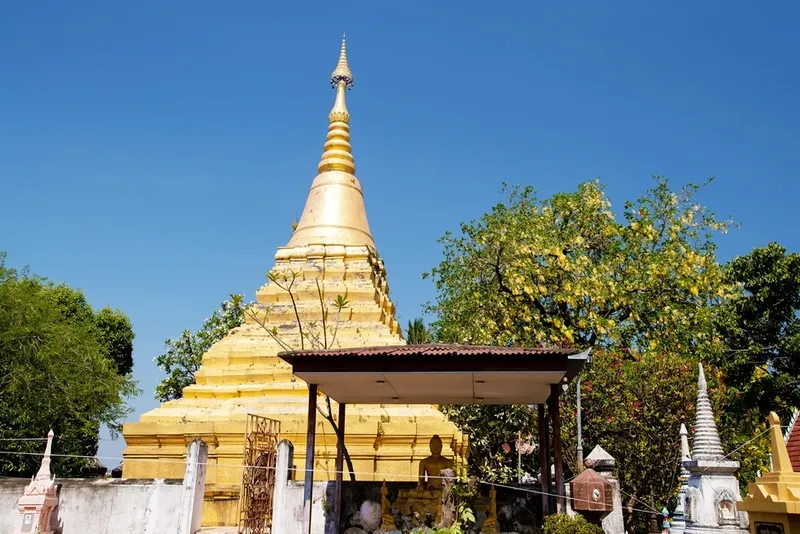
Wat Mani Banphot Worawihan is a third-class royal temple of the Worawihan type in Mueang Tak District, Tak Province. Located along Highway 1 near Somdej Phrajao Taksin Maharaj Hospital, the temple stands on a small hill just before entering the main urban area of Tak. It is one of the most important Buddhist temples in the province, known as a provincial royal temple, a model developed temple, and the home of Phra Phuttha Saen Thong, a revered Chiang Saen-style Buddha image considered sacred by the people of Tak.
The temple was formerly known as Wat Khao Kaeo. Its old name reflects the landscape of the temple, which sits on a gentle hill within the city area. Later, when the temple was elevated to royal temple status, it became known as Wat Mani Banphot Worawihan. The name carries the sense of a precious mountain or sacred hill, matching the temple’s location and spiritual role in the province. Today, the temple remains an accessible and meaningful stop for travelers entering Tak town from Highway 1.
Wat Mani Banphot Worawihan was established in 1847 and received its consecrated boundary in 1893. These dates show that the temple has been part of Tak’s religious landscape for a long period. As a royal temple under the Mahanikaya order, it holds a higher status than ordinary local temples and serves as one of the key Buddhist centers of Tak Province. Its role combines religious practice, provincial identity, and cultural heritage.
The temple’s location is one of its strengths. Although it is close to the main road, hospital, and urban community, the temple grounds feel calm once visitors walk up into the compound. The small hill creates a sense of separation from the busy road below. This makes the temple suitable for a short merit-making visit, a cultural stop before entering town, or a peaceful pause during a journey through northern Thailand.
One of the most distinctive structures inside the temple is the Mon-style chedi behind the main temple area. The chedi has a sixteen-indented-corner form, giving it a balanced and elegant appearance. Its Mon artistic character reflects the cultural diversity of Tak, a province historically connected with central Thailand, Lanna culture, Mon communities, western border routes, and the upper Ping River region. The chedi is therefore not only a religious monument but also a visual reminder of Tak’s multicultural heritage.
Inside the ordination hall, visitors can see a royal portrait of King Chulalongkorn, Rama V, which was presented to the temple. This portrait gives the temple a strong connection with the Thai monarchy and the royal support of Buddhism. It also reinforces the temple’s role as a royal temple of provincial significance. For visitors interested in Thai history, this is one of the important details that makes Wat Mani Banphot Worawihan more than a local place of worship.
The most revered Buddha image at the temple is Phra Phuttha Saen Thong. It is a Chiang Saen-style Buddha image with a lap width of about 30 inches. Local people brought the image from an abandoned temple in Mae Tuen Subdistrict, Mae Ramat District, in 1930. Since then, it has been enshrined at Wat Mani Banphot Worawihan and has become widely respected as a sacred Buddha image of Tak town. For many local worshippers, paying respect to Phra Phuttha Saen Thong is one of the most meaningful reasons to visit the temple.
The story of Phra Phuttha Saen Thong is important because it connects different parts of Tak Province. Mae Ramat and Mae Tuen are located in the western mountain area, while Wat Mani Banphot Worawihan stands near the urban center of Tak. The movement of the Buddha image from an abandoned temple to a royal temple in town shows how sacred objects were preserved and given a new religious life. Instead of being left behind, the image became a spiritual anchor for the wider community.
The Chiang Saen artistic style gives the Buddha image added cultural value. Chiang Saen Buddha images are associated with the Buddhist art of northern Thailand and are often admired for their calm, powerful, and dignified form. The presence of such an image in Tak town reflects the historical links between Tak and the northern cultural sphere. It also makes the temple appealing to visitors interested in Buddhist art and Lanna-related religious heritage.
Wat Mani Banphot Worawihan also plays an active role in religious life. As a provincial royal temple, it is associated with important Buddhist occasions such as Makha Bucha, Visakha Bucha, Asalha Bucha, Buddhist Lent, the end of Buddhist Lent, Kathin ceremonies, and other merit-making activities. Local people, government agencies, and visitors may come to the temple for ceremonies, worship, and Buddhist observance throughout the year.
For travelers, the temple is easy to combine with other attractions in Tak town. A meaningful city route can begin with Wat Mani Banphot Worawihan, followed by the King Taksin Shrine, the old Chinese quarter at Trok Ban Chin, the Ping River walking area, the Rattanakosin 200-Year Suspension Bridge, and other nearby temples. This route gives visitors a balanced view of Tak through religion, history, river culture, and local community life.
Getting There is straightforward by private car, local taxi, or hired vehicle. The temple is located along Highway 1 near Somdej Phrajao Taksin Maharaj Hospital and not far from the city center. Travelers heading north can stop here before entering Tak town, while those staying in town can reach the temple within a short drive. Because the temple stands on a hill, comfortable footwear is recommended.
Visitors should dress modestly and behave respectfully. The temple is an active Buddhist place of worship, so quiet conduct is appropriate. When entering the ordination hall, paying respect to Phra Phuttha Saen Thong, or photographing religious objects, visitors should be mindful of monks, local worshippers, and ongoing ceremonies. A respectful visit allows travelers to appreciate the temple’s sacred and historical value more deeply.
Wat Mani Banphot Worawihan is particularly suitable for travelers who want a cultural stop that is easy to reach but still meaningful. It offers a royal temple status, a sacred Chiang Saen Buddha image, a Mon-style chedi, royal historical associations, and a hilltop atmosphere near the center of Tak. For those passing through Tak on the way to northern Thailand or Mae Sot, this temple is a worthwhile place to pause, pay respect, and learn about the province’s Buddhist heritage.
In summary, Wat Mani Banphot Worawihan is one of the key religious landmarks of Tak Province. Formerly known as Wat Khao Kaeo, it was established in 1847, received its consecrated boundary in 1893, and now serves as a third-class royal temple. Its sacred Phra Phuttha Saen Thong Buddha image, Mon-style chedi, royal portrait of King Chulalongkorn, and convenient hilltop location make it an important destination for both Thai worshippers and foreign travelers interested in the cultural heart of Tak.
| Name | Wat Mani Banphot Worawihan |
| Former Name / Other Name | Wat Khao Kaeo |
| Location | Thetsaban 4 Road, Rahaeng Subdistrict, Mueang Tak District, Tak Province |
| Address | Thetsaban 4 Road, Rahaeng Subdistrict, Mueang Tak District, Tak Province 63000, near Somdej Phrajao Taksin Maharaj Hospital |
| Highlights | Third-class royal temple of Tak Province, located on a hill beside Highway 1, with Phra Phuttha Saen Thong and a Mon-style sixteen-indented-corner chedi |
| History | Established in 1847, received its consecrated boundary in 1893, and later became a third-class royal temple of the Worawihan type |
| Name Origin | Formerly called Wat Khao Kaeo; the current name reflects its royal temple status and hilltop location |
| Distinctive Features | Provincial royal temple and model developed temple, located on a small hill near central Tak and easily accessible from Phahonyothin Road |
| Important Sacred Objects | Phra Phuttha Saen Thong, a Chiang Saen-style Buddha image; royal portrait of King Chulalongkorn; Mon-style chedi; walking Buddha image near the staircase |
| Main Buddha Image | Phra Phuttha Saen Thong, a Chiang Saen-style Buddha image with a 30-inch lap width, brought from an abandoned temple in Mae Tuen Subdistrict, Mae Ramat District, in 1930 |
| Travel Information | Accessible by private car or local transport in Tak town; the temple is on Highway 1 near Somdej Phrajao Taksin Maharaj Hospital before entering the main city area |
| Current Status | Active third-class royal temple of the Worawihan type under the Mahanikaya order and one of the key temples of Tak Province |
| Open Days | Daily |
| Opening Hours | Open for daytime religious visits and community worship |
| Facilities | Temple courtyard, Phra Phuttha Saen Thong worship area, ordination hall, chedi area, and parking space according to local temple conditions |
| Main Areas / Zones | Ordination hall, Phra Phuttha Saen Thong, Mon-style chedi, walking Buddha image, and hilltop temple area |
| Abbot | Phra Khru Methee Worakhun (Chaluai Kanchano, Pali Grade 3) |
| Main Contact Number | 055-511318 |
| Official Website / Official Page | Wat Mani Banphot Worawihan - Khao Kaeo - Royal Temple of Tak Province |
| Nearby Tourist Attractions | 1. Nong Nam Mani Banphot, about 1 km 2. King Taksin Shrine, about 2 km 3. Tak Riverside Walking Street, about 2 km 4. Trok Ban Chin Old Quarter, about 3 km 5. Rattanakosin 200-Year Suspension Bridge, about 3 km 6. Wat Bot Mani Si Bunrueang, about 4 km |
| Nearby Restaurants | 1. Café Amazon, Somdej Phrajao Taksin Maharaj Hospital Branch, about 1 km, Tel. 062-605-6889 2. Preedee Phochana, about 2 km, Tel. 081-707-3800, 082-595-8145 3. Ban Kiang Nam Restaurant, about 4 km, Tel. 055-894-069, 081-953-9441 4. Aiyarawadee Restaurant, about 4 km, Tel. 055-512-419, 094-242-6441 5. Pingview Restaurant & Resort, about 5 km, Tel. 080-044-1133 |
| Nearby Accommodations | 1. Berich Hotel, about 2 km, Tel. 055-516-444, 082-444-6242 2. Suansin Lanna Hotel, about 2 km, Tel. 087-555-9666, 055-891-333, 055-891-189 3. Vanasin Residence, about 2 km, Tel. 055-511-444 4. HOP INN Tak, about 3 km, Tel. 02-080-2222 5. Viang Tak Riverside Hotel, about 3 km, Tel. 055-512-507-8, 081-887-2905 6. Pingview Villa Resort, about 5 km, Tel. 080-044-1133 |
Frequently Asked Questions (FAQ)
Q: Where is Wat Mani Banphot Worawihan located?
A: Wat Mani Banphot Worawihan is located on Thetsaban 4 Road, Rahaeng Subdistrict, Mueang Tak District, Tak Province, near Somdej Phrajao Taksin Maharaj Hospital and Highway 1.
Q: What was the former name of Wat Mani Banphot Worawihan?
A: The temple was formerly known as Wat Khao Kaeo before being elevated to royal temple status and renamed Wat Mani Banphot Worawihan.
Q: What are the main highlights of Wat Mani Banphot Worawihan?
A: The main highlights include Phra Phuttha Saen Thong, the royal portrait of King Chulalongkorn, the Mon-style sixteen-indented-corner chedi, and the walking Buddha image near the staircase.
Q: Why is Phra Phuttha Saen Thong important?
A: Phra Phuttha Saen Thong is a Chiang Saen-style Buddha image with a 30-inch lap width. It was brought from an abandoned temple in Mae Tuen Subdistrict, Mae Ramat District, in 1930 and is revered as a sacred Buddha image of Tak.
Q: What type of temple is Wat Mani Banphot Worawihan?
A: It is a third-class royal temple of the Worawihan type under the Mahanikaya order and one of the key provincial temples of Tak.
Q: Is Wat Mani Banphot Worawihan easy to reach?
A: Yes. The temple is easy to reach because it is located along Highway 1 near central Tak and Somdej Phrajao Taksin Maharaj Hospital. Visitors can travel by private car or local transport.
Q: What nearby attractions can be visited with Wat Mani Banphot Worawihan?
A: Nearby attractions include King Taksin Shrine, Tak Riverside Walking Street, Trok Ban Chin Old Quarter, Rattanakosin 200-Year Suspension Bridge, and Wat Bot Mani Si Bunrueang.
Q: Who should visit Wat Mani Banphot Worawihan?
A: The temple is suitable for visitors interested in royal temples, Buddhist art, Chiang Saen Buddha images, Mon-style architecture, local history, and easy cultural stops in Tak town.
 Category: ●Places of Worship
 Group: ●Temple
Last Update : 3 MonthAgo
 Last Update : 3 MonthAgo
 Click to Access the Navigation Map GPS
Wat Mani Banphot Worawihan Map
Recommend

 Art, Culture and Heritage
 Historical Sites and Monuments(2)
 Landmarks and Memorials(3)
 Art, Craft Centres, Tradition(6)
 Historic Homes and Cities(2)
 Educational Places
 Educational Gardens, Farm(2)
Temple(22)
Educational Gardens, Farm(2)
Temple(22)
 Other Sacred Sites(9)
 Suburban Living
 Village, Community(5)
 Local Market(3)
 Nature and Wildlife
 National Parks and Marine Reserves(9)
 Mountain (Doi)(9)
 Dam, Reservoir, Lake(14)
 Waterfalls(23)
 Hot Springs(2)
 Caves(6)
 River, Canal(1)
 Bays and Beaches(1)
 Islands(1)
 Other natural attractions(1)
 Entertainment and Agricultural
 Farms, Parks and Ecotourism(5)
 Outdoor and Adventure Activities(4)


