
lovethailand home >North Travel Attractions >Tak Travel Attractions >Um Phang >Mae La Mung > Umphang Wildlife Sanctuary
TL;DR: Umphang Wildlife Sanctuary is located at Umphang District, Tak Province, open Access to Thi Lo Su Waterfall Nature Study Area follows official announcements, hours 08.00 – 16.30.
Umphang Wildlife Sanctuary
Open Days: Access to Thi Lo Su Waterfall Nature Study Area follows official announcements from Umphang Wildlife Sanctuary
Opening Hours: 08.00 – 16.30
Umphang Wildlife Sanctuary in Tak Province is one of the most important protected forest areas in western Thailand. Covering approximately 1,619,280 rai in Umphang District, the sanctuary protects a vast mountain forest landscape that forms part of the Western Forest Complex. It is a conservation area for wildlife, natural habitats, watersheds, evergreen forests, deciduous forests, mountain streams, and one of Thailand’s most iconic natural attractions: Thi Lo Su Waterfall.
Umphang Wildlife Sanctuary was officially declared a wildlife sanctuary in 1989. Its main purpose is to conserve wildlife and protect natural habitats across a large and ecologically significant forest area. The sanctuary is connected with the broader western forest landscape, which links protected areas in Tak, Kanchanaburi, Uthai Thani, and borderland forest zones. This continuity allows wildlife to move, feed, reproduce, and survive within a large natural range.
The sanctuary is not simply a tourist destination. It is first and foremost a protected forest and wildlife habitat. Travelers who visit Thi Lo Su Waterfall or other natural areas within the sanctuary should follow official rules closely, stay on designated routes, avoid disturbing wildlife, and check current announcements before traveling. Conditions can change according to season, rainfall, road conditions, and conservation requirements.
The landscape of Umphang Wildlife Sanctuary is dominated by high, complex mountain ranges of the Thanon Thong Chai system. The terrain includes ridges, valleys, streams, cliffs, and deep forest areas. This varied topography supports different forest types, including evergreen forest and deciduous forest. The forest helps regulate water flow, protects soil, provides habitat for wildlife, and sustains the natural beauty that makes Umphang one of Thailand’s most remarkable nature destinations.
The weather in Umphang is especially cool from November to February. This is one of the most popular periods for travel because rainfall is lower, the air is cooler, and access conditions are usually more manageable than during the peak rainy season. However, visitors should still check official updates from Umphang Wildlife Sanctuary before traveling, as access to Thi Lo Su Waterfall may depend on current safety and environmental conditions.
The sanctuary is home to rich forest biodiversity. Wildlife reported from the area includes clouded leopard, Malayan tapir, serow, hawks, and pelicans, among other species. The presence of rare and sensitive wildlife reflects the importance of the area as a conservation landscape. Large mammals and rare species require wide, undisturbed habitats with food, water, and low human disturbance. This is why responsible travel is essential in Umphang.
Thi Lo Su Waterfall is the most famous attraction within Umphang Wildlife Sanctuary. The waterfall is widely regarded as one of the largest and most beautiful waterfalls in Thailand. Surrounded by dense evergreen forest, it descends over a broad limestone mountain face in several powerful tiers. The white curtain of water against the green forest has become the defining image of Umphang and one of the dream destinations for nature travelers in Thailand.
The journey to Thi Lo Su is part of the experience. Reaching the waterfall requires traveling deep into the protected forest landscape of Umphang. Visitors pass through mountain roads, forest routes, local communities, and remote natural scenery. The trip demands time, patience, and preparation. For many travelers, standing before Thi Lo Su after a long journey is memorable precisely because the waterfall still feels connected to the wild forest around it.
Access to Thi Lo Su Waterfall is managed according to official announcements. The latest official information checked from Umphang Wildlife Sanctuary states that the nature study area is open from 08.00 to 16.30, and the 2025 opening announcement specifies access by four-wheel-drive vehicles. Travelers should therefore rely on official updates before departure, especially after heavy rain or during seasonal transition periods.
The route to Thi Lo Su can vary by season and by official conditions. During periods when vehicle access is allowed, travelers usually enter by four-wheel-drive vehicle and continue on foot to the waterfall area. In some travel programs, visitors may combine river rafting on the Mae Klong River with overland access to the waterfall. Travelers should arrange the trip with authorized local operators or confirm details with officials before entering the sanctuary.
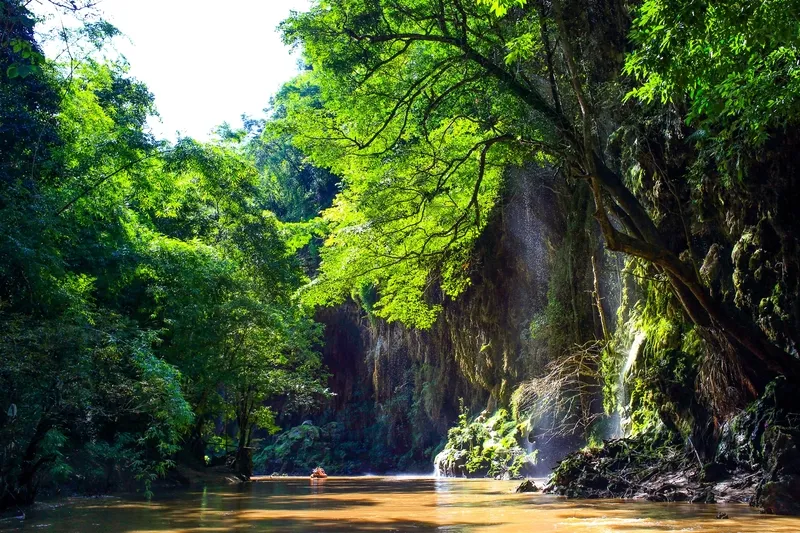
The Mae Klong River in Umphang is closely connected with the tourism experience of the area. Rafting along the river allows travelers to experience cliffs, forested banks, water channels, and mountain scenery before continuing toward Thi Lo Su. Safety is essential. Visitors should wear life jackets, follow the guide’s instructions, and protect electronic devices with waterproof bags because water conditions can change with rainfall and season.
Beyond Thi Lo Su, Umphang District offers several natural attractions connected with the broader forest landscape. These include Thi Lo Cho Waterfall, Doi Hua Mot, Takhobi Cave, and viewpoints around Umphang. Doi Hua Mot is known for morning mist and open hill scenery, while Takhobi Cave offers a different geological experience. Together, these places show that Umphang is not only about one waterfall but about an entire mountain district shaped by forest, water, and borderland geography.
The remoteness of Umphang is part of its identity. The road from Mae Sot to Umphang follows Highway 1090 and is famous for its 1,219 curves. The distance is about 164 kilometers and the journey normally takes around 4 to 5 hours. The route crosses the Thanon Thong Chai mountain range, with many curves, climbs, descents, and scenic forest views. Travelers prone to motion sickness should prepare medication, drinking water, and rest stops.
From Bangkok, travelers can drive north on Highway 1 through Ayutthaya, Ang Thong, Chai Nat, Nakhon Sawan, and Kamphaeng Phet toward Tak Province. Before reaching Tak city, take Highway 105 toward Mae Sot, a distance of about 86 kilometers. From Mae Sot, continue on Highway 1090 toward Umphang. The total distance from Bangkok to Umphang is approximately 668 kilometers, so the journey should be planned with enough rest time.
Public transport is also possible. Travelers can take a bus from Bangkok to Mae Sot, then continue by local songthaew or arranged vehicle from Mae Sot to Umphang. Schedules may change, so travelers should confirm the latest departure times with Mae Sot transport services, local authorities, or accommodation providers in Umphang before traveling. This is especially important for those planning to visit Thi Lo Su on the following day.
Some older travel information mentions small charter flights to Umphang, but this should not be used as a primary travel plan unless the current service status is confirmed directly. Most visitors still reach Umphang by road through Mae Sot. Because the route is long and mountainous, travelers should plan carefully and avoid rushing the journey.
Umphang is one of the districts of Tak Province, located in the southwestern part of the province. It borders Phop Phra District to the north, Kanchanaburi Province to the south, areas connected with Kamphaeng Phet, Nakhon Sawan, and Uthai Thani to the east, and Myanmar to the west. This borderland geography gives Umphang its remote character, rich forests, and strong sense of natural isolation.
Visitors should clearly understand the difference between a tourist attraction and a wildlife sanctuary. Although Thi Lo Su is a famous destination, the surrounding area is still wildlife habitat. Travelers should use only designated trails, avoid loud noise, never feed animals, never collect plants, and carry all trash out of the area. Even small waste or disturbance can affect wildlife behavior and forest health.
Recommended activities in Umphang Wildlife Sanctuary include nature study, waterfall viewing, photography, rafting on authorized routes, birdwatching, and learning about the Western Forest Complex. Visitors should always prioritize safety over photography. Do not climb risky rocks, approach cliff edges, or swim outside areas designated by officials. Waterfall environments can be dangerous when water levels change suddenly.
Preparation is important before entering Umphang. Travelers should bring suitable shoes, rain protection or warm clothing depending on season, insect repellent, personal medicine, a flashlight, waterproof bags, a personal trash bag, and enough cash. Some areas may have limited phone signal or limited digital payment options. If traveling in a group, share the travel plan with accommodation staff or local operators before entering natural routes.
The best season for Thi Lo Su depends on what visitors want to experience. After the rainy season, the waterfall is often powerful and spectacular, but road access may still be more limited. From November to February, the weather is cooler and access is generally easier, although water volume may gradually decrease with the season. Travelers should choose travel dates by balancing waterfall beauty, road safety, and official access conditions.
Most visitors stay in Umphang town or riverside resorts that provide accommodation, meals, rafting, and transport to Thi Lo Su. Accommodation options include resorts, guesthouses, homestays, and tour-service lodges. When choosing accommodation, travelers should consider reliability, experience in arranging Thi Lo Su trips, safety standards, vehicle condition, and clear contact channels.
Restaurants in Umphang are mostly located in town or near accommodation areas. Visitors should plan meals before entering the waterfall route because food services inside the sanctuary are limited compared with urban tourist sites. Many accommodation providers include meals in travel packages. Independent travelers should bring enough drinking water and food but must carry all waste back out.
Thi Lo Su and Umphang offer more than scenic beauty. The journey itself creates a deep sense of respect for nature. The long mountain road, the four-wheel-drive forest route, the walk to the waterfall, and the moment of standing before a massive forest waterfall all remind travelers that great natural places require patience, preparation, and care.
Getting There should be planned as a multi-day trip. From Bangkok, travelers should first reach Mae Sot, then continue to Umphang along Highway 1090. The Mae Sot – Umphang section is about 164 kilometers with 1,219 curves and takes around 4 to 5 hours. After reaching Umphang, travelers should rest and enter the Thi Lo Su route on the following day rather than rushing the entire journey.
Before visiting Thi Lo Su, contact Umphang Wildlife Sanctuary or a reliable local accommodation provider to confirm opening status, water conditions, access route, vehicle requirements, swimming areas, and current rules. Conditions may change after heavy rain or during conservation recovery periods, so the latest official information should always guide the trip.
Overall, Umphang Wildlife Sanctuary is one of Thailand’s most impressive forest destinations. It combines a vast protected forest, rare wildlife, mountain roads, remote borderland scenery, and the magnificent Thi Lo Su Waterfall. Travelers who prepare carefully, respect official rules, and travel responsibly will find Umphang a profound nature experience at the heart of Thailand’s western forest landscape.
| Name | Umphang Wildlife Sanctuary |
| Location | Umphang District, Tak Province |
| Address | Umphang Wildlife Sanctuary, Umphang District, Tak Province 63170 |
| Highlights | Thi Lo Su Waterfall, Western Forest Complex, evergreen forest, deciduous forest, rare wildlife, nature study routes, rafting, and the 1,219-curve road to Umphang |
| History | Declared as Umphang Wildlife Sanctuary in 1989, covering approximately 1,619,280 rai as an important protected forest area of western Thailand |
| Name Origin | Named after Umphang District, the main area of the wildlife sanctuary and an important borderland district in southwestern Tak Province |
| Distinctive Features | High and complex mountain terrain with evergreen forest, deciduous forest, streams, waterfalls, and habitats for rare wildlife such as clouded leopard, Malayan tapir, serow, hawks, and pelicans |
| Travel Information | From Bangkok, take Highway 1 to Tak, Highway 105 to Mae Sot, then Highway 1090 from Mae Sot to Umphang. The Mae Sot – Umphang section is about 164 km with 1,219 curves |
| Current Status | A wildlife sanctuary and nature study area. Access to Thi Lo Su Waterfall must follow official announcements and seasonal conditions |
| Open Days | Access to Thi Lo Su Waterfall Nature Study Area follows official announcements from Umphang Wildlife Sanctuary |
| Opening Hours | 08.00 – 16.30 |
| Facilities | Visitor service points, nature study trail, official swimming areas, service areas near Thi Lo Su Waterfall, and local tour services in Umphang town |
| Main Areas / Zones | Thi Lo Su Waterfall, Thi Lo Su Nature Study Route, Mae Klong River, evergreen forest, deciduous forest, and wildlife conservation areas within the Western Forest Complex |
| Caretaker | Department of National Parks, Wildlife and Plant Conservation / Umphang Wildlife Sanctuary; Mr. Piya Pinyo is head of Umphang Wildlife Sanctuary |
| Main Contact Number | Umphang Wildlife Sanctuary Tel. 055-508780, 065-0027637 / Nature Study and Recreation Section Tel. 063-8800921 / Umphang Subdistrict Administrative Organization Tel. 055-561416 |
| Official Website / Official Page | Facebook: Umphang Wildlife Sanctuary / Tourism Authority of Thailand / Umphang Subdistrict Administrative Organization |
| Nearby Tourist Attractions | 1. Thi Lo Su Waterfall, about 0 km 2. Thi Lo Cho Waterfall, about 20 km 3. Doi Hua Mot, about 25 km 4. Takhobi Cave, about 30 km 5. Umphang Town / Umphang Walking Street, about 28 km 6. Mae Klong River Rafting Point, about 28 km |
| Nearby Restaurants | 1. Ban Khru San Restaurant, Umphang, about 28 km, Tel. 093-4654298, 096-1599236 2. Amo Apa Umphang, about 28 km, Tel. 065-2496966 3. Khrua Khon Ban Hao, about 28 km 4. Khrua Pa Ni Umphang, about 28 km 5. Dotcom Umphang, about 28 km 6. Noodle Shop Before Thi Lo Su Route, about 25 km |
| Nearby Accommodations | 1. Thee Lor Su Riverside Resort, about 28 km, Tel. 089-8321455, 089-0165666, 055-809035 2. Umphang Buri Resort, about 28 km, Tel. 055-561576, 063-9894555, 095-3608209 3. Umphang Kee Resort, about 28 km, Tel. 055-561429 4. Tukasu Cottage, about 28 km, Tel. 081-8258238, 081-8190304 5. Siang Zueng Resort, about 28 km, Tel. 092-2614156 6. Phudoi Campsite & Resort, about 28 km |
Frequently Asked Questions (FAQ)
Q: Where is Umphang Wildlife Sanctuary located?
A: Umphang Wildlife Sanctuary is located in Umphang District, Tak Province. It is a large protected forest area in western Thailand and home to Thi Lo Su Waterfall.
Q: Is Thi Lo Su Waterfall inside Umphang Wildlife Sanctuary?
A: Yes. Thi Lo Su Waterfall is located within Umphang Wildlife Sanctuary and access must follow official announcements and sanctuary regulations.
Q: What are the opening hours for Thi Lo Su Waterfall Nature Study Area?
A: The latest official information checked from Umphang Wildlife Sanctuary lists access from 08.00 to 16.30. Travelers should confirm current announcements before visiting.
Q: What type of vehicle is required to reach Thi Lo Su Waterfall?
A: The 2025 official opening announcement states that access requires a four-wheel-drive vehicle because the route is a natural forest road and conditions may change by season.
Q: How long does it take to travel from Mae Sot to Umphang?
A: The Mae Sot – Umphang route is about 164 km along Highway 1090 and usually takes around 4 to 5 hours. The road is famous for its 1,219 curves.
Q: When is the best time to visit Umphang and Thi Lo Su?
A: November to February is popular because the weather is cool and access is generally easier. The period after the rainy season is good for strong waterfall flow, but road and safety conditions should be checked first.
Q: How can travelers contact Umphang Wildlife Sanctuary?
A: Travelers can contact Umphang Wildlife Sanctuary at 055-508780 or 065-0027637, and the Nature Study and Recreation Section at 063-8800921 during office hours.
 Category: ●Nature and Wildlife
 Group: ●National Parks and Marine Reserves
Last Update : 1 MonthAgo
 Last Update : 1 MonthAgo
 Click to Access the Navigation Map GPS
Umphang Wildlife Sanctuary Map
Recommend

 Art, Culture and Heritage
 Historical Sites and Monuments(2)
 Landmarks and Memorials(3)
 Art, Craft Centres, Tradition(6)
 Historic Homes and Cities(2)
 Educational Places
 Educational Gardens, Farm(2)
 Places of Worship
 Temple(22)
 Other Sacred Sites(9)
 Suburban Living
 Village, Community(5)
 Local Market(3)
National Parks and Marine Reserves(9)
Local Market(3)
National Parks and Marine Reserves(9)
 Mountain (Doi)(9)
 Dam, Reservoir, Lake(14)
 Waterfalls(23)
 Hot Springs(2)
 Caves(6)
 River, Canal(1)
 Bays and Beaches(1)
 Islands(1)
 Other natural attractions(1)
 Entertainment and Agricultural
 Farms, Parks and Ecotourism(5)
 Outdoor and Adventure Activities(4)


