
lovethailand home >Central Travel Attractions >Ratchaburi Travel Attractions >Muang Ratchaburi >Khu Bua > Mueang Boran Ban Khu Bua
TL;DR: Mueang Boran Ban Khu Bua is located at Khu Bua Subdistrict, Mueang Ratchaburi District, Ratchaburi Province, open Open daily, hours 08:00–16:30 hrs. (archaeological site area) / Ban Khu Bua Local Museum.
Mueang Boran Ban Khu Bua
Open Days: Open daily
Opening Hours: 08:00–16:30 hrs. (archaeological site area) / Ban Khu Bua Local Museum 09:00–16:00 hrs., closed on Tuesdays
Mueang Boran Ban Khu Bua is one of the most valuable historical attractions in Ratchaburi Province. This is not merely a cluster of old brick ruins in an open field, but the remains of an ancient Dvaravati city that once flourished in the Mae Klong basin. It is important evidence that the area of present-day Ratchaburi once served as a major urban settlement connected to religion, trade, art, and cultural exchange with the outside world. For anyone looking for things to do in Ratchaburi that offer historical depth, tranquility, and a distinctive atmosphere beyond mainstream tourist spots, Mueang Boran Ban Khu Bua is a destination well worth seeing in person.
When people think of Ratchaburi, many first picture floating markets, cafés, or natural attractions. For history lovers, however, Mueang Boran Ban Khu Bua reveals another side of the province, taking visitors back more than a thousand years. Located in Khu Bua Subdistrict, Mueang Ratchaburi District, this area has yielded a large number of archaeological sites and artifacts, confirming that this land was once an important city during the Dvaravati period. It was not simply a small roadside community, but a settlement with urban planning, religious monuments, artistic production, and a complex cultural development that clearly reflects early urban society in Thai history.
The charm of Mueang Boran Ban Khu Bua lies in the fact that visitors are not simply “looking at ruins,” but walking across land that was once a real city, inhabited by real people, shaped by rituals and beliefs. The evidence found here, including Buddha heads, stucco decorations, divine figures, fragments of stupas, and earthenware vessels, transforms Ban Khu Bua from a distant story in textbooks into a vivid record of people who once lived, built their city, and left traces of their civilization for later generations to study.
Historically, Khu Bua is recognized as one of the most important Dvaravati-period ancient cities in western Thailand. The city was surrounded by moats and earthen embankments, with an oblong rectangular plan and rounded corners oriented north to south. This demonstrates organized urban planning and defensive design. That is significant because it confirms that this settlement did not grow randomly, but functioned as a structured city with designated religious and residential zones, as well as the ability to mobilize resources for the construction of large-scale architecture.
Archaeological surveys and excavations carried out over several periods have revealed a large number of ancient monuments in Khu Bua. At one stage, 44 archaeological sites were formally recorded, and additional sites were identified later. The sheer number of discoveries shows that Mueang Boran Ban Khu Bua did not consist of only one major religious structure, but rather a network of monuments spread across the landscape, including stupa bases, viharns, niches, and other artistic and architectural elements. Together, they reflect the city’s prosperity as a religious and cultural center.
Another factor that makes Mueang Boran Ban Khu Bua especially remarkable is its artistic influence. Many scholars have observed that the art in this area was shaped by Indian Gupta-period traditions transmitted through the Buddhist world, later developing into local forms within the Dvaravati context. Evidence such as Buddha heads, stucco celestial figures, lotus motifs, and stupa base designs shows that this was not an isolated community. Instead, it was a place deeply connected to broader streams of transregional art and culture.
The significance of Ban Khu Bua is also closely linked to the history of Buddhism in Thailand. A large body of evidence from the area indicates that Buddhism had taken root and flourished here for more than a thousand years. The discovery of Buddha images and a variety of religious architectural components suggests that Khu Bua may have been one of the major centers of faith and ritual in the Dvaravati world of the Mae Klong basin.
From a geographical perspective, Mueang Boran Ban Khu Bua stands in an area highly suitable for settlement. Several natural waterways once passed through or connected with major regional rivers, creating advantages for everyday life, agriculture, transportation, and exchange with neighboring communities. A Dvaravati city in such a location had every opportunity to develop into a port city or transit point for people and goods. That helps explain why Ratchaburi in the past was not a peripheral area, but a city with considerable economic and cultural dynamism comparable to other important centers in central Thailand.
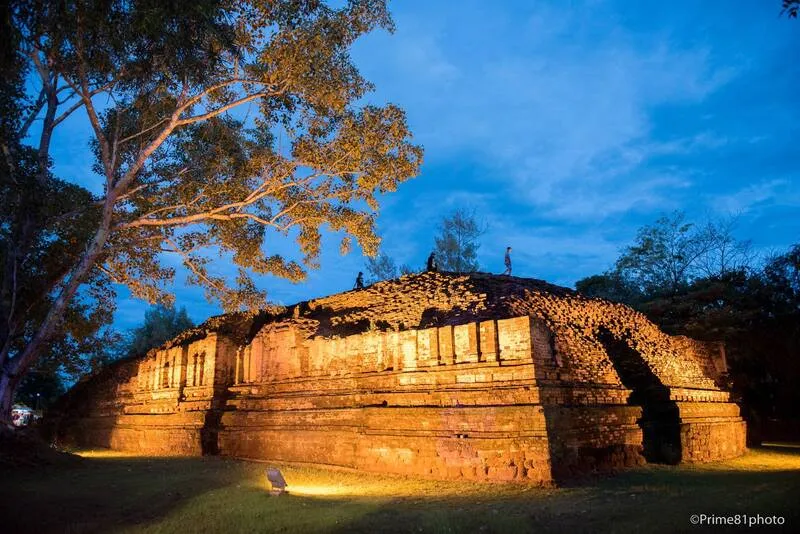
For general visitors, the best-known point within the Ban Khu Bua ancient city area is the archaeological site at Wat Khlong, or the area around Wat Khlong Suwannakhiri. This is one of the clearest places to understand the ancient architectural form. Located near the temple entrance, the monument is notable both for its scale and for the complexity of its base structure. Its ground plan is rectangular with projections extending outward on several sides. The lower base was built of laterite coated with plaster, and a curved lotus base supported the upper sections, allowing visitors to imagine that this was not an ordinary building but a carefully designed religious monument.
One of the most interesting aspects of the Wat Khlong monument is the artistic detail that still survives in fragmentary form. Although much of the upper structure has collapsed over time, excavations uncovered stucco heads of celestial beings, dwarf figures, bronze lamps, and other decorative motifs. These finds make it clear that the religious architecture of Khu Bua was not plain or austere, but once richly embellished, using an artistic language shared with wider Buddhist artistic traditions beyond Ratchaburi alone.
Another site not to be missed is Archaeological Site No. 8, located behind Wat Khu Bua School. This monument is the base of a stupa with a square plan and fairly substantial dimensions. As you approach, you can see the carefully arranged tiers of the base, with curved lotus moldings, a circumambulatory terrace, and surrounding rectangular niches. Although the upper section and the main body of the stupa no longer survive in complete form, what remains is still sufficient for visitors to appreciate the grandeur of Dvaravati craftsmanship.
The charm of Archaeological Site No. 8 lies in the quiet and openness of the area. Visitors are not hemmed in by large amounts of modern construction as they might be at urban attractions, but instead encounter the monument amid the rural atmosphere of Khu Bua. This gives the visit a more reflective quality. To some, a low mound of ancient brick in an open field may appear simple, but for those interested in history, it is deeply powerful because it reveals the passage of time in a direct and unembellished way.
Many people may wonder why Mueang Boran Ban Khu Bua remains important today. The answer is that it helps fill important gaps in our understanding of early Thai history. The ancient city of Khu Bua shows that this region had already developed into an urban center long before the Ayutthaya and Rattanakosin periods. It had religious institutions, urban structure, and artistic traditions linked to the wider world. Visiting the site, therefore, is not just tourism, but a way of seeing the broader development of Thai civilization through an actual historical landscape.
Some of the most important artifacts from Khu Bua are no longer displayed outdoors, but are preserved at the Ratchaburi National Museum, while others remain in the local area, especially around Wat Khlong Suwannakhiri. For the richest possible experience, a visit to Mueang Boran Ban Khu Bua should ideally be part of a connected route: first walk through the religious remains in their original setting, then continue to the museum to view the preserved artifacts. This combination allows visitors to understand both the physical context of the site and the finer details of the objects once used there.
Another aspect that makes Ban Khu Bua worth visiting is the local culture of the surrounding community. Khu Bua Subdistrict is not only home to Dvaravati heritage, but also to a strong Thai Yuan cultural community that has helped preserve local memory. The Ban Khu Bua Local Museum, located within Wat Khlong Suwannakhiri, therefore serves as a bridge between “Khu Bua as an ancient city” and “Khu Bua as a living community.” Travelers with limited time may choose to see only the archaeological remains, but those who want a deeper understanding of the area will gain much from visiting this local museum as well.
In terms of atmosphere, Mueang Boran Ban Khu Bua feels different from visiting a functioning temple or an active historical monument. It offers the mood of a genuine archaeological site. Visitors often notice the quiet, the openness, and the dignified stillness of the landscape. At times, the only sounds may be the wind, birds, or faint noises from the nearby community. This silence is actually an advantage, as it allows for a more focused visit and makes the forms of the brick foundations, old masonry, and traces of construction stand out more clearly than in busier tourist settings.
For photographers, Mueang Boran Ban Khu Bua is especially appealing in the morning or late afternoon, when the light brings out the texture of the old brickwork and the contours of the ancient platforms. The surfaces of brick, laterite, and aged plaster become more dimensional in angled light. Whether taking wide shots to capture the overall atmosphere of the site or close-up images focusing on material textures and architectural details, the location offers a range of compelling visual possibilities.
That said, because most of the area is outdoors, visitors should prepare accordingly. A hat, umbrella, drinking water, and comfortable walking shoes are strongly recommended. Exploring Ban Khu Bua is not like walking through an air-conditioned building, but spending time in the real terrain of an archaeological landscape. Good preparation will make the visit more comfortable and allow more time to appreciate the site fully.
Those interested in art history will quickly realize that Ban Khu Bua is not a place to understand in a single glance. The more one looks, the more questions emerge about city planning, stupa design, religious systems, and the relationship between Khu Bua and other contemporary cities within the Dvaravati network. For school groups, university students, or professionals in history, architecture, and anthropology, Mueang Boran Ban Khu Bua is an especially valuable field site because it offers both physical remains and living community context in one place.
For general travelers, Mueang Boran Ban Khu Bua may not offer rides or dramatic entertainment, but what it gives instead is a different kind of value. It encourages a slower and deeper form of travel, one that involves looking carefully at what remains and gradually reconstructing what once stood there. This kind of experience is ideal for those who want to step away from the usual tourist circuit and discover a side of Ratchaburi rooted in deep time and cultural continuity.
If you are planning a half-day trip, a sensible route is to begin at Mueang Boran Ban Khu Bua, explore the Wat Khlong monument and Archaeological Site No. 8, then stop at the Ban Khu Bua Local Museum to gain an overview of local culture, and finally continue into town to visit the Ratchaburi National Museum to see related artifacts. This route makes the story of Khu Bua much more complete, because it combines the original setting with the preserved objects that have been moved for conservation.
Getting There is relatively convenient, especially for those traveling by private car. From Ratchaburi town, drive south along Thao U Thong Road toward Khu Bua Subdistrict, and within a short time you will reach the main archaeological area. If traveling by train, you can get off at Ratchaburi Station or a nearby station and continue into Khu Bua by local transport. For those without a private vehicle, the easiest option is to hire local transport from Ratchaburi town or use a ride-hailing app and pin Wat Khlong Suwannakhiri or Archaeological Site No. 8 as your starting point.
One thing to keep in mind is that Mueang Boran Ban Khu Bua is not a tourist attraction where everything is contained within a single building. It is an archaeological landscape with remains spread across several points. To make the most of the visit, it is best to allow at least 1.5 to 3 hours for walking and reading the interpretive signs. If you also plan to visit the local museum or the national museum, setting aside half a day would be more suitable.
Viewed in the broader picture, Mueang Boran Ban Khu Bua is more than just a tourist attraction in Ratchaburi. It is tangible evidence of the continuity of civilization on Thai soil. It confirms that Buddhism, art, and urban development in this region have much deeper roots than many people realize. Standing among these brick ruins and stupa bases is, in a sense, like standing in front of a page of history that can still be read with the naked eye.
For travelers who enjoy discovering places of genuine meaning, Mueang Boran Ban Khu Bua is one of the clearest answers Ratchaburi has to offer. It brings together antiquity, silence, knowledge, and community charm in a single landscape. You may not leave with images of flashy activities, but you will leave with a new understanding that Ratchaburi is not defined only by the beauty of the present. It also holds a past stretching back more than a thousand years, still breathing through old bricks, moats, embankments, and traces of faith that remain on the land of Khu Bua to this day.
| Name | Mueang Boran Ban Khu Bua |
| Location | Khu Bua Subdistrict, Mueang Ratchaburi District, Ratchaburi Province |
| Main Visiting Area Address | Around Wat Khlong Suwannakhiri and behind Wat Khu Bua School, Khu Bua Subdistrict, Mueang Ratchaburi District, Ratchaburi Province |
| Place Summary | An important Dvaravati archaeological site in Ratchaburi, this ancient city was enclosed by moats and embankments and contains many archaeological remains scattered across the area. |
| Highlights | See the remains of a real Dvaravati city within a living community, including notable monuments such as Wat Khlong and Archaeological Site No. 8, with easy connections to the Ban Khu Bua Local Museum and the Ratchaburi National Museum. |
| Period / Era | Dvaravati Period, flourishing roughly from the late 7th to 10th centuries CE |
| Site History | Khu Bua was an important ancient city in the Mae Klong basin. Serious archaeological survey began in the 1950s, identifying at least 44 original monuments, followed by ongoing excavation, restoration, and study by the Fine Arts Department and several archaeological teams. |
| Key Evidence | Buddha heads, stucco celestial figures, dwarf motifs, bronze lamps, stupa bases, viharns, and architectural fragments reflecting Dvaravati and Indian artistic influence |
| Name Origin | The site takes its name from the present-day area of “Khu Bua,” associated with the local landscape and the long-established community of Khu Bua Subdistrict. |
| Opening Hours | Archaeological site area 08:00–16:30 hrs. / Ban Khu Bua Local Museum 09:00–16:00 hrs., closed on Tuesdays |
| Fees | Generally, no admission fee is indicated for the archaeological site area / Ban Khu Bua Local Museum has free entry |
| Travel | From Ratchaburi town, take Thao U Thong Road into Khu Bua Subdistrict, then use Wat Khlong Suwannakhiri or Wat Khu Bua School as your navigation point. Without a private vehicle, you can travel into town first and then continue by local hired transport. |
| Current Status | Still active as an important historical attraction and learning site in Ratchaburi, suitable for walking among the ruins and linking the visit with nearby museums |
| Contact Number | 032-730-172 (tourism listing in the TAT system) / Ban Khu Bua Local Museum 081-763-1989, 032-711-765 |
| Nearby Tourist Attractions | 1. Ban Khu Bua Local Museum – approx. 0.5 km – Tel. 081-763-1989, 032-711-765 2. Ratchaburi National Museum – approx. 8 km – Tel. 032-321-513 3. Wat Mahathat Worawihan, Ratchaburi – approx. 8 km – Tel. 062-238-8893 4. Khao Ngu Stone Park – approx. 14 km – Tel. 032-391-308 5. Na Satta Thai Park – approx. 24 km – Tel. 032-383-333, 081-527-2782 |
| Nearby Restaurants | 1. Je Aon Restaurant, Khu Bua – approx. 1 km – Tel. 081-007-6963, 032-730-200 2. Hong Haeng Khwam Lap (Chef Phu Restaurant), Khu Bua – approx. 2 km – Tel. 082-532-2429 3. Jay J & Naree Vegetarian Restaurant, Khu Bua – approx. 4 km – Tel. 086-859-6958, 093-325-5694 4. Ko Bua Thai Food, Khao Wang, Ratchaburi – approx. 8 km – Tel. 097-041-1055 5. BackofficeBurger Ratchaburi – approx. 8 km – Tel. 089-450-8324 |
| Nearby Accommodations | 1. VP Resort Ratchaburi – approx. 3 km – Tel. 064-149-7664, 032-240-499 2. Space 59 Hotel – approx. 8 km – Tel. 032-315-559 3. Sans Hotel Ratchaburi – approx. 8 km – Tel. 032-913-244, 098-398-8896 4. Hotel Wisma Ratchaburi – approx. 9 km – Tel. 032-326-555 5. Napa Hotel Ratchaburi – approx. 9 km – Tel. 065-229-2249, 032-913-266 |
Frequently Asked Questions (FAQ)
Q: What is Mueang Boran Ban Khu Bua?
A: Mueang Boran Ban Khu Bua is an important Dvaravati-period archaeological site in Ratchaburi Province. Located in Khu Bua Subdistrict, Mueang Ratchaburi District, it is an ancient city area where moats, embankments, and many archaeological remains have been discovered.
Q: Why is Mueang Boran Ban Khu Bua important?
A: Its importance lies in the fact that it proves the Ratchaburi area was once a major city during the Dvaravati period, with religious monuments, artistic traditions, and Buddhist evidence dating back more than a thousand years.
Q: What should visitors see at Mueang Boran Ban Khu Bua?
A: The highlights include the monument at Wat Khlong Suwannakhiri, Archaeological Site No. 8 behind Wat Khu Bua School, and the Ban Khu Bua Local Museum. If you have extra time, the Ratchaburi National Museum is also worth visiting to see related artifacts.
Q: What time does Mueang Boran Ban Khu Bua open?
A: The archaeological site area is generally open from around 08:00–16:30 hrs. The Ban Khu Bua Local Museum is open from 09:00–16:00 hrs. and closed on Tuesdays. Morning or late afternoon is the best time to visit to avoid strong sun.
Q: Who is Mueang Boran Ban Khu Bua suitable for?
A: It is ideal for history lovers, students, archaeology enthusiasts, those interested in Dvaravati art, and travelers who want to experience a deeper and more cultural side of Ratchaburi.
Q: Is it easy to get to Mueang Boran Ban Khu Bua?
A: Yes, it is relatively convenient, especially for visitors driving from Ratchaburi town. It takes only a short time to reach Khu Bua Subdistrict. Without a car, you can travel into Ratchaburi town first and then continue by hired transport or ride-hailing app to the Wat Khlong Suwannakhiri area.
 Category: ●Art, Culture and Heritage
 Group: ●Historical Sites and Monuments
Last Update : 7 MonthAgo
 Last Update : 7 MonthAgo
 Click to Access the Navigation Map GPS
Mueang Boran Ban Khu Bua Map
Recommend
 Historical Sites and Monuments(2)
 Landmarks and Memorials(1)
 Art, Craft Centres, Tradition(5)
 Museums(7)
 Art Gallery(1)
 Educational Places
 Educational Gardens, Farm(2)
 Places of Worship
 Temple(18)
 Other Sacred Sites(3)
 Research and Development
 Royal Project(1)
 Suburban Living
 Village, Community(4)
 Local Market(1)
 Floating Market(3)
 Nature and Wildlife
 National Parks and Marine Reserves(2)
 Mountain (Doi)(5)
 Dam, Reservoir, Lake(1)
 Waterfalls(4)
 Hot Springs(2)
 Caves(4)
 Flower Field(2)
 River, Canal(1)
 Other natural attractions(3)
 Entertainment and Agricultural
 Zoos and Aquariums(2)
 Animal camps and shows(1)
 Farms, Parks and Ecotourism(2)
 Waterpark(1)
 Outdoor and Adventure Activities(4)
 Shopping
 Shopping and Night Market(2)
 Spas and Wellness
 Spas and Wellness(1)
 Travel Articles, Recipes
 Travel Review, Food Review(1)


