
lovethailand home >Central Travel Attractions >Ratchaburi Travel Attractions >Chom Bung >Dan Thap Tako > Wat Krok Singkhon
TL;DR: Wat Krok Singkhon is located at 11 Ban Krok Singkhon, Village No. 8, Dan Thap Tako Subdistrict, Chom Bueng District, Ratchaburi 70150, open Open daily, hours 08:00 - 17:00.
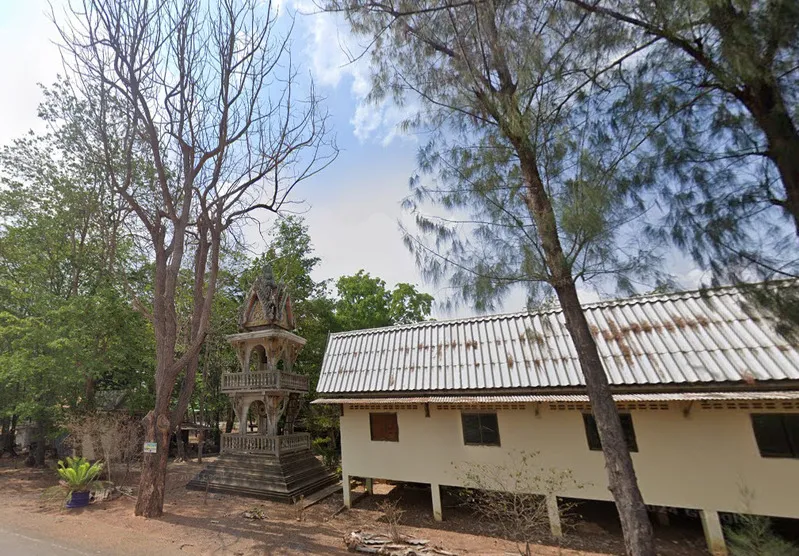
Wat Krok Singkhon
Open Days: Open daily
Opening Hours: 08:00 - 17:00
Wat Krok Singkhon, Ratchaburi is an important community temple of Ban Krok Singkhon, Village No. 8, Dan Thap Tako Subdistrict, Chom Bueng District, Ratchaburi Province. The temple was officially established on 30 December 1988 through the faith and collective donations of local villagers, who built the monastic structures so the site could serve as a residence for monks and as a place for shared religious activities. The temple’s main distinction lies in the fact that it truly grew out of the strength of the community itself. It has a reinforced concrete ordination hall built in 1996, a principal Buddha image in the ordination hall, and the atmosphere of a rural temple in Chom Bueng that still clearly reflects the way of life of local people. For those who want to visit a temple in Ratchaburi that offers a simple, peaceful atmosphere and reveals the genuine connection between a temple and its village, Wat Krok Singkhon is one destination well worth considering.
Wat Krok Singkhon, Ratchaburi is located at 11 Ban Krok Singkhon, Village No. 8, Dan Thap Tako Subdistrict, Chom Bueng District, Ratchaburi Province. It belongs to the Mahanikaya order and occupies 17 rai of temple land. Although it is not a large ancient temple or a royal monastery like some of the major temples in Ratchaburi city, the true value of Wat Krok Singkhon lies in the fact that it is a community temple built through genuine local cooperation, and it clearly reflects the character of a contemporary rural Thai temple.
From a tourism perspective, Wat Krok Singkhon has a kind of charm quite different from the well-known temples that many travelers already recognize. Its appeal does not lie in grand architecture or nationwide fame, but in the authenticity of the community, the relationship between the temple and the villagers, and the sense of peace and simplicity that can be felt immediately upon arrival. A temple of this kind is especially suitable for those who want to see the “real life” of a place rather than visiting only destinations that have already been shaped into commercial landmarks.
The name “Wat Krok Singkhon” comes directly from the name of the village, Ban Krok Singkhon. This is a common pattern in rural Thai society, where temples often take their names from the local community or landscape in order to reflect shared ownership by the people of the area. A temple name of this kind has deep meaning, because it makes clear that the temple is not separate from the village, but truly part of the community’s identity. When local people hear the temple’s name and immediately connect it with their own home village, the temple naturally becomes a strong center of collective spiritual life.
Wat Krok Singkhon was officially established on 30 December 1988. Compared with the ancient temples of Ratchaburi, its history is not especially long, but this gives it an interesting character of another kind, because here we can clearly see the process of a community building its own religious center in the modern period. In other words, the temple did not arise from an old legend or from royal patronage, but from villagers who worked together, donated funds, built the monastic structures, and gradually developed the space into the religious center of their own community.
The fact that the people of Ban Krok Singkhon worked together to build a temple as a place for monks to reside and for merit-making reflects an important value of rural Thai society very clearly. It shows that a temple is not regarded only as a place for ceremonies on important days, but as the spiritual infrastructure of the community, a place that the villagers share for merit-making, funerals, annual traditions, community gatherings, and many other important occasions. Building a temple is therefore not simply about constructing a building, but about creating the very “center of community life” at the same time.
In its early stage, Wat Krok Singkhon served as a monks’ residence and as a basic space for religious activities, before gradually being developed and improved on an ongoing basis. The available information clearly shows that the temple did not remain at only a basic structural stage, but continued to grow steadily. This is characteristic of community temples that expand alongside the faith and capacity of the villagers. As the community becomes stronger, the temple also tends to become more complete.
The main temple structures include the ordination hall and the crematorium. The ordination hall was built in 1996 and is a reinforced concrete structure. This reflects the style of temple construction in rural Thailand in the late 20th century, when modern building materials were widely adopted to increase durability and reduce maintenance burdens. Even though the ordination hall of Wat Krok Singkhon is not an elaborate example of traditional craftsmanship, it still holds value as a clear representation of how contemporary rural Thai temples developed.
The ordination hall is the most sacred space in a Buddhist temple because it is the place for important monastic acts such as ordination, recitation of the monastic code, and other Sangha ceremonies. The fact that Wat Krok Singkhon has its own ordination hall means that the temple has greater institutional and functional completeness than an ordinary monks’ residence. It can therefore serve the community more fully, both in religious terms and in supporting local communal activities.
Inside the ordination hall is the principal Buddha image, which is the temple’s main sacred object. Although public information does not go deeply into its artistic details, the presence of a principal Buddha image in the ordination hall is already enough to indicate the spiritual core of the temple. For local people, the principal image is not merely a Buddha statue inside a building, but a center of reverence, faith, and emotional attachment that connects the community closely to Buddhism.
The crematorium, which appears as one of the temple’s main structures, also reflects another important role of a community temple. Rural Thai temples often serve as places that accommodate both the joyful and sorrowful rituals of life, from merit-making and ordination ceremonies to funerals. Having a crematorium therefore means that the temple serves the community in a complete cycle of life and remains present with the people at every important stage of existence.
Another interesting point is that although public information about Wat Krok Singkhon is still relatively limited, this gap actually creates an opportunity for a high-quality article to perform much better than the general data pages available online. What many of those short information pages still lack is an explanation of the temple’s deeper meaning in relation to the community, the context of Dan Thap Tako, and the development of a rural temple. If an article can fill in these dimensions properly, it will help readers understand Wat Krok Singkhon much more deeply than from reading only brief database-style summaries.
In terms of place, Dan Thap Tako is one of the subdistricts of Chom Bueng District, an area that still strongly reflects agriculture, village life, and local cultural traditions. Because Wat Krok Singkhon is located in Ban Krok Singkhon, the temple has a clearly different atmosphere from temples in the city. It feels more peaceful, more open, and more closely connected to the people. Travelers who enjoy quiet, uncrowded temples often find places like this especially appealing.
Community temples like Wat Krok Singkhon also help us understand Buddhism at the grassroots level very well, because religion in the daily lives of Thai people is not sustained only through major temples or nationally famous sacred sites. It is sustained through village temples like this one, where local people come regularly, make merit on holy days, join annual traditions, and rely on the temple during important moments of life. If one wants to truly understand the meaning of temples in Thai society, the community temple is one of the most important places not to overlook.
Publicly available temple databases generally list the abbot as Phra Athikan Chawalit Yanchalito, while more recent community-level information mentions Phra Ajarn Bunchoet Ataro in a role connected with temple care in recent years. This suggests that the temple continues to be active and continues to have monks guiding the community. Even though the most up-to-date name should still be rechecked before publication on a website, what is already clear is that the temple has not become inactive and still functions as a real religious center for the local area.
In terms of the travel experience, Wat Krok Singkhon is suitable for those who want to explore Ratchaburi in a quiet, simple way and who are looking for places beyond the mainstream route. The temple does not market itself through dramatic visual appeal, but instead has value because of the sincerity of the place itself. Visitors can spend time walking around the ordination hall, paying respect to the principal Buddha image, observing the surrounding village atmosphere, and sensing the close relationship between the temple and the community. This is a very different experience from fast-paced tourism focused only on famous landmarks.
If planning a route in Chom Bueng District, Wat Krok Singkhon can serve well as one stop along the way, especially when paired with natural attractions and cafés in the Chom Bueng area or with routes that continue into Ratchaburi city. This allows travelers to see that Ratchaburi is not made up only of famous city attractions or well-known natural sites, but also of many community temples that reflect the deeper structure of local life in very interesting ways.
Another important aspect is that Wat Krok Singkhon is an example of a temple that grew from the “social capital” of the community in a very real sense. It did not arise from a large government project or enormous outside funding, but from the collective strength of villagers who agreed that their area should have a religious center of its own. This kind of thinking reflects the resilience of rural Thai communities and is especially worth explaining in an article, because it adds another layer of understanding and shows that a temple may hold far more meaning than is immediately visible from the outside.
Getting There Wat Krok Singkhon is located at 11 Ban Krok Singkhon, Village No. 8, Dan Thap Tako Subdistrict, Chom Bueng District, Ratchaburi Province. If traveling from Chom Bueng town, visitors can take the local roads into Dan Thap Tako Subdistrict quite conveniently. The main road of the area is Highway 3274, which connects Chom Bueng District with the surrounding subdistricts. For those traveling from Ratchaburi city, using a private car is the most convenient option, because the temple lies in a rural community area and is not in a zone with public transport as frequent as in the city.
Visitors should dress respectfully according to Thai standards for entering religious places, avoiding sleeveless tops, shorts, or other unsuitable clothing, and should behave properly within the ordination hall. Even though the temple is not large, it is still a sacred place that local people respect very seriously, so visiting with proper regard for the place is extremely important.
The best time to visit is from morning to late morning and again in the late afternoon, when the weather is more comfortable, the natural light is softer, and the atmosphere of the rural temple becomes especially peaceful. For visitors who enjoy photography, Wat Krok Singkhon offers images of genuine simplicity, with the temple buildings set against a rural village backdrop that is clearly different from temples in the city.
To summarize clearly, Wat Krok Singkhon, Ratchaburi, is a community temple that has great value in its own way. Its main strength lies in the fact that it was created through the faith of the villagers of Ban Krok Singkhon, that it has continued to develop since 1988, that it has an ordination hall and principal Buddha image as the center of religious life, and that it serves as the spiritual heart of the local community. Although it is not a large temple or one with wide public fame, it is a temple that helps us understand the role of religion in the daily life of rural communities very deeply.
For those who want to know Ratchaburi from a perspective deeper than the usual check-in locations, Wat Krok Singkhon is another very interesting answer. It does not offer grandeur, but it offers understanding of community, temple life, and the real way of life of the people in Chom Bueng District. Once one has actually visited the place, it becomes very clear that even a small temple or a community temple can hold very high spiritual and cultural value.
| Place Name | Wat Krok Singkhon, Ratchaburi |
| Address | 11 Ban Krok Singkhon, Village No. 8, Dan Thap Tako Subdistrict, Chom Bueng District, Ratchaburi 70150 |
| Place Summary | A Mahanikaya community temple of Ban Krok Singkhon, officially established on 30 December 1988 through donations from local villagers to create a monks’ residence and a place for community religious activities |
| Highlights | A community temple that grew from the faith of local villagers, a reinforced concrete ordination hall, the principal Buddha image in the ordination hall, the rural atmosphere of Chom Bueng, and the close relationship between the temple and the village |
| History | Officially established on 30 December 1988 and named after Ban Krok Singkhon village. Local residents jointly donated funds to build the monastic structures as a monks’ residence and place for merit-making before the temple continued to develop over time |
| Main Features Within the Temple | Ordination hall built in 1996, principal Buddha image in the ordination hall, crematorium, and community religious spaces |
| Name Origin | Named after Ban Krok Singkhon village to reflect its identity as the community temple of local residents |
| Current Abbot / Latest Caretaker | Phra Athikan Chawalit Yanchalito |
| Open Days | Open daily |
| Opening Hours | Please contact the temple before visiting |
| Fees | No admission fee |
| Facilities | Temple grounds, worship areas, ordination hall, crematorium, and parking areas within the temple and nearby community |
| Getting There | From Chom Bueng District, use the main road into Dan Thap Tako Subdistrict, with Highway 3274 serving as the main route of the area, then continue into Ban Krok Singkhon |
| Current Status | Still active and continues to serve as the religious center of Ban Krok Singkhon community |
| Temple Contact Number | No verified public temple phone number was found from updated official sources |
| Zone | Dan Thap Tako Zone / Chom Bueng District / Rural Ratchaburi Zone |
| Nearby Attractions with Distance | 1. Ban Krok Singkhon Health Station / Ban Krok Singkhon Community – approximately 1 km – Local Community Zone 2. Wat Nong Si Nuan – approximately 6 km – Dan Thap Tako / Community Temple Zone 3. Wat Thung Krathin – approximately 8 km – Dan Thap Tako / Community Temple Zone 4. Tham Chomphon – approximately 18 km – Chom Bueng / Nature and Geology Zone 5. Khao Ngu Stone Park – approximately 30 km – Ratchaburi City / Nature and Landmark Zone |
| Nearby Restaurants with Distance | 1. Lom Choi Restaurant, Chom Bueng Branch – approximately 16 km – Chom Bueng / Family Restaurant Zone – Tel. 094-929-9397, 062-619-9569, 081-080-1096 2. Tuu Toon Café – approximately 17 km – Chom Bueng / Forest Café Zone – Tel. 081-269-8388 3. Talui Rice Porridge Restaurant – approximately 18 km – Chom Bueng / Evening Dining Zone – Tel. 083-920-8261 4. Krua Ban Phuean, Boek Phrai – approximately 20 km – Boek Phrai / Local Food Zone – Tel. 082-475-0519 5. Luk Nam Restaurant, Chom Bueng – approximately 18 km – Chom Bueng / Made-to-Order and Local Dishes Zone – Please contact the restaurant via its page directly |
| Nearby Accommodations with Distance | 1. Chomphon Palace Hotel MCRU – approximately 17 km – Chom Bueng / Near University Zone – Tel. 096-939-1410 2. Chom Bueng Inn and Resort – approximately 18 km – Chom Bueng / Daily Accommodation Zone – Tel. 032-261-135 3. For U Resort & Cafe' Chombueng – approximately 18 km – Chom Bueng / Resort and Café Zone – Tel. 065-401-00110 4. Kanwela Hotel Chom Bueng – approximately 18 km – Chom Bueng / District Accommodation Zone – Tel. 098-297-7778, 098-279-6988 5. Modern Place Chom Bueng – approximately 19 km – Chom Bueng / Budget Accommodation Zone – Tel. 089-256-9153, 095-710-8580 |
Frequently Asked Questions (FAQ)
Q: What is the history of Wat Krok Singkhon?
A: Wat Krok Singkhon was officially established on 30 December 1988 by the people of Ban Krok Singkhon, who jointly donated funds to build the temple structures so that it could serve as a monks’ residence and a center of merit-making for the community.
Q: Where is Wat Krok Singkhon located?
A: The temple is located at 11 Ban Krok Singkhon, Village No. 8, Dan Thap Tako Subdistrict, Chom Bueng District, Ratchaburi Province, in the rural zone of Chom Bueng District.
Q: What are the main highlights of Wat Krok Singkhon?
A: Its highlights lie in being a temple created through the collective faith of local villagers, with an ordination hall built in 1996, a principal Buddha image in the hall, and a peaceful rural atmosphere that clearly reflects the close relationship between the temple and the community.
Q: When was Wat Krok Singkhon established?
A: Wat Krok Singkhon was officially established on 30 December 1988, and its ordination hall was later built in 1996.
Q: Who is the abbot of Wat Krok Singkhon?
A: Publicly available temple databases identify the abbot as Phra Athikan Chawalit Yanchalito, but for the most up-to-date information it is best to verify directly with the temple or the local Sangha office before using it for publication.
Q: What can be found inside Wat Krok Singkhon?
A: Inside the temple are a reinforced concrete ordination hall, the principal Buddha image in the hall, a crematorium, and community religious spaces.
Q: What places can I visit after Wat Krok Singkhon?
A: You can continue traveling in the Chom Bueng area to places such as Wat Nong Si Nuan, Wat Thung Krathin, Tham Chomphon, or, if you want to continue toward Ratchaburi city, to Khao Ngu Stone Park and other attractions in town.
 Category: ●Places of Worship
 Group: ●Temple
Last Update : 3 MonthAgo
 Last Update : 3 MonthAgo
 Click to Access the Navigation Map GPS
 Art, Culture and Heritage
 Historical Sites and Monuments(2)
 Landmarks and Memorials(1)
 Art, Craft Centres, Tradition(5)
 Museums(7)
 Art Gallery(1)
 Educational Places
 Educational Gardens, Farm(2)
Temple(18)
Educational Gardens, Farm(2)
Temple(18)
 Other Sacred Sites(3)
 Research and Development
 Royal Project(1)
 Suburban Living
 Village, Community(4)
 Local Market(1)
 Floating Market(3)
 Nature and Wildlife
 National Parks and Marine Reserves(2)
 Mountain (Doi)(5)
 Dam, Reservoir, Lake(1)
 Waterfalls(4)
 Hot Springs(2)
 Caves(4)
 Flower Field(2)
 River, Canal(1)
 Other natural attractions(3)
 Entertainment and Agricultural
 Zoos and Aquariums(2)
 Animal camps and shows(1)
 Farms, Parks and Ecotourism(2)
 Waterpark(1)
 Outdoor and Adventure Activities(4)
 Shopping
 Shopping and Night Market(2)
 Spas and Wellness
 Spas and Wellness(1)
 Travel Articles, Recipes
 Travel Review, Food Review(1)


