
TL;DR: Wat Khung Tamnak is located at Bang Tabun Subdistrict, Ban Laem District, Phetchaburi 76110, open Daily, hours 07:00 – 18:00.
Wat Khung Tamnak
Open Days: Daily
Opening Hours: 07:00 – 18:00
Wat Khung Tamnak, Phetchaburi is a local Buddhist temple under the Mahanikaya order, located in Bang Tabun Subdistrict, Ban Laem District, Phetchaburi Province. Its name is closely tied to the area’s historical memory along the Ban Laem coastline. Royal chronicles mention that Somdet Phra Sanphet VIII (Phrachao Suea) traveled here to fish in the sea during the late Ayutthaya period and stayed overnight at Wat Khung Tamnak. Although no trace of the royal residence remains today, the temple’s name still functions like a historical anchor, helping visitors imagine a time when waterways and the coast of the Gulf of Thailand were both a primary lifeline and a major transportation route for local communities.
The appeal of Wat Khung Tamnak is not limited to written historical accounts. It also lies in its architectural legacy. Thailand’s National Office of Buddhism records that the temple was established in 1898 (B.E. 2441) and received its official boundary (wisungkhamasima) in 1923 (B.E. 2466). These dates reflect a period when Bang Tabun grew into a well-structured coastal community with organized religious institutions. Since then, the temple has continuously served as a center of faith, ritual life, and communal gathering, especially in a coastal landscape where livelihoods depend on water, fishing, and trade. In such places, a temple naturally becomes a stable point of spiritual support when nature is unpredictable.
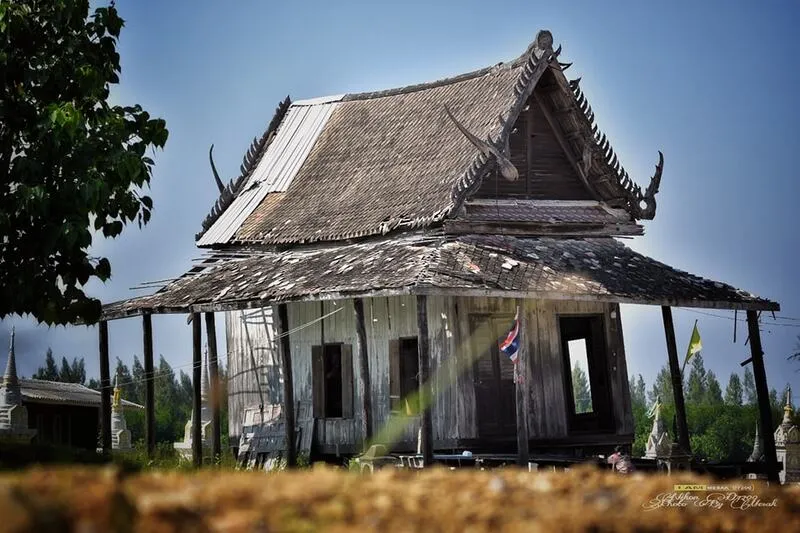
When people speak about Wat Khung Tamnak, many are drawn by one particular highlight: an old ordination hall believed to date back to the late Ayutthaya era. What makes it especially memorable is that it is constructed entirely of teakwood. This is not merely aesthetic craftsmanship; it is cultural evidence of local building wisdom in a humid, windy, and seasonal coastal climate. The choice of timber structure, elevated design, ventilation, and meticulous joinery together form the “language” of Thai master builders—strong, precise, and quietly beautiful.
Inside the ordination hall stands the principal Buddha image, described as being made from thong lang wood. This detail deepens the visit beyond simple worship. It connects materials, craftsmanship, and belief in a single space. A wooden Buddha image within a wooden hall creates a calm, warm atmosphere that feels distinctly alive. As light touches the wood surface, tones and shadows shift through the day, naturally slowing the pace of visitors and encouraging the kind of stillness that a historic temple invites.
Another layer that distinguishes Wat Khung Tamnak from many other community temples in Phetchaburi is its relationship with a Mon community. The area is associated with Mon settlers who migrated from Hongsawadee during the early Rattanakosin period, often linked with the reign of King Rama II. This settlement history reflects population movement and cultural blending in early Bangkok-era Siam. As the heart of the community, the temple became a space where Mon identity remained visible through ritual life, belief, social cohesion, and certain architectural expressions preserved by the community.
One enduring feature frequently mentioned at Wat Khung Tamnak is a stupa in the style of the Shwedagon pagoda, clearly signaling Mon–Burmese cultural roots in the area. The Shwedagon form is recognized by its proportions and dignified silhouette. Placed within a coastal community temple in Phetchaburi, it becomes a cultural bridge—linking the past of a migrating people to the present of a settled community. Seeing this stupa is more than a photo moment; it is a way of reading migration history and community formation through architecture.
The temple’s significance also connects with Thai literature. It is often linked to Sunthorn Phu’s Nirat Mueang Phet, which recalls a royal visit and fishing in a context later associated with Wat Khung Tamnak. A widely repeated verse describes a royal stop at a place prepared to receive the procession, where fishing was done without killing and the catch was released back to the sea, an act remembered in local tradition. This literary layer helps history-minded visitors picture kings, travelers, and coastal life as part of Ayutthaya-era imagination. Even without a surviving royal residence, cultural memory continues to operate through place names, stories, and communal retelling.
The absence of visible remains of the former royal residence does not diminish the temple’s importance. If anything, it makes Wat Khung Tamnak compelling as a place where history and living community life coexist. The temple remains fully active: alms-giving, observance-day worship, ordinations, Kathin, Pha Pa, and family ceremonies that bind the community together. It is not preserved as a static page in a book, but lived as a social and spiritual center that keeps relationships and faith moving forward.
A visit to Wat Khung Tamnak is ideal for travelers who want to explore the Ban Laem–Bang Tabun area in a way that blends temple culture, local narrative, and coastal everyday life. The route offers riverside communities, mangrove boat trips, fresh seafood, and viewpoints over the Bang Tabun estuary. Stopping at the temple adds a calm, meaningful rhythm to the day—not only eating and taking photos, but also encountering the cultural framework of the coast through the place that has long served as the community’s core.
If you come specifically to see the wooden ordination hall, set aside time to observe details slowly—structure, pillars, timber joints, ventilation openings, and the atmosphere inside. These are forms of beauty that do not need heavy explanation. Morning and afternoon light will change the wood’s character and the space’s depth. Being inside a wooden hall is a bodily experience more than a photographic one, and that is precisely why historic temples are best understood in person.
Because Wat Khung Tamnak sits within a close-knit coastal community, visitors should keep respectful temple etiquette: dress modestly, avoid loud voices in worship areas, do not climb on wooden structures, and honor ritual spaces. For local residents, the temple is a spiritual home, not a constructed tourist stage. When visitors show respect, the temple responds with the kind of natural quiet that defines living community sanctuaries.
A well-balanced full-day plan often begins in Phetchaburi town (or via the town route), then heads toward Ban Laem–Bang Tabun. Start at Wat Khung Tamnak to pay respects and appreciate the wooden ordination hall, then continue to Bang Tabun for seafood or a mangrove boat trip, and finish by driving along the coast to Laem Phak Bia or Hat Chao Samran for a sea view in the late afternoon. This structure creates a day that blends faith, culture, nature, and food in a clean, satisfying rhythm.
Getting There From Phetchaburi town, drive toward Ban Laem District and enter Bang Tabun Subdistrict. The final stretch typically uses rural highways and local coastal community roads. Follow signs for “Ban Laem” and “Bang Tabun,” then continue to Wat Khung Tamnak (best reached by private car).
| Place Summary | A Mahanikaya community temple in Bang Tabun associated with the story of King Suea’s coastal fishing visit. Highlights include a historic teakwood ordination hall (believed late Ayutthaya), a wooden principal Buddha image, and a Shwedagon-style stupa within a Mon community setting. |
| Address | Bang Tabun Subdistrict, Ban Laem District, Phetchaburi 76110 |
| Abbot (Latest) | Phra Athikan Chat Uttamo |
| Highlights | King Suea residence legend, teakwood ordination hall (believed late Ayutthaya), wooden principal Buddha image (thong lang wood), Mon cultural traces and Shwedagon-style stupa, coastal community temple atmosphere in Ban Laem–Bang Tabun. |
| Period | Established 1898; Wisungkhamasima granted 1923; wooden ordination hall believed late Ayutthaya period |
| Key Evidence | Teakwood ordination hall, wooden principal Buddha image, Shwedagon-style stupa, historical and literary linkage (Nirat Mueang Phet) associated with King Suea’s coastal fishing narrative. |
| Name Origin | The name “Khung Tamnak” reflects local memory of a river bend (khung) and a former royal residence (tamnak) used to receive a royal visit in the past, though no visible remains exist today. |
| Annual Activities | Kathin, Pha Pa, seasonal merit-making festivals, Buddhist holy day activities, and community events in the Bang Tabun area. |
| Facilities | Parking area, restrooms, worship and merit-making areas, community event space. |
| Fees | No admission fee (donations welcome). |
| Travel | Drive from Phetchaburi town to Ban Laem District, enter Bang Tabun Subdistrict, then continue to Wat Khung Tamnak (private car recommended). |
| Current Status | Open for worship and merit-making as usual. |
| Contact Number | 032-401-546 |
| Nearby Tourist Attractions With Distance | 1) Bang Tabun Community / Estuary Viewpoint – about 8 km 2) Bang Tabun Mangrove Boat Trips – about 9 km 3) Ban Laem Market – about 16 km 4) Laem Phak Bia Project Area – about 22 km 5) Hat Chao Samran Beach – about 26 km |
| Popular Restaurants Nearby With Distance And Phone | 1) Bang Tabun Bay – about 9 km – 065-191-6995 2) Baan Chao Lay (Bang Tabun) – about 9 km – 088-959-4184 3) Ruea Lae Le – about 10 km – 032-489-046 4) Angpao Rim Ao (Bang Tabun) – about 9 km – 084-316-2736 5) Kieng Kluen Seafood – about 26 km – 081-448-5608 |
| Popular Accommodations Nearby With Distance And Phone | 1) Tonboon Resort (Ban Laem) – about 14 km – 065-730-9684 2) i Tara Resort & Spa – about 22 km – 032-478-301 3) Eco Moment Beach Resort – about 26 km – 032-770-555 4) Capstone Resort – about 26 km – 032-770-648 5) Chez nous Boutique Resort – about 26 km – 032-478-620 |
Frequently Asked Questions (FAQ)
Q: Where is Wat Khung Tamnak located?
A: Wat Khung Tamnak is located in Bang Tabun Subdistrict, Ban Laem District, Phetchaburi Province, within the coastal community area connected to the Ban Laem–Bang Tabun route.
Q: How is Wat Khung Tamnak connected to King Suea?
A: Historical narratives and local memory link the area to King Suea’s coastal fishing visit and an overnight stay, which is why the temple name is remembered in relation to a former place prepared to receive the royal procession.
Q: What is special about the temple’s ordination hall?
A: The temple is known for an old ordination hall believed to date to the late Ayutthaya period, built entirely from teakwood—a rare and highly valued form of traditional craftsmanship today.
Q: What is important inside the ordination hall?
A: Inside is the principal Buddha image described as being made from thong lang wood, offering visitors a direct experience of faith expressed through traditional materials and woodworking heritage.
Q: Why is the temple associated with a Mon community?
A: The temple sits within a Mon community connected to early Rattanakosin-era migration, leaving cultural and architectural traces such as a Shwedagon-style stupa.
Q: What type of trip is Wat Khung Tamnak best for?
A: It suits a history-and-culture day trip focused on a wooden ordination hall and coastal community context, with easy continuation to Bang Tabun for seafood and mangrove boat trips, or onward to Laem Phak Bia and Hat Chao Samran in the same day.
Q: After visiting the temple, what should I do in Bang Tabun?
A: Many visitors continue to Bang Tabun for fresh seafood, the estuary viewpoint, and a mangrove boat trip, which is one of the area’s signature activities.
 Category: ●Places of Worship
 Group: ●Temple
 Last Update : 2 MonthAgo
 Click to Access the Navigation Map GPS
 Art, Culture and Heritage
 Historical Sites and Monuments(
 Landmarks and Memorials(
 Royal Palace(
 Art, Craft Centres, Tradition(
 Museums(
 Educational Places
 Educational Gardens, Farm(
 University
 Other religious and spiritural sites(
 Research and Development
 Royal Project(
 Suburban Living
 Village, Community(
 Floating Market(
 Nature and Wildlife
 National Parks and Marine Reserves(
 Mountain (Doi)(
 Dam, Reservoir, Lake(
 Waterfalls(
 Hot Springs(
 Caves(
 River, Canal(
 Bays and Beaches(
 Islands(
 Other natural attractions(
 Entertainment and Agricultural
 Farm, Parks, Gardens and Ecotourism(
 Theater(
 Outdoor and Adventure Activities(
 Travel Articles, Recipes
 Travel Review, Food Review(


