
lovethailand home >Central Travel Attractions >Phetchaburi Travel Attractions >Ban Laem >Bang Ta Bu No Ok > Wat Phet Suwan
TL;DR: Wat Phet Suwan is located at Rural Road 4012, Bang Tabun Ok, Ban Laem, Phetchaburi 76110, Thailand, open Daily, hours 07:00 – 18:00.
Wat Phet Suwan
Open Days: Daily
Opening Hours: 07:00 – 18:00
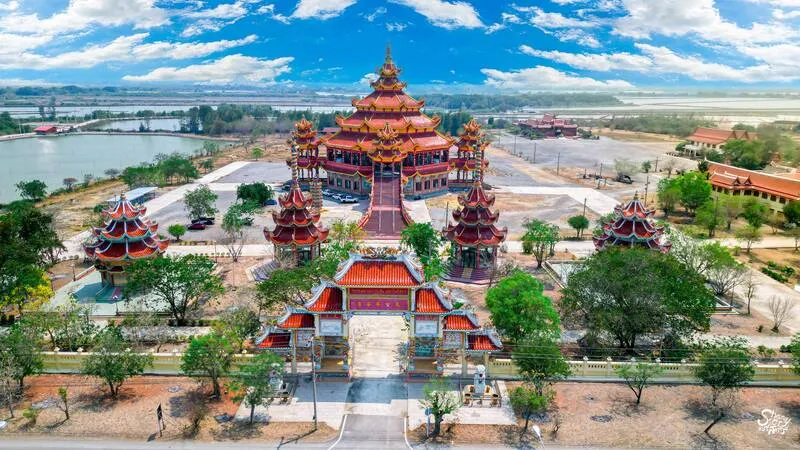
Wat Phet Suwan (Phetchaburi) is a community temple in Ban Laem District, set in the coastal lowlands where everyday life has long been shaped by canals, tidal rivers, salt fields, and the Gulf of Thailand. Although the temple was established in 1966, it is widely known not because it is “new,” but because it gathers several layers of faith, art, and cross-cultural devotion in one place: a revered Srivijaya-style Buddha image known locally as “Luang Pho Chokchai,” a prominent Guanyin shrine that reflects Chinese-Thai religious exchange along the coast, and a beautiful older ordination hall that anchors communal memory through rites of passage and annual merit-making.
In this part of Phetchaburi, villages historically relied on waterways for travel and trade before modern coastal roads became the main arteries. That older geography still matters, because it explains why temples here are not simply places for ceremonies but the social core of the settlement: where people gather for ordinations, funerals, Kathin and Pha Pa offerings, merit-making on Buddhist holy days, and shared community work. Wat Phet Suwan follows that pattern closely. The temple is approached through rural coastal roads, yet once inside, the atmosphere is unmistakably that of a living local temple: calm, functional, and genuinely used by residents rather than staged for tourism.
The spiritual centerpiece for many visitors is “Luang Pho Chokchai,” a Buddha image described as Srivijaya in style. Srivijaya-associated aesthetics are often remembered for a composed, balanced presence that feels serene without being distant. For local devotees, the impact is both visual and emotional: the beauty of the image draws attention, while the temple’s coastal livelihood context shapes how people pray. Communities that depend on tides, fishing, and the sea tend to hold a strong practical spirituality rooted in safety, stability, and the well-being of family. The name “Chokchai” itself reflects that hopeful emphasis—an everyday wish for good outcomes, safe journeys, and life that proceeds without sudden disruption.
Alongside the Buddha image, the Guanyin (Guan Yin) devotion at Wat Phet Suwan is a defining feature. Guanyin represents compassion and gentle protection in Mahayana tradition, and coastal communities in Thailand have long been open to Chinese influence through trade, migration, and intermarriage. At Wat Phet Suwan, Guanyin is not an “extra” attraction added for novelty; it functions as a real devotional focus. Many worshippers come to ask for peace within the family, mercy and kindness in relationships, health for loved ones, and a calmer mind during difficult periods. This form of prayer often feels intimate and personal, and the shrine’s presence within a Thai temple setting becomes a natural expression of cultural blending rather than a contradiction.
Local narratives emphasize that the Guanyin figure is carved from fragrant sandalwood and is considered extremely old. Whether visitors come primarily for Buddhist worship, for Guanyin devotion, or for cultural curiosity, the experience tends to converge in the same way: people slow down, become more mindful, and engage with the place respectfully. The key point for travelers is that Wat Phet Suwan is best visited with the intention to observe and understand, not merely to photograph. It is a temple whose meaning is carried through living practice and local reverence.
The temple grounds also include an older, notably beautiful ordination hall (ubosot), frequently praised by locals. In many Thai communities, an older ubosot is not only an architectural asset but also a “memory container” for the village: generations have passed through it for ordinations, chanting, and important ceremonies. Even when a temple is formally established in the modern era, an older ordination hall can extend the felt history of the site because it preserves craftsmanship, layout, and ritual continuity. At Wat Phet Suwan, this contributes to a sense that the temple’s identity is deeper than the founding year alone.
If you plan your visit as cultural travel, Wat Phet Suwan works well as a calm anchor point within a coastal day trip. Many visitors pair it with Bang Tabun’s riverside seafood scene, mangrove boat routes, salt-field landscapes, and onward stops like Laem Phak Bia (known for environmental projects and coastal scenery) or Hat Chao Samran for a relaxed seaside finish. The value of the temple stop is that it changes the rhythm of the day: from food and views to a quieter, reflective moment where art, devotion, and community life intersect.
For those interested in local religious life, the temple also represents how community cohesion is maintained. Merit-making events are practical social systems: families coordinate food, set up shared spaces, host visitors, and pass on etiquette and stories. In some periods, temples also host larger fairs connected to renovations or sacred rites such as the luk nimit (boundary stone) ceremonies, which draw crowds and strengthen communal ties. When Wat Phet Suwan holds such events, it becomes a focal point not only for worship but for collective participation, where the temple becomes the village’s shared project.
Getting There From Phetchaburi City, drive toward Ban Laem for approximately 12 km, then continue roughly 6 km further toward the Pak Ao – Bang Tabun area. The final stretch typically follows rural coastal roads that pass local settlements and seaside landscapes. The route is straightforward for a private car, and it is easy to combine the visit with Bang Tabun, Laem Phak Bia, and Hat Chao Samran within the same day.
| Place Summary | A community temple in Ban Laem – Bang Tabun area, established in 1966, known for the Srivijaya-style Buddha image “Luang Pho Chokchai,” a prominent Guanyin devotion space, and a beautiful older ordination hall that reflects long-standing local ritual life. |
| Address | Rural Road 4012, Bang Tabun Ok, Ban Laem, Phetchaburi 76110, Thailand |
| Abbot / Temple Head (Latest) | Phra Samuh Sangkat Sutthiyano |
| Key Highlights | Luang Pho Chokchai (Srivijaya-style Buddha image), Guanyin devotion space blending Chinese-Thai religious culture, a beautiful older ordination hall, and an authentic local-temple atmosphere in the coastal lowlands. |
| Period | Established in 1966 – Present |
| Key Evidence / Notable Features | Srivijaya-style Buddha image revered as Luang Pho Chokchai, Guanyin shrine reflecting coastal cultural exchange, and the temple’s older ordination hall used for major rites and communal ceremonies. |
| Name Origin | “Phet Suwan” is commonly understood as an auspicious name evoking value, prosperity, and radiance associated with Buddhist merit and community well-being. |
| Annual Traditions / Community Events | Kathin and Pha Pa merit-making, Buddhist festival observances, and occasional large temple fairs connected to major rites and community fundraising. |
| Facilities | Parking area, restrooms, worship halls for Buddha and Guanyin devotion, and spaces used for communal ceremonies and merit-making. |
| Fees | No entrance fee (donations welcome). |
| Travel | From Phetchaburi City: ~12 km to Ban Laem, then ~6 km further toward Pak Ao – Bang Tabun area via rural coastal roads (best by private car). |
| Current Status | Open for worship and merit-making. |
| Contact Number | 032-489-178, 032-489-060 |
| Nearby Tourist Attractions (Approx. Distance) | 1) Bang Tabun Community / Pak Ao Viewpoints – 6 km 2) Bang Tabun Mangrove Learning & Boat Routes – 8 km 3) Ban Laem Market Area – 18 km 4) Laem Phak Bia Area – 22 km 5) Hat Chao Samran Beach – 25 km |
| Popular Restaurants Nearby (Approx. Distance + Phone) | 1) Bang Tabun Bay – 7 km – 065-191-6995 2) Baan Chao Lay – 7 km – 088-959-4184 3) Ruea Lae Le – 8 km – 065-902-5801 4) Aung Pao Rim Ao (Bang Tabun) – 7 km – 084-316-2736 5) Krua Rim Ao (Bang Tabun) – 7 km – 032-481-335 |
| Popular Accommodations Nearby (Approx. Distance + Phone) | 1) Bang Tabun Homestay – 8 km – 084-160-7879 2) Sampao Ngern Homestay – 8 km – 089-200-7819 3) Fisherman’s Resort (Hat Chao Samran) – 25 km – 032-478-020 4) Capstone Resort (Hat Chao Samran) – 25 km – 032-770-648 5) Chez Nous Boutique Resort (Hat Chao Samran) – 25 km – 088-542-5599 |
Frequently Asked Questions (FAQ)
Q: When was Wat Phet Suwan established?
A: The temple was established in 1966 and remains an active community center for worship and local merit-making in the Ban Laem – Bang Tabun coastal area.
Q: What is “Luang Pho Chokchai” and why is it important?
A: Luang Pho Chokchai is the temple’s revered Buddha image described as Srivijaya-style. Local devotees regard it as a major focus of faith and a source of calm, protection, and good fortune for family life and coastal livelihoods.
Q: Why do visitors come to the Guanyin shrine at this Thai temple?
A: Guanyin is widely revered for compassion and gentle protection. At Wat Phet Suwan, the Guanyin devotion reflects Chinese-Thai religious exchange along the coast, and many worshippers come to pray for family harmony, health, and peace of mind.
Q: What makes the temple worth visiting as cultural travel?
A: Wat Phet Suwan combines living community faith with notable devotional art: a Srivijaya-style Buddha image, a strong Guanyin tradition, and a beautiful older ordination hall, all within a coastal landscape that can be paired with Bang Tabun and nearby seaside destinations.
Q: How long does it take to drive from Phetchaburi City?
A: Typical drive time is about 30–45 minutes depending on traffic, as the route is roughly 12 km to Ban Laem plus about 6 km further toward the Bang Tabun coastal zone.
Q: Are there good seafood restaurants near the temple?
A: Yes. The Bang Tabun area is known for fresh seafood and riverside dining, with popular options such as Bang Tabun Bay, Baan Chao Lay, Ruea Lae Le, and other well-known coastal eateries.
 Category: ●Places of Worship
 Group: ●Temple
Last Update : 4 MonthAgo
 Last Update : 4 MonthAgo
 Click to Access the Navigation Map GPS
Wat Phet Suwan Map
Recommend
 Art, Culture and Heritage
 Historical Sites and Monuments(1)
 Landmarks and Memorials(1)
 Royal Palace(2)
 Art, Craft Centres, Tradition(8)
 Museums(1)
 Educational Places
 Educational Gardens, Farm(4)
Temple(72)
Educational Gardens, Farm(4)
Temple(72)
 Other religious and spiritural sites(6)
 Research and Development
 Royal Project(6)
 Suburban Living
 Village, Community(10)
 Floating Market(1)
 Nature and Wildlife
 National Parks and Marine Reserves(4)
 Mountain (Doi)(3)
 Dam, Reservoir, Lake(3)
 Waterfalls(5)
 Hot Springs(1)
 Caves(13)
 River, Canal(1)
 Bays and Beaches(11)
 Islands(1)
 Other natural attractions(10)
 Entertainment and Agricultural
 Farm, Parks, Gardens and Ecotourism(3)
 Theater(1)
 Outdoor and Adventure Activities(1)
 Travel Articles, Recipes
 Travel Review, Food Review(2)


