
lovethailand home >Central Travel Attractions
>Phetchaburi Travel Attractions >Nong Ya Plong
>Nong Ya Plong
> Wat Nong Ya Plong
TL;DR: Wat Nong Ya Plong is located at Village No. 4, Nong Ya Plong Subdistrict, Nong Ya Plong District, Phetchaburi 76160, open Daily, hours 06:00 – 18:00.
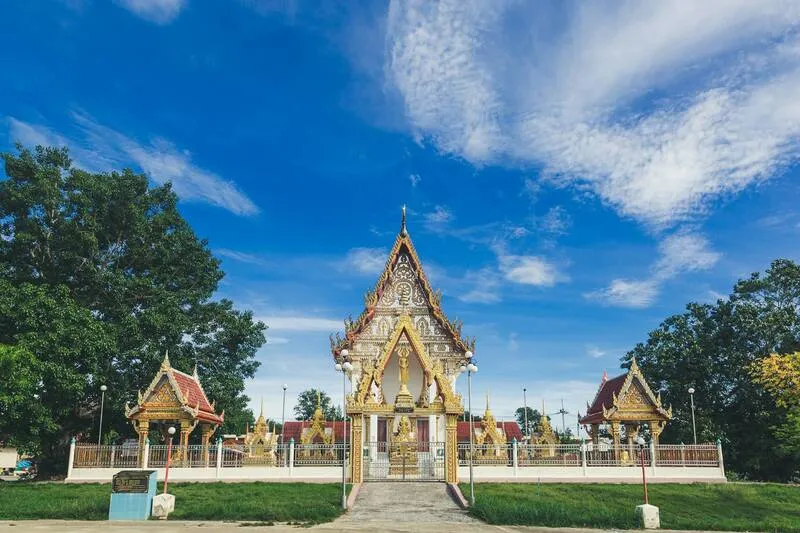
Wat Nong Ya Plong
Open Days: Daily
Opening Hours: 06:00 – 18:00
Wat Nong Ya Plong (Nong Ya Plong District, Phetchaburi) is a local Buddhist temple under the Mahanikaya order, shaped very concretely by the collective faith of people in the area. The temple is located in Village No. 4, Nong Ya Plong Subdistrict, Nong Ya Plong District, Phetchaburi, and sits on a land plot totaling 51 rai 3 ngan. Its surroundings clearly reflect the character of a “community temple” that lives closely alongside residential areas and public roads: to the north it borders private land, to the west it borders private land, while the south and east sides border public roads. This makes the temple easy to access, both for local residents who come to make merit as part of daily life and for visitors who intentionally stop by to pay respects, make donations, or observe how a rural Phetchaburi temple has steadily developed in tandem with its community.
What gives Wat Nong Ya Plong a distinctive narrative is the clearly traceable “path of becoming a temple.” The temple was officially established on 19 July 1976, built through the united efforts of residents of Nong Ya Plong, led by Kamnan Lisri That as a community leader. At that time, having a temple in the area did not mean only a venue for religious rites; it meant a spiritual anchor and a shared public space where people could gather for merit-making, local traditions, ordinations, funerals, and the many community activities that bind families and kin networks tightly together. The royal granting of Visungkhamsima on 15 February 1977 was therefore a formal affirmation of the temple’s standing within the Sangha system and within community life, with the Visungkhamsima boundary designated as 24 meters wide and 40 meters long.
From an architectural and functional perspective, Wat Nong Ya Plong reflects a pattern of gradual construction aligned with local capacity and practical needs. The ubosot measures 6 meters wide and 10 meters long. Its recorded construction year is 1876, and it is described as reinforced concrete. This is a noteworthy point when reading the temple’s physical history, because the materials and form visible today often reflect later renovations or replacement construction more than a fully preserved original structure. In other words, certain elements may have older roots, but what visitors see now is the cumulative result of repair, maintenance, and structured development in later periods.
The prayer hall is 6 meters wide and 25 meters long, built in 1977 as a wooden structure, conveying a warm, practical community-temple atmosphere that is clearly meant for everyday use. The temple has 3 monks’ quarters: 2 are half-concrete, half-wood buildings, and 1 is a fully concrete building, reflecting pragmatic adaptations in monastic living arrangements over time. The viharn is 8 meters wide and 25 meters long, built in 1992 as reinforced concrete. The multipurpose hall measures 12 meters wide and 40 meters long, built in 1993 as reinforced concrete, significantly expanding the temple’s capacity to host large community activities such as annual kathin, pha pa, communal merit-making meals for monks, ordinations, village meetings, and educational and youth programs.
Another reason Wat Nong Ya Plong feels like a “living temple” is its dedicated cremation and memorial hall: 1 building constructed with reinforced concrete. The temple also records sacred objects actively used in rituals, including the principal Buddha image in the ubosot and 20 additional Buddha images. Overall, this makes it clear that the temple was not built primarily for tourism aesthetics; it was developed to support a full cycle of religious life—from daily chanting and alms-giving to candlelight processions, offering ceremonies, and the family rites that take place throughout the year.
In administration and governance, Wat Nong Ya Plong has had successive abbots as recorded: the 1st was Phra Khru Banphot Prachawalai, and the 2nd is Phra Palat Phong Chandasuvanno (2001 – present, according to the provided details). Such continuity helps confirm the temple’s institutional stability and reflects the relationship between the monastic community and local residents. In a community temple, an abbot typically carries responsibilities beyond religious duties—maintaining temple order, overseeing Sangha property, coordinating merit-making events with villagers, and serving as a source of moral support during important moments in village life.
A major strength that should be fully presented in a cultural travel article is the temple’s role in “education,” which gives Wat Nong Ya Plong meaning beyond worship. The temple has operated a Dhamma division of a monastic school since 1976 and opened a Sunday Buddhist Studies Center in 1992. These initiatives show how the temple and community work together to cultivate ethics, basic Buddhist knowledge, and experiential learning opportunities for youth—from Dhamma lessons and understanding the Five Precepts to introductory meditation, Buddhist etiquette, and participation in community service activities.
If you approach Wat Nong Ya Plong as a visitor destination, its key appeal lies in its simplicity and the authenticity of community life. You can sense this from the moment you enter the grounds, because a community temple like this is not designed as a museum-style walking route. It is a place residents genuinely use, with the rhythms of daily life intact: morning merit-making and offerings, daytime upkeep and temple routines, quieter evenings suitable for chanting and peaceful walks, and festive periods when the temple becomes a gathering place for extended families from multiple villages.
In terms of tradition, the “annual activities” of community temples in Phetchaburi generally follow a familiar structure: merit-making on major Buddhist holy days (Makha Bucha, Visakha Bucha, Asalha Bucha, the beginning of Buddhist Lent, and the end of Buddhist Lent), the annual kathin ceremony, communal pha pa offerings, and ordinations scheduled around each family’s circumstances. As the local temple of the area, Wat Nong Ya Plong therefore naturally functions as a continuing venue for these events. For visitors, the essentials are to enter respectfully, dress modestly, speak at an appropriate volume, avoid disturbing monastic duties, and, if you wish to take photos inside the ubosot or viharn, remain composed and ask permission when staff or caretakers are nearby.
Getting There Visiting Wat Nong Ya Plong can be planned in several ways. From Phetchaburi city, travel toward Nong Ya Plong District via the main route linking the city district with the province’s inland areas, then use local roads into Village No. 4, Nong Ya Plong Subdistrict. The temple borders public roads on the south and east sides, making it relatively easy to identify for drivers. If traveling from Bangkok or coastal areas such as Cha-am or Hua Hin, enter Phetchaburi Province first, then cut inland to Nong Ya Plong District by following highway signage and local routes. A key advantage is that the drive passes through communities and rural landscapes, allowing you to extend the trip to nearby nature and community attractions within the same district on a single-day itinerary.
For a “make the most of one day” plan, Wat Nong Ya Plong works well as a starting point or a calm stopover before heading to nearby natural attractions in Nong Ya Plong District, such as the local hot springs, the forest floating market near Kwang Zhou Waterfall, Mae Prachan Dam, or the Guanyin Bodhisattva Religious Park. This zone offers mountain and forest scenery, streams, and community-based activities. If you are also a cafe or local food traveler, the district has spots locals often recommend, including scenic mountain-view cafes, straightforward home-style eateries with bold flavors, and local-style restaurants that are ideal for a meal after making merit.
Overall, Wat Nong Ya Plong suits visitors who want to experience a “real temple in a real community”: seeing how its buildings have developed over time, learning about its educational roles (both the monastic Dhamma school and the Sunday Buddhist Studies Center), and using the temple as a gateway into Phetchaburi’s nature-and-community travel corridor that remains simple, unhurried, and deeply local.
| Summary | A Mahanikaya community temple and spiritual center for Nong Ya Plong, supporting religious rites, annual merit-making, and Buddhist education. |
| Address | Village No. 4, Nong Ya Plong Subdistrict, Nong Ya Plong District, Phetchaburi 76160 |
| Key Highlights | Large community temple (51 rai 3 ngan) with practical, complete structures (ubosot, prayer hall, viharn, multipurpose hall), plus a monastic Dhamma school and a Sunday Buddhist Studies Center. |
| Period | Established 19 July 1976; Visungkhamsima granted 15 February 1977; key structures developed notably during 1977–1993. |
| Key Evidence | Recorded establishment date and Visungkhamsima grant; documented temple buildings with construction years; education roles (monastic Dhamma school/Sunday Buddhist Studies Center). |
| Name Origin | Named after the locality “Nong Ya Plong,” the community, subdistrict, and district name. |
| Abbot (Latest) | Phra Khru Phithak Watcharakit Thawaro |
| Travel | Drive to Nong Ya Plong District, then use local roads into Village No. 4, Nong Ya Plong Subdistrict. The temple borders public roads and is easy to access. |
| Current Status | Open for worship and merit-making as usual. |
| Contact Number | 032-494341 |
| Nearby Attractions With Distance | 1) Nong Ya Plong Hot Springs – 6 km 2) Forest Floating Market at Kwang Zhou Waterfall – 18 km 3) Mae Prachan Dam – 22 km 4) Guanyin Bodhisattva Religious Park – 24 km 5) Wat Yang Nam Klat Tai – 28 km (Tel. 086-804-1427) |
| Popular Restaurants Nearby | 1) 289 Hill Farm Cafe & Resort – 5 km (Tel. 099-289-9628) 2) Inn-Story-Cafe – 16 km (Tel. 064-651-6296, 098-827-4766) 3) Krua Krungthep Tha Takhro – 15 km (Tel. 081-567-8242, 083-125-8242) 4) Benyiam (Mae Prachan Dam Project) – 22 km (Tel. 089-040-6339) 5) Im-Oun Rim Thang – 14 km (Tel. 064-360-7749) |
| Popular Accommodations Nearby | 1) Ban Kru Thip Resort – 12 km (Tel. 081-919-1250) 2) Montoro Resort Nong Ya Plong – 13 km (Tel. 032-473-533) 3) Trin Wellness Phetchaburi – 20 km (Tel. 082-515-4888) 4) Leaves Valley Resort – 25 km (Tel. 089-811-6931, 032-494-202) 5) Le Mae Residence (Khao Yoi) – 45 km (Tel. 095-458-8836) |
Frequently Asked Questions (FAQ)
Q: When was Wat Nong Ya Plong established?
A: The temple was established on 19 July 1976 through the united efforts of local residents.
Q: When did the temple receive Visungkhamsima?
A: Visungkhamsima was granted on 15 February 1977, with a designated boundary of 24 meters wide and 40 meters long.
Q: What are the key buildings inside the temple?
A: The temple includes an ubosot, a prayer hall, a viharn, a multipurpose hall, a memorial hall, and monks’ quarters, as well as the principal Buddha image and 20 additional Buddha images.
Q: What educational roles does the temple support?
A: The temple runs a monastic Dhamma school (opened in 1976) and a Sunday Buddhist Studies Center (opened in 1992).
Q: How should visitors behave when making merit at the temple?
A: Dress modestly, remain composed, avoid loud noise, do not disturb monastic duties, and keep the temple area clean.
Q: Where can I continue my trip after visiting the temple?
A: You can continue to Nong Ya Plong Hot Springs, the forest floating market near Kwang Zhou Waterfall, Mae Prachan Dam, the Guanyin Bodhisattva Religious Park, or Wat Yang Nam Klat Tai within a single-day itinerary.
 Category: ●Places of Worship
 Group: ●Temple
Last Update : 3 MonthAgo
 Last Update : 3 MonthAgo
 Click to Access the Navigation Map GPS
 Art, Culture and Heritage
 Historical Sites and Monuments(1)
 Landmarks and Memorials(1)
 Royal Palace(2)
 Art, Craft Centres, Tradition(8)
 Museums(1)
 Educational Places
 Educational Gardens, Farm(4)
 University Temple(72/246)
 Other religious and spiritural sites(6)
 Research and Development
 Royal Project(6)
 Suburban Living
 Village, Community(10)
 Floating Market(1)
 Nature and Wildlife
 National Parks and Marine Reserves(4)
 Mountain (Doi)(3)
 Dam, Reservoir, Lake(3)
 Waterfalls(5)
 Hot Springs(1)
 Caves(13)
 River, Canal(1)
 Bays and Beaches(11)
 Islands(1)
 Other natural attractions(10)
 Entertainment and Agricultural
 Farm, Parks, Gardens and Ecotourism(3)
 Theater(1)
 Outdoor and Adventure Activities(1)
 Travel Articles, Recipes
 Travel Review, Food Review(2)


