
lovethailand home >North Travel Attractions >Chiang Mai Travel Attractions >Hang Dong >Nong Tong > Wat Intharaphibun
TL;DR: Wat Intharaphibun is located at Ban Nong Khrai, Moo 9, Nong Tong Subdistrict, Hang Dong District, Chiang Mai, open Daily, hours 08:00 – 17:00.
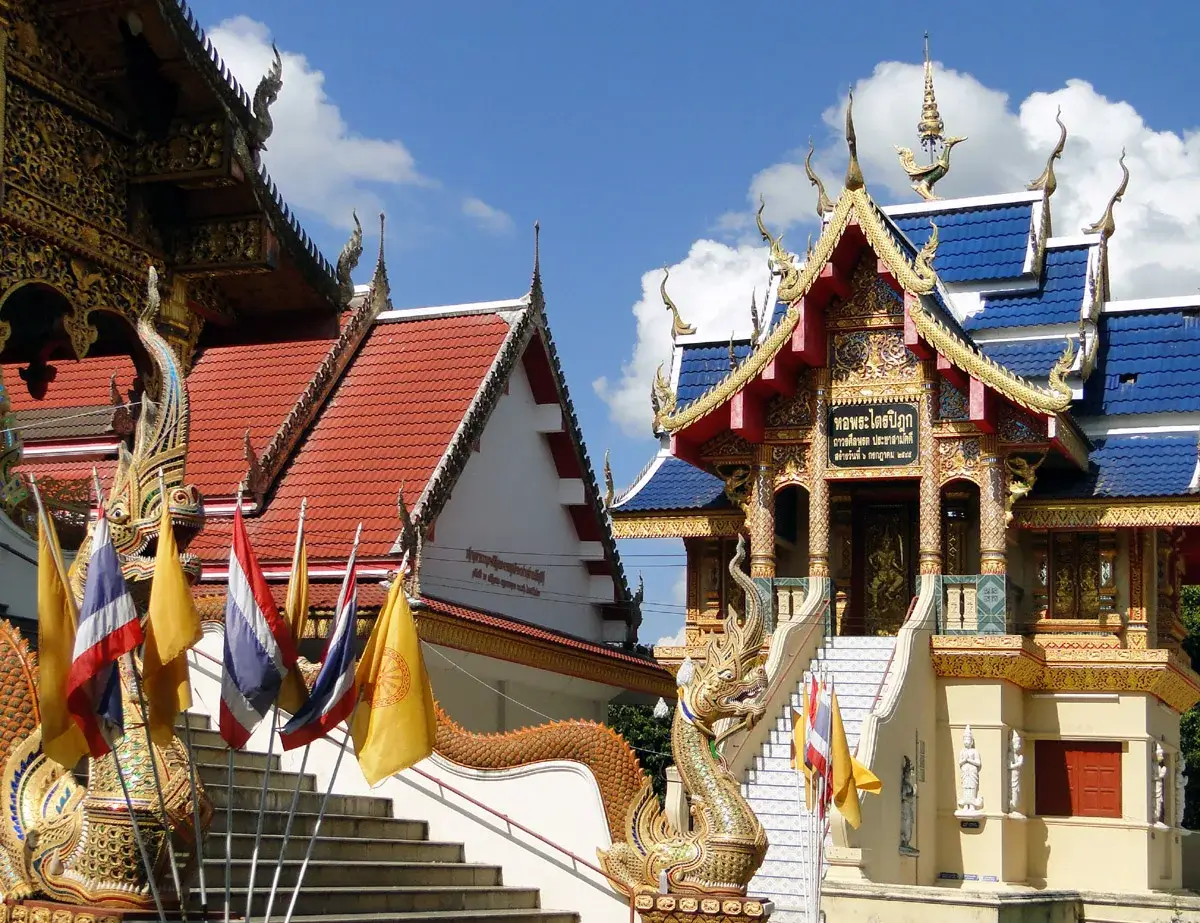
Wat Intharaphibun
Open Days: Daily
Opening Hours: 08:00 – 17:00
Wat Intharaphibun is located at 210 Moo 9, Ban Nong Khrai, Nong Tong Subdistrict, Hang Dong District, Chiang Mai 50340. It is a local Buddhist temple under the Maha Nikaya order and covers 5 rai of temple land. The temple was officially established in 1931. Wat Intharaphibun is an important community temple of Ban Nong Khrai, known for its history as a revived abandoned temple site, its Lanna-style religious structures, its viharn, ordination hall, chedi, scripture hall, Bodhi tree, and continuing role as a center of local Buddhist faith.
The temple’s history began from an abandoned temple land plot. Local people had occupied the land, but Chao Athikan Inta Intayano, who had moved from Wat Thung Phaeng, requested the return of the old temple land and purchased additional land from villagers. He then began rebuilding the temple. Local people called the temple Wat Ubosot Nong Khrai. This local name preserves the memory of Ban Nong Khrai and the temple’s revival from an abandoned sacred site into an active Buddhist temple.
This origin gives Wat Intharaphibun a distinctive value among the temples of Nong Tong Subdistrict. It was not created on empty land without prior meaning; it was restored from land that had once been connected with Buddhism. The revival of the temple reflects continuity of faith, community cooperation, and the transformation of a former sacred site back into a living religious center.
The name Wat Intharaphibun is closely connected with Chao Athikan Inta Intayano, the monk who played a central role in reclaiming and re-establishing the temple. The local name Wat Ubosot Nong Khrai connects the temple with the village and the memory of local residents. Together, the official and local names show how the temple belongs both to formal Buddhist records and to the everyday life of Ban Nong Khrai.
Ban Nong Khrai, Moo 9, is part of Nong Tong Subdistrict in Hang Dong District, Chiang Mai. Nong Tong lies south of Hang Dong and is connected by the San Pa Tong–Lamphun route and Highway 1015. The surrounding area remains strongly agricultural, with rice fields, longan orchards, gardens, and rural settlements. Wat Intharaphibun stands within this Lanna village landscape where temples, farming life, and Buddhist traditions remain closely connected.
Nong Tong Subdistrict has several important community temples, including Wat Nong Tong, Wat Phra Chao Lueam, Wat Tha Nak, Wat Nak Nimit, Wat Pa Lan, Wat Phrueksaram, Wat Sri Lanka, Wat Walukaram, and Wat Intharaphibun. These temples form a living Buddhist network across the subdistrict. Wat Intharaphibun is part of this cultural landscape, linking village religion, agricultural communities, local history, and Lanna Buddhist art.
Wat Intharaphibun has appeared in public Buddhist activities in recent years. In 2019, royal alms were presented to Phra Khru Thawon Sinlaprot Intha Thawaro, then associated with Wat Intharaphibun. In 2021, a royal Kathin-related merit ceremony was held at the temple. These events show that the temple remains active in contemporary Buddhist life and continues to receive respect from the local community and wider devotees.
Phra Khru Thawon Sinlaprot Thawaro, also remembered as Khru Ba Intha, is an important monk associated with Wat Intharaphibun. In later public information related to the 2021 Kathin ceremony, Phra Palat Suphawat Khamphirawangso was identified as the abbot. The continuity of monastic leadership across generations has helped maintain the temple’s religious role, facilities, ceremonies, and community faith.
Important religious structures inside Wat Intharaphibun include the ordination hall, viharn, Lanna-style chedi, scripture hall, large Bodhi tree, and worship areas. The ordination hall supports formal monastic ceremonies. The viharn is used for worship, sermons, and community merit-making. The chedi, scripture hall, and Bodhi tree add artistic, educational, and devotional dimensions to the temple.
The chedi at Wat Intharaphibun is a Lanna-style chedi commonly found in Chiang Mai. It has a round form on a high square indented base, with enlarged and raised moulding tiers, a smaller bell-shaped section, circular lotus bands influenced by Pagan-style forms, an indented throne, niches on 4 sides, and 4 smaller chedis surrounding the main chedi. This makes the chedi one of the most important visual and cultural features of the temple.
The scripture hall is another meaningful feature. It preserves palm-leaf manuscripts containing Buddhist teachings. In a Lanna community temple, a scripture hall is not only a storage space. It represents the preservation of Dhamma knowledge, local literacy, and the transmission of Buddhist learning across generations.
The temple also has a large Bodhi tree with wooden supports. In Lanna Buddhist belief, offering Bodhi supports symbolizes supporting Buddhism and sustaining the faith. The practice is also associated with blessings and personal well-being. The Bodhi tree area is therefore an important devotional space, not merely a shaded natural feature.
Important things to see at Wat Intharaphibun include the ordination hall, viharn, Lanna-style chedi, scripture hall with palm-leaf manuscripts, large Bodhi tree with supports, temple grounds, and the calm atmosphere of Ban Nong Khrai’s community temple. The temple is best experienced slowly, with attention to its revival history and Lanna Buddhist character.
Visitors should pay respect to the Buddha images in the viharn and worship areas, the Lanna-style chedi, and the Bodhi tree according to personal faith. Proper conduct is important: dress modestly, speak quietly, avoid disturbing monks or local devotees, and ask permission before photographing sensitive areas such as the ordination hall, scripture hall, monks’ residences, or active ceremonies.
Temple activities are connected with the Buddhist calendar and Lanna village traditions. These include Buddhist holy days, Buddhist Lent, the end of Buddhist Lent, Kathin, forest robe offerings, temple maintenance activities, and merit-making by local devotees. Kathin is especially important because it brings the community together to offer robes and support temple restoration and maintenance.
The role of Wat Intharaphibun in Ban Nong Khrai can be understood through religion, society, and culture. Religiously, it is a place for worship, sermons, ceremonies, and merit-making. Socially, it brings villagers together during Buddhist events. Culturally, it preserves the memory of an abandoned temple site, the local name Wat Ubosot Nong Khrai, Lanna chedi art, palm-leaf manuscript traditions, and Bodhi support beliefs.
Nong Tong also contains Wiang Mano Ancient Settlement, an important historical site associated with Hariphunchai. Combining Wat Intharaphibun with Wiang Mano and other nearby temples allows visitors to understand Nong Tong through several layers: ancient settlement history, local village temples, Lanna Buddhist art, agricultural life, and continuing community faith.
A connected cultural route can begin at Wat Intharaphibun to learn about its revival from an abandoned temple site and to see its Lanna structures. Visitors can then continue to Wat Nong Tong, Wiang Mano Ancient Settlement, Wat Phra Chao Lueam, Wat Sa Trai Nurak or Wat Na Wiang, Wat Tha Nak, and Wat Nak Nimit. This route is suitable for a half-day or full-day cultural trip in southern Hang Dong.
Wat Intharaphibun is suitable for travelers interested in Lanna village temples, revived sacred sites, Lanna chedi architecture, scripture halls, palm-leaf manuscripts, Bodhi support traditions, and the quieter cultural side of Chiang Mai. It is not a large commercial tourist temple. Its value lies in its history, living faith, and close relationship with Ban Nong Khrai.
Getting There is easiest by private car, rental car, or ride-hailing service. From Chiang Mai city, travel toward Hang Dong District, then continue to Nong Tong Subdistrict via the San Pa Tong–Lamphun route or Highway 1015. The temple is located in Ban Nong Khrai, Moo 9. Visitors can set the destination as Wat Intharaphibun, Ban Nong Khrai, Nong Tong Subdistrict, Hang Dong District, Chiang Mai.
The distance from Chiang Mai city to Nong Tong is about 28 kilometers and usually takes around 35 minutes in normal traffic. Visitors should allow 45 minutes to 1 hour to pay respect, see the viharn, ordination hall, chedi, scripture hall, Bodhi tree, and temple grounds. Those planning to connect the temple with nearby historical places and temples should plan a half-day route.
Overall, Wat Intharaphibun is a meaningful community temple of Ban Nong Khrai with historical, religious, and Lanna cultural value. It began as a revived abandoned temple site, was officially established in 1931, and continues to serve as a place of worship, merit-making, and community faith. For travelers seeking the quieter local side of Chiang Mai, Wat Intharaphibun is a valuable stop on the Nong Tong cultural route.
| Name | Wat Intharaphibun |
| Local Name | Wat Ubosot Nong Khrai |
| Location | Ban Nong Khrai, Moo 9, Nong Tong Subdistrict, Hang Dong District, Chiang Mai |
| Address | 210 Moo 9, Ban Nong Khrai, Nong Tong Subdistrict, Hang Dong District, Chiang Mai 50340, Thailand |
| Temple Type | Local Buddhist temple under the Maha Nikaya order |
| Temple Land Area | 5 rai |
| Open Days | Daily |
| Opening Hours | 08:00 – 17:00 |
| Established | 1931 |
| History | Originally abandoned temple land. Chao Athikan Inta Intayano requested the return of the old temple land, purchased additional land, and rebuilt the temple. |
| Highlights | A Ban Nong Khrai community temple revived from abandoned temple land, with an ordination hall, viharn, Lanna-style chedi, scripture hall, palm-leaf manuscripts, and a large Bodhi tree with supports |
| Distinctive Features | A local Buddhist temple reflecting temple revival, village faith, Lanna chedi art, manuscript preservation, and Bodhi support traditions in Nong Tong Subdistrict |
| Main Areas / Structures | Ordination hall, viharn, Lanna-style chedi, scripture hall, Bodhi tree area, temple grounds, and worship areas |
| What To See | Lanna-style chedi, ordination hall, viharn, scripture hall with palm-leaf manuscripts, large Bodhi tree, Bodhi supports, and the atmosphere of Ban Nong Khrai’s community temple |
| What To Worship | Buddha images in the viharn, Lanna-style chedi, and the large Bodhi tree according to personal faith |
| Important Monks | Chao Athikan Inta Intayano and Phra Khru Thawon Sinlaprot Thawaro |
| Abbot / Caretaker | Phra Palat Suphawat Khamphirawangso |
| Contact Number | 053-464-394 |
| Community Role | A place for worship, merit-making, sermons, Kathin, temple maintenance, and community faith in Ban Nong Khrai |
| Current Status | An active community temple in Nong Tong Subdistrict, listed in public temple databases, travel sources, and Buddhist activity records |
| Travel Information | From Chiang Mai city, travel toward Hang Dong District, then continue to Nong Tong Subdistrict via the San Pa Tong–Lamphun route or Highway 1015. Private car, rental car, or ride-hailing service is recommended. |
| Nearby Tourist Attractions | 1. Wat Nong Tong, about 3 km 2. Wiang Mano Ancient Settlement, about 4 km 3. Wat Phra Chao Lueam, about 5 km 4. Wat Sa Trai Nurak / Wat Na Wiang, about 6 km 5. Wat Nak Nimit, about 6 km |
| Nearby Restaurants | 1. Krua Malawin Nong Tong, about 4 km, Tel. 093-239-3442 2. The Dream Cafe Chiang Mai, about 5 km, Tel. 095-612-0683 3. GOOD LUCK CAFE Nong Tong, about 5 km, Tel. 064-494-1494, 083-535-9963 4. Ping Pang Khun Kru, about 6 km, Tel. 096-901-8566 5. Khao Soi Hang Dong Mae Ui Noo Branch 1, about 15 km, Tel. 053-443-069, 098-750-6214, 080-629-2528 |
| Nearby Accommodations | 1. Baan Tawai Lanna Resort, about 15 km, Tel. 063-654-7997 2. Soft Resort Kadfarang, about 17 km, Tel. 081-681-1739 3. Laan Mai Fai Chang Resort, about 18 km, Tel. 082-994-7888 4. Baan Suan Hill Lodge, about 19 km, Tel. 089-834-2329 5. Veranda High Resort Chiang Mai, about 24 km, Tel. 053-365-007, 062-398-6899, 098-913-7699 |
Frequently Asked Questions (FAQ)
Q: Where is Wat Intharaphibun located?
A: Wat Intharaphibun is located at 210 Moo 9, Ban Nong Khrai, Nong Tong Subdistrict, Hang Dong District, Chiang Mai 50340, Thailand.
Q: What is the local name of Wat Intharaphibun?
A: Local villagers call Wat Intharaphibun Wat Ubosot Nong Khrai.
Q: When was Wat Intharaphibun established?
A: Wat Intharaphibun was officially established as a temple in 1931.
Q: What is special about Wat Intharaphibun’s history?
A: The temple began from abandoned temple land that Chao Athikan Inta Intayano reclaimed and expanded before rebuilding the temple.
Q: What should visitors see at Wat Intharaphibun?
A: Visitors should see the ordination hall, viharn, Lanna-style chedi, scripture hall with palm-leaf manuscripts, large Bodhi tree, Bodhi supports, and the calm community temple atmosphere.
Q: Who should visit Wat Intharaphibun?
A: It is suitable for travelers interested in Lanna community temples, revived sacred sites, Lanna chedi architecture, scripture halls, palm-leaf manuscripts, Bodhi support traditions, and Nong Tong cultural routes.
Q: What nearby places can be visited with Wat Intharaphibun?
A: Nearby places include Wat Nong Tong, Wiang Mano Ancient Settlement, Wat Phra Chao Lueam, Wat Sa Trai Nurak, and Wat Nak Nimit.
 Category: ●Places of Worship
 Group: ●Temple
Last Update : 2 WeekAgo
 Last Update : 2 WeekAgo
 Click to Access the Navigation Map GPS
 Muang Chiang Mai(121)Chom Thong(47)Mae Chaem(25)Chiang Dao(33)Doi Saket(68)Mae Taeng(85)Mae Rim(69)Samoeng(29)Fang(71)Mae Ai(59)Phrao(70)San Pa Tong(103)San Kamphaeng(66)San Sai(73)Hang Dong(73)Hot(32)Doi Tao(22)Omkoi(11)Saraphi(74)Wiang Haeng(15)Chai Prakan(28)Mae Wang(32)Mae On(22)Doi Lo(33)Galyani Vadhana(1)


