
lovethailand home >North Travel Attractions >Chiang Mai Travel Attractions >Hang Dong >San Phak Wan > Wat Chimphliwan
TL;DR: Wat Chimphliwan is located at 165 Moo 2, Ban Ton Ngio, San Phak Wan Subdistrict, Hang Dong District, Chiang Mai Province, open Daily, hours 08.00 – 17.00.

Wat Chimphliwan
Open Days: Daily
Opening Hours: 08.00 – 17.00
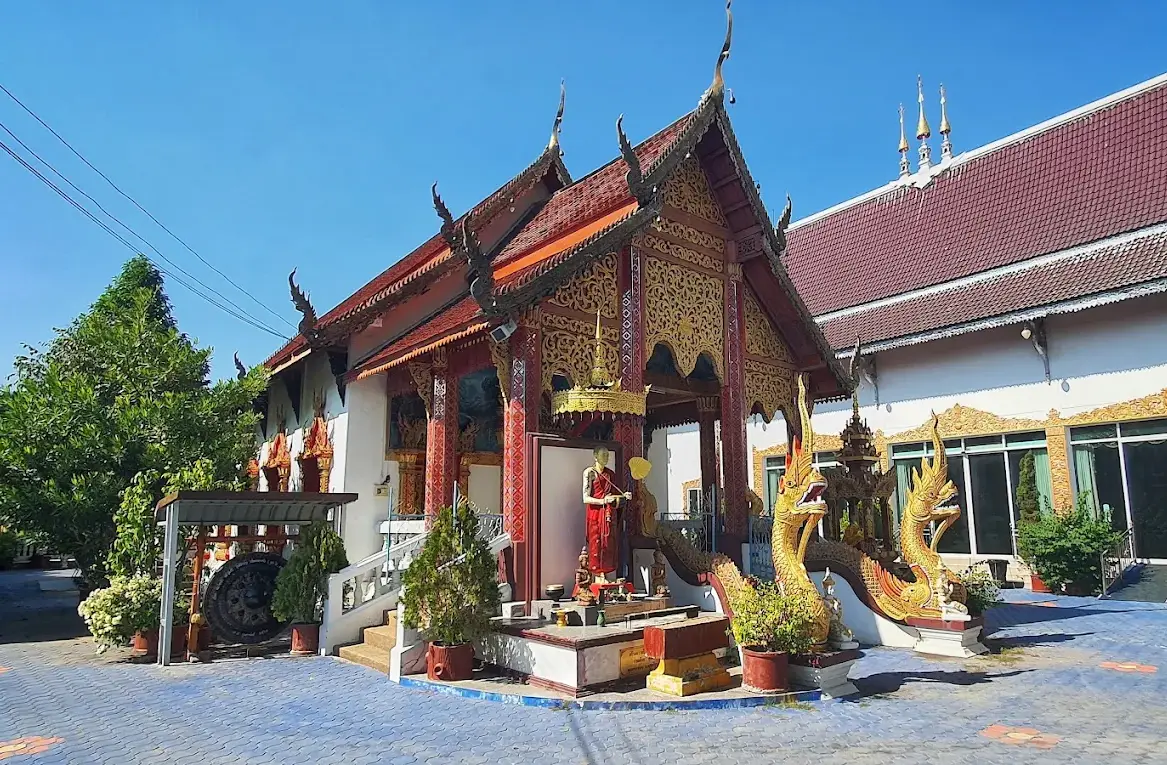
Wat Chimphliwan, also locally known as Wat Ton Ngio, is located at 165 Moo 2, Ban Ton Ngio, San Phak Wan Subdistrict, Hang Dong District, Chiang Mai Province. It is a private Buddhist temple under the Mahanikaya order, with a temple land area of 8 rai. The temple was officially established in 1826 and received royal granting of wisungkhamsima on 31 July 1951. Wat Chimphliwan is an important community temple of Ban Ton Ngio, valued for its Buddhist role, its local legend of the golden coconut, its connection with the Ton Ngio and Nong Ngio landscape, and its continuing role in Lanna Buddhist traditions.
San Phak Wan Subdistrict lies in Hang Dong District, not far from Chiang Mai city. The area connects with Chiang Mai–Hang Dong Road, Route 108, local roads, and routes leading to well-known Hang Dong attractions. It includes old villages, community temples, local food, accommodations, craft destinations, and family attractions. Wat Chimphliwan is therefore suitable for travelers who want to combine a peaceful temple visit with a broader Hang Dong route, including Kad Farang Village, Baan Tawai Handicraft Village, Grand Canyon Water Park Chiang Mai, Wat Ton Kwen, Chiang Mai Night Safari, and Royal Park Rajapruek.
Ban Ton Ngio is the village closely associated with Wat Chimphliwan. The local name Wat Ton Ngio preserves the memory of the ngio tree and Nong Ngio, the pond area connected with the temple’s founding legend. The word Chimphli is also associated with the ngio tree in Thai and Buddhist cultural language. The temple name therefore brings together trees, water, sacred space, and community memory in one identity.
The central legend of Wat Chimphliwan tells of a golden coconut used for divination at Wat Doi Tham. According to the story, wherever the golden coconut floated and came ashore would become a prosperous place for building a temple. The coconut eventually floated to the Ton Ngio and Nong Ngio area. When people found it there, the old temple was moved and rebuilt at the pond site. The temple became known as Wat Ton Ngio and later Wat Chimphliwan.
This golden coconut legend gives Wat Chimphliwan a distinctive identity. The story does not describe the temple merely as a structure built on land; it describes a sacred site chosen through an auspicious sign. Such stories are common in Lanna cultural memory, where temples, water, trees, sacred objects, and community faith often come together to explain why a place became spiritually important. Wat Chimphliwan is a clear example of how local belief and Buddhist community life shape a temple’s identity.
The temple’s official establishment in 1826 shows that Ban Ton Ngio had a long-standing Buddhist community. In a Lanna village context, a temple is not only a religious building. It is a center for merit-making, sermons, alms-giving, kathin, pha pa, memorial rites, community ceremonies, and the shared spiritual life of villagers. Wat Chimphliwan therefore represents both religious faith and the long-term identity of Ban Ton Ngio.
The royal granting of wisungkhamsima on 31 July 1951 gave Wat Chimphliwan a formal boundary for monastic acts. This status is important for a village temple because it confirms the temple’s ability to support formal Sangha activities according to Buddhist discipline. Wat Chimphliwan combines an old founding legend with continuing religious status in the present day.
The contemporary abbot recorded in local information is Phra Athikan Kittikorn Dhammanando. In a community temple, the abbot plays an important role in caring for the temple, leading ceremonies, giving Dhamma guidance, coordinating merit-making events, and maintaining the relationship between monks and villagers. With monastic leadership and local support, Wat Chimphliwan continues to function as the spiritual center of Ban Ton Ngio.
The temple compound covers 8 rai, providing enough space for worship, community religious activity, merit-making, temple gatherings, and ceremonies connected with the temple’s sacred objects. Important areas include the worship area, temple courtyard, religious activity spaces, community merit-making spaces, and the area connected with the temple’s Phra That and sacred relic veneration.
The main points of interest at Wat Chimphliwan are the Buddha worship area, Phra That-related area, ceremony spaces, the temple courtyard, and the overall atmosphere of Wat Ton Ngio connected with the golden coconut legend. Visitors should begin with respectful worship, calm the mind, and then slowly observe the temple and its community setting. The temple’s value lies in its legend, local memory, and living role rather than in large-scale tourism.
Wat Chimphliwan has a clear role in Lanna Buddhist tradition. Local planning records mention the temple as a venue for Tang Tham Luang, a Lanna-style Maha Vessantara Jataka sermon event, and for the Phra That bathing ceremony. These activities show that the temple is not only a place for daily worship; it is also a community venue for Buddhist literature, sermons, sacred relic devotion, and annual religious practice.
Tang Tham Luang, or Lanna Maha Vessantara Jataka preaching, is an important Lanna Buddhist tradition. It involves listening to a major sermon text and is closely connected with merit-making, Buddhist storytelling, and the transmission of religious literature. Wat Chimphliwan’s role in hosting this activity reflects its importance as a living temple for Dhamma learning and community participation.
The Phra That bathing ceremony at Wat Chimphliwan also reflects Lanna devotional practice. Bathing a Phra That or sacred relic structure is an act of respect toward the Triple Gem and a way for villagers to gather, make merit, prepare the temple, listen to sermons, and strengthen community unity. This ceremony adds another important dimension to the temple’s role in Ban Ton Ngio.
Regular Buddhist activities at Wat Chimphliwan follow the rhythm of Lanna village temple life. These include Buddhist holy day merit-making, alms-giving, sermons, kathin, pha pa, Visakha Bucha, Asalha Bucha, Buddhist Lent, the end of Buddhist Lent, memorial merit-making, Tang Tham Luang, and the Phra That bathing ceremony. These activities bring monks, elders, families, young people, and neighbors together through shared religious practice.
Wat Chimphliwan plays an important role as the spiritual center of Ban Ton Ngio. When villagers hold merit-making events, ceremonies, or Buddhist observances, the temple provides both sacred space and community gathering space. Monks lead religious practice, while villagers support the temple and maintain it as a shared community asset. This relationship between temple and village is central to Lanna community Buddhism.
San Phak Wan has several community temples, including Wat Chai Sathit, Wat Thawon Tham, Wat Phasukaram, and Wat Latthiwanaram. Each temple serves its own village and preserves a specific local identity. Wat Chimphliwan stands out through the golden coconut legend, the local name Wat Ton Ngio, and its role in Tang Tham Luang and Phra That bathing traditions.
For travelers, Wat Chimphliwan is suitable as a quiet temple stop in a Hang Dong itinerary. It can be combined with Wat Chai Sathit, Kad Farang Village, Baan Tawai Handicraft Village, North Hill Golf Club, Grand Canyon Water Park Chiang Mai, Wat Ton Kwen, Chiang Mai Night Safari, and Royal Park Rajapruek. A cultural route can begin with Wat Chimphliwan and nearby community temples, while a family route can continue to Grand Canyon Water Park Chiang Mai, Chiang Mai Night Safari, or Royal Park Rajapruek.
Wat Chimphliwan is suitable for elderly visitors seeking peaceful worship, families traveling around Hang Dong, cultural travelers interested in Lanna legends, and visitors who want to understand San Phak Wan through a real community temple. Its value lies in simplicity, long history, the golden coconut story, Phra That devotion, and its ongoing role in Ban Ton Ngio.
Getting There is convenient by private car, rental car, or hired transport from Chiang Mai city. Take Chiang Mai–Hang Dong Road or Route 108 through the Hang Dong area, then continue into San Phak Wan Subdistrict and Ban Ton Ngio, Moo 2. Another option is to use the outer ring road and local roads of San Phak Wan. The drive from central Chiang Mai generally takes around 25 to 40 minutes depending on traffic.
The best time to visit is in the morning or late afternoon when the weather is more comfortable. Visitors should dress modestly, keep noise low, respect monks’ areas, avoid disturbing worshippers or ceremony participants, and take photos with discretion. If a merit-making event, Maha Vessantara sermon, Phra That bathing ceremony, or community ceremony is taking place, local participants should be given priority. Wat Chimphliwan remains an active community temple, so a calm and respectful visit is the best way to experience it.
In summary, Wat Chimphliwan, or Wat Ton Ngio, is a historic community temple of Ban Ton Ngio, San Phak Wan Subdistrict, Hang Dong District, Chiang Mai Province. Its value lies in its establishment in 1826, royal granting of wisungkhamsima in 1951, golden coconut legend, Ton Ngio and Nong Ngio identity, Phra That devotion, Tang Tham Luang Maha Vessantara Jataka sermon tradition, Phra That bathing ceremony, and its continuing role as the spiritual center of Ban Ton Ngio. It is a meaningful stop for travelers who want to understand Chiang Mai through local temples and living Lanna Buddhist culture.
| Name | Wat Chimphliwan / Wat Ton Ngio |
| Type | Private Buddhist Temple Under The Mahanikaya Order |
| Location | 165 Moo 2, Ban Ton Ngio, San Phak Wan Subdistrict, Hang Dong District, Chiang Mai Province |
| Address | 165 Moo 2, Ban Ton Ngio, San Phak Wan Subdistrict, Hang Dong District, Chiang Mai 50230, Thailand |
| Coordinates | 18.70489, 98.9622 |
| Highlights | Historic Ban Ton Ngio community temple with the golden coconut legend, Ton Ngio and Nong Ngio identity, Tang Tham Luang Maha Vessantara Jataka sermon tradition, and Phra That bathing ceremony |
| History | Officially established as a temple in 1826 and received royal granting of wisungkhamsima on 31 July 1951 |
| Local Name | Wat Ton Ngio |
| Name Origin And Legend | Connected with the golden coconut legend from Wat Doi Tham. The coconut floated to the Ton Ngio and Nong Ngio area, leading villagers to move the old temple and rebuild it at this pond site. |
| Temple Land Area | 8 rai |
| Community Context | Located in Ban Ton Ngio, Moo 2, San Phak Wan Subdistrict, serving as a community temple for merit-making, sermons, Buddhist ceremonies, and Lanna traditions |
| Main Areas / Zones | Worship area, temple courtyard, religious activity area, community merit-making spaces, Phra That area, and community ceremony area |
| Sacred Objects | Buddha images, Phra That, and sacred relic veneration connected with the temple’s Phra That bathing ceremony |
| Abbot / Caretaker | Phra Athikan Kittikorn Dhammanando |
| Traditions / Merit-Making Events | Buddhist holy day merit-making, alms-giving, sermons, kathin, pha pa, Visakha Bucha, Asalha Bucha, Buddhist Lent, the end of Buddhist Lent, Tang Tham Luang Maha Vessantara Jataka sermon, and the Phra That bathing ceremony of Wat Chimphliwan |
| Community Role | Spiritual center of Ban Ton Ngio, supporting worship, Dhamma teaching, Buddhist ceremonies, Lanna traditions, and preservation of the golden coconut legend |
| Current Status | Active community temple in San Phak Wan Subdistrict, Hang Dong District, Chiang Mai Province |
| Open Days | Daily |
| Opening Hours | 08.00 – 17.00 |
| Travel Information | From Chiang Mai city, take Chiang Mai–Hang Dong Road or Route 108 through the Hang Dong area, then continue into San Phak Wan Subdistrict and Ban Ton Ngio, Moo 2. Another option is the outer ring road and local roads in San Phak Wan. Private car, rental car, and hired transport are the most convenient options. |
| Nearby Tourist Attractions | 1. Wat Chai Sathit, about 2 km 2. Kad Farang Village, about 3 km 3. Baan Tawai Handicraft Village, about 4 km 4. North Hill Golf Club, about 5 km 5. Grand Canyon Water Park Chiang Mai, about 7 km 6. Wat Ton Kwen / Wat Intharawat, about 8 km 7. Chiang Mai Night Safari, about 10 km 8. Royal Park Rajapruek, about 11 km |
| Nearby Restaurants | 1. Tham Thi Ban Aroi Chang San Phak Wan, about 1 km, Tel. 063-525-2663, 092-816-3431 2. Green Kai San Phak Wan, about 2 km, Tel. 085-031-3446 3. Kuay Jap Boran San Phak Wan, about 2 km, Tel. 063-793-7870 4. Yum Talay Thong San Phak Wan, about 3 km, Tel. 086-193-0296 5. Pongsathorn Salapao Savoy Hang Dong Branch, about 4 km, Tel. 097-951-7889 6. North Hill’s Mix Restaurant & Bar, about 5 km, Tel. 053-908-999 |
| Nearby Accommodations | 1. Ban Pornchanok Hotel, about 2 km, Tel. 089-191-5720 2. P&A Thai Lanna Resort, about 3 km, Tel. 089-561-1509 3. Hang Dong Hill, about 3 km, Tel. 081-827-2853 4. Baan Tawai Lanna Resort, about 4 km, Tel. 063-654-7997 5. North Hill City Resort, about 5 km, Tel. 053-333-111, 093-131-0277 |
Frequently Asked Questions (FAQ)
Q: Where is Wat Chimphliwan located?
A: Wat Chimphliwan is located at 165 Moo 2, Ban Ton Ngio, San Phak Wan Subdistrict, Hang Dong District, Chiang Mai 50230, Thailand.
Q: What is another name for Wat Chimphliwan?
A: Wat Chimphliwan is locally known as Wat Ton Ngio because of its connection with the golden coconut legend and the Ton Ngio and Nong Ngio area.
Q: When was Wat Chimphliwan established?
A: Wat Chimphliwan was officially established as a temple in 1826 and received royal granting of wisungkhamsima on 31 July 1951.
Q: What is the golden coconut legend of Wat Chimphliwan?
A: The legend says a golden coconut from Wat Doi Tham was used for divination. Wherever it floated ashore would become a prosperous place for building a temple. It floated to the Ton Ngio and Nong Ngio area, so the old temple was moved and rebuilt there.
Q: Who is the abbot of Wat Chimphliwan?
A: The abbot recorded in local information is Phra Athikan Kittikorn Dhammanando.
Q: What important traditions are associated with Wat Chimphliwan?
A: Important traditions include Tang Tham Luang Maha Vessantara Jataka sermon, the Phra That bathing ceremony of Wat Chimphliwan, and regular Buddhist community merit-making throughout the year.
Q: What are the opening hours of Wat Chimphliwan?
A: Wat Chimphliwan is open daily from 08.00 to 17.00.
Q: What nearby attractions can be combined with Wat Chimphliwan?
A: Nearby places include Wat Chai Sathit, Kad Farang Village, Baan Tawai Handicraft Village, North Hill Golf Club, Grand Canyon Water Park Chiang Mai, Wat Ton Kwen, Chiang Mai Night Safari, and Royal Park Rajapruek.
 Category: ●Places of Worship
 Group: ●Temple
Last Update : 1 WeekAgo
 Last Update : 1 WeekAgo
 Click to Access the Navigation Map GPS
Wat Chimphliwan Map
Recommend

 Muang Chiang Mai(121)Chom Thong(47)Mae Chaem(25)Chiang Dao(33)Doi Saket(68)Mae Taeng(85)Mae Rim(69)Samoeng(29)Fang(71)Mae Ai(59)Phrao(70)San Pa Tong(103)San Kamphaeng(66)San Sai(73)Hang Dong(73)Hot(32)Doi Tao(22)Omkoi(11)Saraphi(74)Wiang Haeng(15)Chai Prakan(28)Mae Wang(32)Mae On(22)Doi Lo(33)Galyani Vadhana(1)


