
lovethailand home >North Travel Attractions >Chiang Mai Travel Attractions >Hang Dong >Nong Khwai > Wat Sahassakhun
TL;DR: Wat Sahassakhun is located at 82 Moo 4, Ban Pan Tao, Nong Khwai Subdistrict, Hang Dong District, Chiang Mai Province, open Daily, hours 08.00 – 17.00.

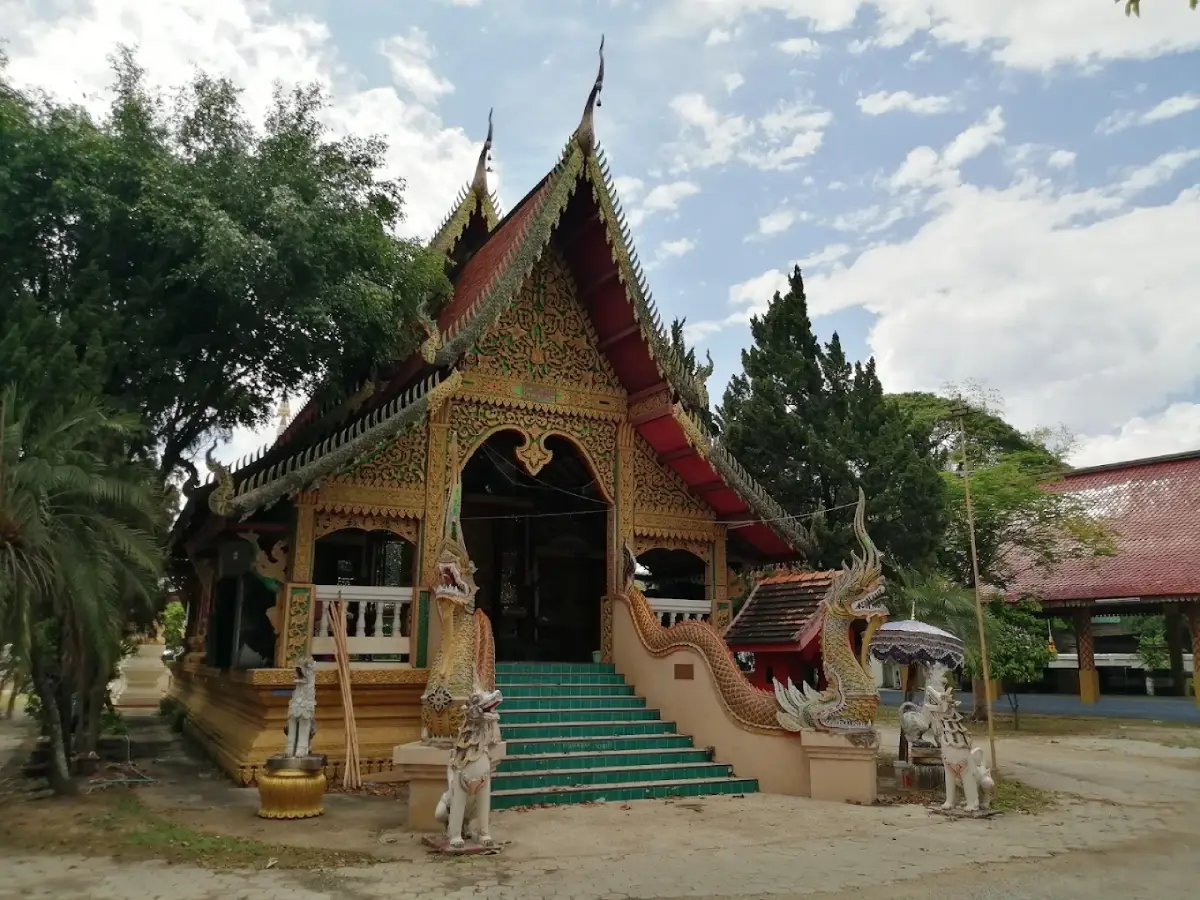
Wat Sahassakhun
Open Days: Daily
Opening Hours: 08.00 – 17.00
Wat Sahassakhun, also known locally as Wat Pan Tao or Wat Phan Tao, is located at 82 Moo 4, Ban Pan Tao, Nong Khwai Subdistrict, Hang Dong District, Chiang Mai Province. It is a private Buddhist temple under the Mahanikaya order, covering 3 rai and 37 square wah. The temple was established in 1882 and remains the community temple of Ban Pan Tao. Its value lies in its role as a village spiritual center, a place for merit-making, sermons, annual Buddhist events, and the preservation of local memory connected with the older name of the community.
Nong Khwai Subdistrict lies southwest of Chiang Mai city in Hang Dong District. The area includes old villages, agricultural land, irrigation channels, residential communities, tourist attractions, restaurants, and accommodations. It is connected by important routes such as Chiang Mai–Hot Road, Route 108, and Hang Dong–Samoeng Road, Route 1269. In the past, Nong Khwai was largely a farming landscape with village temples and irrigation systems at the center of community life. Today, it has become more suburban, but its temples continue to preserve Lanna Buddhist identity and local village memory.
Ban Pan Tao is Moo 4 of Nong Khwai Subdistrict and is closely connected with Wat Sahassakhun. The temple serves as the village’s main Buddhist center, where local residents make merit, listen to sermons, support kathin and pha pa ceremonies, and participate in annual religious events. A temple of this scale is important because it remains close to everyday village life. It is not simply a tourist stop, but a real community temple used by local people throughout the year.
The name Wat Sahassakhun carries an auspicious Buddhist meaning. “Sahassa” suggests a thousand or abundance, while “khun” means virtue, goodness, or beneficial quality. Together, the name can be understood as a place of abundant virtue and merit. The local names Wat Pan Tao and Wat Phan Tao preserve another layer of identity, keeping alive the memory of the village name and local pronunciation that existed before the official temple name became widely used.
According to local accounts, the older village name was associated with the words khi tao or khi thao, later giving rise to the name Wat Pan Tao or Wat Phan Tao. The community later rebuilt and improved the temple to suit changing times and named it Wat Sahassakhun. This history shows that the temple name is not only a label, but also a record of local memory, language change, and the development of the temple through community faith.
Wat Sahassakhun was built in 1882, at a time when Ban Pan Tao needed a Buddhist temple to serve the village. In the Lanna context, building a temple meant more than creating a religious structure. It meant creating a spiritual center where monks and villagers could meet, where families could make merit, where younger generations could learn Buddhist values, and where village traditions could continue from year to year.
The recorded temple land covers 3 rai and 37 square wah under Nor Sor 3 Kor document number 289. The northern boundary connects with an irrigation channel, the southern boundary also connects with an irrigation channel, the eastern boundary connects with a public road, and the western boundary connects with private land. The temple also has three plots of monastic land totaling 2 rai and 3 square wah. These details are important because they show how the temple sits within a traditional Lanna agricultural landscape shaped by water, roads, village land, and community use.
The monastic structure recorded in the temple history is the monks’ residence. Although public information about other individual buildings is limited, Wat Sahassakhun continues to function as a community temple with worship areas, a temple courtyard, merit-making spaces, and areas used for community Buddhist activities. This structure supports the essential role of a village temple: providing a place for monks to reside, for villagers to worship, and for the community to gather around shared Buddhist practice.
The contemporary abbot recorded for the temple is Phra Phuwadol Khanthasilo. Historical temple records mention earlier abbots, including Phra Kham Khamphira, Phra Anan, Phra Kham Phirol, Phra Ya Wirat, Phra Kham Phira, Phra Bunboeng Panyawaro, and Phra Intha Aggasuwanno. These names show continuity in temple leadership and the long-term preservation of Buddhist practice in Ban Pan Tao.
In a community temple such as Wat Sahassakhun, monks play an important role in both religious and social life. They lead ceremonies, teach Dhamma, coordinate merit-making events, and serve as a spiritual anchor for local residents during important moments in life. The presence of monastic leadership allows the temple to remain active and meaningful, rather than simply existing as a name on a register or map.
The main appeal of Wat Sahassakhun lies in its quiet village-temple identity. It is not a large tourist temple or a landmark attraction, but its value comes from its closeness to Ban Pan Tao. The local temple names, the irrigation-channel setting, the temple courtyard, and the annual religious activities all show how the temple remains embedded in local life. Visitors can experience a calmer and more genuine side of Chiang Mai through this community temple.
Visitors should pay attention to the atmosphere of Ban Pan Tao’s temple, the worship area, monks’ residence, temple courtyard, and community activity spaces. Those interested in local history can observe how the temple connects with the village landscape, especially the relationship between the temple, irrigation channels, public roads, and the surrounding community. This is a good example of how village temples, water systems, and everyday life form a single cultural landscape in Lanna communities.
Wat Sahassakhun supports the regular cycle of Buddhist village life, including Buddhist holy day merit-making, alms-giving, sermons, kathin, pha pa, Visakha Bucha, Asalha Bucha, Buddhist Lent, the end of Buddhist Lent, and memorial merit-making. Nong Khwai municipal procurement records also refer to preparation for a Phra That bathing project at Wat Sahassakhun, showing the temple’s continuing role in local Buddhist traditions. In Lanna culture, bathing a chedi or sacred relic structure is an act of devotion, renewal, and community unity.
Annual merit-making activities bring Ban Pan Tao residents back to the temple. Elders, families, young people, and devotees gather to prepare the space, make offerings, participate in ceremonies, and support the temple. These activities make Wat Sahassakhun a living religious space. It functions not only as a Buddhist temple, but also as a social and cultural center where community bonds are maintained through shared practice.
Nong Khwai has several temples that can be combined into a local temple route, including Wat Sahassakhun, Wat Intharawat or Wat Ton Kwen, Wat Wutthi Rat, Wat Pho Phichit, Wat Roi Chan, Wat Tong Kai, Wat Doi Pao, Wat Khun Se, and Wat Saeng Chotnaram. Each temple preserves the story of its own village. Wat Sahassakhun stands out as the temple of Ban Pan Tao, while Wat Wutthi Rat is associated with Ban Fon and Khru Ba Duang Dee, Wat Pho Phichit with the Nong Khwai Kham legend, and Wat Tong Kai with Thai Lue-influenced temple heritage.
A practical route can begin with worship at Wat Sahassakhun in the morning or late afternoon, then continue to Wat Ton Kwen for old Lanna architecture, Chiang Mai Night Safari for family activities, Royal Park Rajapruek for gardens and exhibitions, Ban Rai Kong Khing for community-based wellness tourism, or Kad Farang Village and Baan Tawai Handicraft Village for food, crafts, and relaxation. This makes the temple a useful stop in a half-day or full-day Hang Dong and Nong Khwai itinerary.
Wat Sahassakhun is suitable for visitors who prefer quiet temples and want to understand Chiang Mai through local community life. Elderly visitors can come for peaceful worship, families can include it in a Hang Dong route, cultural travelers can learn about village temples and irrigation landscapes, and those who prefer less crowded places can use the temple as a calm spiritual stop. Its simplicity is part of its value.
Getting There is convenient by private car, rental car, or hired transport from Chiang Mai city. Take Chiang Mai–Hot Road or Route 108, then continue into Nong Khwai Subdistrict and Ban Pan Tao, Moo 4. Another practical route is Hang Dong–Samoeng Road, Route 1269, which passes through the Nong Khwai area and connects several villages in the subdistrict. The drive from central Chiang Mai generally takes around 25 to 40 minutes depending on traffic.
The best time to visit is in the morning or late afternoon when the weather is more comfortable. Visitors should dress modestly, keep noise low, respect monks’ areas, avoid disturbing worshippers or ceremony participants, and take photos with discretion. If a merit-making event or community ceremony is taking place, local participants should be given priority. Wat Sahassakhun remains an active village temple, so a calm and respectful visit is the best way to experience it.
In summary, Wat Sahassakhun is a historic community temple of Ban Pan Tao, Nong Khwai Subdistrict, Hang Dong District, Chiang Mai Province. Its value lies in its local names Wat Pan Tao and Wat Phan Tao, its establishment in 1882, its connection with irrigation channels and the agricultural landscape of Nong Khwai, its monks’ residence, temple courtyard, annual merit-making events, and its continuing role as the spiritual center of Ban Pan Tao. It is a meaningful stop for travelers who want to understand Chiang Mai through local temples and Lanna village culture near the city.
| Name | Wat Sahassakhun / Wat Pan Tao / Wat Phan Tao |
| Type | Private Buddhist Temple Under The Mahanikaya Order |
| Location | 82 Moo 4, Ban Pan Tao, Nong Khwai Subdistrict, Hang Dong District, Chiang Mai Province |
| Address | 82 Moo 4, Ban Pan Tao, Nong Khwai Subdistrict, Hang Dong District, Chiang Mai 50230, Thailand |
| Reference Coordinates | PWG9+595, Nong Khwai, Hang Dong District, Chiang Mai |
| Highlights | Community temple of Ban Pan Tao, locally known as Wat Pan Tao / Wat Phan Tao, established in 1882 and connected with the irrigation-channel landscape of Nong Khwai |
| History | Built in 1882. Locally known as Wat Ban Tao / Wat Pan Tao before the community improved the temple and named it Wat Sahassakhun. |
| Former / Local Names | Wat Ban Tao, Wat Pan Tao, Wat Phan Tao |
| Name Meaning | Sahassakhun suggests abundant virtue and goodness, while Pan Tao / Phan Tao preserves the local village memory and pronunciation. |
| Temple Land Area | 3 rai, 37 square wah, Nor Sor 3 Kor document no. 289 |
| Monastic Land | Three plots totaling 2 rai, 3 square wah, Nor Sor 3 Kor document nos. 288, 290, and 291 |
| Boundaries | North: irrigation channel; South: irrigation channel; East: public road; West: private land |
| Community Context | Located in Ban Pan Tao, Moo 4, one of the villages of Nong Khwai Subdistrict, Hang Dong District, Chiang Mai Province |
| Main Areas / Zones | Monks’ residence, worship area, temple courtyard, religious activity area, merit-making spaces, and community event areas |
| Important Structures | Monks’ residence and community temple spaces for Buddhist activities |
| Abbot / Caretaker | Phra Phuwadol Khanthasilo |
| Recorded Abbots | Phra Kham Khamphira, Phra Anan, Phra Kham Phirol, Phra Ya Wirat, Phra Kham Phira, Phra Bunboeng Panyawaro, and Phra Intha Aggasuwanno |
| Traditions / Merit-Making Events | Buddhist holy day merit-making, alms-giving, kathin, pha pa, sermons, Visakha Bucha, Asalha Bucha, Buddhist Lent, the end of Buddhist Lent, memorial merit-making, and the Phra That bathing tradition at Wat Sahassakhun |
| Community Role | Spiritual center of Ban Pan Tao, supporting merit-making, sermons, Lanna Buddhist traditions, and the preservation of village memory in Moo 4, Nong Khwai |
| Current Status | Active community temple in Nong Khwai Subdistrict, Hang Dong District, Chiang Mai Province |
| Open Days | Daily |
| Opening Hours | 08.00 – 17.00 |
| Travel Information | From Chiang Mai city, take Chiang Mai–Hot Road or Route 108, then continue into Nong Khwai Subdistrict and Ban Pan Tao, Moo 4. Another practical option is Hang Dong–Samoeng Road, Route 1269, which passes through Nong Khwai. Private car, rental car, and hired transport are the most convenient options. |
| Nearby Tourist Attractions | 1. Wat Ton Kwen / Wat Intharawat, about 1 km 2. Wat Wutthi Rat / Wat Ban Fon, about 2 km 3. Wat Pho Phichit / Wat Nong Khwai Kham, about 3 km 4. Chiang Mai Night Safari, about 4 km 5. Royal Park Rajapruek, about 5 km 6. Ban Rai Kong Khing, about 5 km 7. Wat Phra That Doi Kham, about 7 km |
| Nearby Restaurants | 1. Nic’s Restaurant & Playground, about 3 km, Tel. 087-007-3769 2. Sojo’s Cafe, about 3 km, Tel. 083-863-0510 3. Cuisine de Garden, about 3 km, Tel. 053-441-599 4. Khaomao-Khaofang Chiang Mai, about 4 km, Tel. 053-838-444, 063-665-5838 5. Kuay Tiao Tong Kai By Bai Fern, about 4 km, Tel. 086-193-5423 6. North Hill’s Mix Restaurant & Bar, about 8 km, Tel. 053-908-999 |
| Nearby Accommodations | 1. Content Villa Chiang Mai, about 3 km, Tel. 062-439-9799 2. The Lilly Hotel Chiang Mai, about 4 km, Tel. 053-275557, 095-687-2657 3. North Hill City Resort, about 8 km, Tel. 053-333-111, 093-131-0277 4. Veranda High Resort Chiang Mai, about 10 km, Tel. 053-365-007, 062-398-6899, 098-913-7699 5. Baan Tawai Lanna Resort, about 10 km |
Frequently Asked Questions (FAQ)
Q: Where is Wat Sahassakhun located?
A: Wat Sahassakhun is located at 82 Moo 4, Ban Pan Tao, Nong Khwai Subdistrict, Hang Dong District, Chiang Mai 50230, Thailand.
Q: What are the local names of Wat Sahassakhun?
A: Wat Sahassakhun is locally known as Wat Pan Tao, Wat Phan Tao, and Wat Ban Tao.
Q: When was Wat Sahassakhun established?
A: Wat Sahassakhun was built in 1882 and remains the community temple of Ban Pan Tao.
Q: What does the name Wat Sahassakhun mean?
A: The name Sahassakhun suggests abundant virtue and goodness, while Pan Tao and Phan Tao preserve the local village memory and pronunciation.
Q: What can visitors see at Wat Sahassakhun?
A: Visitors can see the monks’ residence, worship area, temple courtyard, merit-making spaces, and the calm atmosphere of a Lanna community temple connected with irrigation channels and village life.
Q: What are the opening hours of Wat Sahassakhun?
A: Wat Sahassakhun is open daily from 08.00 to 17.00.
Q: How can travelers get to Wat Sahassakhun from Chiang Mai city?
A: Take Chiang Mai–Hot Road or Route 108, then continue into Nong Khwai Subdistrict and Ban Pan Tao, Moo 4. Another option is Hang Dong–Samoeng Road, Route 1269.
Q: What nearby attractions can be combined with Wat Sahassakhun?
A: Nearby places include Wat Ton Kwen, Wat Wutthi Rat, Wat Pho Phichit, Chiang Mai Night Safari, Royal Park Rajapruek, Ban Rai Kong Khing, and Wat Phra That Doi Kham.
 Category: ●Places of Worship
 Group: ●Temple
Last Update : 6 DayAgo
 Last Update : 6 DayAgo
 Click to Access the Navigation Map GPS
 Muang Chiang Mai(121)Chom Thong(47)Mae Chaem(25)Chiang Dao(33)Doi Saket(68)Mae Taeng(85)Mae Rim(69)Samoeng(29)Fang(71)Mae Ai(59)Phrao(70)San Pa Tong(103)San Kamphaeng(66)San Sai(73)Hang Dong(73)Hot(32)Doi Tao(22)Omkoi(11)Saraphi(74)Wiang Haeng(15)Chai Prakan(28)Mae Wang(32)Mae On(22)Doi Lo(33)Galyani Vadhana(1)


