
lovethailand home >North Travel Attractions >Chiang Mai Travel Attractions >Hang Dong >Ban Pong > Wat Pracha Kasem
TL;DR: Wat Pracha Kasem is located at Ban Mae Ha Nuea, Ban Pong Subdistrict, Hang Dong District, Chiang Mai Province, open Daily, hours 08.00 – 17.00.
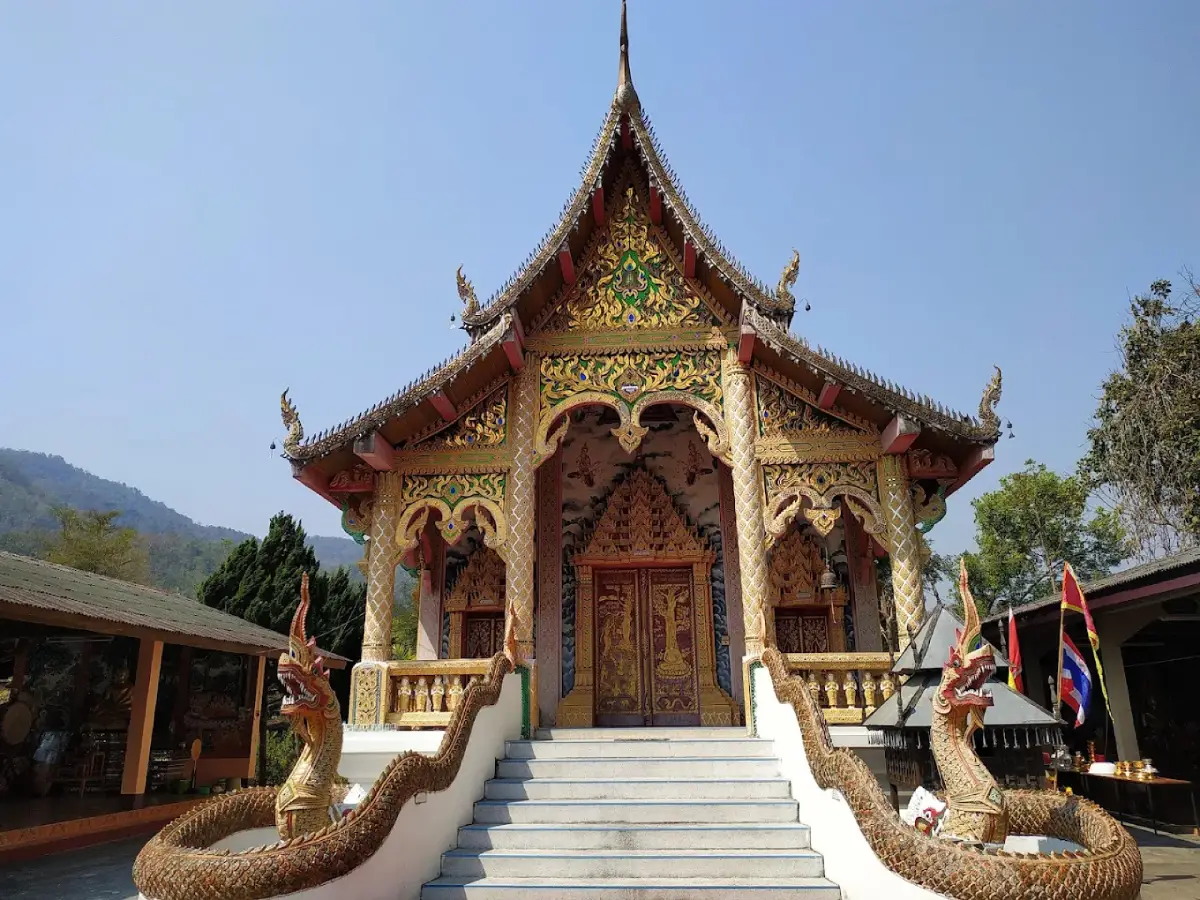
Wat Pracha Kasem
Open Days: Daily
Opening Hours: 08.00 – 17.00
Wat Pracha Kasem is located in Moo 5, Ban Mae Ha Nuea, Ban Pong Subdistrict, Hang Dong District, Chiang Mai Province. It is a local Buddhist temple under the Mahanikaya order, covering an area of 2 rai. The temple was established in 1757 and received its Wisungkham Sima in 1955. Originally known as Wat Mae Ha, it remains an important community temple with a chedi, sacred Buddha images, and Luang Pho Pra Kasem as an object of local devotion.
Ban Mae Ha Nuea is part of Ban Pong Subdistrict, a western Hang Dong area connected with the Hang Dong–Samoeng route, foothill communities, agricultural life, local schools, temples, streams, and rural roads. Wat Pracha Kasem stands within this living village landscape and continues to connect Buddhist practice with the daily life of the local community.
The name Wat Pracha Kasem has an auspicious meaning. “Pracha” refers to the people or community, while “Kasem” conveys peace, happiness, and well-being. Together, the name gives the sense of a temple that brings calm and spiritual well-being to the people. This meaning fits the temple’s role as a place for merit-making, worship, community gatherings, and moral learning.
The temple began as a deserted religious site. Local residents, moved by Buddhist faith, cleared the area and built a temporary pavilion so that monks could stay and religious activities could begin again. Later, the local faith community built additional monastic structures until the site became a stable village temple. This origin shows how Wat Pracha Kasem grew from collective village devotion rather than from a single act of construction.
The fact that the temple began as a deserted site is important to its history. In many Lanna communities, temples were restored and sustained by villagers who contributed labor, materials, food, and support for monks. Wat Pracha Kasem preserves this pattern clearly: a community first revived a sacred space, then gradually built the structures needed for worship, monastic life, and village ceremonies.
The temple was formerly called Wat Mae Ha, after the village. This older name shows the close relationship between the temple and Ban Mae Ha. The later name Wat Pracha Kasem expresses a broader sense of communal happiness and peace, but the older name still preserves the temple’s local roots and its origin as a village temple.
Wat Pracha Kasem received its Wisungkham Sima on 6 February 1955. The consecrated boundary is 9 meters wide and 12 meters long. This is important because the Wisungkham Sima defines the formal area for monastic acts, especially ceremonies performed within the ordination hall. The temple therefore has both a long local history and formal religious standing within the Thai Buddhist monastic system.
The temple land covers 2 rai. Its northern boundary borders the Mae Ha stream, while the southern, eastern, and western sides border the Samoeng–Hang Dong road. These boundaries show the temple’s relationship with both the natural landscape and local travel routes. The stream connects the temple with the local environment, while the road links it with the wider Ban Pong and Hang Dong area.
Important monastic structures at Wat Pracha Kasem include the ordination hall, sermon hall, and monks’ quarters. The ordination hall is used for formal monastic ceremonies. The sermon hall supports Dhamma listening, merit-making, village meetings, and community religious events. The monks’ quarters support the daily life of the resident Sangha. Together, these structures allow the temple to function as a complete community temple.
Sacred objects include several Buddha images, the temple chedi, and Luang Pho Pra Kasem, who is deeply respected by local people. The Buddha images are central to worship and merit-making. The chedi gives the temple a sacred Lanna character, while Luang Pho Pra Kasem remains a devotional focus for villagers and visitors.
The chedi is one of the temple’s key highlights. In northern Thai community temples, a chedi often serves as a symbolic and spiritual center. Visitors should begin by paying respect to the Buddha images and the chedi, then continue to observe the temple grounds, the sermon hall, and the quiet village-temple atmosphere.
The temple’s historical abbot list includes Phra Athikan Banya, Phra Athikan Kunna, Phra Athikan Duang, Phra Athikan Mo, Phra Athikan Singkaew, Phra Athikan Singchai, Phra Athikan Boonma, Phra Athikan Duang Techawaro, and Phra Athikan Linthong Inthawiro from 1981 onward. Current temple information used for this article identifies Phra Duangdee Narinto as the abbot of Wat Pracha Kasem.
Wat Pracha Kasem is also connected with local education. Wat Pracha Kasem School is part of the educational landscape of Ban Pong Subdistrict, showing how the temple name extends beyond the temple grounds into community learning. In many Lanna villages, temples and schools function together as institutions that shape knowledge, discipline, morality, and community identity from childhood.
The temple continues to appear in local community activities. Ban Pong Subdistrict Municipality has recorded volunteer activities involving cleaning and improving the landscape around the Mae Tha Chang watercourse and Wat Pracha Kasem, as well as community health activities in Ban Mae Ha. This shows that the temple remains an active part of local life, not only a historical religious site.
For Buddhist traditions, Wat Pracha Kasem supports the usual cycle of community merit-making: Buddhist holy days, Buddhist Lent, the end of Buddhist Lent, Kathin, robe-offering ceremonies, Lanna Songkran, and village religious activities. These events bring residents together, reinforce the relationship between temple and village, and keep local Buddhist customs alive.
The atmosphere of Wat Pracha Kasem is calm, modest, and local. It is best suited for travelers who appreciate community temples rather than highly commercial tourist attractions. Its value lies in the restoration of a deserted temple site, its formal monastic status, its chedi, its sacred Buddha images, Luang Pho Pra Kasem, and its continuing role in Ban Mae Ha Nuea.
Key things to see include the ordination hall, sermon hall, monks’ quarters, Buddha images, chedi, and the devotional area associated with Luang Pho Pra Kasem. Visitors interested in local history should note the former name Wat Mae Ha, the temple’s origin as a restored deserted site, and its boundaries along the Mae Ha stream and the Samoeng–Hang Dong road.
Wat Pracha Kasem can be included in a broader Ban Pong and Hang Dong route. Nearby places include Wat Aranyawas Ban Pong, Tham Takkatan, Grand Canyon Chiang Mai, Chiang Mai Night Safari, and Royal Park Rajapruek. The route combines local temples, village history, nature, family attractions, restaurants, cafés, and accommodation along the western side of Hang Dong.
This route is suitable for travelers who want to see Chiang Mai beyond the old city and the major tourist temples. Ban Pong offers older community temples, foothill scenery, farm-based communities, resorts, cafés, and quieter local roads. Wat Pracha Kasem is a useful starting point for understanding how village temples continue to anchor local identity.
Getting There is most convenient by private car or rental car. From Chiang Mai city, travel toward Hang Dong via the Chiang Mai–Hang Dong road or the canal road, then continue into Ban Pong Subdistrict and Ban Mae Ha Nuea. Public transport users should travel first to Hang Dong or Ban Pong, then continue by local transport or hired vehicle to the temple.
Visitors should dress modestly, speak quietly, and respect the sacred areas of the temple. If a ceremony or community activity is taking place, priority should be given to monks and local residents. Photography should be done respectfully, especially around the ordination hall, chedi, sermon hall, and worship areas.
Wat Pracha Kasem is suitable for travelers interested in old community temples, Lanna village history, chedis, sacred Buddha images, and the Ban Pong–Samoeng route. It may not be a large tourist attraction, but it is meaningful because it grew from local devotion, preserves the memory of Wat Mae Ha, and continues to serve as a spiritual center for Ban Mae Ha Nuea.
| Name | Wat Pracha Kasem / Wat Mae Ha |
| Location | Ban Mae Ha Nuea, Ban Pong Subdistrict, Hang Dong District, Chiang Mai Province |
| Address | Moo 5, Ban Mae Ha Nuea, Ban Pong Subdistrict, Hang Dong District, Chiang Mai 50230, Thailand |
| Coordinates | 18.79426, 98.83639 |
| Type | Local Buddhist temple under the Mahanikaya order |
| Temple Area | 2 rai |
| History | Built in 1757; originally a deserted temple site restored by local villagers who cleared the land and built a temporary pavilion before developing it into a village temple |
| Wisungkham Sima | Granted on 6 February 1955; consecrated boundary 9 meters wide and 12 meters long |
| Former Name | Wat Mae Ha |
| Name Meaning | The name suggests peace, well-being, and happiness for the people of the community |
| Boundary | North: Mae Ha stream; South: Samoeng–Hang Dong road; East: Samoeng–Hang Dong road; West: Samoeng–Hang Dong road |
| Main Structures | Ordination hall, sermon hall, monks’ quarters, chedi, and community religious activity areas |
| Sacred Objects / Worship Points | Buddha images, chedi, and Luang Pho Pra Kasem |
| Abbot / Caretaker | Phra Duangdee Narinto |
| Historical Abbots | Phra Athikan Banya, Phra Athikan Kunna, Phra Athikan Duang, Phra Athikan Mo, Phra Athikan Singkaew, Phra Athikan Singchai, Phra Athikan Boonma, Phra Athikan Duang Techawaro, and Phra Athikan Linthong Inthawiro |
| Community Role | Spiritual center of Ban Mae Ha Nuea, supporting merit-making, Dhamma listening, local activities, and learning connected with Wat Pracha Kasem School |
| Traditions / Merit-Making | Buddhist holy days, Buddhist Lent, the end of Buddhist Lent, Kathin, robe-offering ceremonies, Lanna Songkran, and local community merit-making |
| Travel Information | From Chiang Mai city, travel toward Hang Dong, then continue into Ban Pong Subdistrict and Ban Mae Ha Nuea. Private car or rental car is recommended. |
| Current Status | An old active community temple connected with local religious activities, community work, and education in Ban Pong Subdistrict |
| Open Days | Daily |
| Opening Hours | 08.00 – 17.00 |
| Local Authority | Ban Pong Subdistrict Municipality, Tel. 053-111-596 |
| Nearby Tourist Attractions | 1. Wat Aranyawas Ban Pong, about 4 km 2. Tham Takkatan, Ban Pong Subdistrict, about 6 km 3. Grand Canyon Chiang Mai, about 12 km 4. Chiang Mai Night Safari, about 14 km 5. Royal Park Rajapruek, about 15 km |
| Nearby Restaurants | 1. Pak Ju Na Hub Khao Hiso, about 5 km, Tel. 086-114-5383 2. Fueang Fa Restaurant, about 6 km, Tel. 053-365-231 3. The Horse Barn Eatery, about 7 km 4. Chantra Khiri Chalet Chiangmai, about 8 km, Tel. 052-010-156, 052-010-155, 081-802-0666 5. The Higher Room Veranda High Resort MGallery, about 9 km, Tel. 053-365-007 |
| Nearby Accommodations | 1. Insda Wellness Resort, about 1 km 2. PongInRak Farmstay, about 8 km, Tel. 081-025-9679 3. Veranda High Resort Chiang Mai – MGallery, about 9 km, Tel. 053-365-007 4. Suan Bua Hotel & Resort, about 9 km, Tel. 053-365-270 5. Baan Plaidoi Resort, about 10 km, Tel. 081-950-4510 |
Frequently Asked Questions (FAQ)
Q: Where is Wat Pracha Kasem located?
A: Wat Pracha Kasem is located in Moo 5, Ban Mae Ha Nuea, Ban Pong Subdistrict, Hang Dong District, Chiang Mai 50230, Thailand.
Q: When was Wat Pracha Kasem built?
A: Wat Pracha Kasem was built in 1757. It began as a deserted temple site restored by local villagers.
Q: What was the former name of Wat Pracha Kasem?
A: The temple was formerly known as Wat Mae Ha, reflecting its close connection with Ban Mae Ha.
Q: What are the main sacred points at Wat Pracha Kasem?
A: The main sacred points are the Buddha images, the chedi, and Luang Pho Pra Kasem, who is respected by local residents.
Q: What important structures are found at Wat Pracha Kasem?
A: Important structures include the ordination hall, sermon hall, monks’ quarters, chedi, and community religious activity areas.
Q: What type of traveler is Wat Pracha Kasem suitable for?
A: It is suitable for travelers interested in old community temples, Lanna village history, chedis, local sacred images, and the Ban Pong–Samoeng route.
Q: What nearby attractions can be visited with Wat Pracha Kasem?
A: Nearby places include Wat Aranyawas Ban Pong, Tham Takkatan, Grand Canyon Chiang Mai, Chiang Mai Night Safari, and Royal Park Rajapruek.
 Category: ●Places of Worship
 Group: ●Temple
Last Update : 1 WeekAgo
 Last Update : 1 WeekAgo
 Click to Access the Navigation Map GPS
 Muang Chiang Mai(121)Chom Thong(47)Mae Chaem(25)Chiang Dao(33)Doi Saket(68)Mae Taeng(85)Mae Rim(69)Samoeng(29)Fang(71)Mae Ai(59)Phrao(70)San Pa Tong(103)San Kamphaeng(66)San Sai(73)Hang Dong(73)Hot(32)Doi Tao(22)Omkoi(11)Saraphi(74)Wiang Haeng(15)Chai Prakan(28)Mae Wang(32)Mae On(22)Doi Lo(33)Galyani Vadhana(1)


