
lovethailand home >North Travel Attractions >Chiang Mai Travel Attractions >Hang Dong >Ban Pong > Wat Thong Siri
TL;DR: Wat Thong Siri is located at Ban Mae Khanin Nuea, Ban Pong Subdistrict, Hang Dong District, Chiang Mai Province, open Daily, hours 08.00 – 17.00.

Wat Thong Siri
Open Days: Daily
Opening Hours: 08.00 – 17.00
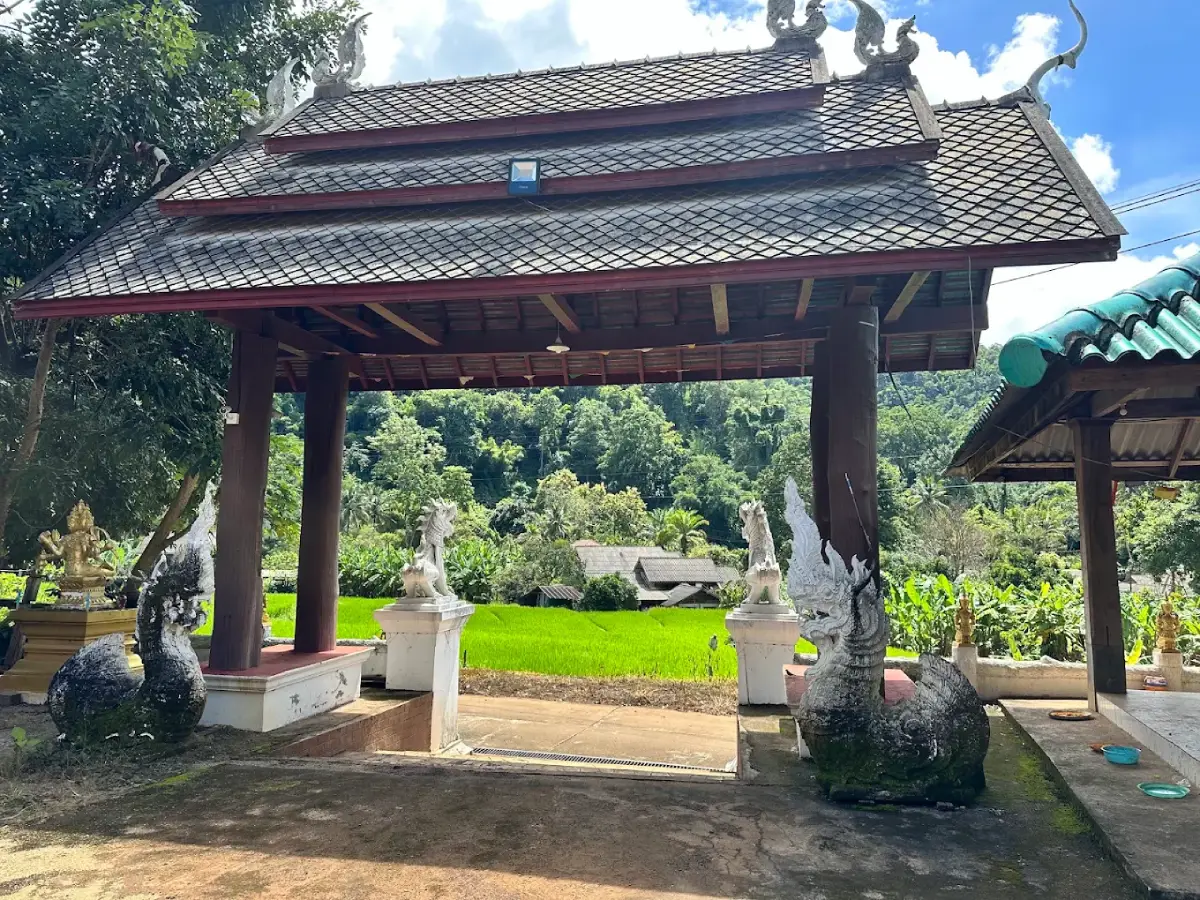
Wat Thong Siri is located at No. 65, Moo 6, Ban Mae Khanin Nuea, Ban Pong Subdistrict, Hang Dong District, Chiang Mai Province. It is a local Buddhist temple under the Mahanikaya order, covering an area of 1 rai and 76 square wa. The temple was permitted to be built in 1860 and is currently under the care of Phra Khru Phimon Silasunthon. Locally, it is also known as Wat Mae Khanin Nuea because it serves as the main village temple of Ban Mae Khanin Nuea.
Ban Mae Khanin Nuea is Moo 6 of Ban Pong Subdistrict, located along the Hang Dong–Samoeng route in Chiang Mai. The village lies in a foothill agricultural landscape where local life is closely connected with farming, cool-climate crops, avocados, passion fruit, vegetables, and community-based tourism. Wat Thong Siri stands within this living village context, connecting Buddhism, local settlement, agriculture, and the cultural identity of Ban Mae Khanin Nuea.
The name Wat Thong Siri has an auspicious meaning. “Thong” suggests gold, value, beauty, and blessing, while “Siri” conveys prosperity, goodness, and auspiciousness. Together, the name gives the sense of a temple that supports the spiritual well-being of the community. At the same time, the local name Wat Mae Khanin Nuea shows how closely the temple is tied to the village itself.
Wat Thong Siri was built in 1860, making it one of the old community temples of Ban Pong Subdistrict. During the period when rural communities in Hang Dong were developing around agriculture and village settlement, a temple was essential to community life. It served as a place for worship, merit-making, learning, ceremonies, and social gatherings. Wat Thong Siri grew with Ban Mae Khanin Nuea and has remained part of local religious life for generations.
The most distinctive feature of Wat Thong Siri is its old wooden viharn. Local information records that the temple has an old wooden viharn which was later built together with mortar using an old lime-burning method. This detail is significant because it reflects traditional local craftsmanship. In older Lanna village temples, wood was often the primary building material, and later repairs or extensions sometimes combined wood with lime-based mortar produced through traditional techniques.
The use of traditionally burned lime points to an older construction knowledge system. In the past, lime mortar was not simply a modern manufactured material. It involved local understanding of raw materials, fire, burning, preparation, curing, and practical use in building. Craftsmen needed to understand how the material worked with local climate and temple architecture. Wat Thong Siri therefore preserves not only a religious building, but also traces of local building wisdom.
The old wooden viharn is important as a worship space and a marker of the temple’s age. A viharn is where laypeople pay respect to Buddha images, listen to Dhamma, receive blessings, and participate in religious ceremonies. Even though detailed architectural documentation of the viharn is not widely available, the confirmed presence of an old wooden structure combined with traditional mortar work makes the temple meaningful for travelers interested in local Lanna craftsmanship and community temples.
With an area of 1 rai and 76 square wa, Wat Thong Siri is a compact village temple. Its value does not come from monumental scale, but from its local character. It is a quiet temple that still belongs closely to the village. Visitors can experience the atmosphere of a living community temple rather than a highly commercial tourist site. This makes it suitable for travelers who want to understand Chiang Mai through smaller village temples and rural cultural routes.
Ban Mae Khanin Nuea is known for agriculture, especially avocados, cool-climate vegetables, passion fruit, and produce connected with the Royal Project development area of Thung Roeng. The village also has community-based products and local tourism routes. Wat Thong Siri therefore stands within an active agricultural community, not an isolated heritage site. It is a spiritual center placed among fields, orchards, mountain routes, and village livelihoods.
As a community temple, Wat Thong Siri serves as a spiritual center for Ban Mae Khanin Nuea. Villagers use the temple for merit-making, Buddhist holy days, Kathin, robe-offering ceremonies, Buddhist Lent, the end of Buddhist Lent, Lanna Songkran, and seasonal community merit-making. These activities keep the relationship between temple, village, monks, and laypeople active throughout the year.
The local name Wat Mae Khanin Nuea is important because it shows that the temple is part of the village’s identity. When residents refer to the temple by the village name, they are not only describing a location. They are also expressing the temple’s role as a place of shared memory, ceremonies, and community belonging. In this sense, Wat Thong Siri is both a Buddhist temple and a cultural anchor for Ban Mae Khanin Nuea.
Key things to see at Wat Thong Siri include the old wooden viharn, the main worship area, the temple courtyard, and the quiet village-temple atmosphere. Travelers interested in vernacular architecture should observe the relationship between timber and mortar work, which reflects how local temples adapted over time. Travelers interested in community life should connect the temple visit with the agricultural and cultural routes of Ban Mae Khanin Nuea.
The atmosphere of Wat Thong Siri is calm, modest, and local. It is not designed as a large tourist attraction, and that is part of its value. The temple represents a quieter form of Chiang Mai travel, where history is found in village names, wooden buildings, temple courtyards, agricultural routes, and the everyday life of local residents.
Wat Thong Siri can be included in a Ban Pong and Mae Khanin Nuea travel route. Visitors can begin with a temple visit, then continue to Mae Khanin Kinnon, Royal Rose Garden Huai Phak Phai, Thung Roeng Royal Project, Loha Prasat Phra That Si Mueang Pong, or Patara Elephant Farm. This route combines Buddhism, agriculture, nature, community tourism, and family-friendly activities along the Hang Dong–Samoeng road.
For a half-day trip, travelers can visit Wat Thong Siri, Mae Khanin Kinnon, and a local restaurant or café. For a full-day trip, the route can be extended to the Thung Roeng Royal Project, Royal Rose Garden Huai Phak Phai, and nearby cultural or nature attractions in Ban Pong. This gives visitors a broader understanding of how temples, farming, village products, and local tourism are connected in this area.
The surrounding area includes several useful stops. Mae Khanin Kinnon offers nature-based activities and accommodation in Ban Mae Khanin Nuea. Royal Rose Garden Huai Phak Phai and the Thung Roeng Royal Project connect the area with agricultural learning and highland produce. Loha Prasat Phra That Si Mueang Pong adds another Buddhist landmark to the route, while Patara Elephant Farm provides an additional family-friendly attraction in the Ban Pong area.
Getting There is most convenient by private car or rental car. From Chiang Mai city, take the Chiang Mai–Hang Dong road or the canal road toward Hang Dong District, then continue into Ban Pong Subdistrict and Ban Mae Khanin Nuea. The route is suitable for travelers who want to visit several places along the Hang Dong–Samoeng road in one day.
Travelers driving to the temple should plan the Ban Pong and Mae Khanin Nuea route in advance, especially if continuing toward the Thung Roeng Royal Project or other mountain-side attractions. Some sections of the route follow foothill terrain, so careful driving is recommended. Public transport users should travel first to Hang Dong, then continue by local transport or hired vehicle into Ban Pong and Ban Mae Khanin Nuea.
Visitors should dress modestly, speak quietly, and respect the temple as a living religious space. If religious activities are taking place, give priority to monks and local residents. Photography should be done respectfully, especially around the old viharn and worship areas. Wat Thong Siri is a community temple, and respectful behavior helps preserve its quiet local atmosphere.
Wat Thong Siri is suitable for travelers who want to understand Chiang Mai through old village temples rather than only famous city temples. Its strengths are its history from 1860, its local name Wat Mae Khanin Nuea, its old wooden viharn, and its setting within an agricultural village known for avocados and cool-climate produce. A visit to Wat Thong Siri is therefore a meaningful way to enter the heart of Ban Mae Khanin Nuea.
| Name | Wat Thong Siri / Wat Mae Khanin Nuea |
| Location | Ban Mae Khanin Nuea, Ban Pong Subdistrict, Hang Dong District, Chiang Mai Province |
| Address | No. 65, Moo 6, Ban Mae Khanin Nuea, Ban Pong Subdistrict, Hang Dong District, Chiang Mai 50230, Thailand |
| Coordinates | 18.79977, 98.7931 |
| Type | Local Buddhist temple under the Mahanikaya order |
| Temple Area | 1 rai and 76 square wa |
| History | Built in 1860; an old community temple of Ban Mae Khanin Nuea and Ban Pong Subdistrict |
| Local Name | Wat Mae Khanin Nuea |
| Community Context | Located in Ban Mae Khanin Nuea, Moo 6 of Ban Pong, an agricultural village along the Hang Dong–Samoeng route known for avocados, cool-climate crops, and community tourism |
| Highlights | Old wooden viharn, traditional lime-mortar construction, and a peaceful village-temple atmosphere |
| Main Structures | Old wooden viharn, worship area, temple courtyard, and community religious activity area |
| Craftsmanship Feature | An old wooden viharn combined with mortar made through traditional lime-burning methods, reflecting local Lanna building wisdom |
| Abbot / Caretaker | Phra Khru Phimon Silasunthon |
| Community Role | Spiritual center of Ban Mae Khanin Nuea, supporting merit-making, Dhamma listening, and village Buddhist ceremonies |
| Traditions / Merit-Making | Buddhist holy days, Buddhist Lent, the end of Buddhist Lent, Kathin, robe-offering ceremonies, Lanna Songkran, and local community merit-making |
| Travel Information | From Chiang Mai city, travel toward Hang Dong, then continue into Ban Pong Subdistrict and Ban Mae Khanin Nuea. Private car or rental car is recommended. |
| Current Status | A living community temple of Ban Mae Khanin Nuea in a Ban Pong area that continues to develop community-based and agricultural tourism |
| Open Days | Daily |
| Opening Hours | 08.00 – 17.00 |
| Local Authority | Ban Pong Subdistrict Municipality, Tel. 053-111-596 |
| Nearby Tourist Attractions | 1. Mae Khanin Kinnon, about 2 km 2. Royal Rose Garden Huai Phak Phai, about 4 km 3. Thung Roeng Royal Project, about 5 km 4. Loha Prasat Phra That Si Mueang Pong, about 8 km 5. Patara Elephant Farm, about 9 km |
| Nearby Restaurants | 1. Mae Tha Chang Kang Tong, about 6 km, Tel. 091-859-2949 2. Mai Yai Restaurant, about 7 km, Tel. 091-143-1120 3. Doo View Kao Duea, about 8 km, Tel. 089-557-3667 4. Ban Dong View Doi, about 9 km, Tel. 081-951-8888 5. Max Wine & Coffee On Hill, about 10 km, Tel. 086-654-5555 |
| Nearby Accommodations | 1. Mae Khanin Kinnon, about 2 km, Tel. 081-544-9411 2. Baan Kwan Khiang Dao, about 3 km, Tel. 094-940-8726 3. PongInRak Farmstay, about 8 km, Tel. 081-882-7760 4. Bulan Buri Resort, about 9 km, Tel. 053-365-440 5. Baan Plaidoi Resort, about 12 km, Tel. 081-950-4510 |
Frequently Asked Questions (FAQ)
Q: Where is Wat Thong Siri located?
A: Wat Thong Siri is located at No. 65, Moo 6, Ban Mae Khanin Nuea, Ban Pong Subdistrict, Hang Dong District, Chiang Mai 50230, Thailand.
Q: When was Wat Thong Siri built?
A: Wat Thong Siri was built in 1860 and is an old community temple of Ban Mae Khanin Nuea.
Q: Why is Wat Thong Siri also called Wat Mae Khanin Nuea?
A: The temple is located in Ban Mae Khanin Nuea and serves as the village temple, so local residents commonly refer to it as Wat Mae Khanin Nuea.
Q: What is the main highlight of Wat Thong Siri?
A: Its main highlight is the old wooden viharn combined with traditional lime-mortar construction, reflecting local Lanna craftsmanship.
Q: What type of traveler is Wat Thong Siri suitable for?
A: It is suitable for travelers interested in old community temples, wooden viharns, Lanna vernacular craftsmanship, and the Mae Khanin Nuea route along Hang Dong–Samoeng.
Q: What nearby places can be visited with Wat Thong Siri?
A: Nearby places include Mae Khanin Kinnon, Royal Rose Garden Huai Phak Phai, Thung Roeng Royal Project, Loha Prasat Phra That Si Mueang Pong, and Patara Elephant Farm.
Q: How can travelers get to Wat Thong Siri?
A: From Chiang Mai city, travel toward Hang Dong, then continue into Ban Pong Subdistrict and Ban Mae Khanin Nuea. A private car or rental car is recommended.
 Category: ●Places of Worship
 Group: ●Temple
Last Update : 6 DayAgo
 Last Update : 6 DayAgo
 Click to Access the Navigation Map GPS
 Muang Chiang Mai(121)Chom Thong(47)Mae Chaem(25)Chiang Dao(33)Doi Saket(68)Mae Taeng(85)Mae Rim(69)Samoeng(29)Fang(71)Mae Ai(59)Phrao(70)San Pa Tong(103)San Kamphaeng(66)San Sai(73)Hang Dong(73)Hot(32)Doi Tao(22)Omkoi(11)Saraphi(74)Wiang Haeng(15)Chai Prakan(28)Mae Wang(32)Mae On(22)Doi Lo(33)Galyani Vadhana(1)


