
lovethailand home >North Travel Attractions >Chiang Mai Travel Attractions >Saraphi >Nong Phueng > Wat Don Chuen
TL;DR: Wat Don Chuen is located at Ban Don Chuen, Chiang Mai–Lamphun Road, Nong Phueng Subdistrict, Saraphi District, Chiang Mai Province, open Daily, hours 08.00 – 17.00.

Wat Don Chuen
Open Days: Daily
Opening Hours: 08.00 – 17.00
Wat Don Chuen is a local Buddhist temple under the Mahanikaya monastic order, located at No. 113, Ban Don Chuen, Chiang Mai–Lamphun Road, Nong Phueng Subdistrict, Saraphi District, Chiang Mai Province. It is an old community temple of Ban Don Chuen with a history that began from an abandoned temple site known as Pan Chuen. The temple was restored by Khruba Sitthi and was established in 1816. The temple land covers 4 rai and 59 square wah under land title No. 1359. It received its Wisungkhamsima on 4 November 1966, with the boundary measuring 6 meters wide and 12.50 meters long. Important areas include the viharn, ordination hall, alms hall, monks’ residence, multipurpose hall, gateway arch, and pagoda. The current abbot is Phra Khru Samu Yongyut Sanyachitto.
Wat Don Chuen should be understood as an old community temple of Nong Phueng, not only as a small roadside temple along the Chiang Mai–Lamphun route. Its history includes several important layers: an abandoned sacred site, restoration by a respected monk and local devotees, the granting of Wisungkhamsima, continuous monastic succession, and the temple’s ongoing role as a community activity space. The temple therefore reflects Buddhism, local restoration, Lanna architecture, and village life in Saraphi District.
The name Don Chuen is connected with Ban Don Chuen. Don often suggests slightly raised ground or a mound-like area, while Chuen is associated with the older name Pan Chuen. The temple name preserves both the identity of the village and the memory of the older abandoned site. Once the sacred site was restored, the name Don Chuen became attached to the spiritual center of the community.
Ban Don Chuen is located in Nong Phueng Subdistrict, an area with several old temples and archaeological sites connected with the wider Chiang Mai–Lamphun cultural route. Nearby places include Wat Phra Non Nong Phueng, Wat Ku Jok Pok archaeological site, and Wat Kum Kam Teepram archaeological site. Wat Don Chuen therefore belongs to a cultural landscape where community temples, ancient sites, and Lanna Buddhist memory are closely linked.
The founding of the temple in 1816 makes Wat Don Chuen one of the old temples of Saraphi District. Its earliest recorded story begins with an abandoned temple called Pan Chuen. Khruba Sitthi initiated the restoration of the site, bringing Buddhist life back to an area that had lost its active religious function. Such restoration was more than construction; it returned a shared spiritual center to the village.
Khruba Sitthi is an important figure in the history of Wat Don Chuen because he initiated the restoration of the abandoned Pan Chuen temple and served as the first abbot in the temple’s recorded succession. His role helped transform the site from an abandoned sacred place into an active Buddhist temple for the community.
The granting of Wisungkhamsima on 4 November 1966 was a major milestone in the temple’s religious history. A Wisungkhamsima is the formal monastic boundary used for important Sangha rites, especially ordination and ecclesiastical ceremonies. Wat Don Chuen’s boundary measures 6 meters wide and 12.50 meters long. Although compact in size, it confirms the temple’s formal role within Buddhist monastic practice.
The temple land covers 4 rai and 59 square wah. Its boundaries connect with irrigation channels and public roads: to the north a public irrigation channel, to the south a public road, to the east a public road, and to the west another public irrigation channel. This setting reflects the character of a Lanna community temple closely connected with water systems and local movement routes.
The irrigation channels beside the temple reflect the agricultural life of Lanna communities. These channels are not merely waterways; they connect fields, gardens, houses, and daily village life. Wat Don Chuen’s position beside irrigation channels shows how Buddhism, agriculture, and community infrastructure have long been connected in Nong Phueng.
The main structures of Wat Don Chuen include the monks’ residence, viharn, alms hall, ordination hall, and multipurpose hall. The important sacred feature recorded within the temple is the pagoda. Together, these elements allow the temple to support monastic residence, worship, Dhamma listening, Sangha rites, merit-making, village gatherings, and community events.
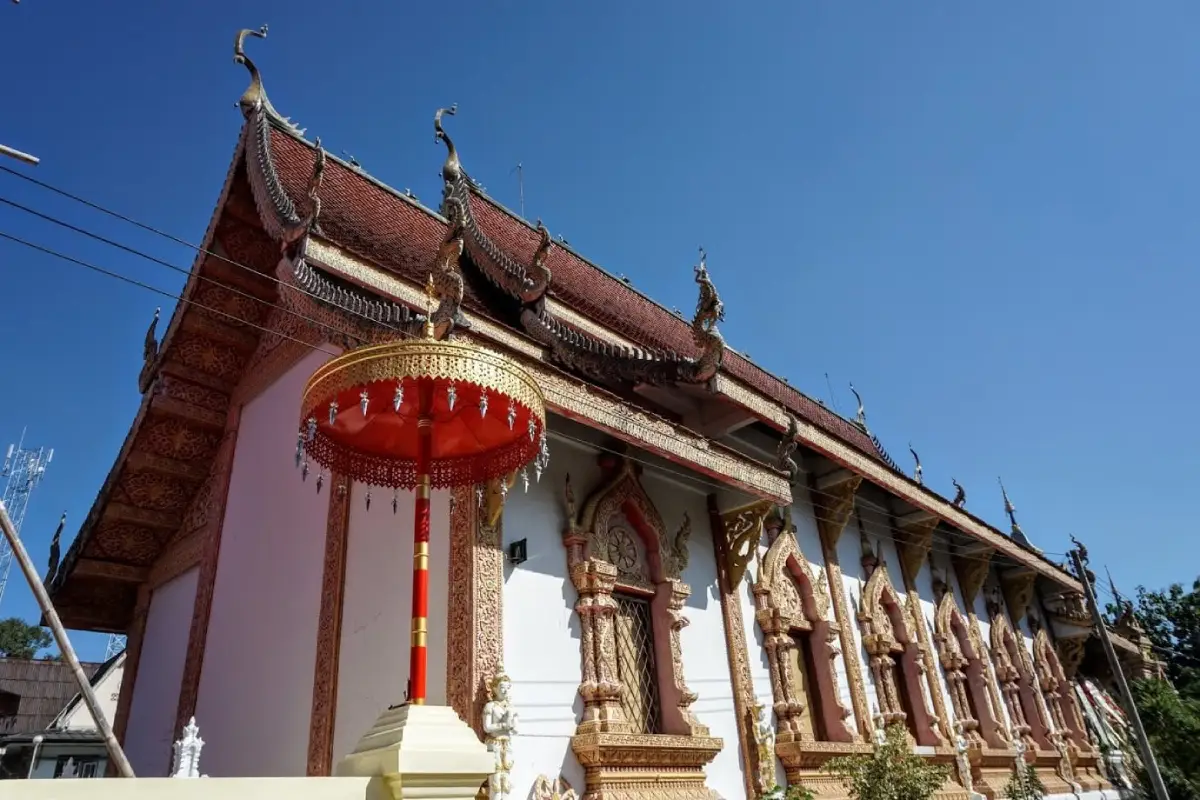
The viharn is an important devotional space for worship, Dhamma listening, and village religious activities. Cultural heritage studies describe the viharn of Wat Don Chuen as Lanna architecture. Visitors should remove shoes where required, speak softly, and pay respect calmly. The viharn is not only an architectural feature; it is a living sacred space used by the community across generations.
The ordination hall is directly connected with the temple’s Wisungkhamsima and formal monastic activities. Visitors should approach it respectfully, avoid disturbing monks, and understand that it is a sacred area governed by Buddhist monastic discipline. The ordination hall is one of the clearest signs of the temple’s complete religious status.
The alms hall reflects the daily relationship between monks and villagers. Merit-making in a Lanna community temple often includes offering food, alms, and religious items. The alms hall therefore shows how temple life is sustained not only by monastic practice but also by the participation of local people.
The multipurpose hall supports community and religious activities, including Dhamma listening, Kathin, robe-offering ceremonies, meetings, and public activities. In 2025, Nong Phueng Municipality used Wat Don Chuen as a venue for a community vocational training activity, showing that the temple remains an active public space for the local community.
The monks’ residence supports the continuity of religious life. With resident monks, the temple can maintain daily chanting, monastic routines, alms-related activities, religious guidance, and ceremonies for villagers. Wat Don Chuen therefore remains a living Buddhist center rather than only a historic temple.
The pagoda is an important sacred feature within the temple. In Lanna Buddhism, a pagoda represents the stability of the religion and serves as a focus of reverence for local devotees. Visitors should walk respectfully around the area and avoid touching, climbing, or leaning on sacred structures.
The gateway arch is another feature worth noticing. A Lanna-style gateway marks the transition from village space into sacred temple space. Passing through it should be done with respect, as it leads visitors into an area used by villagers for merit-making, worship, and Buddhist ceremonies.
The succession of abbots shows the continuity of temple care across generations. Temple records list Khruba Sitthi, Khruba Nuan, Phra Khamphiro, Phra Khru Yanawiphat, Phra Thongkham, Phra Athikan Anan, Phra Suwan, Phra Banchong, and Phra Khru Samu Yongyut Sanyachitto. This succession reflects the long-term religious life of the temple and the community’s ongoing support.
Phra Khru Yanawiphat, also remembered as Khruba Khamtan, was an important former abbot of Wat Don Chuen, serving from 1943 to 1977. He remains part of local devotional memory associated with the temple. In the context of a cultural travel article, his importance is best understood as part of the temple’s monastic history and community faith.
Phra Khru Samu Yongyut Sanyachitto is the current abbot according to local temple-history records. In a community temple, the abbot plays an important role in guiding faith, maintaining the temple compound, organizing merit-making activities, and preserving the relationship between monks and villagers.
Wat Don Chuen serves as the spiritual center of Ban Don Chuen. It supports Buddhist holy days, Buddhist Lent, the end of Buddhist Lent, Kathin, robe-offering ceremonies, Songkran, elder-respect customs, Yi Peng, and local village merit-making. These events bring villagers together to make merit, offer food, listen to Dhamma, and preserve Lanna Buddhist traditions.
During the Lanna New Year, Wat Don Chuen is a suitable place for merit-making, Buddha-image bathing, elder-respect activities, and community gatherings. These traditions are not merely annual ceremonies. They help connect villagers with elders, monks, families, and the community’s shared identity.
The main appeal of Wat Don Chuen for visitors is the story of an abandoned temple restored by Khruba Sitthi, its founding in 1816, Lanna-style viharn, gateway arch, ordination hall, pagoda, alms hall, multipurpose hall, and its role as an active community venue in Nong Phueng. It is suitable for visitors interested in old temples of Saraphi, Lanna community temples, and cultural routes connected with Wiang Kum Kam.
The temple atmosphere is calm and local. Visitors should allow around 30 to 60 minutes to observe the viharn, ordination hall, alms hall, multipurpose hall, monks’ residence, pagoda, gateway arch, and surrounding temple grounds. Morning or late afternoon is generally the most comfortable time to walk around and appreciate the character of a community temple.
Visitors should dress modestly, speak softly, remove shoes before entering sacred buildings, avoid touching Buddha images, pagodas, or sacred objects unnecessarily, and avoid disturbing monks or villagers during ceremonies. If a merit-making event, training activity, or community gathering is taking place, visitors should allow space for local participants and behave respectfully within the temple grounds.
Getting There is possible by taking the Chiang Mai–Lamphun Road from Chiang Mai city toward Saraphi District, then continuing into Nong Phueng Subdistrict and Ban Don Chuen. Private car, rental car, or local hired transport is the most convenient option. Wat Don Chuen can be combined easily with other temples in Nong Phueng and the wider Wiang Kum Kam cultural route.
A practical cultural route can begin at Wat Don Chuen and continue to Wat Chiang Saen, Wat Phra Non Nong Phueng, Wat Kong Sai, Wat San Khue, Wat Ku Jok Pok archaeological site, and Wat Kum Kam Teepram archaeological site. Travelers who want to extend the route can continue to Wat Saraphi, Wat Chang Khoeng, Wat Pak Kong, and Wat Mongkhon Wanaram in Saraphi Subdistrict.
Overall, Wat Don Chuen is valuable for its history, Buddhist identity, Lanna architecture, and community role. Beginning as an abandoned temple called Pan Chuen, restored by Khruba Sitthi, founded in 1816, granted Wisungkhamsima in 1966, and still serving the Ban Don Chuen community, the temple remains a meaningful destination for travelers interested in Saraphi’s living Lanna temple heritage.
| Name | Wat Don Chuen |
| Former / Related Names | Pan Chuen, Wat Don Chin |
| Location | Ban Don Chuen, Chiang Mai–Lamphun Road, Nong Phueng Subdistrict, Saraphi District, Chiang Mai Province |
| Address | No. 113, Ban Don Chuen, Chiang Mai–Lamphun Road, Nong Phueng Subdistrict, Saraphi District, Chiang Mai Province 50140, Thailand |
| Temple Type | Local Buddhist temple under the Mahanikaya monastic order |
| Temple Land | 4 rai and 59 square wah |
| Land Title | Land title No. 1359 |
| Temple Boundaries | North: public irrigation channel South: public road East: public road West: public irrigation channel |
| Highlights | Old community temple of Ban Don Chuen, restored from an abandoned temple called Pan Chuen by Khruba Sitthi, with a Lanna-style viharn, gateway arch, ordination hall, pagoda, and active community role in Nong Phueng |
| History | Built in 1816; originally an abandoned temple known as Pan Chuen before being restored by Khruba Sitthi |
| Wisungkhamsima | Granted on 4 November 1966; the boundary measures 6 meters wide and 12.50 meters long |
| Main Areas / Zones | Monks’ residence, viharn, alms hall, ordination hall, multipurpose hall, and gateway arch |
| Sacred Feature | Pagoda inside the temple compound |
| Architectural Highlight | Lanna-style viharn and gateway arch |
| Abbot | Phra Khru Samu Yongyut Sanyachitto |
| Important Monks In Temple History | Khruba Sitthi, who initiated the restoration, and Phra Khru Yanawiphat, a respected former abbot |
| Open Days | Daily |
| Opening Hours | 08.00 – 17.00 |
| Important Religious Activities | Buddhist holy days, Buddhist Lent, end of Buddhist Lent, Kathin, robe-offering ceremonies, Songkran, elder-respect activities, Yi Peng, Ban Don Chuen village merit-making, and community activities of Nong Phueng |
| Travel Information | Take the Chiang Mai–Lamphun Road from Chiang Mai city toward Saraphi District, then continue into Nong Phueng Subdistrict and Ban Don Chuen. Private car, rental car, or local hired transport is the most convenient option |
| Current Status | Active community temple in Nong Phueng Subdistrict and a venue for Buddhist worship, village merit-making, and community activities |
| Nearby Tourist Attractions | 1. Wat Chiang Saen, Nong Phueng, about 2 km 2. Wat Phra Non Nong Phueng, about 3 km 3. Wat Kong Sai, Nong Phueng, about 4 km 4. Wat San Khue, Nong Phueng, about 5 km 5. Wat Ku Jok Pok Archaeological Site, Nong Phueng, about 5 km 6. Wat Kum Kam Teepram Archaeological Site, about 6 km |
| Nearby Restaurants | 1. Sureerat Made-To-Order Food, Nong Phueng, about 2 km, Tel. 095-450-3692 2. Im Chang Nong Phueng, about 3 km, Tel. 063-074-6487 3. AT CHA CAFE Nong Phueng, about 4 km, Tel. 063-686-1539 4. Bang Bo Garden & Kitchen, Nong Phueng, about 5 km, Tel. 081-568-5854 5. Manual Feed Tea & Coffee Nong Phueng, about 5 km, Tel. 065-397-6883 |
| Nearby Accommodations | 1. Baan Nam Ping Riverside Village, about 5 km, Tel. 086-654-6663 2. Baan Hom Samunphrai, about 7 km, Tel. 053-817-362 3. 9Roomz, about 8 km, Tel. 095-446-0758, 053-963-829 4. Baan Saraphi, about 9 km, Tel. 053-321-942 5. Ruean Thip Resort, about 10 km, Tel. 098-556-6291 |
Frequently Asked Questions (FAQ)
Q: Where is Wat Don Chuen located?
A: Wat Don Chuen is located at No. 113, Ban Don Chuen, Chiang Mai–Lamphun Road, Nong Phueng Subdistrict, Saraphi District, Chiang Mai Province 50140. It is a local Buddhist temple under the Mahanikaya monastic order.
Q: What was the former name of Wat Don Chuen?
A: Wat Don Chuen was originally an abandoned temple known as Pan Chuen before Khruba Sitthi initiated its restoration and revived it as a community temple.
Q: When was Wat Don Chuen built?
A: Wat Don Chuen was built in 1816 and received its Wisungkhamsima on 4 November 1966.
Q: What can visitors see at Wat Don Chuen?
A: Visitors can see the monks’ residence, Lanna-style viharn, alms hall, ordination hall, multipurpose hall, gateway arch, pagoda, and the calm atmosphere of a living community temple in Nong Phueng.
Q: What is special about the viharn at Wat Don Chuen?
A: The viharn of Wat Don Chuen is recognized as Lanna architecture and serves as an important space for worship, Dhamma listening, and community merit-making.
Q: Who is the abbot of Wat Don Chuen?
A: The abbot of Wat Don Chuen is Phra Khru Samu Yongyut Sanyachitto. Khruba Sitthi and Phra Khru Yanawiphat are also important monks in the temple’s history.
Q: What are the opening hours of Wat Don Chuen?
A: Wat Don Chuen is open daily from 08.00 to 17.00.
Q: What nearby places can be visited with Wat Don Chuen?
A: Nearby places include Wat Chiang Saen, Wat Phra Non Nong Phueng, Wat Kong Sai, Wat San Khue, Wat Ku Jok Pok Archaeological Site, Wat Kum Kam Teepram Archaeological Site, and the wider Wiang Kum Kam cultural route.
 Category: ●Places of Worship
 Group: ●Temple
Last Update : 6 DayAgo
 Last Update : 6 DayAgo
 Click to Access the Navigation Map GPS
Wat Don Chuen Map
Recommend

 Muang Chiang Mai(121)Chom Thong(47)Mae Chaem(25)Chiang Dao(33)Doi Saket(68)Mae Taeng(85)Mae Rim(69)Samoeng(29)Fang(71)Mae Ai(59)Phrao(70)San Pa Tong(103)San Kamphaeng(66)San Sai(73)Hang Dong(73)Hot(32)Doi Tao(22)Omkoi(11)Saraphi(74)Wiang Haeng(15)Chai Prakan(28)Mae Wang(32)Mae On(22)Doi Lo(33)Galyani Vadhana(1)


