
lovethailand home >North Travel Attractions >Chiang Mai Travel Attractions >Saraphi >Yang Noeng > Wat Phra Non Pa Ket Thi
TL;DR: Wat Phra Non Pa Ket Thi is located at Ban Phra Non Pa Ket Thi, Moo 4, Yang Noeng Subdistrict, Saraphi District, Chiang Mai Province, open Daily, hours 06.00 – 18.00; the recommended time to enter the reclining Buddha viharn for.
Wat Phra Non Pa Ket Thi
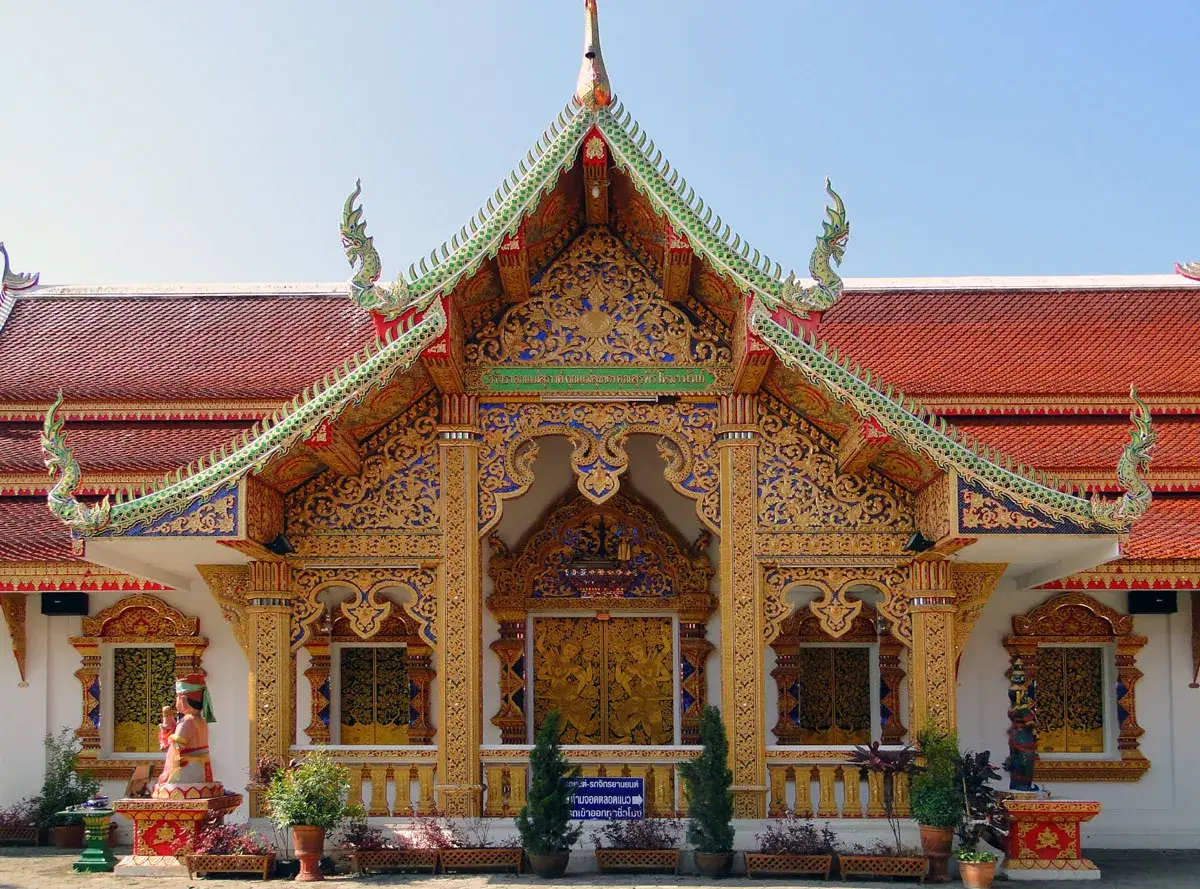
Open Days: Daily
Opening Hours: 06.00 – 18.00; the recommended time to enter the reclining Buddha viharn for worship is 08.00 – 17.00
Wat Phra Non Pa Ket Thi is a local Buddhist temple under the Mahanikaya monastic order, located at No. 198, Moo 4, Ban Phra Non Pa Ket Thi, Yang Noeng Subdistrict, Saraphi District, Chiang Mai Province 50140. The temple is one of the most meaningful cultural and religious sites in Saraphi because it houses the revered reclining Buddha known as Phra Non Saen Suk, or Phra Non Pa Ket Thi. The reclining Buddha is associated with a local tradition that says the Buddha’s hair relic is enshrined inside the head of the image. It is also regarded as one of Chiang Mai’s important reclining Buddha images, alongside Phra Non Khon Muang, Phra Non Mae Pu Kha, and Phra Non Nong Phueng.
Wat Phra Non Pa Ket Thi is more than a quick temple stop. Its value lies in several layers of history and legend: the story of the Buddha teaching a violent giant in a dense ket forest, the story of Nai Saen Saeo and his daughter Nang Uthum, the creation of the reclining Buddha image, the enshrinement of the Buddha’s hair relic, the old forest landscape, the later restoration of a once-neglected sacred image, and the temple’s continuing connection with the local community of Yang Noeng and Saraphi.
The name Pa Ket Thi refers to the old landscape of the area. The word ket is linked with a type of tree associated with the local legend, while thi suggests density or abundance. The name therefore recalls a time when this area was covered with dense ket trees before it gradually became a village and agricultural community. The temple’s name preserves the memory of the original landscape even though the surroundings have changed over time.
The temple land covers 5 rai, 3 ngan, and 76 square wah under title deed No. 11740. Its northern boundary borders a public road, the southern and eastern boundaries border Nong Faek Road, and the western boundary borders a public irrigation canal. This setting reflects the typical relationship between a Lanna community temple, village roads, waterways, and daily local life. Wat Phra Non Pa Ket Thi functions as a religious site, a community space, and a cultural landmark in the same compound.
The temple was established in 1555 and received its Wisungkhamsima on 31 August 1943. A Wisungkhamsima is the official monastic boundary used for important Sangha rites, especially ordination and formal ecclesiastical ceremonies. This status confirms that Wat Phra Non Pa Ket Thi has long functioned as a formal Buddhist temple, not merely as a shrine for the reclining Buddha.
Phra Non Pa Ket Thi, also known as Phra Non Saen Suk, is enshrined inside the reclining Buddha viharn. The image measures 7 wa, 1 sok, and 12 inches in length, and 1 wa and 9 inches in width. The Buddha lies in the parinirvana posture, symbolizing the Buddha’s final passing. Visitors should enter the viharn calmly, pay respect to the image, and take time to reflect on the Buddhist teaching of impermanence and mindfulness.
According to local legend, the Buddha came to the ket forest while a giant was chasing Nang Uthum, the daughter of Nai Saen Saeo. The Buddha taught the giant the Dhamma until the giant became remorseful and abandoned violence. Nang Uthum survived, and later took her father to meet the Buddha. The Buddha gave him a hair relic as an object of reverence.
Nai Saen Saeo and his daughter then built a reclining Buddha image and enshrined the Buddha’s hair relic inside its head. The place where the image was enshrined later became Wat Phra Non Pa Ket Thi. This legend gives the reclining Buddha deep religious meaning: it is associated with compassion, protection, transformation, and the continuity of faith in the local community.
Another layer of the local story connects the site with the Lua people and the former ket forest. The legend says that villagers created the reclining Buddha to commemorate the Buddha’s visit and to preserve the sacred relic. This makes the temple significant not only as a Buddhist site but also as a cultural memory of older communities in the Lanna region.
Phra Non Saen Suk is also connected with Princess Dara Rasmi, who once came to pay respect to the reclining Buddha and gave the image the name Phra Non Saen Suk. This name, meaning a reclining Buddha of great happiness, remains widely remembered. It links the temple with both local devotion and the wider cultural history of Chiang Mai and Lanna.
Local history also records that the reclining Buddha was once found in a neglected forest condition. Around 150 years ago, an elder from Chiang Mai known as Mo Kam or Mo Prakham found the large reclining Buddha image in the forest. Although the site was overgrown, the face of the Buddha image remained beautiful and inspiring. He encouraged villagers to restore the image and the temple, allowing the sacred site to return to community life.
The main highlight of the temple is the reclining Buddha viharn. Visitors should begin by paying respect to Phra Non Saen Suk, then observe the posture, scale, and atmosphere of the image. The parinirvana posture carries a profound Buddhist message about impermanence, calmness, and spiritual completion. This makes the viharn meaningful for both worshippers and travelers interested in Buddhist art.
Other areas of the temple compound are also worth seeing respectfully, including the ordination hall, temple courtyard, ceremony areas, and spaces connected with Buddhist education. Wat Phra Non Pa Ket Thi is also associated with Saraphi Pariyatti School, showing that the temple plays an educational role for monks and novices in addition to being a place of worship and pilgrimage.
An important annual tradition at the temple is the worship, water-pouring, and gold-leaf offering ceremony for Phra Non Saen Suk, linked with Visakha Bucha Day. This Buddhist holy day commemorates the birth, enlightenment, and passing of the Buddha. The ceremony is therefore not only an act of merit-making but also a communal expression of respect for the Buddha and care for the temple’s sacred heritage.
Wat Phra Non Pa Ket Thi remains a spiritual center for local communities in Yang Noeng, Nong Phueng, and nearby areas. The temple supports Buddhist holy day observances, Buddhist Lent, the end of Buddhist Lent, Kathin, robe-offering ceremonies, annual merit-making events, and Buddhist education. Current Kathin information also shows that the temple continues to have resident monks and active religious activities.
The current abbot listed in the 2025 Kathin information is Phra Athikan Thanawat Aphiwanno. Phra Khru Sophon Thammanuwat Achinnathammo is an important monk who appears in older temple records and is associated with the temple’s earlier history and local Sangha administration. Including both names helps distinguish current temple leadership from older historical records.
The atmosphere of Wat Phra Non Pa Ket Thi is suitable for travelers who want to worship an important reclining Buddha in a calmer setting than the major tourist temples in central Chiang Mai. Visitors should allow time for the viharn, the temple courtyard, and the surrounding community context rather than treating the temple only as a photo stop. Its real value lies in the combination of legend, faith, restoration, and local continuity.
Getting There is convenient from Chiang Mai city. Take the Chiang Mai – Lamphun Road, Route 106, toward Saraphi District, then continue into Yang Noeng Subdistrict and Ban Phra Non Pa Ket Thi, Moo 4. The temple is not far from the Chiang Mai – Lamphun tree-lined road, one of Saraphi’s most recognizable cultural routes. Private car, rental car, or local hired transport is the most convenient option.
A good half-day or full-day route can combine Wat Phra Non Pa Ket Thi with Wat Weluwan, Wat Ton Hiew, Wat Ku Suea, the Chiang Mai – Lamphun tree-lined road, and Wiang Kum Kam. This route allows travelers to understand Saraphi through old temples, Lanna legends, community life, historic roads, and the ancient city landscape near Chiang Mai.
The best time to visit is in the morning or late afternoon, when the weather is more comfortable. Visitors who want to worship inside the reclining Buddha viharn should plan for 08.00 to 17.00. The temple compound is listed as open daily from 06.00 to 18.00. During Buddhist holy days, Visakha Bucha Day, or the annual worship and gold-leaf offering period, visitors should dress respectfully and behave quietly because local merit-making activities may be taking place.
Visitors should dress modestly, speak softly, remove shoes before entering required areas, avoid touching the reclining Buddha or sacred objects, avoid climbing on temple structures, and take photos respectfully. If monks or local residents are conducting ceremonies, keep an appropriate distance. A good temple visit begins with respect for the living faith of the community.
Wat Phra Non Pa Ket Thi deserves a place in a Chiang Mai cultural itinerary because it combines legend, sacred art, community history, Buddhist education, and the Lanna landscape of Saraphi. Phra Non Saen Suk is not only an important reclining Buddha image; it is also a symbol of faith preserved, restored, and passed down through generations.
| Name | Wat Phra Non Pa Ket Thi |
| Known As | Phra Non Pa Ket Thi, Phra Non Saen Suk |
| Location | Ban Phra Non Pa Ket Thi, Moo 4, Yang Noeng Subdistrict, Saraphi District, Chiang Mai Province |
| Address | No. 198, Moo 4, Yang Noeng Subdistrict, Saraphi District, Chiang Mai Province 50140, Thailand |
| Coordinates | 18.7058026, 99.0296361 |
| Temple Type | Local Buddhist temple under the Mahanikaya monastic order |
| Highlights | Phra Non Saen Suk, a reclining Buddha image in the parinirvana posture, associated with the Buddha’s hair relic and regarded as one of Chiang Mai’s important reclining Buddha images |
| History | Established in 1555 and granted Wisungkhamsima on 31 August 1943 |
| Name Origin | Named after the former ket forest where ket trees once grew densely, giving rise to the name Pa Ket Thi |
| Temple Land | 5 rai, 3 ngan, 76 square wah, title deed No. 11740 |
| Boundaries | North: public road; South and East: Nong Faek Road; West: public irrigation canal |
| Main Areas / Zones | Reclining Buddha viharn, ordination hall, temple courtyard, ceremony areas, and Saraphi Pariyatti School |
| Sacred Object | Phra Non Saen Suk, a reclining Buddha image measuring 7 wa, 1 sok, and 12 inches in length, and 1 wa and 9 inches in width |
| Abbot / Important Monk | Current abbot: Phra Athikan Thanawat Aphiwanno Important monk in older temple records: Phra Khru Sophon Thammanuwat Achinnathammo |
| Open Days | Daily |
| Opening Hours | Temple compound: 06.00 – 18.00; recommended time for the reclining Buddha viharn: 08.00 – 17.00 |
| Important Religious Event | Annual worship, water-pouring, and gold-leaf offering for Phra Non Saen Suk around Visakha Bucha Day, as well as Kathin and community merit-making events |
| Travel Information | From Chiang Mai city, take Route 106, the Chiang Mai – Lamphun Road, toward Saraphi District. Continue into Yang Noeng Subdistrict and Ban Phra Non Pa Ket Thi, Moo 4. Private car, rental car, or local hired transport is the most convenient option |
| Current Status | Active community temple and important reclining Buddha site in Saraphi District |
| Nearby Tourist Attractions | 1. Chiang Mai – Lamphun Tree-Lined Road, about 1 km 2. Wat Weluwan, Yang Noeng, about 2 km 3. Wat Ton Hiew, about 3 km 4. Wat Ku Suea, about 4 km 5. Wiang Kum Kam, about 8 km |
| Nearby Restaurants | 1. Nai Ya Kitchen Yang Noeng Saraphi, about 2 km, Tel. 095-830-4248 2. Chiang Rai Nam Ngiao Noodles & Cooked-to-Order Food Yang Noeng Saraphi, about 2 km, Tel. 095-685-3549 3. Vietnamese Noodles Longevity Saraphi Yang Noeng Branch, about 3 km, Tel. 094-407-3996 4. Khao Man Kai Yang Noeng Saraphi, about 3 km, Tel. 097-976-4819 5. Wan Wan Wild Food And Mala, about 4 km, Tel. 064-971-6247 |
| Nearby Accommodations | 1. 9Roomz, about 2 km, Tel. 095-446-0758 2. Ruean Thip Resort, about 4 km, Tel. 098-556-6291 3. Relax Garden House, about 6 km, Tel. 090-326-6108 4. Baan Nam Ping Riverside Village, about 8 km, Tel. 053-439040, 086-654-6663 5. Tassana Garden Saraphi Chiangmai, about 9 km, Tel. 081-441-6644 |
Frequently Asked Questions (FAQ)
Q: Where is Wat Phra Non Pa Ket Thi located?
A: Wat Phra Non Pa Ket Thi is located at No. 198, Moo 4, Yang Noeng Subdistrict, Saraphi District, Chiang Mai Province 50140.
Q: Why is Wat Phra Non Pa Ket Thi important?
A: The temple houses Phra Non Saen Suk, a revered reclining Buddha image associated with the Buddha’s hair relic and regarded as one of Chiang Mai’s important reclining Buddha images.
Q: How large is Phra Non Saen Suk?
A: Phra Non Saen Suk measures 7 wa, 1 sok, and 12 inches in length, and 1 wa and 9 inches in width.
Q: What does the name Pa Ket Thi mean?
A: The name refers to the old dense ket forest that once covered the area and later became the name of the village and temple.
Q: What are the opening hours of Wat Phra Non Pa Ket Thi?
A: The temple compound is listed as open daily from 06.00 to 18.00, while the recommended time to enter the reclining Buddha viharn is 08.00 to 17.00.
Q: Who is the current abbot of Wat Phra Non Pa Ket Thi?
A: The current abbot is Phra Athikan Thanawat Aphiwanno. Phra Khru Sophon Thammanuwat Achinnathammo appears as an important monk in older temple records.
Q: What nearby places can be visited with Wat Phra Non Pa Ket Thi?
A: Nearby places include the Chiang Mai – Lamphun tree-lined road, Wat Weluwan, Wat Ton Hiew, Wat Ku Suea, and Wiang Kum Kam.
 Category: ●Places of Worship
 Group: ●Temple
Last Update : 5 DayAgo
 Last Update : 5 DayAgo
 Click to Access the Navigation Map GPS
Wat Phra Non Pa Ket Thi Map
Recommend

 Muang Chiang Mai(121)Chom Thong(47)Mae Chaem(25)Chiang Dao(33)Doi Saket(68)Mae Taeng(85)Mae Rim(69)Samoeng(29)Fang(71)Mae Ai(59)Phrao(70)San Pa Tong(103)San Kamphaeng(66)San Sai(73)Hang Dong(73)Hot(32)Doi Tao(22)Omkoi(11)Saraphi(74)Wiang Haeng(15)Chai Prakan(28)Mae Wang(32)Mae On(22)Doi Lo(33)Galyani Vadhana(1)


