
lovethailand home >North Travel Attractions >Chiang Mai Travel Attractions >Saraphi >Tha Wang Tan > Wat Pa Poe
TL;DR: Wat Pa Poe is located at Ban Pa Poe, Village No. 2, Ko Klang Road, Tha Wang Tan Subdistrict, Saraphi District, Chiang Mai Province, open Daily, hours 08.00 – 17.00.

Wat Pa Poe
Open Days: Daily
Opening Hours: 08.00 – 17.00
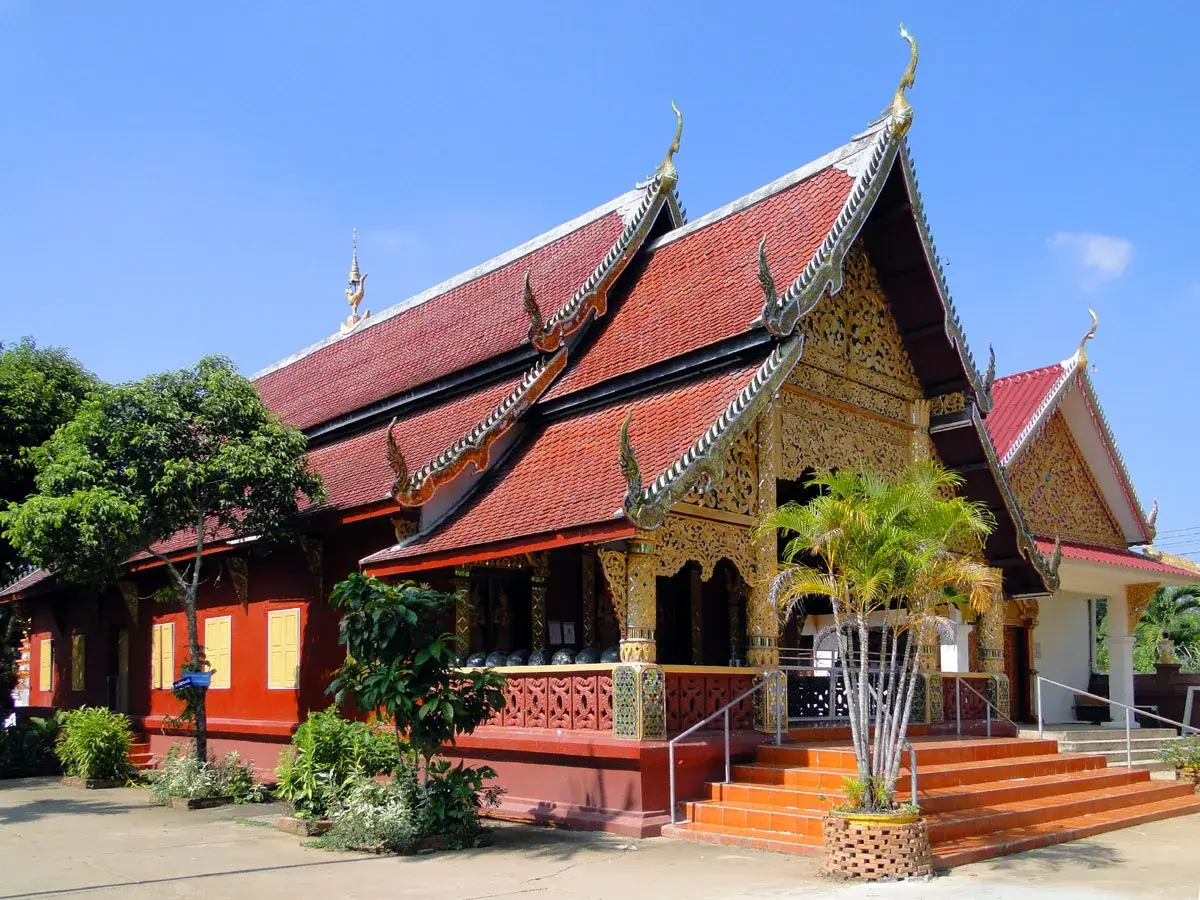
Wat Pa Poe is located at No. 16/3, Village No. 2, Ban Pa Poe, Ko Klang Road, Tha Wang Tan Subdistrict, Saraphi District, Chiang Mai Province 50140. It is a local Buddhist temple under the Mahanikaya sect and one of the old community temples of Tha Wang Tan. The temple was established in B.E. 2204 and remains an active Buddhist temple with resident monks. It stands about 300 meters east of the Ping River and belongs to the western side of the Wiang Kum Kam cultural landscape. The current abbot is Phra Athikan Sayan Khunawuttho.
The name “Wat Pa Poe” preserves a vivid local memory. In the northern Thai context, the word “poe” is associated with mud, wet ground, and slippery paths. Local tradition says that when people traveled to celebrate the temple, heavy rain made the paths muddy and difficult. Visitors had to wash mud from their bodies and feet, so Phra Phrom proposed the name Wat Pa Poe. The temple name therefore records not only a religious place but also the landscape, weather, and travel conditions experienced by the community in the past.
The temple history is associated with Chao Tu, a nephew of Muen San, who became a monk and stayed at Wat Nandaram. A man named Phrom, who had served him, also ordained and later stayed at Wat Pa Poe. After the temple celebration, Chao Tu allowed Phra Phrom to remain at Wat Pa Poe until the end of his life. This foundation story gives the temple a strong local identity because it links monastic life, service, community memory, and the naming of the temple.
The establishment date of B.E. 2204 makes Wat Pa Poe one of the old temples of Tha Wang Tan and Saraphi. Its history belongs to a landscape connected with old Lanna settlements and the wider Wiang Kum Kam area. While some nearby sites are known mainly as archaeological ruins, Wat Pa Poe is significant because it remains a living community temple. It helps visitors understand the area not only through monuments but also through active Buddhist practice.
Tha Wang Tan Subdistrict is an important part of Saraphi District. It covers about 13.63 square kilometers, or approximately 8,614 rai, and consists of 13 villages: Ban Chedi Liam, Ban Pa Poe, Ban Klang, Ban Pong, Ban Pa Ngio, Ban Pa Sao, Ban Buak Hua Chang, Ban Buak Khrok Nuea, Ban Buak Khrok Tai, Ban San Pa Kwao, Ban Chang Kham, Ban Hang Khwae, and Ban Pa Kluai. Ban Pa Poe is Village No. 2, and Wat Pa Poe serves as one of its important spiritual centers.
The wider setting of Tha Wang Tan gives Wat Pa Poe additional cultural value. The subdistrict is closely tied to Wiang Kum Kam, the ancient city associated with King Mangrai and early Lanna history. Temples such as Wat Chedi Liam, Wat Chang Kham, Wat That Khao, and several ancient ruins represent the archaeological side of the area. Wat Pa Poe represents another side: an active community temple still used for merit-making, Buddhist ceremonies, and village traditions.
The temple is located close to the Ping River and within a residential community. This setting is important because village temples in Lanna culture were never separated from everyday life. They stood near homes, roads, water systems, and agricultural routes. Wat Pa Poe therefore should be understood as part of Ban Pa Poe’s living landscape, not only as a single temple compound.
The temple land is recorded in local documentation as covering 2 rai, 1 ngan, and 20 square wah under land title deed No. 41240. The temple is accessible from the Chiang Mai 700th Anniversary Road by entering Ban Pa Poe Road for about 650 meters, where the temple appears on the left. It can also be reached from Mahidol Road via Ko Klang Road. This accessibility makes it suitable for visitors who want to combine local village temples with the Wiang Kum Kam route.
Although Wat Pa Poe is located in an area associated with Wiang Kum Kam, no visible archaeological remains are currently found within the temple. For this reason, the value of Wat Pa Poe should be read through its living role, its old foundation story, its name origin, and its relationship with Ban Pa Poe rather than through visible ancient structures. This makes it different from nearby ruins and monuments, and that difference is part of its identity.
The strongest feature of Wat Pa Poe is its name as a record of local experience. The story of muddy paths, rain, temple celebration, and the suggestion of Phra Phrom shows how a community could name a sacred place from actual environmental conditions. For cultural travelers, this kind of temple is valuable because it shows how local language and memory shape the identity of a place.
For Ban Pa Poe, the temple remains a spiritual and social center. Residents use it for merit-making, Buddhist holy days, food offerings to monks, sermons, Kathin, robe-offering events, memorial ceremonies, and annual village activities. The temple brings together monks, elders, families, young people, and lay supporters. This continuing relationship between temple and village is one of the most important features of Lanna community life.
One important tradition associated with Wat Pa Poe is the Phra That bathing ceremony. The local municipality has supported activities to preserve this tradition as part of community cultural heritage. Such ceremonies bring residents together to honor sacred monuments, clean and prepare the temple grounds, make offerings, listen to sermons, and pass local values to younger generations.
The Phra That bathing tradition has special meaning in Lanna culture. It is an expression of respect for the sacred space of the temple and a way for the community to renew its relationship with Buddhism. It also encourages children, youth, and residents to learn about local customs, temple etiquette, and the importance of preserving cultural identity.
Tha Wang Tan also preserves other traditions such as Songkran, water-pouring ceremonies for elders, support-pole processions, sand-carrying rituals at temples, Yi Peng or Loy Krathong, and activities connected with Wiang Kum Kam. Wat Pa Poe belongs to this wider cultural calendar, where each village temple helps sustain Buddhist practice, family values, and local identity.
For cultural travelers, Wat Pa Poe is best visited as a quiet community temple. It is not defined by large visible ruins or a grand tourist complex. Its value lies in its long history, its name story, its setting near Wiang Kum Kam, and its role as an active temple of Ban Pa Poe. Visitors should pay respect, walk quietly around the temple grounds, and observe the relationship between the temple, village roads, and nearby community life.
Wat Pa Poe can also be combined with Wat Ubosot, or Wat Bot, a deserted archaeological site located very close to the northeast of the temple. This combination allows visitors to see both sides of the area: a living temple with resident monks and a nearby ancient ruin linked with the historical landscape of Wiang Kum Kam.
Key things to experience at Wat Pa Poe include the worship area, the temple grounds, the quiet village atmosphere of Ban Pa Poe, Ko Klang Road, the nearby Ping River context, and the connection with the Wiang Kum Kam route. Visitors interested in local history should pay attention to the temple’s name story because it reveals more about past travel conditions and village memory than a simple date can provide.
A good cultural route can combine Wat Pa Poe with Wat Ubosot, the Wiang Kum Kam Information Center, Wat Chedi Liam, Wat Chang Kham, Wat That Khao, Wat E-Kang, Wat Ban Klang, Wat Pa Ngio, Wat Buak Khrok Nuea, and Wat Buak Khrok Tai. A half-day route can focus on Wat Pa Poe, Wat Ubosot, the information center, and Wat Chedi Liam. A full-day route can add nearby temples, the Chiang Mai–Lamphun rubber tree road, local restaurants, and accommodations in Saraphi or Wiang Kum Kam.
Getting There is easiest by private car, rental car, motorbike, taxi, or ride-hailing service. From Chiang Mai city, take the Chiang Mai 700th Anniversary Road and enter Ban Pa Poe Road for about 650 meters; Wat Pa Poe will be on the left. Another route is from Mahidol Road through Ko Klang Road into Ban Pa Poe. Visitors planning to explore several temples should arrange transport for several hours.
The best time to visit is in the morning or late afternoon, when the weather is more comfortable and the atmosphere is peaceful. Visitors interested in local community life may come during Buddhist holy days, Kathin, robe-offering events, or the Phra That bathing ceremony. Those seeking a quiet visit should choose a weekday outside major ceremonies.
Visitors should follow standard Thai temple etiquette: dress modestly, speak softly, remove shoes where required, do not enter private monastic areas, avoid disturbing ceremonies, do not touch sacred objects unnecessarily, and ask permission before photographing people closely. Wat Pa Poe is an active community temple, so respectful behavior is essential.
In summary, Wat Pa Poe is a historic Mahanikaya community temple in Ban Pa Poe, Tha Wang Tan Subdistrict, Saraphi District, Chiang Mai. Established in B.E. 2204, it preserves a local story involving Chao Tu, Phra Phrom, muddy travel paths, and the origin of the temple name. Located near the Ping River and within the western side of the Wiang Kum Kam landscape, the temple remains active with resident monks and Phra Athikan Sayan Khunawuttho as abbot. It is a meaningful destination for travelers who want to understand local Lanna Buddhism, village temple life, and the quieter cultural side of Tha Wang Tan near Wiang Kum Kam.
| Name | Wat Pa Poe |
| Location | Ban Pa Poe, Village No. 2, Ko Klang Road, Tha Wang Tan Subdistrict, Saraphi District, Chiang Mai Province |
| Address | No. 16/3, Village No. 2, Ban Pa Poe, Ko Klang Road, Tha Wang Tan Subdistrict, Saraphi District, Chiang Mai 50140, Thailand |
| Coordinates | 18.749364, 98.991698 |
| Temple Type | Local Buddhist temple under the Mahanikaya sect and a religious site in the western side of the Wiang Kum Kam landscape |
| Temple Code | 350191008 |
| Area | 2 rai, 1 ngan, 20 square wah |
| Land Title Deed | No. 41240 |
| Highlights | Historic community temple of Ban Pa Poe, established in B.E. 2204, known for its name story connected with muddy travel paths, rain, and the suggestion of Phra Phrom |
| History | Established in B.E. 2204 within the Lanna-period cultural landscape of Tha Wang Tan and Wiang Kum Kam |
| Name Origin | The name comes from a local story that people traveling to celebrate the temple had to wash off mud because rain made the paths wet and slippery; Phra Phrom proposed the name Wat Pa Poe |
| Key Figures | Chao Tu, nephew of Muen San Phra Phrom, associated with the temple’s monastic story and name origin |
| Community Context | Located in Ban Pa Poe, one of the 13 villages of Tha Wang Tan Subdistrict, a community area connected with village roads, irrigation features, homes, and the nearby Wiang Kum Kam cultural route |
| Location Context | About 300 meters east of the Ping River and located on the western side of the Wiang Kum Kam landscape; the surrounding area is now a residential community |
| Important Zones And Activity Areas | Worship Area And Buddhist Activity Space Temple Grounds For Merit-Making And Community Events Community Gathering Area For Buddhist Holy Days, Kathin, Robe-Offering Events, And The Phra That Bathing Tradition Community Temple Area Linked With Tha Wang Tan And Wiang Kum Kam Routes |
| Archaeological Status | No visible archaeological remains are currently found within the temple, but it remains an active religious site with resident monks and a strong community role |
| Important Ceremonies | Phra That bathing ceremony at Wat Pa Poe, Kathin, robe-offering events, Buddhist Lent, the end of Lent, Buddhist holy days, memorial merit-making, and annual village ceremonies |
| Travel Information | From Chiang Mai 700th Anniversary Road, enter Ban Pa Poe Road for about 650 meters and the temple will be on the left; it can also be reached from Mahidol Road through Ko Klang Road |
| Current Status | Open as an active community temple with resident monks, used for Buddhist ceremonies, merit-making, and local village activities |
| Open Days | Daily |
| Opening Hours | 08.00 – 17.00 |
| Abbot / Caretaker | Phra Athikan Sayan Khunawuttho |
| Nearby Tourist Attractions | 1. Wat Ubosot / Wat Bot, about 0.1 km 2. Wiang Kum Kam Information Center, about 2 km 3. Wat Chedi Liam, about 3 km 4. Wat Chang Kham, about 3 km 5. Wat That Khao, about 3.5 km 6. Wat Ban Klang, about 4 km 7. Wat Pa Ngio, about 5 km 8. Chiang Mai–Lamphun Rubber Tree Road, about 7 km |
| Nearby Restaurants | 1. Pa Noi Grilled Pork In Front Of Wat Pa Poe, about 0.1 km, Tel. 062-028-9325 2. Fresh Coffee Ban Pa Poe, about 1 km, Tel. 085-709-7118 3. Ginger Farm Saraphi, about 3 km 4. Aunt Ra Duck Noodles Tha Wang Tan Saraphi, about 4 km, Tel. 083-197-0230 5. Pao Pao Khao Man Kai Tha Wang Tan Ban Pa Ngio, about 5 km, Tel. 098-854-8724 6. Krua Sa Pa Tha Wang Tan, about 5 km, Tel. 080-229-8450 |
| Nearby Accommodations | 1. Casa Malee Family Villa, about 1 km 2. De Wiangkumkam, about 3 km, Tel. 094-471-0117 3. Wiang Kum Kam Resort, about 4 km, Tel. 097-949-4227 4. Maraya Hotel & Resort, about 5 km, Tel. 053-812-121 5. Chiang Mai Garden Bungalows, about 6 km, Tel. 083-272-6681 |
Frequently Asked Questions (FAQ)
Q: Where is Wat Pa Poe located?
A: Wat Pa Poe is located at No. 16/3, Village No. 2, Ban Pa Poe, Ko Klang Road, Tha Wang Tan Subdistrict, Saraphi District, Chiang Mai Province 50140.
Q: What are the opening days and hours of Wat Pa Poe?
A: The temple is open daily from 08.00 to 17.00.
Q: Why is Wat Pa Poe historically important?
A: Wat Pa Poe was established in B.E. 2204 and is an old community temple within the Tha Wang Tan and Wiang Kum Kam cultural landscape.
Q: What is the origin of the name Wat Pa Poe?
A: The name comes from a local story that people traveling to celebrate the temple had to wash off mud because rain made the paths wet and slippery. Phra Phrom then proposed the name Wat Pa Poe.
Q: How is Wat Pa Poe connected with Wiang Kum Kam?
A: The temple is located on the western side of the Wiang Kum Kam landscape and about 300 meters east of the Ping River, making it part of the wider cultural setting of the ancient city area.
Q: Are there visible archaeological remains at Wat Pa Poe today?
A: No visible archaeological remains are currently found within the temple, but Wat Pa Poe remains an active temple with resident monks and a continuing community role.
Q: What important ceremonies are associated with Wat Pa Poe?
A: Important ceremonies include the Phra That bathing ceremony, Kathin, robe-offering events, Buddhist Lent, the end of Lent, Buddhist holy days, memorial merit-making, and annual village ceremonies.
Q: What nearby places can be visited with Wat Pa Poe?
A: Nearby places include Wat Ubosot or Wat Bot, the Wiang Kum Kam Information Center, Wat Chedi Liam, Wat Chang Kham, Wat That Khao, Wat Ban Klang, Wat Pa Ngio, and the Chiang Mai–Lamphun rubber tree road.
 Category: ●Places of Worship
 Group: ●Temple
Last Update : 5 DayAgo
 Last Update : 5 DayAgo
 Click to Access the Navigation Map GPS
Wat Pa Poe Map
Recommend

 Muang Chiang Mai(121)Chom Thong(47)Mae Chaem(25)Chiang Dao(33)Doi Saket(68)Mae Taeng(85)Mae Rim(69)Samoeng(29)Fang(71)Mae Ai(59)Phrao(70)San Pa Tong(103)San Kamphaeng(66)San Sai(73)Hang Dong(73)Hot(32)Doi Tao(22)Omkoi(11)Saraphi(74)Wiang Haeng(15)Chai Prakan(28)Mae Wang(32)Mae On(22)Doi Lo(33)Galyani Vadhana(1)


