
lovethailand home >North Travel Attractions >Chiang Mai Travel Attractions >San Pa Tong >Mae Ka > Wat Pa Chedi Liam
TL;DR: Wat Pa Chedi Liam is located at Moo 4, Ban Nong Khrop, Mae Ka Subdistrict, San Pa Tong District, Chiang Mai Province, open Daily, hours Daytime.

Wat Pa Chedi Liam
Open Days: Daily
Opening Hours: Daytime
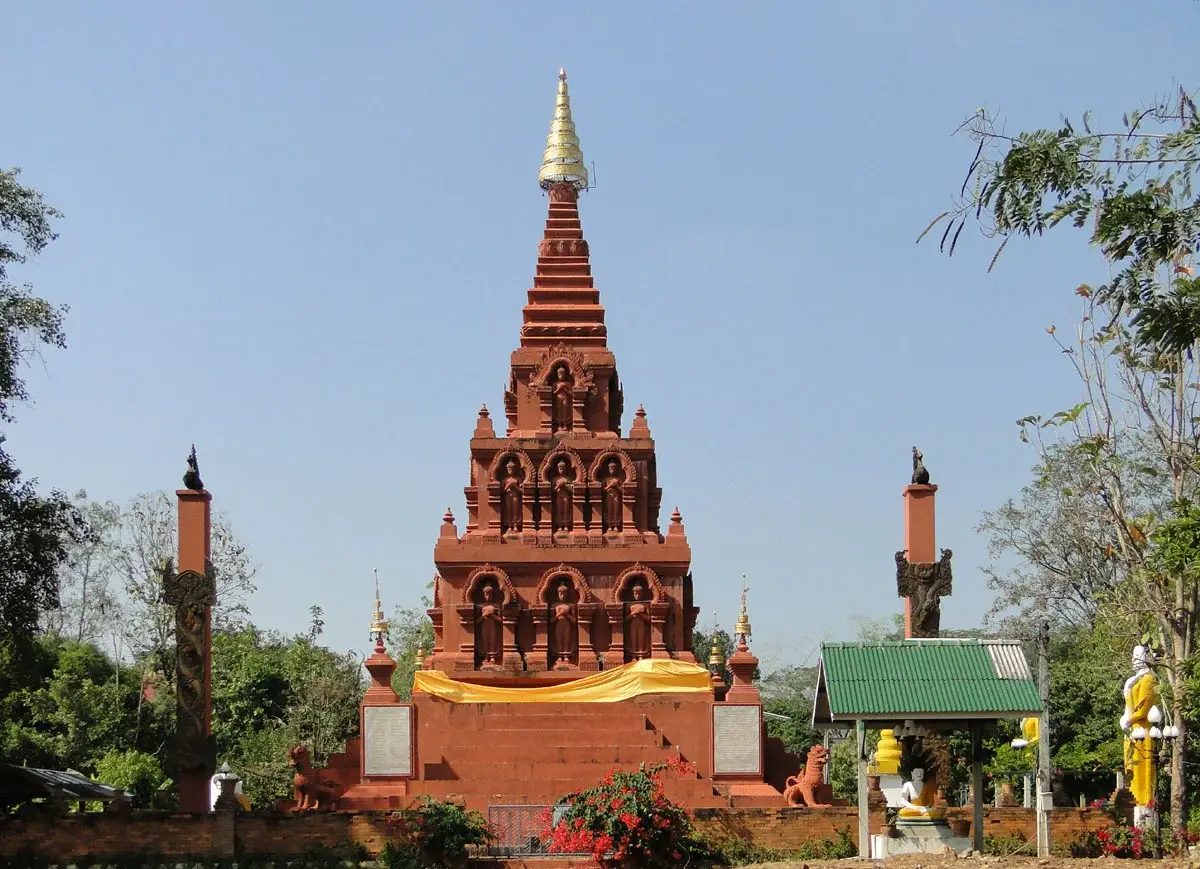
Wat Pa Chedi Liam is a Dhammayut Buddhist temple in Ban Nong Khrop, Moo 4, Mae Ka Subdistrict, San Pa Tong District, Chiang Mai Province. Officially established as a temple in 1979 and granted Wisungkhamsima in 1988, it is an important local temple with deep connections to the Mon community along the Ping River. The temple’s main highlight is Phra That Chedi Liam, a sacred stupa that enshrines relics of the Buddha and features 28 stucco Buddha images arranged around the structure according to the Buddhist lineage tradition.
Wat Pa Chedi Liam stands within Ban Nong Khrop, a riverside community on the western side of the Ping River in Chiang Mai Province. The area is historically connected with Mon communities, including Ban Ko Chok, which has Wat Ko Chok as its community temple, and other Mon settlements on the Lamphun side of the river. This setting makes Wat Pa Chedi Liam more than a local temple. It is part of a cultural landscape shaped by Buddhism, Mon identity, river-based settlement, and the rural history of San Pa Tong.
Ban Nong Khrop is associated with the Mon name “Koh Pin,” which is linked to older Mon settlement memory. Local history connects communities in this area with Mon people who migrated and settled in Thailand generations ago. The temple’s name, sacred stupa, and community identity preserve traces of that history. For cultural travelers, Wat Pa Chedi Liam offers a meaningful way to understand how Mon heritage and Lanna Buddhist culture meet in the Chiang Mai countryside.
The temple has several layers of history. In official records, it was elevated as a temple with resident monks on 12 October 1979 and later received Wisungkhamsima according to a Royal Gazette announcement dated 4 March 1988. In local memory, however, the temple was once an abandoned temple that had been restored more than once. Khru Ba Doeng is remembered for restoring it in 1921. After another period of abandonment, Phra Achan Thonghuat restored it again in 1971. These layers give the temple historical depth beyond its official establishment date.
The name Wat Pa Chedi Liam also has a distinctive linguistic background. In the past, the temple was known by several names, including Wat Chet Oi Liam, Wat Koep, Wat Nu, Wat Tung, and Wat Meng. The name Wat Meng relates to the idea of a Mon temple. The name “Chet Oi Liam” is understood as a Mon expression meaning a ruined stupa temple, and the sound “liam” became associated with the Thai and northern Thai word “liam,” meaning angular or square. The present name, Wat Pa Chedi Liam, therefore reflects language, ethnic memory, and local naming tradition, not only the visible shape of the stupa.
Phra That Chedi Liam is the most important sacred structure of the temple. The stupa rises about 19 meters from the ground to the top of the tiered umbrella. Each side of the main stupa is about 9 meters wide, and the surrounding stupa wall measures about 22 meters on each side. Inside the stupa are relics of the Buddha. Around the exterior are 28 stucco Buddha images arranged according to the lineage of Buddhas in the Buddhavamsa tradition. This makes the stupa both a sacred focus for worship and an important subject for studying Buddhist visual culture.
The Buddha images are arranged on the four sides of the stupa. The east side features Buddha images in the contemplation posture. The south side features images in the posture of gazing. The west side features images in the gesture of reassurance or protection, while the north side features images in the gesture of forbidding relatives from conflict. Visitors can walk around the stupa respectfully and observe how the arrangement connects religious meaning, direction, and sacred movement around the monument.
Wat Pa Chedi Liam also carries the atmosphere of a “forest temple” in the sense of calmness, simplicity, and religious focus. It does not feel like a large commercial tourist temple. Its value lies in the quiet temple grounds, the sacred stupa, the history of restoration, and the relationship between the temple and Ban Nong Khrop community. Visitors should take time to walk slowly, pay respect, and appreciate the details around the stupa and the surrounding temple area.
The importance of Wat Pa Chedi Liam to the local community is not limited to its legal temple status or Wisungkhamsima. It remains a place of faith for Ban Nong Khrop and a cultural marker for the Mon communities along the Ping River. The temple supports merit-making, Buddhist observance, local gatherings, and the preservation of shared memory. Together with nearby temples such as Wat Nong Khrop, Wat Ko Chok, Wat Inthawichai, and other temples in Mae Ka Subdistrict, it forms part of a wider network of community temples.
Mae Ka Subdistrict has many important local temples, including Wat Nong Tao Kham, Wat Rong Wua, Wat Ko Chok, Wat Nong Khrop, Wat San Ka Wan, Wat Sai Mun, Wat San Khok Chang, Wat Phra Chao Ton Luang, Wat Inthawichai, Wat Rong Khut, Wat Mae Ka, Wat Pa Kluai, Wat Bo Kang, and Wat Pa Chedi Liam. This concentration of temples reflects a strong Buddhist foundation in the area and makes Mae Ka a meaningful route for travelers interested in temple culture, local history, and rural communities south of Chiang Mai city.
Religious activities at Wat Pa Chedi Liam follow the rhythm of a local Buddhist temple and Dhammayut community. Visitors may encounter merit-making on Buddhist holy days, almsgiving, robe-offering ceremonies, forest robe offerings, candlelight processions on major Buddhist days, and community efforts to care for sacred structures. These activities keep the temple active as a living religious place rather than a silent historical site.
The temple is especially suitable for travelers who enjoy quiet temples, Mon history, riverside communities, and deeper cultural routes in Chiang Mai. Its appeal is not noise or scale, but the stillness of the grounds, the meaning of Phra That Chedi Liam, and the story of an abandoned temple restored through faith. Travelers who enjoy slow temple visits and local history will find Wat Pa Chedi Liam particularly rewarding.
Visitors should dress modestly and behave respectfully. The stupa, stupa wall, and stucco Buddha images should not be climbed or touched unnecessarily. Photography should be done from appropriate areas without disturbing monks or local worshippers. Because this is a sacred site still used by the community, the visit should be treated as a respectful temple visit, not only as a sightseeing stop.
Getting There is most convenient by private car, rental car, or local hired transport. From Chiang Mai city, take Highway 108 toward San Pa Tong District, then continue into Mae Ka Subdistrict and Ban Nong Khrop, Moo 4. The final approach passes through village and rural areas, so drivers should proceed carefully. For navigation, search for “Wat Pa Chedi Liam Mae Ka San Pa Tong” to avoid confusion with other similarly named temples in Chiang Mai.
Wat Pa Chedi Liam can be included in a cultural route around Mae Ka and the Ping River communities. Travelers can begin at Wat Pa Chedi Liam and Phra That Chedi Liam, then continue to Wat Nong Khrop, Wat Ko Chok, Wat Inthawichai, the fish sanctuary by the Ping River, and Wat Phra Chao Ton Luang. For a broader itinerary, the route can also connect to Wiang Tha Kan and other cultural sites in San Pa Tong.
A half-day trip can begin with a morning visit to Wat Pa Chedi Liam for worship and stupa viewing, followed by nearby temples in Mae Ka and lunch in the San Pa Tong area. In the afternoon, visitors can continue to Wat Inthawichai, the riverside fish sanctuary, or Wiang Tha Kan. This route combines temples, Mon community history, rural scenery, food, and local cultural sites in one accessible journey.
In summary, Wat Pa Chedi Liam is one of the most meaningful temples in Ban Nong Khrop, Mae Ka Subdistrict. Its value lies in its Dhammayut status, its history of restoration from an abandoned temple, its Mon community context, and the remarkable Phra That Chedi Liam. The stupa is about 19 meters high, about 9 meters wide on each side, enshrines relics of the Buddha, and displays 28 stucco Buddha images around the structure. For travelers seeking a quieter and deeper Chiang Mai experience, Wat Pa Chedi Liam is a strong addition to a San Pa Tong cultural route.
| Name | Wat Pa Chedi Liam |
| Location | Moo 4, Ban Nong Khrop, Mae Ka Subdistrict, San Pa Tong District, Chiang Mai Province |
| Coordinates | 18.52313, 98.89005 |
| Highlights | Dhammayut temple in Ban Nong Khrop, known for Phra That Chedi Liam and its historical connection with Mon communities along the Ping River |
| History | Officially established as a temple in 1979 and granted Wisungkhamsima in 1988; formerly an abandoned temple restored through local faith |
| Name Origin | Linked with the Mon name “Pha Chet Oi Liam,” understood as a ruined stupa temple; the sound later became associated with “liam” in Thai and northern Thai |
| Distinctive Features | Quiet forest-temple atmosphere in a Mon community, suitable for worship, stupa viewing, and learning about Ping River cultural history |
| Important Religious Structures | Phra That Chedi Liam, stupa wall, 28 stucco Buddha images, and the surrounding temple grounds |
| Main Sacred Object | Phra That Chedi Liam, about 19 meters high and about 9 meters wide on each side, enshrining relics of the Buddha |
| Travel Information | From Chiang Mai city, take Highway 108 toward San Pa Tong District, then continue into Mae Ka Subdistrict and Ban Nong Khrop, Moo 4 |
| Current Status | Listed as a Dhammayut Buddhist temple in Mae Ka Subdistrict, San Pa Tong District, Chiang Mai Province |
| Open Days | Daily |
| Opening Hours | Daytime |
| Nearby Tourist Attractions | 1. Wat Nong Khrop, about 1 km 2. Wat Ko Chok, Ban Ton Tan, about 3 km 3. Fish Sanctuary by the Ping River in front of Wat Inthawichai, about 5 km 4. Wat Phra Chao Ton Luang, about 6 km 5. Wiang Tha Kan, about 13 km |
| Nearby Restaurants | 1. Mak Nua Beef Grill, about 5 km, Tel. 084-939-8939 2. Khao Phuen Un Khao Soi Tai at Ruamchok Market, about 7 km, Tel. 092-440-9356 3. Khuadam Tum Zap, San Pa Tong, about 10 km, Tel. 097-971-6422 4. Rabeang Khao Tha, Ban Mae, San Pa Tong, about 10 km, Tel. 061-997-8299 5. Rong Than Ruang Khao, San Pa Tong, about 12 km |
| Nearby Accommodations | 1. Tai Resort Sanpatong, about 14 km, Tel. 063-096-7000 2. Kao Mai Lanna Resort, about 18 km, Tel. 053-481-201, 086-428-7481 3. Phanumas Longstay and Resort, about 19 km, Tel. 083-685-9786 4. Boontarn Sanctuary Chiang Mai, about 20 km, Tel. 052-013-695 5. Rice Barn and Rooms, about 25 km, Tel. 081-960-3997 |
Frequently Asked Questions (FAQ)
Q: Where is Wat Pa Chedi Liam located?
A: Wat Pa Chedi Liam is located in Ban Nong Khrop, Moo 4, Mae Ka Subdistrict, San Pa Tong District, Chiang Mai Province.
Q: When was Wat Pa Chedi Liam officially established?
A: Wat Pa Chedi Liam was officially established as a temple in 1979 and granted Wisungkhamsima in 1988.
Q: What is the main highlight of Wat Pa Chedi Liam?
A: The main highlight is Phra That Chedi Liam, a sacred stupa enshrining relics of the Buddha and surrounded by 28 stucco Buddha images.
Q: How is Wat Pa Chedi Liam connected with the Mon community?
A: The temple stands in Ban Nong Khrop, a community historically connected with Mon settlements along the Ping River, and its older name is linked with the Mon language.
Q: What is the form of Phra That Chedi Liam?
A: The stupa is about 19 meters high and about 9 meters wide on each side, with a surrounding wall and 28 stucco Buddha images arranged around it.
Q: How can travelers get to Wat Pa Chedi Liam?
A: From Chiang Mai city, take Highway 108 toward San Pa Tong District, then continue into Mae Ka Subdistrict and Ban Nong Khrop, Moo 4.
Q: What kind of travelers should visit Wat Pa Chedi Liam?
A: It is suitable for travelers interested in quiet temples, sacred stupas, Mon community history, Ping River settlements, and deeper cultural routes in San Pa Tong.
Q: What nearby places can be visited with Wat Pa Chedi Liam?
A: Nearby places include Wat Nong Khrop, Wat Ko Chok, the fish sanctuary near Wat Inthawichai, Wat Phra Chao Ton Luang, and Wiang Tha Kan.
 Category: ●Places of Worship
 Group: ●Temple
Last Update : 1 WeekAgo
 Last Update : 1 WeekAgo
 Click to Access the Navigation Map GPS
 Muang Chiang Mai(121)Chom Thong(47)Mae Chaem(25)Chiang Dao(33)Doi Saket(68)Mae Taeng(85)Mae Rim(69)Samoeng(29)Fang(71)Mae Ai(59)Phrao(70)San Pa Tong(103)San Kamphaeng(66)San Sai(73)Hang Dong(73)Hot(32)Doi Tao(22)Omkoi(11)Saraphi(74)Wiang Haeng(15)Chai Prakan(28)Mae Wang(32)Mae On(22)Doi Lo(33)Galyani Vadhana(1)


