
lovethailand home >North Travel Attractions >Chiang Mai Travel Attractions >San Pa Tong >Ban Mae > Wat Hang Dong (Ban Mae)
TL;DR: Wat Hang Dong (Ban Mae) is located at Ban Den, Moo 2, Ban Mae Subdistrict, San Pa Tong District, Chiang Mai Province, open Daily, hours Daytime.

Wat Hang Dong (Ban Mae)
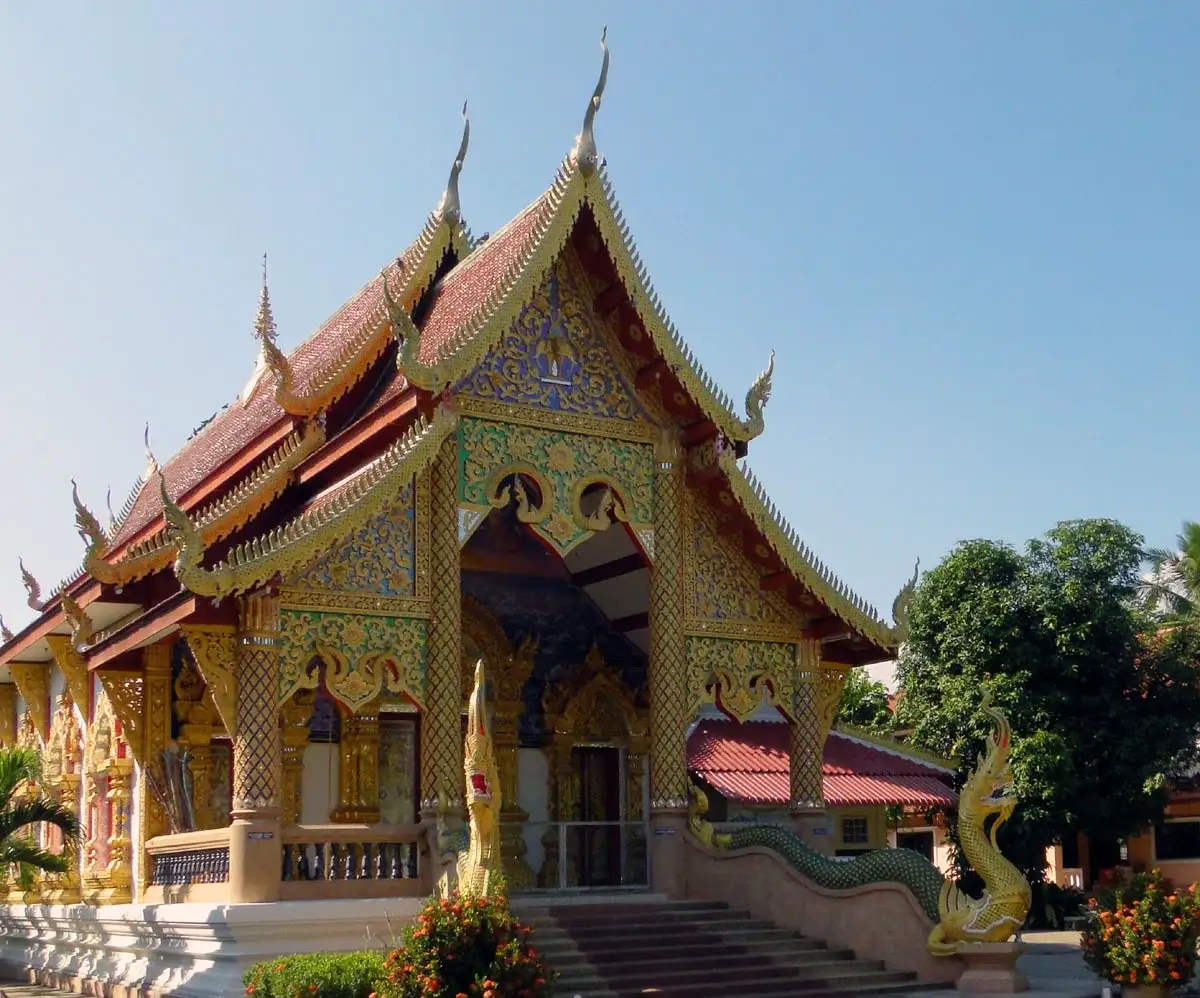
Open Days: Daily
Opening Hours: Daytime
Wat Hang Dong (Ban Mae) is a local Buddhist temple under the Mahanikaya order in Ban Mae Subdistrict, San Pa Tong District, Chiang Mai Province. It was officially established as a temple in 1897 and is closely connected with Ban Den, the old Hang Dong village area, and the rural canal-side communities of Ban Mae. The temple is suitable for visitors who want to make merit, visit a quiet local temple, and understand how Buddhist temples, irrigation canals, farmland, and Lanna village life are connected in the countryside south of Chiang Mai city. Its important features include the viharn, sermon hall, monks’ quarters, and old Lanna cultural objects such as ritual texts, a preaching pulpit, a scripture chest, a long ceremonial drum, and a temple worship drum.
Wat Hang Dong (Ban Mae) is located at No. 6, Ban Den, Moo 2, Ban Mae Subdistrict, San Pa Tong District, Chiang Mai Province. The temple land covers 4 rai and 10 square wah. Older temple records also place Wat Hang Dong in Ban Den, Ban Mae Subdistrict, San Pa Tong District, with the same land area. The temple’s history is especially interesting because local accounts describe it as an old canal-side temple originally located in the area of Moo 5, Ban Mae Subdistrict. After the original village declined and became deserted, the temple remained and later became associated with Ban Den, Moo 2. This gives Wat Hang Dong both an official history beginning in 1897 and a deeper local memory connected with an older settlement beside an irrigation canal.
The name “Wat Hang Dong” should be understood carefully in this context. There are several places and temples with similar names in Chiang Mai Province, including temples in Hang Dong District and Hot District. Wat Hang Dong (Ban Mae) is the temple in Ban Mae Subdistrict, San Pa Tong District. Identifying it with “Ban Mae” helps distinguish this temple from other Wat Hang Dong sites and prevents confusion for travelers using maps or search engines.
The history of Wat Hang Dong reflects the transformation of rural Lanna communities. The temple was once described as a canal-side temple, and irrigation canals were essential to northern Thai agricultural life. In Lanna villages, canals supported rice farming, settlement patterns, and community organization. Temples near canals were not only religious sites but also part of the agricultural and social landscape. Even when an older village declined, the temple could remain as a spiritual and historical marker of the former community.
Wat Hang Dong was officially established as a temple in 1897, a period when many village temples in San Pa Tong and Ban Mae were being recognized more formally. Temples established during this period often served many functions: merit-making, sermon listening, community meetings, festival organization, and the preservation of religious knowledge. In the past, local temples were also places where palm-leaf manuscripts, Dhamma texts, scripture chests, pulpits, and ceremonial instruments were kept and used.
One of the most important aspects of Wat Hang Dong is the survival of old cultural objects. Although only some items remain today, the temple is associated with Lanna ritual texts, a preaching pulpit, a scripture chest, a long ceremonial drum, and a temple worship drum. These objects are more than antiques. They show the temple’s past role as a center of religious learning, preaching, ritual sound, and community ceremony. The scripture chest reflects the preservation of Buddhist texts, the pulpit relates to sermons, and the drums connect the temple with merit-making events and village signals.
The main religious structures of Wat Hang Dong include a viharn, a sermon hall, and monks’ quarters. The viharn is the main worship space where visitors can pay respect and where religious ceremonies are held. The sermon hall serves as a gathering space for villagers during Buddhist events, religious talks, and community activities. The monks’ quarters support the daily monastic life of the temple. Together, these structures show the temple’s role as both a sacred space and a community center.
The temple land covers 4 rai and 10 square wah. Its recorded boundaries are closely connected with the rural landscape: to the north is a public irrigation canal, to the south are the temple’s monastic land and a canal, to the east is a public road, and to the west are privately owned rice fields. The temple also has three plots of monastic land totaling 1 rai, 1 ngan, and 45 square wah. These details show the close relationship between Wat Hang Dong, irrigation systems, farmland, and public village routes.
Wat Hang Dong should not be viewed only as an isolated temple compound. It belongs to a wider Buddhist landscape in Ban Mae Subdistrict, where several temples are distributed across different villages. These include Wat Hang Dong, Wat Tha Pong, Wat Chim Phli or Wat Ton Ngio, Wat Ban San, Wat Rong Khum, Wat Thammachai, Wat Kio Lae Noi, Wat Ban Dong, Wat Tha Duea, Aram Som Suk, and Wat Ban Piang. The number of temples in the area shows the strong Buddhist foundation of Ban Mae and makes the subdistrict a meaningful route for visitors interested in community temples.
The succession of abbots at Wat Hang Dong helps show the continuity of temple administration in the modern period. Known abbots include Phra Athikan Techakaro, serving from 1939 to 1950; Phra Athikan Chum Charuwanno, serving from 1951 to 1974; Phra Athikan Khamtan Dhammadharo, serving from 1975 to 1981; Phra Athikan Wichian Wichito, serving from 1982 to 1986; and Phra Khru Prapat Panyakhon from 1987 onward. The user-provided information identifies the current abbot as Phra Khru Prapat Panyakhon Phuripanyo, showing his continuing importance in the temple’s contemporary administration.
Older local memory also mentions earlier monks associated with the temple, including Khru Ba Kham, Khru Ba Chai, Khru Ba Narata, Khru Ba Noi, and Khru Ba Kaeo. Although the exact years are not preserved, these names are important as part of the community’s memory. They show that the temple’s history is not only recorded in official documents but also carried in local oral tradition.
The main appeal of Wat Hang Dong for visitors is its quiet village atmosphere and its connection with Lanna cultural heritage. Visitors should take time to see the viharn, sermon hall, monks’ quarters, and temple grounds. If old objects such as the scripture chest, pulpit, long drum, or worship drum are visible, they should be understood as objects of religious and cultural value. They are linked with sermons, Buddhist texts, temple ceremonies, and the soundscape of village merit-making.
Wat Hang Dong is best appreciated by travelers who prefer calm local temples rather than large tourist attractions. It is not a commercial tourist site, but a living community temple. Visitors should dress modestly, speak quietly, avoid entering monks’ residential areas without permission, and refrain from touching old objects or religious items. Respectful behavior is especially important in a village temple where local people continue to worship and hold ceremonies.
The temple’s religious life is connected with typical Lanna village Buddhist traditions such as merit-making on Buddhist holy days, almsgiving, Kathin robe-offering ceremonies, forest robe offerings, sermon listening, and village religious events. These activities connect monks, elders, families, youth, and returning community members. The temple therefore remains both a spiritual center and a place where social relationships are maintained.
Historically, Wat Hang Dong helps tell the story of Ban Den, the old Hang Dong village area, and Ban Mae Subdistrict. Its history includes an older canal-side temple, a deserted village, and the temple’s later association with Ban Den. This pattern reflects changes that often occurred in rural communities, where settlement centers could shift because of water systems, agricultural conditions, roads, and administrative changes. The temple remained as a marker of memory and faith in the landscape.
For travelers interested in Lanna culture, Wat Hang Dong is a useful place to understand the role of Dhamma script, temple texts, scripture chests, pulpits, and temple drums. In the past, local temples were centers of learning. Monks and knowledgeable laypeople transmitted moral teachings, ritual knowledge, and cultural memory through sermons and ceremonies. The remaining old objects at Wat Hang Dong make the temple valuable for cultural learning, not only for a short merit-making visit.
Getting There is most convenient by private car, rental car, or local hired transport. From Chiang Mai city, take Highway 108, the Chiang Mai – Hot route, toward San Pa Tong District. Then continue into Ban Mae Subdistrict and Ban Den, Moo 2. The roads near the temple pass through village, canal, and agricultural areas, so drivers should proceed carefully. For navigation, search for “Wat Hang Dong Ban Mae San Pa Tong” to avoid confusion with other temples of the same name.
Wat Hang Dong can be included in a cultural route through Ban Mae Subdistrict. Travelers can visit Wat Hang Dong and then continue to Wat Ban San, Wat Rong Khum, Wat Tha Pong, Wat Ban Piang, or Wat Ban Dong. The route can also connect with Wiang Tha Kan and Kao Mai Lanna in San Pa Tong. This itinerary is suitable for visitors who want to see local history, village temples, Lanna culture, and rural Chiang Mai beyond the old city.
A half-day visit can begin at Wat Hang Dong in the morning, followed by nearby temples in Ban Mae and lunch at a local restaurant in San Pa Tong. In the afternoon, visitors can continue to Wiang Tha Kan or stop at a café or local restaurant. This route helps travelers understand how temples, villages, restaurants, accommodations, and historical sites are linked within San Pa Tong District.
Wat Hang Dong is suitable for travelers who like quiet temples, Lanna cultural objects, local history, and community-based routes. Its importance does not come from grand scale, but from its history as a former canal-side temple, its official establishment in 1897, its community role, and its remaining traces of Lanna religious culture.
In summary, Wat Hang Dong (Ban Mae) is an old community temple in San Pa Tong with religious, historical, agricultural, and cultural value. It shows that rural temples were not only places for rituals but also centers of memory, learning, manuscripts, sermons, drums, and village identity. For travelers seeking a quieter and deeper view of Chiang Mai, Wat Hang Dong (Ban Mae) is a meaningful stop on a temple and cultural route through Ban Mae and San Pa Tong.
| Name | Wat Hang Dong (Ban Mae) |
| Location | Ban Den, Moo 2, Ban Mae Subdistrict, San Pa Tong District, Chiang Mai Province |
| Address | No. 6, Ban Den, Moo 2, Ban Mae Subdistrict, San Pa Tong District, Chiang Mai Province |
| Highlights | Old community temple in Ban Mae Subdistrict, historically connected with a former canal-side temple in the Moo 5 area and officially established in 1897 |
| History | Established in 1897; connected with Ban Den, the former Hang Dong village area, irrigation canals, and agricultural land |
| Name Origin | The name is linked with the old Hang Dong community context in Ban Mae; the phrase “Ban Mae” helps distinguish it from other temples with the same name |
| Distinctive Features | A quiet old community temple with a canal-side history and remaining traces of Lanna religious culture |
| Temple Land Area | 4 rai, 10 square wah |
| Boundaries | North: public irrigation canal; South: monastic land and canal; East: public road; West: privately owned rice fields |
| Monastic Land | 3 plots totaling 1 rai, 1 ngan, 45 square wah |
| Important Religious Structures | Viharn, sermon hall, and monks’ quarters |
| Important Old Objects | Lanna ritual texts, preaching pulpit, scripture chest, long ceremonial drum, and temple worship drum |
| Travel Information | From Chiang Mai city, take Highway 108 toward San Pa Tong District, then continue into Ban Mae Subdistrict and Ban Den, Moo 2 |
| Current Status | Listed as a Buddhist temple in Ban Mae Subdistrict, San Pa Tong District, Chiang Mai Province |
| Open Days | Daily |
| Opening Hours | Daytime |
| Abbot / Caretaker | Phra Khru Prapat Panyakhon Phuripanyo |
| Nearby Tourist Attractions | 1. Wat Ban San, about 2 km 2. Wat Rong Khum, about 3 km 3. Wat Tha Pong, about 4 km 4. Wat Ban Piang, about 5 km 5. Wiang Tha Kan, about 9 km |
| Nearby Restaurants | 1. Rabeang Khao Tha, Ban Mae, San Pa Tong, about 2 km, Tel. 061-997-8299 2. Khuadam Tum Zap, San Pa Tong, about 2 km, Tel. 097-971-6422 3. Rong Than Ruang Khao, San Pa Tong, about 3 km, Tel. 091-078-4618 4. WICHMAI x Neow Kai, San Pa Tong, about 4 km, Tel. 087-755-9937 5. Hainan Chicken Rice San Pa Tong, about 8 km, Tel. 085-864-7768 |
| Nearby Accommodations | 1. Kao Mai Lanna Resort, about 10 km, Tel. 053-481-201, 086-428-7481 2. Phanumas Longstay and Resort, about 11 km, Tel. 083-685-9786 3. Boontarn Sanctuary Chiang Mai, about 12 km, Tel. 052-013-695 4. Tai Resort Sanpatong, about 13 km, Tel. 063-096-7000 5. Rice Barn and Rooms, about 18 km, Tel. 081-960-3997 |
Frequently Asked Questions (FAQ)
Q: Where is Wat Hang Dong (Ban Mae) located?
A: Wat Hang Dong (Ban Mae) is located at No. 6, Ban Den, Moo 2, Ban Mae Subdistrict, San Pa Tong District, Chiang Mai Province.
Q: When was Wat Hang Dong (Ban Mae) established?
A: Wat Hang Dong was officially established as a temple in 1897.
Q: What is the key historical background of Wat Hang Dong?
A: It was originally associated with an old canal-side temple in the Moo 5 area of Ban Mae. After the original village declined, the temple became associated with Ban Den, Moo 2.
Q: What important structures are inside Wat Hang Dong?
A: Important structures include the viharn, sermon hall, and monks’ quarters.
Q: What old objects are associated with Wat Hang Dong?
A: The temple is associated with Lanna ritual texts, a preaching pulpit, a scripture chest, a long ceremonial drum, and a temple worship drum.
Q: Who is the abbot of Wat Hang Dong (Ban Mae)?
A: The abbot is Phra Khru Prapat Panyakhon Phuripanyo.
Q: How can travelers get to Wat Hang Dong (Ban Mae)?
A: From Chiang Mai city, take Highway 108 toward San Pa Tong District, then continue into Ban Mae Subdistrict and Ban Den, Moo 2.
Q: What nearby places can be visited with Wat Hang Dong?
A: Nearby places include Wat Ban San, Wat Rong Khum, Wat Tha Pong, Wat Ban Piang, and Wiang Tha Kan.
 Category: ●Places of Worship
 Group: ●Temple
Last Update : 6 DayAgo
 Last Update : 6 DayAgo
 Click to Access the Navigation Map GPS
Wat Hang Dong (Ban Mae) Map
Recommend

 Muang Chiang Mai(121)Chom Thong(47)Mae Chaem(25)Chiang Dao(33)Doi Saket(68)Mae Taeng(85)Mae Rim(69)Samoeng(29)Fang(71)Mae Ai(59)Phrao(70)San Pa Tong(103)San Kamphaeng(66)San Sai(73)Hang Dong(73)Hot(32)Doi Tao(22)Omkoi(11)Saraphi(74)Wiang Haeng(15)Chai Prakan(28)Mae Wang(32)Mae On(22)Doi Lo(34)Galyani Vadhana(1)


