
lovethailand home >North Travel Attractions >Chiang Mai Travel Attractions >San Pa Tong >Ban Mae > Wat Ban Dong (Ban Mae)
TL;DR: Wat Ban Dong (Ban Mae) is located at Ban Dong, Mu 11, Ban Mae Subdistrict, San Pa Tong District, Chiang Mai Province, open Daily, hours 08.00 – 17.00.

Wat Ban Dong (Ban Mae)
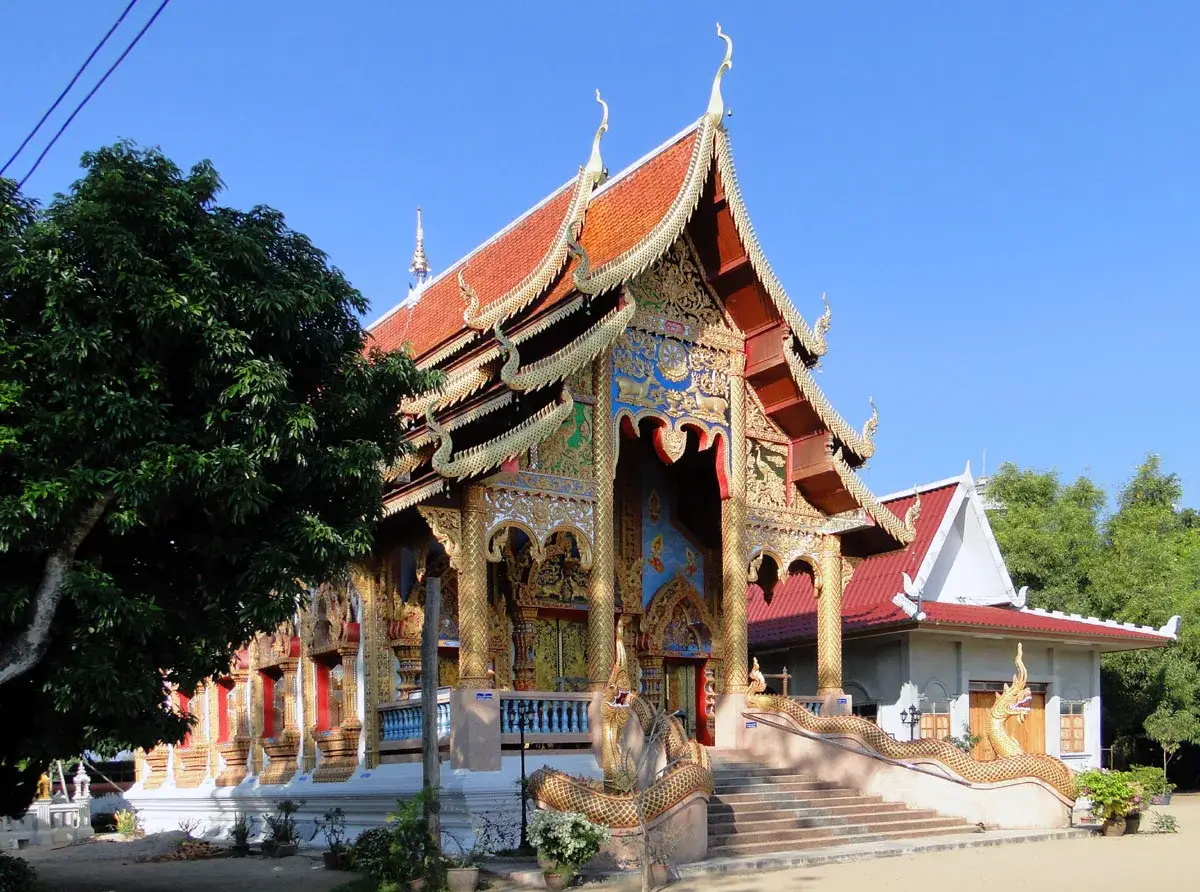
Open Days: Daily
Opening Hours: 08.00 – 17.00
Wat Ban Dong (Ban Mae) is a local Buddhist temple under the Mahanikaya order, located at No. 129, Ban Dong, Mu 11, Ban Mae Subdistrict, San Pa Tong District, Chiang Mai Province. The temple is an important religious center of Ban Dong and has served the community for many generations. It was built in 1799 and remains an active temple for local Buddhist practice today. The temple land covers 4 rai, 1 ngan, and 68 square wah. Its setting among village land, farmland, public roads, and local gardens reflects the close relationship between temple life and rural Lanna community life.
Ban Dong is one of the villages of Ban Mae Subdistrict in San Pa Tong District. The village has a strong local and agricultural context, and Wat Ban Dong functions as the main spiritual center of the community. It is not only a place for Buddhist ceremonies but also a shared space where villagers gather for merit-making, Buddhist holy days, Dharma listening, temple maintenance, and community activities throughout the year.
The temple boundaries show how closely Wat Ban Dong is connected with the surrounding village landscape. To the north, the boundary measures about 31 meters and borders villagers’ rice fields. To the south, it measures about 72 meters and borders villagers’ garden land. To the east, it measures about 37 meters and borders a public road. To the west, it measures about 37 meters and borders villagers’ garden land. These details show that the temple is surrounded by farmland, gardens, roads, and everyday village life.
Since Wat Ban Dong was built in 1799, the temple has a history of more than two centuries. It has witnessed many phases of Ban Mae community life, from traditional agricultural society and village expansion to modern local development in San Pa Tong. The temple therefore serves not only as a religious site but also as a social record of Ban Dong and Ban Mae Subdistrict.
Important structures within Wat Ban Dong include a viharn, monks’ residence, sermon hall, and other monastic structures. These are the essential elements of a Lanna community temple. The viharn serves as the main worship and ceremony space. The monks’ residence supports daily monastic life. The sermon hall supports Dharma listening, temple meetings, and community merit-making. Other temple structures help support Buddhist ceremonies and lay community activities.
The viharn is the heart of Wat Ban Dong. It is where villagers pay respect, make merit, listen to Dharma, and participate in important Buddhist ceremonies. In a Lanna village temple, the viharn is more than an architectural structure. It is the main meeting point between monks and laypeople through chanting, offerings, merit-making, and annual religious events.
The monks’ residence allows the temple to remain active throughout the year. Resident monks use this space for living, chanting, study, temple care, and preparation for religious duties. A temple with resident monks supports the community not only during major annual festivals but also through Buddhist holy days, family ceremonies, merit-making, and spiritual guidance in daily life.
The sermon hall is another important part of Wat Ban Dong. It supports Dharma listening, temple meetings, merit-making preparation, and village activities. In northern Thai communities, the sermon hall is often a shared space where villagers gather to prepare Kathin, pha pa, Buddhist Lent, end-of-Lent ceremonies, family merit-making, and other Buddhist events.
Phra Khru Phiphatkitchakoson Chantasaro is the abbot of Wat Ban Dong. The recorded line of temple leadership includes Phra Athikan Samai, Phra Athikan Ma, Phra Athikan In Kaeo, Phra Athikan Un Ruean, and Phra Khru Phiphatkitchakoson. This sequence reflects continuity in the care of the temple across generations and shows the long-term relationship between the Sangha and Ban Dong community.
In 2022, Wat Ban Dong had a documented development related to the process of seeking a royal monastic boundary. This is significant because a royal monastic boundary is connected with the formal space required for Sangha acts. It also reflects the temple’s continuing institutional development as an active Buddhist site in the community.
Wat Ban Dong serves Ban Dong in many ways. It is a place where elders make merit, where young people learn Buddhist manners, where families conduct ceremonies, and where villagers gather during the annual cycle of Buddhist observances. During merit-making events, villagers help prepare the temple grounds, offer food, arrange ceremonial items, and support the temple together.
Annual activities at Wat Ban Dong follow the rhythm of a Lanna community temple. These include Buddhist holy day observances, Dharma listening, Songkran, Buddhist Lent, the end of Buddhist Lent, Kathin robe-offering ceremonies, pha pa merit-making, and family merit-making ceremonies. Even without a separately documented annual festival suitable for detailed inclusion, the temple’s role as a village Buddhist center remains central to community life.
Ban Mae Subdistrict contains several village temples, including Wat Hang Dong, Wat Tha Pong, Wat Ton Ngio or Wat Chimphli, Wat Ban San, Wat Rong Khum, Wat Thammachai, Wat Kio Lae Noi, Wat Ban Dong, Wat Tha Duea, Som Suk Monastery, and Wat Ban Piang. This network reflects the Lanna pattern in which each village maintains a temple as a center of faith, tradition, education, and community life. Wat Ban Dong is an important part of this religious landscape.
The main appeal of Wat Ban Dong lies in its long history, its village setting, its essential community-temple structures, and its continuing role as the spiritual center of Ban Dong. The temple is suitable for visitors who want to experience a quiet Lanna village temple rather than a large commercial tourist attraction.
The main things to appreciate at Wat Ban Dong are the viharn, sermon hall, monks’ residence, and the calm atmosphere of Ban Dong village. Visitors should move slowly and respectfully, understanding that this is a living temple used by local residents in everyday religious life.
Visitors should pay respect in the main worship area of the viharn. They may make merit, offer alms, or participate in temple activities when appropriate. Modest dress, quiet behavior, and respectful photography are important, especially inside worship areas and around ceremonial spaces.
Wat Ban Dong is suitable for travelers interested in Lanna community temples, old temples of Ban Mae Subdistrict, peaceful merit-making, rural village culture, and cultural routes in San Pa Tong. It is best visited at a slow pace, allowing time to understand the relationship between the temple, Ban Dong, agricultural land, and the wider Ban Mae community.
Wat Ban Dong can be included in a connected cultural route through Ban Mae and San Pa Tong. Nearby places include Wat Thammachai, Wat Tha Pong, Wat Ban San, Wat Rong Khum, Wat Ton Ngio or Wat Chimphli, Wat Tha Duea, Wat Kio Lae Noi, and Ban Kio Lae Noi Wood-Carving Village. This route works well for a half-day or full-day trip combining temple visits, local food, village culture, and craft learning.
Getting There is easiest by private car or rental car. From Chiang Mai city, take Chiang Mai–Hot Road, Highway 108, through Hang Dong toward San Pa Tong, then continue into Ban Mae Subdistrict and Ban Dong, Mu 11. Another option is to take the canal road through the Hang Dong area toward Ban Mae. Local village roads should be used carefully, especially on Buddhist holy days, school traffic hours, weekends, and temple-event days.
The best time to visit is in the morning or afternoon before evening. These periods are suitable for worship, walking around the viharn and sermon hall, and continuing to nearby temples or craft villages. Visitors who want to see community activity may visit during Buddhist holy days or annual temple events, while those who prefer a quieter visit can come on ordinary weekdays.
In summary, Wat Ban Dong (Ban Mae) is an old community temple in Ban Dong, Mu 11, Ban Mae Subdistrict, San Pa Tong District, Chiang Mai. Built in 1799, the temple occupies 4 rai, 1 ngan, and 68 square wah and contains a viharn, monks’ residence, sermon hall, and other monastic structures. With Phra Khru Phiphatkitchakoson Chantasaro as abbot, the temple remains a meaningful destination for worship, community history, and quiet Lanna cultural travel.
| Name | Wat Ban Dong (Ban Mae) |
| Location | Ban Dong, Mu 11, Ban Mae Subdistrict, San Pa Tong District, Chiang Mai Province |
| Address | No. 129, Ban Dong, Mu 11, Ban Mae Subdistrict, San Pa Tong District, Chiang Mai Province |
| Place Type | Local Buddhist temple under the Mahanikaya order |
| Temple Area | 4 rai, 1 ngan, and 68 square wah |
| Highlights | An old Ban Dong community temple built in 1799, with a viharn, monks’ residence, sermon hall, and a continuing role as a village Buddhist center |
| History | Built in 1799 as a community temple of Ban Dong in Ban Mae Subdistrict |
| Distinctive Features | A Lanna community temple connected with Ban Dong, rice fields, villagers’ garden land, public roads, and the agricultural landscape of Ban Mae Subdistrict |
| Travel Information | From Chiang Mai city, take Chiang Mai–Hot Road, Highway 108, through Hang Dong toward San Pa Tong, then continue into Ban Mae Subdistrict and Ban Dong, Mu 11; private car or rental car is most convenient |
| Current Status | A community temple of Ban Dong, Ban Mae Subdistrict, open for daily visits and merit-making |
| Open Days | Daily |
| Opening Hours | 08.00 – 17.00 |
| Important Structures | Viharn, monks’ residence, sermon hall, and other monastic structures |
| Abbot / Caretaker | Phra Khru Phiphatkitchakoson Chantasaro |
| Monastic Boundary Status | The temple had a documented development related to preparing for a royal monastic boundary request in 2022 |
| Key Boundaries | North about 31 meters bordering villagers’ rice fields; south about 72 meters bordering villagers’ garden land; east about 37 meters bordering a public road; west about 37 meters bordering villagers’ garden land |
| Nearby Tourist Attractions | 1. Wat Thammachai, about 2 km 2. Wat Tha Pong, about 3 km 3. Wat Ban San, about 4 km 4. Wat Rong Khum / Wat Rong Khum Chedi, about 5 km 5. Wat Kio Lae Noi / Ban Kio Lae Noi Wood-Carving Village, about 8 km |
| Nearby Restaurants | 1. Rabeang Khao Tha Ban Mae San Pa Tong, about 5 km, Tel. 061-997-8299 2. CURB, about 7 km, Tel. 083-479-2953 3. On Fleek San Pa Tong, about 8 km, Tel. 085-868-0513 4. Daek Jung-Gu San Pa Tong, about 8 km 5. Krua Tid Sen San Pa Tong, about 8 km |
| Nearby Accommodations | 1. Panatsaya Homestay, about 7 km, Tel. 093-131-6417 2. Mae Khan Pool Villa, about 8 km, Tel. 086-831-9164 3. Tai Resort Sanpatong, about 10 km, Tel. 063-096-7000 4. Home Thai Resort, about 12 km, Tel. 063-952-8228 5. Kaomai Lanna Resort, about 14 km, Tel. 053-481-201 |
Frequently Asked Questions (FAQ)
Q: Where is Wat Ban Dong (Ban Mae) located?
A: Wat Ban Dong is located at No. 129, Ban Dong, Mu 11, Ban Mae Subdistrict, San Pa Tong District, Chiang Mai Province.
Q: When was Wat Ban Dong built?
A: Wat Ban Dong was built in 1799 as a community temple of Ban Dong in Ban Mae Subdistrict.
Q: How large is Wat Ban Dong?
A: The temple land covers 4 rai, 1 ngan, and 68 square wah.
Q: What important structures are found at Wat Ban Dong?
A: Important structures include a viharn, monks’ residence, sermon hall, and other monastic structures.
Q: Who is the abbot of Wat Ban Dong?
A: Phra Khru Phiphatkitchakoson Chantasaro is the abbot of Wat Ban Dong.
Q: Why is Wat Ban Dong important to the community?
A: Wat Ban Dong is the spiritual center of Ban Dong, supporting Buddhist holy days, Dharma listening, Kathin, pha pa merit-making, family ceremonies, and community gatherings.
Q: What type of traveler is Wat Ban Dong suitable for?
A: It is suitable for travelers interested in Lanna community temples, old temples of Ban Mae Subdistrict, peaceful merit-making, village culture, and cultural routes in San Pa Tong.
Q: What is the best way to get to Wat Ban Dong?
A: A private car or rental car is the most convenient option. Take Chiang Mai–Hot Road, Highway 108, through Hang Dong toward San Pa Tong, then continue into Ban Mae Subdistrict and Ban Dong, Mu 11.
 Category: ●Places of Worship
 Group: ●Temple
Last Update : 1 WeekAgo
 Last Update : 1 WeekAgo
 Click to Access the Navigation Map GPS
Wat Ban Dong (Ban Mae) Map
Recommend

 Muang Chiang Mai(121)Chom Thong(47)Mae Chaem(25)Chiang Dao(33)Doi Saket(68)Mae Taeng(85)Mae Rim(69)Samoeng(29)Fang(71)Mae Ai(59)Phrao(70)San Pa Tong(103)San Kamphaeng(66)San Sai(73)Hang Dong(73)Hot(32)Doi Tao(22)Omkoi(11)Saraphi(74)Wiang Haeng(15)Chai Prakan(28)Mae Wang(32)Mae On(22)Doi Lo(33)Galyani Vadhana(1)


