
lovethailand home >North Travel Attractions >Chiang Mai Travel Attractions >San Pa Tong >Ban Mae > Wat Thammachai
TL;DR: Wat Thammachai is located at Ban Mae, Mu 9, Ban Mae Subdistrict, San Pa Tong District, Chiang Mai Province, open Daily, hours 08.00 – 17.00.

Wat Thammachai
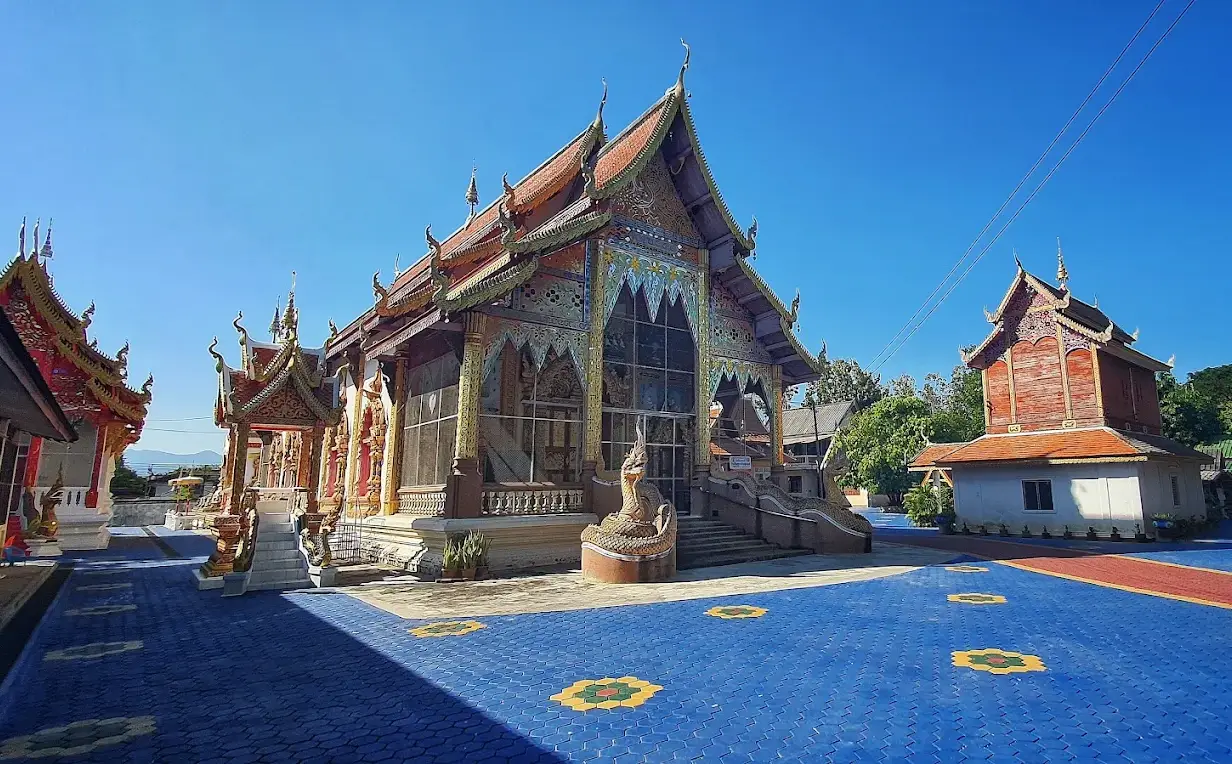
Open Days: Daily
Opening Hours: 08.00 – 17.00
Wat Thammachai is a local Buddhist temple under the Mahanikaya order, located at No. 68, Mu 9, Ban Mae Subdistrict, San Pa Tong District, Chiang Mai Province. The temple is one of the old religious centers of Ban Mae and is closely connected with the ancient local area known as Mueang Mae or Wiang Mae. Local elders have passed down that the temple was permitted to be established around 1757. Today, Wat Thammachai remains an active community temple and an important Buddhist site in Ban Mae Subdistrict.
The temple land covers 6 rai and 19 square wah under Nor Sor 3 document No. 181. Its northern boundary measures about 2 sen, 4 wah, and 2 sok, bordering a public irrigation canal. The southern boundary measures about 1 sen, 13 wah, and 2 sok, bordering a public road. The western boundary measures about 2 sen, 19 wah, and 2 sok, bordering a public irrigation canal. The eastern boundary measures about 1 sen and 2 wah, bordering private land. These boundaries show how the temple is woven into the landscape of canals, roads, village land, and daily community life.
Wat Thammachai received its royal monastic boundary on February 2, 1956. The boundary measures 40 meters wide and 80 meters long. It was formally consecrated as a monastic boundary on February 15, 1960. This is significant because the royal monastic boundary and consecrated boundary define the proper area for formal Sangha acts. Wat Thammachai therefore has an established religious status within the Thai Buddhist system.
The history of Wat Thammachai is especially important because the temple stands in the central area of Mueang Mae or Wiang Mae. Local tradition says that a woman once led the establishment of this settlement. Evidence remembered by the community includes earthen embankments that once formed a city wall, locally called “khue wiang.” Only limited traces of the old earthen wall are visible today because parts of the area have been used as private farmland. Even so, the memory of Wiang Mae gives Wat Thammachai a deeper historical layer than many ordinary village temples.
The temple was formerly known as Wat Ban Mae. Over time, the name was pronounced as Wat Ban Mae in the local form and later changed to Wat Thammachai. The name change is connected with the temple’s position between Ban Mae and Ban Chedi Noeng and may also relate to the religious name of an abbot in that period. The temple name therefore preserves local linguistic history, village identity, and the changing relationship between temple and community.
One of the most remarkable parts of Wat Thammachai’s history is the record of its old viharn. The ancient viharn was built in three sections. Its walls were made of brick with white lime plaster, and clay was used with the brickwork. Wooden posts divided the interior into bays, with the structure stepping down in three levels and two side eaves. The roof was covered with baked clay tiles. The walls contained old paintings, including an image of Mount Sumeru. The posts and upper structure were made of teak, with decorative elements such as chofa and bai raka in local style.
Around 1897, the old viharn had deteriorated. The abbot and lay supporters repaired it, replacing decorative elements such as the chofa and bai raka according to the style preferred at that time. During this period, the temple name was changed to Wat Thammachai. This restoration shows that the temple was continuously adapted and maintained by the community rather than left unchanged as a static monument.
Later, Wat Thammachai became abandoned for a period because there was no abbot and no monks or novices in residence. Important ancient objects of the temple, including Buddha images, were moved by the Sangha to nearby Wat Nam Bo Luang for preservation. This period is significant because it shows that the temple’s sacred objects were considered valuable enough to be protected even when the temple itself was temporarily without resident monks.
Around 1907, the temple supporters restored damaged monastic structures and invited monks and novices to reside at the temple again. This brought Wat Thammachai back into active religious life. The restoration allowed villagers to use the temple once more for merit-making, Dharma listening, ceremonies, and community gatherings.
In 1951, the abbot, temple committee, and lay supporters requested permission to dismantle the old viharn because it had become too deteriorated to restore in its original form. A new viharn was then built according to the style of that period and has continued to serve as the temple’s main religious space. This marks a major transition in the temple’s history, from the old Lanna viharn to a newer structure that could continue serving the community.
Although the ancient viharn no longer survives in its original full form, its recorded details remain valuable for understanding the temple. They reveal older Lanna building techniques, including brick and clay construction, white lime plaster, stepped structural sections, teak columns and roof structure, baked clay tiles, and mural painting. These details make Wat Thammachai an important temple for local history and cultural interpretation, not merely a place of worship.
Ban Mae Subdistrict contains several village temples, including Wat Hang Dong, Wat Tha Pong, Wat Ton Ngio or Wat Chimphli, Wat Ban San, Wat Rong Khum, Wat Thammachai, Wat Kio Lae Noi, Wat Ban Dong, Wat Tha Duea, Som Suk Monastery, and Wat Ban Piang. This network reflects a Lanna pattern in which each village maintains a temple as a center of faith, tradition, education, and community life. Wat Thammachai is an important part of this religious landscape.
Wat Thammachai serves Ban Mae in several ways. It is a place where elders make merit, where young people learn Buddhist manners, where families conduct ceremonies, and where villagers gather throughout the year. During religious and community events, the temple becomes a place where people help prepare the grounds, offer food, listen to Dharma, make merit, and preserve local traditions.
Annual activities at Wat Thammachai follow the rhythm of a Lanna community temple. These include Buddhist holy day observances, Dharma listening, Songkran, Buddhist Lent, the end of Buddhist Lent, Kathin robe-offering ceremonies, pha pa merit-making, and family merit-making ceremonies. Such activities allow monks, lay supporters, elders, young people, and community leaders to maintain Buddhist practice together.
The main appeal of Wat Thammachai lies in its connection with Wiang Mae, its former names Wat Ban Mae and Wat Ban Mae in local pronunciation, its record of an old Lanna viharn, and its revival from an abandoned period. The temple is suitable for visitors who want to experience a quiet Lanna community temple and understand the historical layers of Ban Mae and San Pa Tong.
The main things to appreciate at Wat Thammachai are the present viharn, the monastic boundary area, the calm community atmosphere, and the historical context of the old viharn. Visitors should not look only for monumental scale. The temple’s value lies in its long history, its connection with Wiang Mae, and its continued role in village Buddhist life.
Visitors should pay respect in the main worship area of the viharn. They may make merit, offer alms, or participate in temple activities when appropriate. Modest dress, quiet behavior, and respectful photography are important, especially inside the viharn and around ceremonial spaces.
Wat Thammachai is suitable for travelers interested in Lanna community temples, the history of Wiang Mae, old temples of Ban Mae Subdistrict, Lanna viharn architecture, revived temple histories, and cultural routes in San Pa Tong. It is best visited at a slow pace, allowing time to understand the relationship between the temple, village, irrigation canals, and local history.
Wat Thammachai can be included in a connected cultural route through Ban Mae and San Pa Tong. Nearby places include Wat Tha Pong, Wat Ton Ngio or Wat Chimphli, Wat Ban San, Wat Rong Khum, Wat Kio Lae Noi, Ban Kio Lae Noi Wood-Carving Village, Wat Tha Duea, and Wat Ban Piang. This route works well for a half-day or full-day trip combining temple visits, local food, village culture, and craft learning.
Getting There is easiest by private car or rental car. From Chiang Mai city, take Chiang Mai–Hot Road, Highway 108, through Hang Dong toward San Pa Tong, then continue into Ban Mae Subdistrict and Ban Mae, Mu 9. Another option is to take the canal road through the Hang Dong area toward Ban Mae. Local village roads should be used carefully, especially on Buddhist holy days, school traffic hours, weekends, and temple-event days.
The best time to visit is in the morning or afternoon before evening. These periods are suitable for worship, walking around the viharn, and continuing to nearby temples or craft villages. Visitors who want to see community activity may visit during Buddhist holy days or annual temple events, while those who prefer a quieter visit can come on ordinary weekdays.
In summary, Wat Thammachai is an old community temple in Ban Mae, Mu 9, Ban Mae Subdistrict, San Pa Tong District, Chiang Mai. It was permitted to be established around 1757 according to local tradition, stands in the historic area of Wiang Mae, and preserves a strong memory of an old Lanna viharn with brick-and-lime walls, teak structure, and ancient murals. After a period of abandonment, the temple was revived by local supporters and remains an active temple today. With its royal monastic boundary, community role, and historical layers, Wat Thammachai is a meaningful destination for worship, local history, and quiet Lanna cultural travel.
| Name | Wat Thammachai |
| Former / Related Names | Wat Ban Mae, Wat Ban Mae in local pronunciation |
| Location | Ban Mae, Mu 9, Ban Mae Subdistrict, San Pa Tong District, Chiang Mai Province |
| Address | No. 68, Mu 9, Ban Mae Subdistrict, San Pa Tong District, Chiang Mai 50120 |
| Place Type | Local Buddhist temple under the Mahanikaya order |
| Temple Area | 6 rai and 19 square wah under Nor Sor 3 document No. 181 |
| Highlights | An old Ban Mae community temple connected with Wiang Mae, former temple names, an old Lanna viharn record, and a royal monastic boundary |
| History | Permitted to be established around 1757 according to local tradition; old viharn restored around 1897; temple revived around 1907; new viharn built after the old one deteriorated in 1951 |
| Royal Monastic Boundary | Granted on February 2, 1956; boundary size 40 meters by 80 meters; formally consecrated on February 15, 1960 |
| Distinctive Features | A Lanna community temple connected with Mueang Mae or Wiang Mae, old earthen city-wall traces, public irrigation canals, village roads, and old viharn history |
| Travel Information | From Chiang Mai city, take Chiang Mai–Hot Road, Highway 108, through Hang Dong toward San Pa Tong, then continue into Ban Mae Subdistrict and Ban Mae, Mu 9; private car or rental car is most convenient |
| Current Status | A community temple of Ban Mae, Ban Mae Subdistrict, open for daily visits and merit-making |
| Open Days | Daily |
| Opening Hours | 08.00 – 17.00 |
| Important Structures | Present viharn, royal monastic boundary and consecrated boundary area, old Lanna viharn history, and community temple grounds |
| Key Boundaries | North borders a public irrigation canal; south borders a public road; west borders a public irrigation canal; east borders private land |
| Nearby Tourist Attractions | 1. Wat Tha Pong, about 3 km 2. Wat Ton Ngio / Wat Chimphli, about 4 km 3. Wat Ban San, about 4 km 4. Wat Rong Khum / Wat Rong Khum Chedi, about 5 km 5. Wat Kio Lae Noi / Ban Kio Lae Noi Wood-Carving Village, about 8 km |
| Nearby Restaurants | 1. Rabeang Khao Tha Ban Mae San Pa Tong, about 5 km, Tel. 061-997-8299 2. CURB, about 7 km, Tel. 083-479-2953 3. On Fleek San Pa Tong, about 8 km, Tel. 085-868-0513 4. Daek Jung-Gu San Pa Tong, about 8 km 5. Krua Tid Sen San Pa Tong, about 8 km |
| Nearby Accommodations | 1. Panatsaya Homestay, about 7 km, Tel. 093-131-6417 2. Mae Khan Pool Villa, about 8 km, Tel. 086-831-9164 3. Tai Resort Sanpatong, about 10 km, Tel. 063-096-7000 4. Home Thai Resort, about 12 km, Tel. 063-952-8228 5. Kaomai Lanna Resort, about 14 km, Tel. 053-481-201 |
Frequently Asked Questions (FAQ)
Q: Where is Wat Thammachai located?
A: Wat Thammachai is located at No. 68, Mu 9, Ban Mae Subdistrict, San Pa Tong District, Chiang Mai 50120.
Q: When was Wat Thammachai established?
A: Wat Thammachai was permitted to be established around 1757 according to local tradition passed down by community elders.
Q: What were the former names of Wat Thammachai?
A: The temple was formerly known as Wat Ban Mae and later locally pronounced as Wat Ban Mae before being renamed Wat Thammachai.
Q: How is Wat Thammachai connected with Wiang Mae?
A: The temple stands in the central area of Mueang Mae or Wiang Mae, where local tradition remembers earthen city-wall traces known as khue wiang.
Q: When did Wat Thammachai receive its royal monastic boundary?
A: Wat Thammachai received its royal monastic boundary on February 2, 1956, and the boundary was formally consecrated on February 15, 1960.
Q: What is the main historical highlight of Wat Thammachai?
A: The main historical highlight is the record of its old Lanna viharn, which had brick-and-lime walls, teak structure, baked clay roof tiles, and ancient murals.
Q: What type of traveler is Wat Thammachai suitable for?
A: It is suitable for travelers interested in Lanna community temples, Wiang Mae history, old temples of Ban Mae Subdistrict, peaceful merit-making, and cultural routes in San Pa Tong.
Q: What is the best way to get to Wat Thammachai?
A: A private car or rental car is the most convenient option. Take Chiang Mai–Hot Road, Highway 108, through Hang Dong toward San Pa Tong, then continue into Ban Mae Subdistrict and Ban Mae, Mu 9.
 Category: ●Places of Worship
 Group: ●Temple
Last Update : 2 HourAgo
 Last Update : 2 HourAgo
 Click to Access the Navigation Map GPS
 Muang Chiang Mai(121)Chom Thong(47)Mae Chaem(25)Chiang Dao(33)Doi Saket(68)Mae Taeng(85)Mae Rim(69)Samoeng(29)Fang(71)Mae Ai(59)Phrao(70)San Pa Tong(103)San Kamphaeng(66)San Sai(73)Hang Dong(74)Hot(32)Doi Tao(22)Omkoi(11)Saraphi(74)Wiang Haeng(15)Chai Prakan(28)Mae Wang(32)Mae On(22)Doi Lo(34)Galyani Vadhana(1)


