
lovethailand home >North Travel Attractions >Chiang Mai Travel Attractions >San Pa Tong >Ban Mae > Wat Tha Pong
TL;DR: Wat Tha Pong is located at Ban Tha Pong, Mu 3, Ban Mae Subdistrict, San Pa Tong District, Chiang Mai Province, open Daily, hours 08.00 – 17.00.

Wat Tha Pong
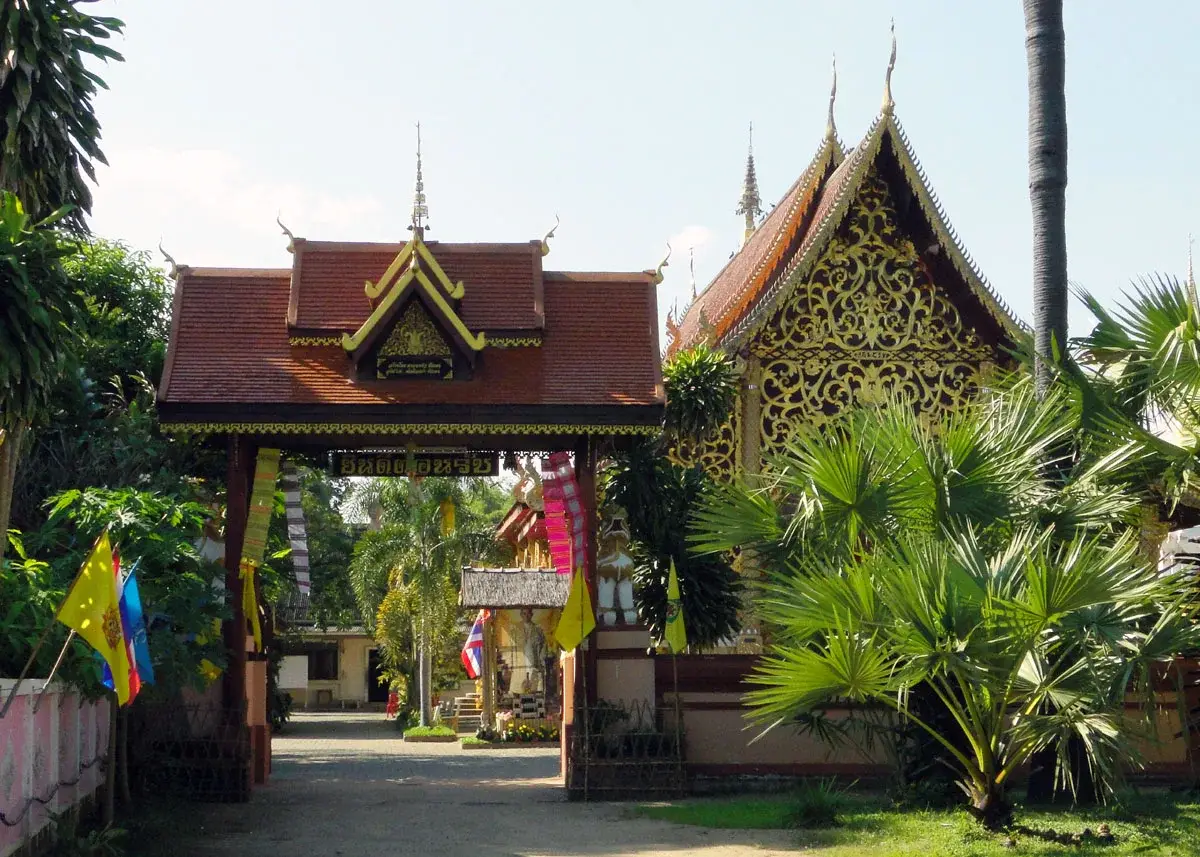
Open Days: Daily
Opening Hours: 08.00 – 17.00
Wat Tha Pong is a local Buddhist temple under the Mahanikaya order, located at No. 173, Ban Tha Pong, Mu 3, Ban Mae Subdistrict, San Pa Tong District, Chiang Mai Province. The temple land covers 3 rai, 1 ngan, and 97 square wah under land title deed No. 15320. It also has one plot of monastic land measuring 1 rai, 1 ngan, and 84 square wah under land title deed No. 15039. Wat Tha Pong was established in 1884 and remains an important community temple connected with Ban Tha Pong, the Mae Khan River, local irrigation canals, school land, and the Buddhist life of Ban Mae Subdistrict.
The name Wat Tha Pong is directly connected with Ban Tha Pong. The village is located near the Mae Khan River, where plants and local vegetation were abundant around the river landing area. The word “tha” suggests a river landing or waterside access point, while “pong” is connected with the local landscape and the fertile riverside environment remembered by villagers. The temple name therefore preserves the relationship between the village, water, farming land, and community memory.
The temple’s founding history includes an important local story. When villagers began construction and dug the ground for the foundation of the wall, they found a human skull and other bone fragments. Local elders therefore understood that the area had likely once been used as a cemetery before it became the temple site. This gives Wat Tha Pong a deeper historical layer: the land changed from a place associated with death and memory into a Buddhist temple, a place of merit, peace, and community faith.
The name of the first abbot who initiated the construction is not clearly known. Local elders only passed down that after enough monks and novices resided at the temple, the community proposed its formal establishment through the Sangha hierarchy. The temple was named after Ban Tha Pong. At that time, the area was connected with Ban Mae Subdistrict and Mae Wang District before later administrative changes placed it under San Pa Tong District. Wat Tha Pong therefore reflects both Buddhist and administrative history in the Ban Mae area.
The temple boundaries show its relationship with water systems, education, and public space. The northern side borders a public road. The southern side borders an irrigation canal. The eastern side borders school land. The western side also borders an irrigation canal. These details show that Wat Tha Pong is surrounded by elements central to Lanna village life: public routes, canals, school grounds, and the everyday movement of the community.
Irrigation canals are important in Lanna village life because they support agriculture and daily living. Wat Tha Pong, located near canals and the Mae Khan River area, is therefore part of a landscape shaped by water, farming, education, and religion. Understanding the temple means looking beyond the buildings and seeing it as part of the wider Ban Tha Pong community environment.
Important structures at Wat Tha Pong include a viharn, monks’ residence, multipurpose hall, alms pavilion, kitchen, and scripture hall. These structures allow the temple to support religious and community activities. The viharn is the main worship space. The monks’ residence supports daily monastic life. The multipurpose hall supports village and temple events. The alms pavilion is connected with food offerings. The kitchen supports merit-making ceremonies, and the scripture hall reflects the temple’s connection with Buddhist learning.
The viharn is one of the most important spaces at Wat Tha Pong. It is where villagers pay respect, listen to Dharma, make merit, and participate in Buddhist ceremonies. In a Lanna community temple, the viharn is not merely an architectural structure. It is the heart of temple life, where monks and laypeople meet through faith, chanting, offerings, and annual religious activities.
The principal Buddha image in the viharn is the main sacred object of Wat Tha Pong. Visitors should begin by paying respect in this area, calming the mind, and making merit according to their faith. In a village temple, the principal Buddha image serves as the spiritual center for Buddhist holy days, annual ceremonies, and important family occasions.
The monks’ residence allows the temple to remain active throughout the year. Resident monks use this space for living, chanting, study, temple care, and preparation for religious duties. A temple with resident monks supports the community not only during annual festivals but also through Buddhist holy days, family ceremonies, merit-making, and spiritual guidance.
The multipurpose hall and alms pavilion show the temple’s role as a shared village space. The multipurpose hall supports large gatherings, temple meetings, and community activities. The alms pavilion is closely connected with food offerings and merit-making. In Lanna Buddhist practice, villagers often work together to prepare food, offerings, and ceremonial items, making these spaces essential parts of living temple culture.
The kitchen is also important in temple life because many village merit-making events involve shared food preparation for monks and participants. The temple kitchen represents the practical side of faith: villagers working together behind the scenes to prepare meals, clean utensils, arrange offerings, and support temple ceremonies.
The scripture hall adds an educational dimension to Wat Tha Pong. It is associated with the preservation of Buddhist texts, scriptures, or temple learning materials. In a community temple, such a structure reflects the importance of Dharma learning and the preservation of religious knowledge.
Wat Tha Pong has an educational history through its Dhamma section of the Phra Pariyatti Dhamma school, opened in 1947. This shows that the temple’s role extends beyond merit-making and ceremonies. It has also served as a place for Buddhist study and moral learning for monks, novices, and interested learners in the community.
The recorded abbots of Wat Tha Pong include Phra Athikan Ka, Phra Athikan Ta, Chao Athikan Unchai Yano, Phra Khru Bunma Metho, Phra Athikan Suksan Suthino, and Phra Athikan Duangthip Aruno in the local historical record. Current temple information identifies Phra Khru Arun Bowonrat Aruno as the abbot of Wat Tha Pong. This sequence reflects continuous monastic care across generations.
Phra Khru Arun Bowonrat Aruno serves as the abbot of Wat Tha Pong, maintaining the temple, guiding Buddhist activities, and preserving the relationship between the temple and Ban Tha Pong. A temple with several structures and an educational role requires continuous care in buildings, discipline, ceremonies, and community coordination.
Ban Mae Subdistrict contains several village temples, including Wat Hang Dong, Wat Tha Pong, Wat Ton Ngio or Wat Chimphli, Wat Ban San, Wat Rong Khum, Wat Thammachai, Wat Kio Lae Noi, Wat Ban Dong, Wat Tha Duea, Som Suk Monastery, and Wat Ban Piang. This network reflects the Lanna pattern in which each village maintains a temple as a center of faith, tradition, education, and community life.
Wat Tha Pong serves Ban Tha Pong in many ways. It is a place where elders make merit, where young people learn Buddhist manners, where families conduct ceremonies, and where villagers gather throughout the year. During religious and community events, the temple becomes a place where people help prepare the grounds, offer food, make merit, and preserve local traditions.
Annual activities at Wat Tha Pong follow the rhythm of a Lanna community temple. These include Buddhist holy day observances, Dharma listening, Songkran, Buddhist Lent, the end of Buddhist Lent, Kathin robe-offering ceremonies, pha pa merit-making, and family merit-making ceremonies. These activities allow monks, lay supporters, elders, young people, and community leaders to maintain Buddhist practice together.
The main appeal of Wat Tha Pong lies in its old community history, its founding story connected with a former cemetery site, its name connected with the Mae Khan River landscape, and its complete set of village temple structures. It is a suitable place for visitors who want to understand a quiet Lanna village temple rather than a large commercial tourist attraction.
The main things to appreciate at Wat Tha Pong are the viharn, principal Buddha image, scripture hall, multipurpose hall, alms pavilion, monks’ residence, and the calm village atmosphere around the temple. Visitors should move slowly and respectfully, understanding that this is a living temple used by local residents in everyday religious life.
Visitors should pay respect in the main worship area of the viharn and before the principal Buddha image. They may make merit, offer alms, or participate in temple activities when appropriate. Modest dress, quiet behavior, and respectful photography are important, especially inside the viharn and around ceremonial spaces.
Wat Tha Pong is suitable for travelers interested in Lanna community temples, old temples in Ban Mae Subdistrict, local stories, Buddhist education, peaceful merit-making, and cultural routes in San Pa Tong. It is best visited at a slow pace, allowing time to understand the relationship between the temple, the village, school land, irrigation canals, and the Mae Khan River.
Wat Tha Pong can be included in a connected cultural route through Ban Mae and San Pa Tong. Nearby places include Wat Ton Ngio or Wat Chimphli, Wat Ban San, Wat Rong Khum, Wat Tha Duea, Wat Kio Lae Noi, Ban Kio Lae Noi Wood-Carving Village, and the Ban Mae–Hang Dong cultural route. This route works well for a half-day or full-day trip combining temple visits, local food, village culture, and local craft learning.
Getting There is easiest by private car or rental car. From Chiang Mai city, take Chiang Mai–Hot Road, Highway 108, through Hang Dong toward San Pa Tong, then continue into Ban Mae Subdistrict and Ban Tha Pong, Mu 3. Another option is to take the canal road through the Hang Dong area toward Ban Mae. Local village roads should be used carefully, especially on Buddhist holy days, school traffic hours, weekends, and temple-event days.
The best time to visit is in the morning or afternoon before evening. These periods are suitable for worship, walking around the viharn, and continuing to nearby temples or craft villages. Visitors who want to see community activity may visit during Buddhist holy days or annual temple events, while those who prefer a quieter visit can come on ordinary weekdays.
In summary, Wat Tha Pong is an old community temple in Ban Tha Pong, Mu 3, Ban Mae Subdistrict, San Pa Tong District, Chiang Mai. Established in 1884, the temple is connected with the Mae Khan River, local irrigation canals, school land, and the agricultural landscape of the village. Its important structures include a viharn, monks’ residence, multipurpose hall, alms pavilion, kitchen, and scripture hall. With a principal Buddha image in the viharn and Phra Khru Arun Bowonrat Aruno as abbot, Wat Tha Pong is a meaningful destination for worship, local history, and quiet Lanna cultural travel.
| Name | Wat Tha Pong |
| Location | Ban Tha Pong, Mu 3, Ban Mae Subdistrict, San Pa Tong District, Chiang Mai Province |
| Address | No. 173, Ban Tha Pong, Mu 3, Ban Mae Subdistrict, San Pa Tong District, Chiang Mai 50120 |
| Place Type | Local Buddhist temple under the Mahanikaya order |
| Temple Area | Temple land: 3 rai, 1 ngan, 97 square wah under land title deed No. 15320; monastic land: 1 plot measuring 1 rai, 1 ngan, 84 square wah under land title deed No. 15039 |
| Highlights | An old community temple established in 1884, with a founding story connected with a former cemetery site, a name linked to the Mae Khan River landscape, and important structures including a viharn and scripture hall |
| History | Established in 1884 and named after Ban Tha Pong, a village near the Mae Khan River |
| Distinctive Features | A Lanna community temple connected with Ban Tha Pong, school land, irrigation canals, the Mae Khan River, and the agricultural landscape of Ban Mae Subdistrict |
| Travel Information | From Chiang Mai city, take Chiang Mai–Hot Road, Highway 108, through Hang Dong toward San Pa Tong, then continue into Ban Mae Subdistrict and Ban Tha Pong, Mu 3; private car or rental car is most convenient |
| Current Status | A community temple of Ban Tha Pong, Ban Mae Subdistrict, open for daily visits and merit-making |
| Open Days | Daily |
| Opening Hours | 08.00 – 17.00 |
| Important Structures | Viharn, monks’ residence, multipurpose hall, alms pavilion, kitchen, and scripture hall |
| Important Sacred Object | Principal Buddha image in the viharn |
| Temple Education | The temple has a history of opening a Phra Pariyatti Dhamma school, Dhamma section, from 1947 |
| Abbot / Caretaker | Phra Khru Arun Bowonrat Aruno |
| Main Contact Number | 080-675-9268 |
| Key Boundaries | North borders a public road; south borders an irrigation canal; east borders school land; west borders an irrigation canal |
| Nearby Tourist Attractions | 1. Wat Ton Ngio / Wat Chimphli, about 3 km 2. Wat Ban San, about 4 km 3. Wat Rong Khum, about 5 km 4. Wat Tha Duea, about 6 km 5. Wat Kio Lae Noi / Ban Kio Lae Noi Wood-Carving Village, about 8 km |
| Nearby Restaurants | 1. Rabeang Khao Tha Ban Mae San Pa Tong, about 4 km 2. CURB, about 6 km, Tel. 083-479-2953 3. Daek Jung-Gu San Pa Tong, about 7 km 4. On Fleek San Pa Tong, about 8 km 5. Krua Tid Sen San Pa Tong, about 8 km |
| Nearby Accommodations | 1. Panatsaya Homestay, about 6 km 2. Mae Khan Pool Villa, about 8 km, Tel. 086-831-9164 3. Tai Resort Sanpatong, about 10 km, Tel. 063-096-7000 4. Home Thai Resort, about 12 km, Tel. 063-952-8228 5. Kaomai Lanna Resort, about 14 km, Tel. 053-481-201 |
Frequently Asked Questions (FAQ)
Q: Where is Wat Tha Pong located?
A: Wat Tha Pong is located at No. 173, Ban Tha Pong, Mu 3, Ban Mae Subdistrict, San Pa Tong District, Chiang Mai 50120.
Q: When was Wat Tha Pong established?
A: Wat Tha Pong was established in 1884 and was named after Ban Tha Pong, a village near the Mae Khan River.
Q: What is the origin of the name Ban Tha Pong?
A: The name is connected with the riverside area near the Mae Khan River, where plants and vegetation were abundant around the river landing area.
Q: What important structures are found at Wat Tha Pong?
A: Important structures include a viharn, monks’ residence, multipurpose hall, alms pavilion, kitchen, and scripture hall.
Q: What is the main sacred object at Wat Tha Pong?
A: The main sacred object is the principal Buddha image in the viharn.
Q: What is Wat Tha Pong’s role in Buddhist education?
A: The temple has a history of opening a Phra Pariyatti Dhamma school, Dhamma section, from 1947.
Q: Who is the abbot of Wat Tha Pong?
A: Phra Khru Arun Bowonrat Aruno is the abbot of Wat Tha Pong.
Q: What type of traveler is Wat Tha Pong suitable for?
A: It is suitable for travelers interested in Lanna community temples, old temples in Ban Mae Subdistrict, local stories, Buddhist education, peaceful merit-making, and cultural routes in San Pa Tong.
 Category: ●Places of Worship
 Group: ●Temple
Last Update : 3 DayAgo
 Last Update : 3 DayAgo
 Click to Access the Navigation Map GPS
 Muang Chiang Mai(121)Chom Thong(47)Mae Chaem(25)Chiang Dao(33)Doi Saket(68)Mae Taeng(85)Mae Rim(69)Samoeng(29)Fang(71)Mae Ai(59)Phrao(70)San Pa Tong(103)San Kamphaeng(66)San Sai(73)Hang Dong(73)Hot(32)Doi Tao(22)Omkoi(11)Saraphi(74)Wiang Haeng(15)Chai Prakan(28)Mae Wang(32)Mae On(22)Doi Lo(34)Galyani Vadhana(1)


