
lovethailand home >North Travel Attractions >Chiang Mai Travel Attractions >San Pa Tong >Mae Ka > Wat Inthawichai
TL;DR: Wat Inthawichai is located at Ban Mae Khong, Mu 9, Mae Ka Subdistrict, San Pa Tong District, Chiang Mai Province, open Daily, hours 08.00 – 17.00.
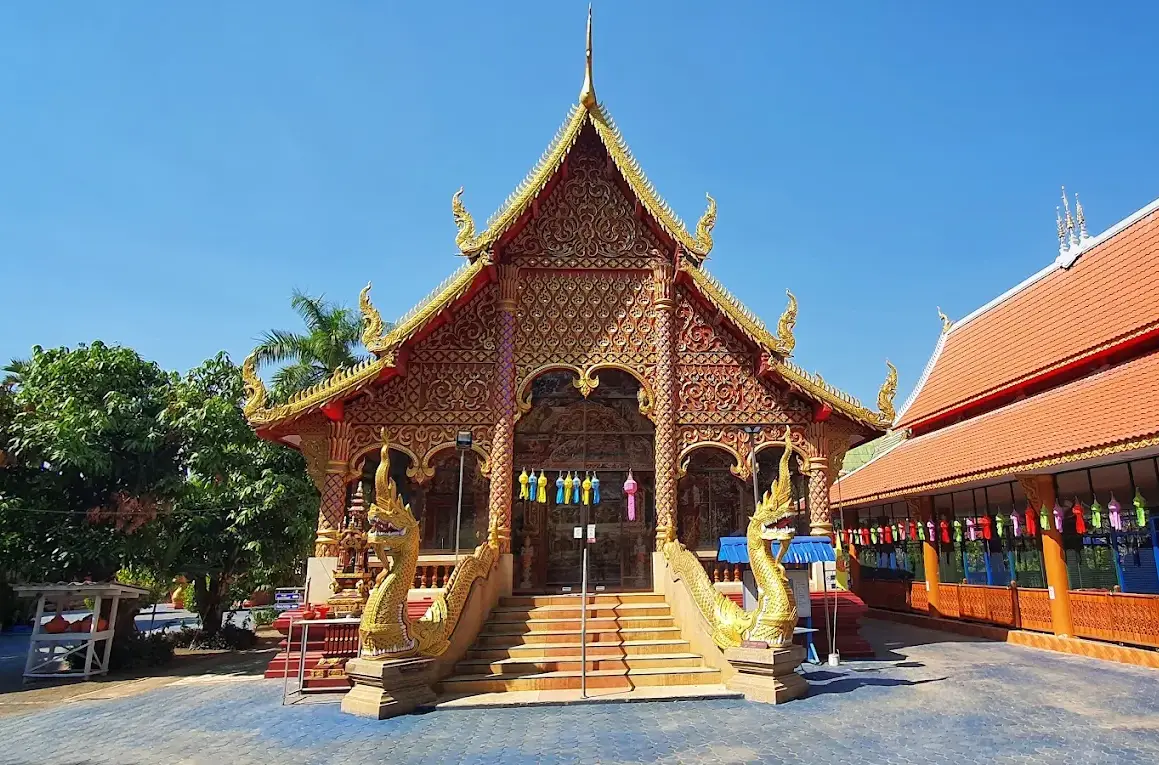
Wat Inthawichai
Open Days: Daily
Opening Hours: 08.00 – 17.00
Wat Inthawichai (Mae Khong) is a local Buddhist temple under the Mahanikaya order, located at No. 129, Mu 9, Ban Mae Khong, Mae Ka Subdistrict, San Pa Tong District, Chiang Mai Province. The temple was officially approved by the Department of Religious Affairs as a complete temple in 1902. Chao Athikan In Kham Inthawichayo was the founding abbot and an important figure in the establishment of the temple. When the temple was first established at this site, it was known as Wat Chai Chana Mongkhon. The name was later changed to Wat Inthawichai to correspond with the religious name of the founding abbot.
The temple land covers 4 rai, 2 ngan, and 97 square wah under Nor Sor 3 document No. 69659, volume 697, page 59. It also has two plots of monastic land. The first plot measures 3 ngan and 72 square wah under Nor Sor 3 Kor document No. 69658, volume 697, page 58. The second plot measures 3 ngan and 50 square wah under Nor Sor 3 Kor document No. 62. These land details show that the temple has a stable religious foundation for monastic life, community activities, and temple maintenance.
The temple boundaries reflect its close connection with the village landscape. To the north, the boundary measures about 2 sen and 9 wah, bordering a public path. To the south, it measures about 2 sen and 12 wah, bordering an irrigation canal and Wat Inthawichai School. To the east, it measures about 2 sen, bordering a public embankment. To the west, it measures about 1 sen and 10 wah, bordering a public irrigation canal. The temple is therefore situated within a living environment of roads, canals, a school, and water-management structures.
The location beside Wat Inthawichai School highlights the relationship between temple and education in Lanna communities. Temples and schools often support one another in moral education, religious observances, and the transmission of local customs. Children and young people learn temple manners, respect for sacred spaces, and participation in community activities through this close relationship between temple and school.
Wat Inthawichai received its royal monastic boundary on September 8, 1955, and the boundary was formally consecrated on February 17, 1979. This is an important milestone because a royal monastic boundary and consecrated boundary define the proper area for Sangha acts such as ordination and other monastic procedures. These details show that Wat Inthawichai has a complete religious status within the Thai Buddhist system.
The recorded abbots of Wat Inthawichai include Chao Athikan In Kham Inthawichayo, Phra Khru In Kham Yatikaro, Phra Maha Kasem Aggapunyo, and Phra Khru Sathitthamaphinan, who is the current abbot of Wat Inthawichai (Mae Khong). This sequence reflects continuity in monastic leadership from the founding period to the present. Each abbot helped preserve the temple, guide Buddhist activities, and maintain the relationship between the temple and Ban Mae Khong.
Important structures at Wat Inthawichai include an ubosot, viharn, monks’ residence, chedi, two multipurpose buildings, kitchen, and toilets. These structures allow the temple to support both monastic and lay community activities. The ubosot supports formal Sangha acts. The viharn serves as the main worship space. The monks’ residence supports daily monastic life. The chedi is an important sacred structure. The multipurpose buildings, kitchen, and toilets help the temple serve local merit-making and community events.
The ubosot is one of the most important religious spaces at Wat Inthawichai. Because the temple has received a royal monastic boundary and has formally consecrated its boundary, the ubosot carries strong significance for monastic discipline and Buddhist ceremonies. Visitors should approach this area with respect, keeping quiet and observing proper temple etiquette.
The viharn is the main devotional space for villagers and visitors. It is where people pay respect, make merit, listen to Dharma, and take part in Buddhist ceremonies. In a Lanna community temple, the viharn is not merely an architectural structure. It is the heart of the temple’s devotional life, where monks and laypeople meet through offerings, chanting, and annual religious activities.
The chedi is an important sacred feature of the temple. In Lanna Buddhist culture, a chedi represents continuity, devotion, and the sacred identity of the temple grounds. Visitors should observe and pay respect around the chedi with calm and care, as it is one of the temple’s main sacred areas.
The monks’ residence allows the temple to remain active in daily Buddhist life. Resident monks use this space for living, chanting, study, temple care, and preparation for religious duties. A temple with resident monks supports the community throughout the year through Buddhist holy days, family ceremonies, merit-making, and spiritual guidance.
The two multipurpose buildings are important for community use. They support temple meetings, merit-making events, family ceremonies, and village activities. The kitchen reflects the practical side of Lanna temple life, where villagers often work together to prepare food, offer meals to monks, and welcome people during temple events.
One of the most distinctive features of Wat Inthawichai is the fish sanctuary in the Ping River area in front of the temple. Many natural fish live there, and the temple community has conserved the area as a place where people can relax and feed fish. This riverside feature gives Wat Inthawichai a strong connection with nature, the Ping River, community conservation, and everyday village life.
Local agencies have also supported aquatic-resource conservation at the fish sanctuary in front of the temple. Fish release activities and improvements to the riverside landscape have helped make the area more attractive for villagers, passersby, visitors, and people who come to make merit at the temple. This makes Wat Inthawichai a place where Buddhism, environmental care, and community recreation meet.
Ban Mae Khong is a community connected with waterways, irrigation canals, agriculture, and riverside life. Because Wat Inthawichai borders irrigation canals and has a fish sanctuary in front of the temple, it clearly shows the relationship between temple, water, agriculture, and community identity. Visitors can understand the temple not only as a place of worship but also as part of a living water-based village landscape.
Mae Ka Subdistrict contains several village temples, including Wat Ko Chok, Wat Sai Mun, Wat Mae Ka, Wat Rong Khut, Wat Rong Wua, Wat San Kawan, Wat San Khok Chang, Wat Nong Khaem, Wat Nong Khrop, Wat Nong Tao Kham, and Wat Inthawichai. These temples reflect the Lanna pattern in which each village maintains a temple as a center of faith, tradition, social relationship, and local memory. Wat Inthawichai is an important part of this Buddhist landscape in San Pa Tong.
Wat Inthawichai serves Ban Mae Khong in many ways. It is a place where elders make merit, where young people learn temple manners, where families hold ceremonies, and where villagers gather for annual Buddhist events. The temple supports Buddhist holy day observances, Dharma listening, Kathin robe-offering ceremonies, pha pa merit-making, Buddhist Lent, end-of-Lent activities, and family merit-making ceremonies.
Kathin merit-making at Wat Inthawichai reflects the temple’s active present-day role. Such events require cooperation among monks, local agencies, community leaders, and lay supporters. Kathin after the Buddhist Lent season is one of the most important annual traditions, helping villagers support the temple, strengthen unity, and preserve Buddhist practice in the community.
The main appeal of Wat Inthawichai lies in its former name Wat Chai Chana Mongkhon, its name change connected with the founding abbot, its complete temple status in 1902, its royal monastic boundary, its community structures, and its riverside fish sanctuary. These elements make the temple meaningful for worship, local history, riverside atmosphere, and Lanna community culture.
The main things to appreciate at Wat Inthawichai are the ubosot, viharn, chedi, multipurpose buildings, and the fish sanctuary beside the Ping River in front of the temple. Visitors should begin by paying respect in the main worship area and then observe the temple grounds calmly. Those with more time can visit the riverside fish sanctuary to experience the temple’s connection with nature and local conservation.
Visitors should pay respect in the viharn and around the chedi. Merit-making at Wat Inthawichai is connected with a long community history and the continuity of Buddhist faith in Ban Mae Khong. Visitors should dress modestly, keep voices low, avoid disturbing monks or local residents, and take photographs respectfully, especially around the ubosot, viharn, chedi, and ceremonial spaces.
Wat Inthawichai is suitable for travelers interested in Lanna community temples, old temple histories, the Ping River fish sanctuary, quiet merit-making, and cultural routes in San Pa Tong. It is not a large-scale commercial tourist attraction, but it offers a meaningful view of how temples, schools, canals, rivers, and community life are connected in northern Thailand.
Wat Inthawichai can be included in a cultural route through Mae Ka and San Pa Tong. Nearby places include the fish sanctuary in front of Wat Inthawichai, Wat Nong Tao Kham, Wat Nong Khrop, Wat Nong Khaem, Wat San Khok Chang, Thung Fa Bot Market or Kad Ngua San Pa Tong, and Wiang Tha Kan Ancient Town. This route works well for a half-day or full-day trip combining temple visits, local food, village culture, and local history.
Getting There is easiest by private car or rental car. From Chiang Mai city, take the Chiang Mai–Hot Road, also known as Highway 108, toward San Pa Tong District. Continue into Mae Ka Subdistrict and Ban Mae Khong, Mu 9. Local roads pass through village and agricultural areas, so drivers should proceed carefully, especially on Buddhist holy days, weekends, school hours, and temple-event days.
The best time to visit is in the morning or afternoon before evening. These periods are suitable for worship, quiet walking, and observing the ubosot, viharn, chedi, and fish sanctuary. Travelers who want to continue the route can connect Wat Inthawichai with nearby temples, Thung Fa Bot Market, or Wiang Tha Kan Ancient Town on the same San Pa Tong cultural route.
In summary, Wat Inthawichai (Mae Khong) is an important community temple in Ban Mae Khong, Mu 9, Mae Ka Subdistrict, San Pa Tong District, Chiang Mai. Formerly known as Wat Chai Chana Mongkhon, the temple was officially approved as a complete temple in 1902, received its royal monastic boundary on September 8, 1955, and formally consecrated the boundary on February 17, 1979. With an ubosot, viharn, monks’ residence, chedi, multipurpose buildings, kitchen, toilets, and the Ping River fish sanctuary in front of the temple, it is a meaningful destination for worship, community history, riverside atmosphere, and quiet Lanna cultural travel.
| Name | Wat Inthawichai (Mae Khong) |
| Former / Related Names | Wat Chai Chana Mongkhon, Wat Inthawichai, Wat Intharawichai |
| Location | Ban Mae Khong, Mu 9, Mae Ka Subdistrict, San Pa Tong District, Chiang Mai Province |
| Address | No. 129, Mu 9, Mae Ka Subdistrict, San Pa Tong District, Chiang Mai 50120 |
| Place Type | Local Buddhist temple under the Mahanikaya order |
| Temple Area | Temple land: 4 rai, 2 ngan, 97 square wah; monastic land: two plots totaling 1 rai and 22 square wah |
| Highlights | An old community temple of Ban Mae Khong, formerly named Wat Chai Chana Mongkhon, with an ubosot, viharn, chedi, multipurpose buildings, and a fish sanctuary by the Ping River in front of the temple |
| History | Officially approved as a complete temple in 1902, with Chao Athikan In Kham Inthawichayo as the founding abbot |
| Royal Monastic Boundary | Granted on September 8, 1955; formally consecrated on February 17, 1979 |
| Distinctive Features | A Lanna community temple connected with Ban Mae Khong, Wat Inthawichai School, public irrigation canals, and the Ping River fish sanctuary |
| Travel Information | From Chiang Mai city, take the Chiang Mai–Hot Road toward San Pa Tong, then continue into Mae Ka Subdistrict and Ban Mae Khong, Mu 9; private car or rental car is most convenient |
| Current Status | A community temple of Ban Mae Khong, Mae Ka Subdistrict, open for daily visits and merit-making |
| Open Days | Daily |
| Opening Hours | 08.00 – 17.00 |
| Important Structures | Ubosot, viharn, monks’ residence, chedi, two multipurpose buildings, kitchen, and toilets |
| Natural Highlight | Fish sanctuary by the Ping River in front of Wat Inthawichai, used as a local relaxation and fish-feeding area |
| Abbot / Caretaker | Phra Khru Sathitthamaphinan |
| Main Contact Number | 053-837-641, 081-366-5509 |
| Key Boundaries | North about 2 sen and 9 wah bordering a public path; south about 2 sen and 12 wah bordering an irrigation canal and Wat Inthawichai School; east about 2 sen bordering a public embankment; west about 1 sen and 10 wah bordering a public irrigation canal |
| Nearby Tourist Attractions | 1. Fish Sanctuary In Front Of Wat Inthawichai, about 0 km 2. Wat Nong Tao Kham, about 2 km 3. Wat Nong Khrop, about 4 km 4. Wat Nong Khaem, about 5 km 5. Thung Fa Bot Market / Kad Ngua San Pa Tong, about 8 km |
| Nearby Restaurants | 1. Baan Ton Mai Home Stay & Coffee, about 5 km, Tel. 084-613-4997 2. Nong Fluke Restaurant, about 6 km, Tel. 053-829-528 3. 9 Kaprao Ban Ton Krok, about 7 km, Tel. 089-647-4487, 096-559-0311 4. On Fleek San Pa Tong, about 8 km, Tel. 085-868-0513 5. ZAPALiMENE San Pa Tong, about 9 km, Tel. 096-236-9197, 064-874-2594 |
| Nearby Accommodations | 1. Huen Hom Kham Homestay Resort, about 5 km, Tel. 086-183-1327 2. Tai Resort Sanpatong, about 8 km 3. Home Thai Resort, about 10 km, Tel. 063-952-8228 4. Kaomai Lanna Resort, about 14 km, Tel. 053-481-201 5. Kaomai Lanna Resort & Hotel, about 14 km, Tel. 053-481-201 |
Frequently Asked Questions (FAQ)
Q: Where is Wat Inthawichai (Mae Khong) located?
A: Wat Inthawichai is located at No. 129, Mu 9, Ban Mae Khong, Mae Ka Subdistrict, San Pa Tong District, Chiang Mai Province.
Q: What was the former name of Wat Inthawichai?
A: Wat Inthawichai was formerly known as Wat Chai Chana Mongkhon before being renamed to correspond with the religious name of the founding abbot.
Q: When was Wat Inthawichai officially approved as a complete temple?
A: Wat Inthawichai was officially approved by the Department of Religious Affairs as a complete temple in 1902.
Q: When did Wat Inthawichai receive its royal monastic boundary?
A: Wat Inthawichai received its royal monastic boundary on September 8, 1955, and formally consecrated the boundary on February 17, 1979.
Q: What important structures are found at Wat Inthawichai?
A: Important structures include an ubosot, viharn, monks’ residence, chedi, two multipurpose buildings, kitchen, and toilets.
Q: What is the main highlight of Wat Inthawichai?
A: The temple is known for its old community-temple history, its former name Wat Chai Chana Mongkhon, its complete monastic status, and the fish sanctuary by the Ping River in front of the temple.
Q: Who is the abbot of Wat Inthawichai?
A: Phra Khru Sathitthamaphinan is the abbot of Wat Inthawichai (Mae Khong).
Q: What type of traveler is Wat Inthawichai suitable for?
A: It is suitable for travelers interested in Lanna community temples, old temple histories, the Ping River fish sanctuary, peaceful merit-making, and cultural routes in San Pa Tong.
 Category: ●Places of Worship
 Group: ●Temple
Last Update : 2 WeekAgo
 Last Update : 2 WeekAgo
 Click to Access the Navigation Map GPS
 Muang Chiang Mai(121)Chom Thong(47)Mae Chaem(25)Chiang Dao(33)Doi Saket(68)Mae Taeng(85)Mae Rim(69)Samoeng(29)Fang(71)Mae Ai(59)Phrao(70)San Pa Tong(103)San Kamphaeng(66)San Sai(73)Hang Dong(73)Hot(32)Doi Tao(22)Omkoi(11)Saraphi(74)Wiang Haeng(15)Chai Prakan(28)Mae Wang(32)Mae On(22)Doi Lo(33)Galyani Vadhana(1)


