
lovethailand home >North Travel Attractions >Chiang Mai Travel Attractions >San Pa Tong >Mae Ka > Wat San Khok Chang
TL;DR: Wat San Khok Chang is located at Ban San Khok Chang, Mu 7, Mae Ka Subdistrict, San Pa Tong District, Chiang Mai Province, open Daily, hours 08.00 – 17.00.

Wat San Khok Chang
Open Days: Daily
Opening Hours: 08.00 – 17.00
Wat San Khok Chang is a local Buddhist temple under the Mahanikaya order, located at No. 196, Ban San Khok Chang, Intharat Uthit Road, Mu 7, Mae Ka Subdistrict, San Pa Tong District, Chiang Mai Province. The temple land covers 8 rai, 2 ngan, and 99 square wah under Nor Sor 3 document No. 52. Wat San Khok Chang was formerly an abandoned temple known locally as Wat Luang. It was officially elevated by the Ministry of Education as a temple with resident monks on November 15, 1967, and later received its royal monastic boundary on January 16, 1975. The monastic boundary measures 40 meters wide and 80 meters long.
The name Wat San Khok Chang is closely connected with Ban San Khok Chang, Mu 7, in Mae Ka Subdistrict. The word “san” in northern Thai place names often refers to a ridge or raised land, while “khok chang” suggests a local memory associated with an elephant enclosure or a place remembered by the community through that name. The temple name therefore preserves local identity and the memory of the village landscape.
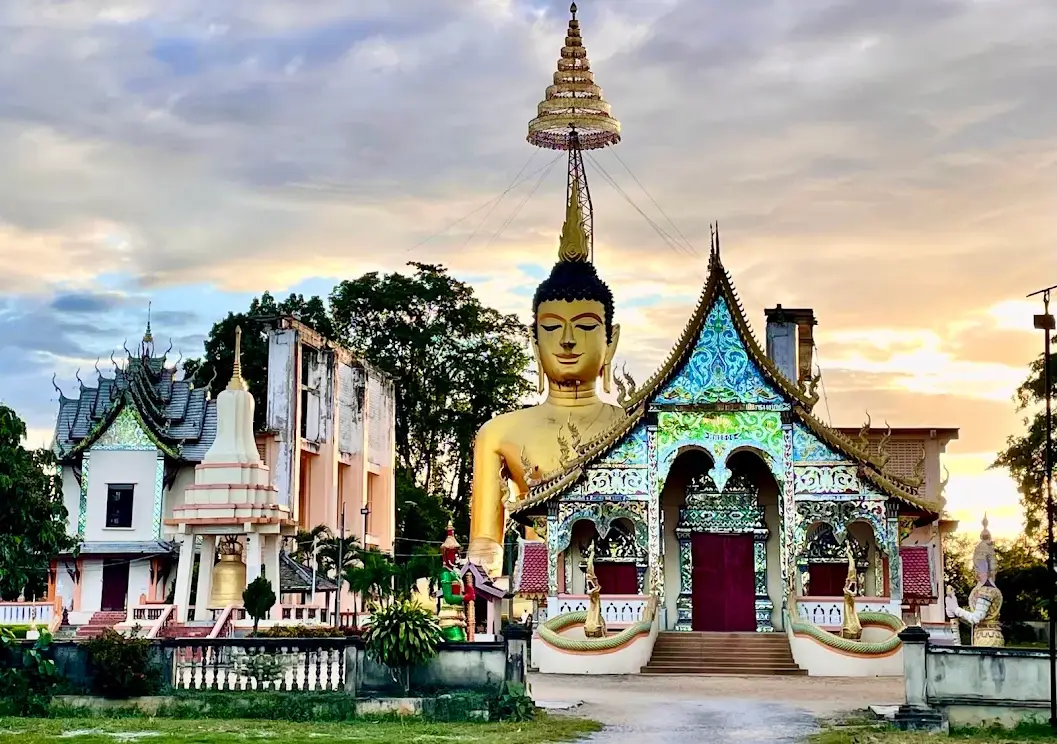
Wat San Khok Chang is also known as Wat Phra Phuttha Santiparangkan or Wat Phra Phuttha Santipakarang. These names are connected with the temple’s major Buddha image, Phra Phuttha Santiparangkan Si Phingkhanakhon Mongkhon. This large Buddha image is the temple’s most important sacred object and the central focus of devotion for villagers and visitors.
The temple’s history began from a site that had once been an abandoned temple. Villagers remembered it as Wat Luang. The restoration of the site into a functioning temple reflects the faith and cooperation of the local community. In Lanna communities, abandoned sacred sites often remain in local memory, and when faith and community strength return, such places can be revived as living temples again.
The official elevation of the abandoned temple as a temple with resident monks on November 15, 1967 gave Wat San Khok Chang a firm religious status within the community. The later royal monastic boundary granted on January 16, 1975 strengthened its role as a proper monastic site. A royal monastic boundary defines the formal area for Sangha acts such as ordination and other Buddhist monastic procedures. This allows the temple to function more fully within the Thai Buddhist system.
The temple boundaries reflect its connection with the village environment. The northern boundary measures about 63 wah and 2 sok. The southern boundary measures about 61 wah and borders a road. The eastern boundary measures about 50 wah and borders a road. The western boundary measures about 58 wah and borders an irrigation channel. These surroundings connect the temple with roads, water management, agriculture, and village life.
Mae Ka Subdistrict contains several village temples, including Wat Ko Chok, Wat Sai Mun, Wat Mae Ka, Wat Rong Khut, Wat Rong Wua, Wat San Kawan, Wat Nong Khrop, Wat Nong Tao Kham, Wat Inthawichai, and Wat San Khok Chang. These temples reflect the Lanna pattern in which each village maintains a temple as a center of faith, tradition, social relationship, and local memory. Wat San Khok Chang is part of this wider Buddhist landscape in San Pa Tong.
Important structures at Wat San Khok Chang include a northern Thai mixed Thai-style ubosot and two monks’ residence buildings. The ubosot is an important space for monastic acts according to Buddhist discipline. Its form, combining Thai and northern local style, reflects the temple’s religious function and regional identity. Visitors should approach the ubosot with quiet respect because it is one of the temple’s most sacred areas.
The two monks’ residence buildings support the daily life of resident monks. Monks use these spaces for living, chanting, study, temple care, and preparation for religious duties. A temple with resident monks is a living religious institution, supporting Buddhist holy days, family ceremonies, and the spiritual needs of the local community throughout the year.
The most important sacred object at Wat San Khok Chang is Phra Phuttha Santiparangkan Si Phingkhanakhon Mongkhon, a large Buddha image granted and ritually consecrated by His Majesty the King. The image combines Chiang Saen and early Sukhothai artistic characteristics. This makes it significant not only as a focus of devotion but also as a Buddha image with distinctive artistic value.
Phra Phuttha Santiparangkan Si Phingkhanakhon Mongkhon gives the temple a strong devotional identity. Many people know the temple through this large Buddha image, sometimes referring to it as a temple of Phra Chao Ton Luang. The image serves as a spiritual center for villagers who come to pay respect, make merit, and seek peace of mind.
Phra Suthian Anawilo is the abbot of Wat San Khok Chang. The abbot plays an important role in maintaining the temple, guiding Buddhist activities, and preserving the relationship between the temple and Ban San Khok Chang. For a temple revived from an abandoned site, continuous leadership is especially important for maintaining faith, order, and community participation.
The main appeal of Wat San Khok Chang lies in two major elements: its revival from an abandoned temple and its important large Buddha image. Together, these make the temple more than a local place of worship. It is a site where village memory, Buddhist restoration, royal religious association, and local devotion meet in one place.
Wat San Khok Chang serves Ban San Khok Chang in many ways. It is a place where elders make merit and listen to Dharma, where young people learn temple manners and Buddhist values, where families conduct ceremonies, and where villagers gather for annual religious events. The temple therefore functions as both a religious and social center of the village.
Annual activities at Wat San Khok Chang follow the rhythm of Lanna village temples. These include Buddhist holy day observances, Dharma listening, Kathin robe-offering ceremonies, pha pa merit-making, Songkran or northern Thai New Year activities, candle offerings for Buddhist Lent, end-of-Lent activities, and family merit-making ceremonies. During such events, villagers help prepare food, offerings, ceremonial items, and temple grounds.
The main things to appreciate at Wat San Khok Chang are Phra Phuttha Santiparangkan Si Phingkhanakhon Mongkhon, the Thai-northern style ubosot, the monks’ residences, and the quiet atmosphere of Ban San Khok Chang. Visitors should begin by paying respect to the large Buddha image and then observe the temple slowly and respectfully.
Visitors should pay respect at the large Buddha image and the temple’s main worship areas. Modest clothing, a quiet voice, respectful photography, and care around sacred spaces are important. Visitors should avoid touching sacred objects without permission and should not disturb monks or villagers during ceremonies.
Wat San Khok Chang is suitable for travelers interested in Lanna community temples, revived abandoned temple sites, large Buddha images, Chiang Saen and early Sukhothai artistic influence, and quieter cultural routes in San Pa Tong. It is not a large-scale commercial tourist attraction, but it offers meaningful insight into village Buddhism and local faith in northern Thailand.
Wat San Khok Chang can be included in a connected cultural route in Mae Ka and San Pa Tong. Nearby places include Wat Nong Khrop, Wat Nong Tao Kham, Wat San Kawan, Wat Rong Wua, Thung Fa Bot Market or Kad Ngua San Pa Tong, and Wiang Tha Kan Ancient Town. This route works well for a half-day or full-day trip combining temple visits, local food, village culture, and local history.
Getting There is easiest by private car or rental car. From Chiang Mai city, take the Chiang Mai–Hot Road, also known as Highway 108, toward San Pa Tong District. Continue into Mae Ka Subdistrict and Ban San Khok Chang, Mu 7. The temple is located on Intharat Uthit Road within the village area, so drivers should proceed carefully, especially on Buddhist holy days, weekends, and temple-event days.
The best time to visit is in the morning or afternoon before evening. These periods are suitable for worship, quiet walking, and continuing to nearby temples or attractions. Travelers who want to visit Thung Fa Bot Market should plan according to the market schedule. Those interested in local history can continue to Wiang Tha Kan Ancient Town on the same San Pa Tong cultural route.
In summary, Wat San Khok Chang is an important community temple in Ban San Khok Chang, Mu 7, Mae Ka Subdistrict, San Pa Tong District, Chiang Mai. Formerly an abandoned temple known as Wat Luang, it was elevated as a temple with resident monks on November 15, 1967 and received its royal monastic boundary on January 16, 1975. With a Thai-northern style ubosot, two monks’ residence buildings, and the large Buddha image Phra Phuttha Santiparangkan Si Phingkhanakhon Mongkhon, the temple is a meaningful destination for worship, local history, and quiet Lanna cultural travel.
| Name | Wat San Khok Chang |
| Alternative Names | Wat Phra Phuttha Santiparangkan, Wat Phra Phuttha Santipakarang, Wat Luang |
| Location | Ban San Khok Chang, Mu 7, Mae Ka Subdistrict, San Pa Tong District, Chiang Mai Province |
| Address | No. 196, Ban San Khok Chang, Intharat Uthit Road, Mu 7, Mae Ka Subdistrict, San Pa Tong District, Chiang Mai Province |
| Coordinates | 18.56006, 98.92628 |
| Place Type | Local Buddhist temple under the Mahanikaya order |
| Temple Area | 8 rai, 2 ngan, 99 square wah under Nor Sor 3 document No. 52 |
| Highlights | A community temple revived from an abandoned temple site, with the large Buddha image Phra Phuttha Santiparangkan Si Phingkhanakhon Mongkhon and a Thai-northern style ubosot |
| History | Formerly an abandoned temple known as Wat Luang; elevated as a temple with resident monks on November 15, 1967; granted its royal monastic boundary on January 16, 1975 |
| Royal Monastic Boundary | 40 meters wide and 80 meters long |
| Distinctive Features | A Lanna community temple connected with an abandoned temple revival, a large royal-associated Buddha image, village roads, and an irrigation channel |
| Travel Information | From Chiang Mai city, take the Chiang Mai–Hot Road toward San Pa Tong, then continue into Mae Ka Subdistrict and Ban San Khok Chang, Mu 7; private car or rental car is most convenient |
| Current Status | A community temple of Ban San Khok Chang, Mae Ka Subdistrict, open for daily visits and merit-making |
| Open Days | Daily |
| Opening Hours | 08.00 – 17.00 |
| Important Structures | Thai-northern style ubosot and two monks’ residence buildings |
| Important Sacred Object | Phra Phuttha Santiparangkan Si Phingkhanakhon Mongkhon, a large Buddha image with Chiang Saen and early Sukhothai artistic characteristics |
| Abbot / Caretaker | Phra Suthian Anawilo |
| Main Contact Number | 053-837-328 |
| Key Boundaries | North about 63 wah and 2 sok; south about 61 wah bordering a road; east about 50 wah bordering a road; west about 58 wah bordering an irrigation channel |
| Nearby Tourist Attractions | 1. Wat Nong Khrop, about 2 km 2. Wat Nong Tao Kham, about 3 km 3. Wat San Kawan, about 4 km 4. Wat Rong Wua, about 5 km 5. Thung Fa Bot Market / Kad Ngua San Pa Tong, about 8 km |
| Nearby Restaurants | 1. Baan Ton Mai Home Stay & Coffee, about 5 km, Tel. 084-613-4997 2. Nong Fluke Restaurant, about 6 km, Tel. 053-829-528 3. 9 Kaprao Ban Ton Krok, about 7 km, Tel. 089-647-4487, 096-559-0311 4. Song Nakhon Restaurant San Pa Tong, about 8 km, Tel. 098-771-7581 5. ZAPALiMENE San Pa Tong, about 9 km, Tel. 096-236-9197, 064-874-2594 |
| Nearby Accommodations | 1. Huen Ui Oey (Sane Wang Khrok), about 5 km, Tel. 087-680-4038 2. Tai Resort Sanpatong, about 8 km, Tel. 063-096-7000 3. Home Thai Resort, about 10 km, Tel. 063-952-8228 4. P Resort & W Resort, about 11 km, Tel. 064-334-4566 5. Kaomai Lanna Resort, about 14 km, Tel. 053-481-201, 086-428-7481 |
Frequently Asked Questions (FAQ)
Q: Where is Wat San Khok Chang located?
A: Wat San Khok Chang is located at No. 196, Ban San Khok Chang, Intharat Uthit Road, Mu 7, Mae Ka Subdistrict, San Pa Tong District, Chiang Mai Province.
Q: Does Wat San Khok Chang have other names?
A: Yes. It is also known as Wat Phra Phuttha Santiparangkan or Wat Phra Phuttha Santipakarang. The abandoned temple site was formerly known locally as Wat Luang.
Q: What is the main history of Wat San Khok Chang?
A: It was formerly an abandoned temple before being elevated as a temple with resident monks on November 15, 1967. It received its royal monastic boundary on January 16, 1975.
Q: What is the most important Buddha image at Wat San Khok Chang?
A: The most important Buddha image is Phra Phuttha Santiparangkan Si Phingkhanakhon Mongkhon, a large Buddha image with Chiang Saen and early Sukhothai artistic characteristics.
Q: What important structures are found at Wat San Khok Chang?
A: Important structures include a Thai-northern style ubosot and two monks’ residence buildings.
Q: Who is the abbot of Wat San Khok Chang?
A: Phra Suthian Anawilo is the abbot of Wat San Khok Chang.
Q: What type of traveler is Wat San Khok Chang suitable for?
A: It is suitable for travelers interested in Lanna community temples, revived abandoned temple sites, large Buddha images, quiet merit-making, and cultural routes in San Pa Tong.
Q: What is the best way to get to Wat San Khok Chang?
A: A private car or rental car is the most convenient option. Take the Chiang Mai–Hot Road toward San Pa Tong, then continue into Mae Ka Subdistrict and Ban San Khok Chang, Mu 7.
 Category: ●Places of Worship
 Group: ●Temple
Last Update : 21 HourAgo
 Last Update : 21 HourAgo
 Click to Access the Navigation Map GPS
 Muang Chiang Mai(121)Chom Thong(47)Mae Chaem(25)Chiang Dao(33)Doi Saket(68)Mae Taeng(85)Mae Rim(69)Samoeng(29)Fang(71)Mae Ai(59)Phrao(70)San Pa Tong(103)San Kamphaeng(66)San Sai(73)Hang Dong(74)Hot(32)Doi Tao(22)Omkoi(11)Saraphi(74)Wiang Haeng(15)Chai Prakan(28)Mae Wang(32)Mae On(22)Doi Lo(34)Galyani Vadhana(1)


